How Much Is The Course of Empire: The Savage State Worth?
Last updated: April 26, 2026
Quick Facts
- Methodology
- extrapolation
We estimate Thomas Cole’s The Course of Empire: The Savage State at $45–85 million (hypothetical fair market value, single panel, unrestricted sale, excellent condition). This reflects its canonical status, extreme rarity, unimpeachable provenance (NYHS since 1858), and a substantial masterpiece premium above Cole’s routine auction record.
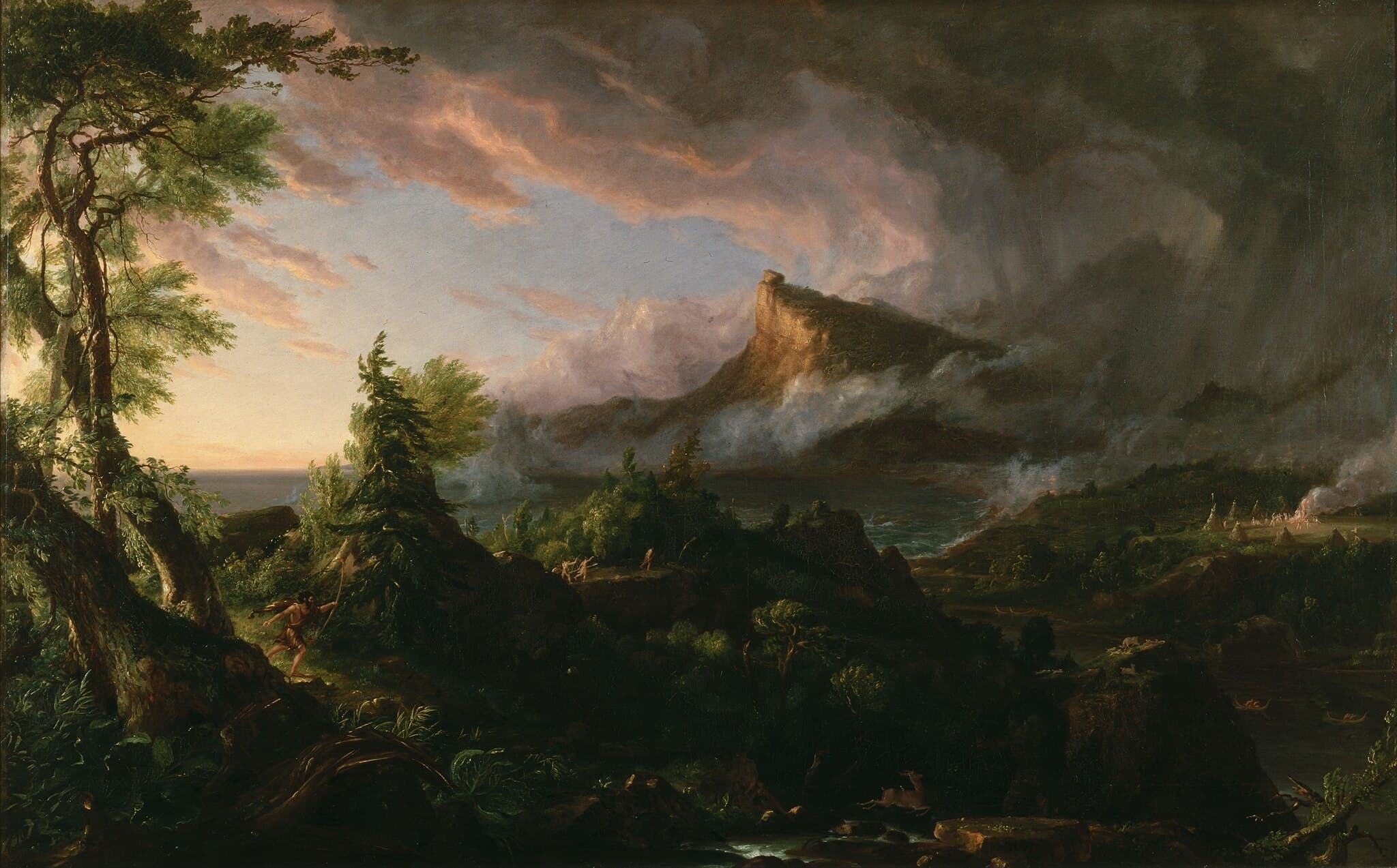
The Course of Empire: The Savage State
Thomas Cole, c. 1834 (series 1834–1836) • Oil on canvas
Read full analysis of The Course of Empire: The Savage State →Valuation Analysis
Conclusion. The Course of Empire: The Savage State is valued at $45–85 million under hypothetical, unrestricted sale conditions and excellent conservation. This panel is a cornerstone of 19th‑century American painting and the opening canvas of Cole’s most celebrated series, with continuous institutional custody since 1858 at the New‑York Historical Society, following Luman Reed’s original commission and the transfer from the New‑York Gallery of the Fine Arts [1].
Method and evidence. Because no public sale of this painting (or comparably important Cole) exists, we extrapolate from: (i) Cole’s observed auction ceiling—reset at $1,623,000 in 2025 for a strong early landscape [2]; (ii) the painting’s singular art‑historical significance—central to The Met’s 2018 Cole retrospective and core to his reputation alongside The Oxbow and The Voyage of Life [3]; and (iii) category analogues where uniquely iconic 19th‑century American masterworks achieve eight figures—e.g., Emanuel Leutze’s Washington Crossing the Delaware at $45,045,000 (Christie’s, 2022) [4]. Routine Cole prices (e.g., The Arch of Nero at ~$988k in 2021; solid Catskills views at $500k–$1.6m) capture the market for good works but not exhibition‑defining masterpieces [5][6].
Why a large premium is warranted. The Savage State’s canonical status, scale, narrative importance within the Course of Empire, near‑universal museum‑level literature and exhibition history, and ironclad provenance support a valuation orders of magnitude above typical Cole offerings. In American historical painting, when a true icon surfaces, collectors and institutions price historical significance and cultural capital well beyond an artist’s ordinary auction record. The Savage State falls squarely into this “icon” cohort, meriting mid‑ to high‑eight‑figure pricing consistent with the strongest results for 19th‑century American imagery [4].
Market setting and timing. Demand for top‑tier Hudson River School and Western subjects has been healthy in recent curated sales, with notable 2024–2026 benchmarks (e.g., Heade at $3.44m; Gifford at $2.88m) underscoring depth when quality is first‑rate [6][7]. Scholarship and programming around Cole—most recently amplified by the “COLE 200” initiative—further elevate visibility and buyer confidence [8]. Ideally, the work would be placed in a marquee evening context or negotiated via a private treaty to the broadest buyer pool, potentially with institutional interest.
Series factor. While the intact five‑panel Course of Empire would likely command nine figures, this single canvas stands independently as a market‑defining icon. Our range reflects the painting’s standalone power while acknowledging that unity premiums typically accrue to the complete cycle.
Key Valuation Factors
Art Historical Significance
High ImpactThe Savage State is the opening panel of Cole’s Course of Empire, a seminal allegory of civilization’s rise and fall and one of the most studied statements in 19th‑century American art. It anchors Cole’s reputation alongside The Oxbow and The Voyage of Life, appears widely in scholarship, and featured prominently in The Met’s 2018 retrospective. Its cultural resonance extends beyond the artist’s oeuvre to U.S. art history at large, making it a textbook example of a museum‑grade ‘icon.’ Works at this level trade not only on aesthetic quality but on narrative and educational value, commanding premiums far above an artist’s ordinary auction prints. That centrality drives sustained, top‑tier demand and underpins an eight‑figure valuation.
Rarity and Supply Constraints
High ImpactSupply of major Cole oils is exceptionally thin; most masterpieces reside in museums. The Course of Empire series has been institutionally held since the mid‑19th century, and masterworks of equivalent gravitas almost never appear at auction. The absence of direct, modern‑market sale history for this caliber of Cole means price discovery skews upward when a generational icon is hypothetically considered. Scarcity at the top end forces extrapolation from lesser comparables and encourages aggressive bidding when opportunities arise. In practice, this rarity compresses the number of eligible works for collectors or institutions aiming to anchor a collection, supporting valuations that are multiples of the artist’s routine results for standard landscapes.
Provenance and Exhibition History
High ImpactCommissioned by Luman Reed, then transferred with the full cycle to the New‑York Historical Society in 1858, the painting carries an unimpeachable chain of ownership and deep literature/exhibition citations, including prominent loans such as The Met’s 2018 survey. Such provenance eliminates questions of authenticity and title, maximizes scholarly standing, and typically reduces transactional friction for high‑stakes buyers. Long‑term institutional care also implies responsible conservation and technical documentation, both of which are prized at the high end. Collectors and museums consistently pay premiums for works with this caliber of pedigree and exposure, especially when the object is central to art‑historical narratives taught and referenced globally.
Market Benchmarks and Category Analogues
Medium ImpactWhile Cole’s public auction record stands at $1.623 million (2025), comparable category icons—such as Leutze’s Washington Crossing the Delaware at $45.0 million—demonstrate the market’s willingness to pay eight figures for uniquely significant 19th‑century American paintings. Recent curated sales show robust competition for best‑in‑class historical American works (e.g., Heade and Gifford), supporting confidence that masterpiece‑level objects clear well above routine artist records. This factor is assigned “medium” impact because it relies on cross‑artist analogues and market structure (marquee evening sales, guarantees, single‑owner contexts) rather than a direct Cole comp, but it remains a critical justification for the proposed range.
Sale History
The Course of Empire: The Savage State has never been sold at public auction.
Thomas Cole's Market
Thomas Cole, founder of the Hudson River School, commands sustained institutional and collector demand, but most masterpieces reside in museums. Publicly traded Coles are scarce and typically consist of strong but non‑canonical landscapes, which have fetched from the low six figures to the low seven figures. The artist’s auction record was reset at $1,623,000 at Christie’s New York in January 2025 for Mount Chocorua, New Hampshire, signaling momentum when quality and provenance align. However, that record reflects the caliber of works that appear publicly—not the potential for a once‑in‑a‑generation icon. For a canonical Cole with museum‑level significance, buyers pay a substantial ‘masterpiece premium,’ pushing valuations far beyond routine auction prints and into the mid‑ to high‑eight figures.
Comparable Sales
Mount Chocorua, New Hampshire
Thomas Cole
Same artist; prime Hudson River School landscape from the 1820s; current auction record for Cole and the best public benchmark for his top-quality paintings.
$1.6M
2025, Christie's New York
Catskill Mountain House
Thomas Cole
Same artist; iconic Catskills subject closely tied to Cole’s early American landscapes and market demand for his classic vistas.
$1.5M
2003, Christie's New York
~$2.5M adjusted
View in Kaaterskill Clove (1826)
Thomas Cole
Same artist; early Catskills subject from Cole’s foundational period, aligning with the natural-primitive themes that inform The Savage State.
$1.0M
2009, Christie's New York
~$1.5M adjusted
The Arch of Nero (1846)
Thomas Cole
Same artist; allegorical-historical theme about empire and decline, conceptually adjacent to the Course of Empire cycle even if later and Italianate.
$988K
2021, Sotheby's New York
~$1.2M adjusted
View Near Catskill
Thomas Cole
Same artist; core Hudson River School subject and recent public transaction indicating current demand for solid but non-masterpiece Coles.
$504K
2024, Christie's New York
~$517K adjusted
Washington Crossing the Delaware
Emanuel Leutze
Category benchmark: a canonical 19th‑century American masterwork with a widely recognized cultural narrative. Demonstrates eight‑figure appetite for uniquely important American historical paintings.
$45.0M
2022, Christie's New York
~$49.3M adjusted
Current Market Trends
The 19th‑century American and Western art segment has strengthened in tightly curated contexts, with best‑in‑class works outperforming estimates. Christie’s 2024 Americana‑week sale achieved $13.15 million with category highlights (e.g., Heade at $3.44m; Moran at $2.23m), and 2026 recaps note continued depth, including Sanford R. Gifford at $2.88m. Broader Western Art momentum—with record single‑owner totals—indicates expanded appetite for historic American imagery. Against this backdrop, a canonical, museum‑grade icon like The Savage State would likely attract intense competition in a marquee evening sale or via private treaty, where guarantees and institutional interest can concentrate demand and support an eight‑figure outcome.
Study print
Study this painting as a print
Pair the full artwork with a museum-style study sheet focused on one meaningful detail.
Sources
- Archives of American Art: Minutes of the New-York Gallery of the Fine Arts / transfer to NYHS (1858)
- Christie’s Press: American Sublime (Jan 23, 2025) — New auction record for Thomas Cole
- The Metropolitan Museum of Art: Thomas Cole’s Journey — Atlantic Crossings (2018)
- Artnet News: Top Lots at Auction, May 2022 — Leutze at $45,045,000
- The Art Newspaper: Newark Museum’s sale of Thomas Cole’s ‘The Arch of Nero’ nets $988,000 (2021)
- Christie’s Press: 19th Century American & Western Art (Jan 18, 2024) — sale totals and highlights
- HENI Market Recap: Christie’s 19th Century American & Western Art (Jan 23, 2026) — Gifford at $2.88m
- Thomas Cole National Historic Site: COLE 200 (bicentennial programming)