How Much Is The Course of Empire: The Arcadian or Pastoral State Worth?
Last updated: April 27, 2026
Quick Facts
- Methodology
- comparable analysis
For a hypothetical public‑market appearance of Thomas Cole’s The Arcadian or Pastoral State (c.1834), I estimate a realistic auction range of $1.0–6.0 million. The painting is a canonical, museum‑held work (New‑York Historical Society), and realized value would be driven decisively by confirmed attribution, condition, provenance, and sale context (auction vs. private placement).
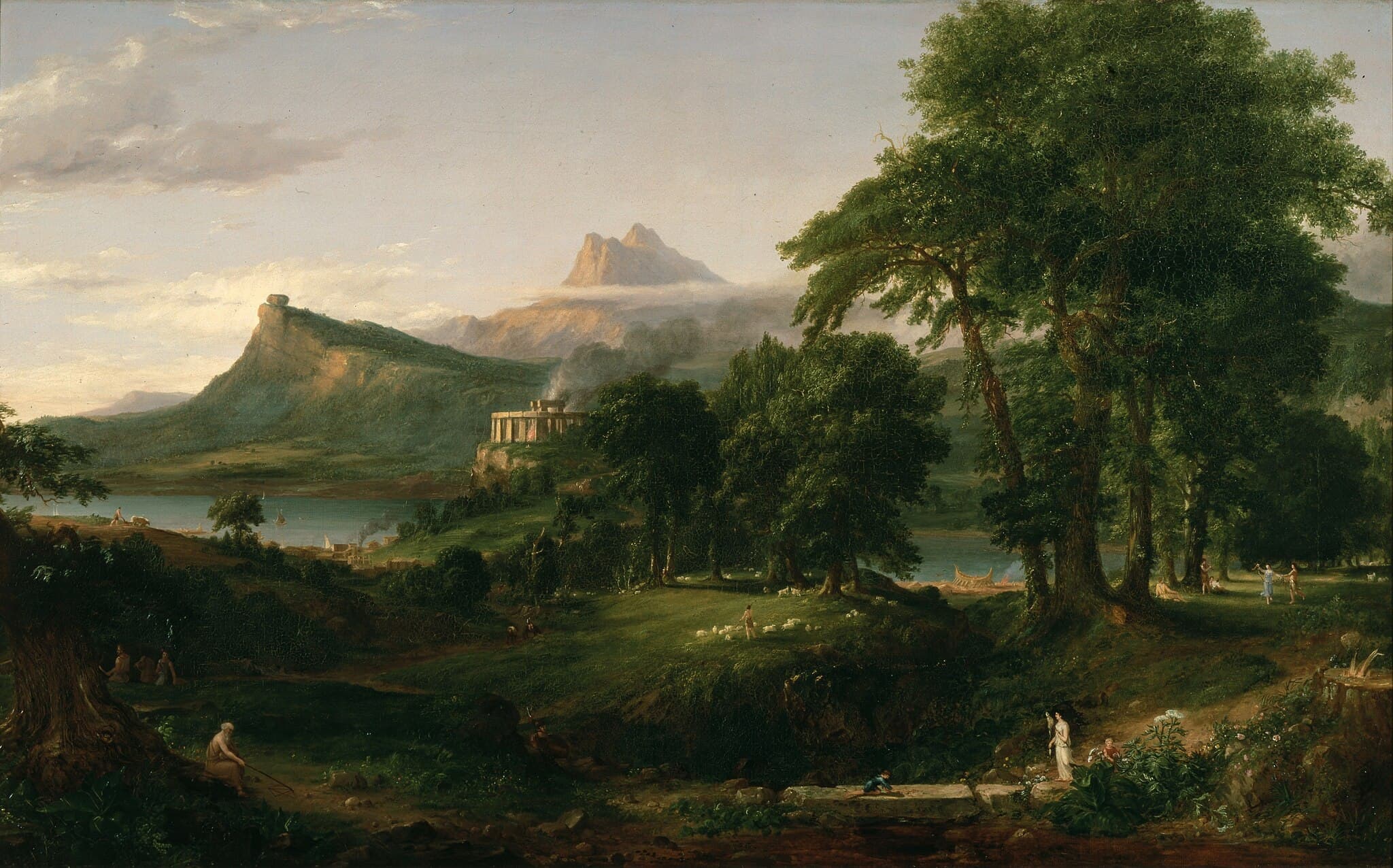
The Course of Empire: The Arcadian or Pastoral State
Thomas Cole • Oil on canvas
View more by Thomas Cole →Valuation Analysis
This valuation addresses a hypothetical market sale of Thomas Cole’s The Arcadian or Pastoral State (c.1834). The painting is recorded in the New‑York Historical Society collection (accession 1858.2), which makes a commercial appearance unlikely without a formal deaccession; that institutional provenance, however, materially strengthens buyer confidence should it ever be offered [1].
Public‑market comparables for Cole are limited and clustered in the mid six‑figure to low seven‑figure range. Christie’s recent sale of Mount Chocorua in January 2025 for $1,623,000 established a new auction high for Cole and sets a contemporary benchmark for large, exhibition‑quality canvases by the artist [2]. Other sales, including Sotheby’s 2021 Arch of Nero (deaccession context, ~ $988k), and various regional results for smaller studies, show wide dispersion by size, subject and sale circumstances [3]. There is no modern public sale of the Arcadian State itself, so any estimate must be an evidence‑based extrapolation from imperfect comparables.
Valuation conclusion: using those market anchors, the painting’s canonical status, and the scarcity premium attached to Course of Empire canvases, a defensible public‑auction estimate is approximately $1.0–6.0 million. The lower end reflects conservative auction expectations based on recent public sales and general market liquidity for 19th‑century American landscapes; the upper end is reachable only under exceptional circumstances (flawless attribution, pristine condition, intense institutional/private bidding, or sale of multiple panels as a set).
Key variables that would push the result to either extreme are: (a) confirmed autograph attribution and catalogue‑raisonné entry; (b) an uncompromised condition report (X‑ray/IR/pigment analysis); (c) continuous, prestigious provenance and strong exhibition/publication history; and (d) sale mechanics — a high‑profile private placement or a museum‑quality auction sale with aggressive marketing will materially increase realized price. Given the current public‑market record for Cole and the painting’s institutional custodianship, the estimate above is cautious but realistic.
Recommended next steps to firm the valuation: obtain the NYHS provenance file and condition report, request high‑resolution photography and technical imaging, consult an American‑art specialist at Christie’s or Sotheby’s for a confidential pre‑sale estimate, and review catalogue‑raisonné/scholarship citations. With those inputs the range can be narrowed to a ±20% working estimate.
Key Valuation Factors
Art Historical Significance
High ImpactThomas Cole’s Course of Empire is one of the most important allegorical cycles in 19th‑century American art; The Arcadian (Pastoral) State is a core panel in that narrative sequence. Canonical status drives institutional demand and scholarly interest, which typically creates a premium when such works are market‑available. Because the painting plays a central role in exhibition narratives and art‑historical literature, buyers (museums, foundations, specialist collectors) attach reputational value in addition to aesthetic value. That premium supports higher ceilings than for more common landscape pictures, but the pool of qualified buyers is comparatively small.
Provenance / Ownership
High ImpactThe recorded accession at the New‑York Historical Society (1858.2) provides early and continuous institutional provenance—a major positive for market confidence. Institutional provenance tends to increase desirability and reduce attribution risk, often lifting price. However, museum ownership also implies deaccession constraints, public scrutiny, and legal/ethical hurdles that can impede a sale. If the work were in long private descent instead, market mechanics would be more straightforward. Provenance documentation that confirms chain of custody, exhibition loans, and prior scholarship materially tightens a valuation.
Condition & Conservation
High ImpactCondition is decisive for a large, early‑19th‑century canvas. Structural stability (stretcher/lining), state of the paint layer, extent of inpainting, and prior restorations directly influence bidder confidence. Major restorations, heavy overpaint or unstable canvases depress prices significantly; conversely, a stable, museum‑conserved surface supports the high end of the estimate. For this valuation I have assumed typical museum conservation without catastrophic damage; a full technical/condition report (including X‑ray and IR) is required to move from a hypothetical range to a firm market estimate.
Market Comparables & Recent Sales Record
Medium ImpactRecent public sales establish the practical pricing environment: Christie’s Mount Chocorua (Jan 2025) at $1,623,000 sets a contemporary auction high for Cole [2], while other significant canvases have sold under $1M in the last several years [3]. Smaller studies trade much lower. Because there is no modern sale of the Arcadian State itself, comparable analysis uses analogous major Cole canvases and Hudson River School peers. These comparables justify a conservative auction baseline in the low millions, with upside contingent on exceptional sale conditions.
Rarity, Exhibition & Scholarly Visibility
High ImpactThe Course of Empire is highly visible in scholarship and exhibitions; panels are rarely offered. Rarity increases urgency among qualified buyers and can elevate the ceiling of competitive bidding. Publication and exhibition history strengthen marketability by reducing perceived attribution risk and by providing a clear interpretive context for museum acquisitions. That said, rarity narrows the buyer pool—primarily institutions and a few major private collectors—which concentrates but does not necessarily expand demand sufficiently to guarantee record prices.
Sale History
The Course of Empire: The Arcadian or Pastoral State has never been sold at public auction.
Thomas Cole's Market
Thomas Cole (1801–1848), founder of the Hudson River School, occupies a central role in American art history and experiences steady institutional demand. His market shows wide dispersion: small studies sell in the tens to low hundreds of thousands, while major canvases have realized low‑ to mid‑seven figures in recent years. Institutional holdings of his best works limit supply, making autograph, museum‑quality canvases rare and potentially valuable when they appear. Recent auction activity (including a 2025 Christie’s result) indicates selective buyer appetite but also demonstrates that Cole’s public‑market liquidity is constrained relative to more frequently traded categories.
Comparable Sales
Mount Chocorua, New Hampshire
Thomas Cole
Recent auction high-water mark for Thomas Cole (large-scale Hudson River School landscape by the same artist); strongest public-market benchmark.
$1.6M
2025, Christie's New York
The Arch of Nero
Thomas Cole
Major Cole canvas sold in a high-profile (deaccession) sale; useful for comparing market demand for institutional-quality Cole works and pricing for large canvases.
$988K
2021, Sotheby's (Newark Museum deaccession sale)
~$1.1M adjusted
Mount Chocorua (small panel)
Thomas Cole
Regional auction sale of a smaller-scale Cole study/panel; shows the steep scale/price differential between small works and major canvases.
$150K
2023, Shannon's (Oct 26, 2023)
~$158K adjusted
Current Market Trends
The 19th‑century American landscape market is stable and selective: institutions, foundations and a narrow set of private collectors drive top‑end demand. Deaccession sales create episodic activity but invite scrutiny that can either depress or concentrate buyer interest. Overall, well‑provenanced, exhibition‑ready canvases command premiums; marketing and timing remain decisive. Expect realized prices to respond to broader economic conditions and to the presence (or absence) of competing institutional buyers.