How Much Is The Course of Empire: The Consummation of Empire Worth?
Last updated: April 27, 2026
Quick Facts
- Methodology
- comparable analysis
The Consummation of Empire (Thomas Cole, 1835–36) is a canonical, museum‑quality canvas and — if marketable — would most likely sell in the mid‑seven‑figure band. Based on institutional provenance, scarcity of comparable sales, and recent auction benchmarks for Cole, a reasoned market range is $4,000,000–$8,000,000.
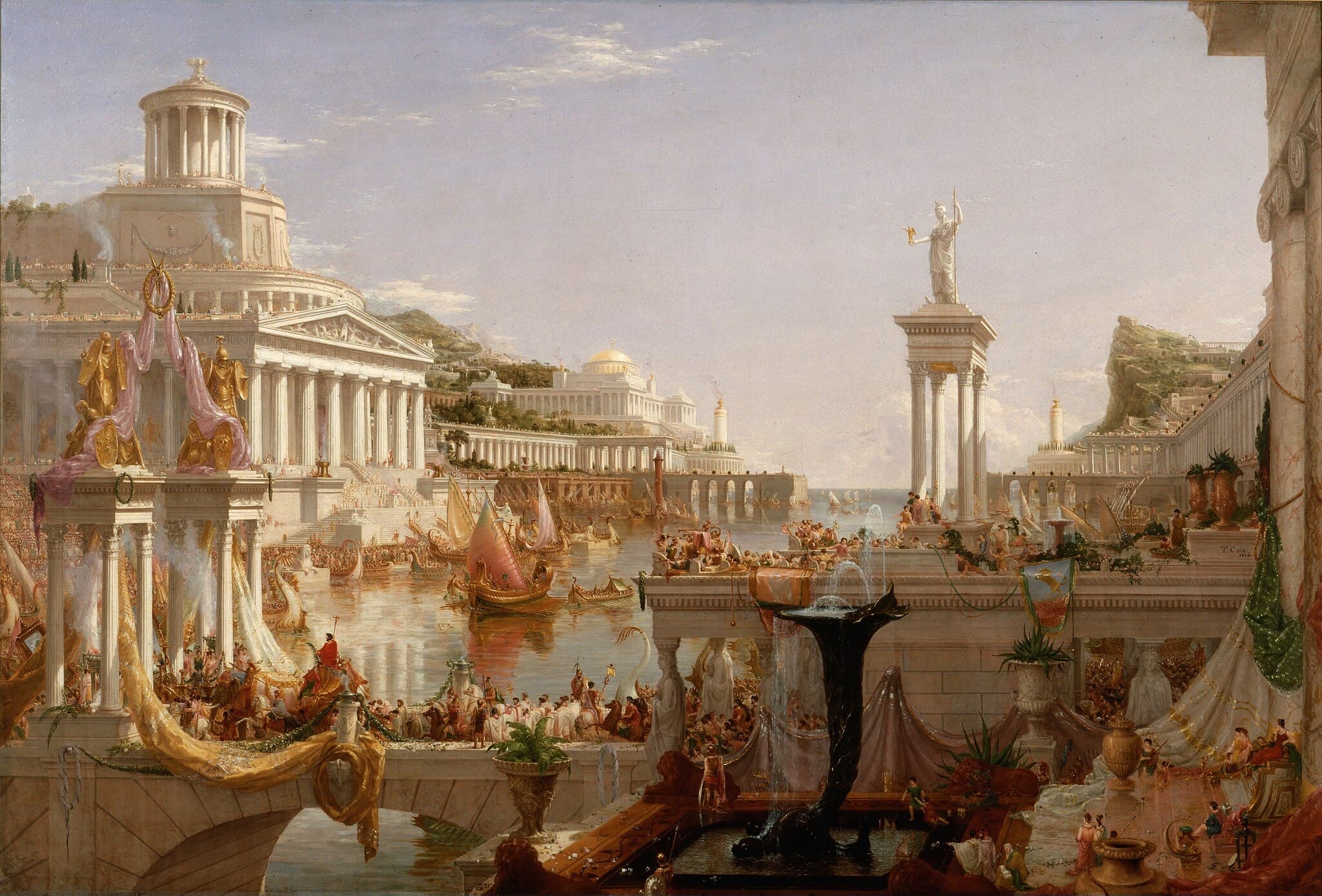
The Course of Empire: The Consummation of Empire
Thomas Cole, 1836 • Oil on canvas
View more by Thomas Cole →Valuation Analysis
Valuation conclusion: The Course of Empire: The Consummation of Empire is estimated at $4,000,000–$8,000,000 assuming the work were legally marketable and in typical museum condition. This figure is derived by a comparable‑analysis methodology that weights recent marquee Cole auction results, category precedent for museum‑quality 19th‑century American narrative canvases, and an institutional‑provenance premium.[1][2]
The principal market anchor is the recent Christie’s January 2025 result for a major Thomas Cole landscape (Mount Chocorua, New Hampshire, $1,623,000), which establishes current public‑auction demand for high‑quality Cole canvases. That record is a conservative reference point: Course of Empire canvases are conceptually and historically more significant than most single landscapes and therefore should command a premium above typical landscape comparables. Additional relevant data points include Sotheby’s and deaccession examples of narrative Cole works that realized lower seven‑figure or high six‑figure sums, demonstrating a spread in outcomes tied to condition, provenance, and sale context.[2]
Provenance and availability: The Consummation has long been in institutional care (New‑York Historical Society accession), which both enhances its market standing and makes an actual sale unlikely absent an authorized deaccession process. Museum provenance increases buyer confidence and can produce a provenance premium; however, donor restrictions and deaccession guidelines (AAMD, state rules) are the dominant real‑world constraint on marketability and therefore on achieving the theoretical high end of the range.[1]
Key value drivers: (1) Canonical status of the cycle; (2) rarity of such a work entering the market; (3) condition and conservation history (not publicly available here); and (4) competitive bidding among institutions and top private collectors if released. Each of these can swing value materially — condition and legal constraints are the largest risk factors.
Sale strategy implications: If sale were contemplated, the work would most likely perform best with maximum scholarly presentation (catalogue essay, conservation report) and either a marquee auction evening placement or a discreet brokered sale to a major institution. In practice, a deaccession sale to raise funds for a collection frequently yields different buyer behavior (and pricing) than a market‑driven evening auction, so strategy matters materially to final price.
Next steps to tighten the estimate: obtain the NYHS accession and donor documentation, secure a detailed condition/conservation report and full exhibition/publication history, and run confidential reserve checks with senior specialists at Christie’s and Sotheby’s. Those actions would refine or materially change the band above.[1][2]
Key Valuation Factors
Art Historical Significance
High ImpactThomas Cole's Course of Empire is one of the most important nineteenth‑century narrative projects in American art; The Consummation is a central canvas in that five‑painting cycle. Its iconographic ambition, repeated citation in scholarship and exhibitions, and central role in Cole’s legacy give it exceptional cultural capital. Works of this stature carry both academic and market premiums because they are illustrated in catalogues raisonnés, frequently loaned to major exhibitions, and considered essential holdings in any representative American art collection. That academic stature translates directly into stronger institutional and private interest should the work become market‑available.
Provenance & Institutional Ownership
High ImpactThe painting’s long institutional ownership (New‑York Historical Society accession) strengthens provenance and curatorial documentation, which typically increases buyer confidence and realizations. Museum provenance is a double‑edged driver: it raises perceived authenticity and historical importance — supporting a premium — but also introduces institutional deaccession rules, donor restrictions, and reputational considerations that frequently prevent sale or narrow the pool of legitimate buyers. When museum works do enter the market they often attract competitive bidding and higher prices, but only after satisfying legal/ethical requirements.
Rarity & Market Comparables
High ImpactDirect market comparables for canonical Course of Empire canvases are essentially non‑existent because the series has been retained by institutions for generations. The best public benchmarks are important Cole works that have recently sold — e.g., the Christie’s 2025 Mount Chocorua result — which indicate robust seven‑figure demand for top examples. Given the Consummation’s superior iconographic and historical weight relative to many sold Coles, a clear rarity premium is justified; that premium is the main reason our estimate sits well above typical landscape sale levels.
Condition & Conservation
Medium ImpactCondition can materially shift the final price. Museum‑held works generally receive conservation attention, but any evidence of lining, significant restoration, inpainting, or structural instability can reduce market value. A clean, stable surface and full conservation documentation support the high end of the estimate. Conversely, unresolved conservation issues or a record of heavy treatment could reduce buyer confidence and lower value by a material percentage versus the presented band.
Legal/Deaccession Constraints & Marketability
High ImpactDeaccession rules, donor covenants, and professional guidelines (including AAMD policies) can legally or ethically bar sale or require proceeds to be used for restricted purposes. These constraints often make museum masterpieces effectively non‑marketable and are the principal practical barrier to realizing the theoretical market value. Even when permitted, deaccession sales can attract limited buyer pools or specialized auction channels, which affects realized price and timing.
Sale History
The Course of Empire: The Consummation of Empire has never been sold at public auction.
Thomas Cole's Market
Thomas Cole is the acknowledged founder of the Hudson River School and remains a leading figure in 19th‑century American painting. His market is characterized by a small number of high‑quality institutional or private examples that can produce seven‑figure results and a larger secondary market of studies and lesser works that trade in five‑ to six‑figure ranges. Recent high‑profile results (notably a Christie’s 2025 auction record) confirm institutional and collector appetite for fresh‑to‑market, well‑provenanced Coles, although realized prices vary widely with condition, subject, and sale context.
Comparable Sales
Mount Chocorua, New Hampshire
Thomas Cole
Same artist; recent marquee auction lot and reported new public-auction record for Cole (high-quality early landscape). Useful as a current public-auction benchmark for major Cole works.
$1.6M
2025, Christie's New York
The Arch of Nero (1846)
Thomas Cole
Same artist and narrative/historical subject (closer thematically to Course of Empire); sold in a deaccession sale—helps gauge institutional-piece demand though realized below top-market headline results.
$988K
2021, Sotheby's (Newark Museum deaccession)
~$1.1M adjusted
Catskill Mountain House
Thomas Cole
Historic seven-figure auction sale for an important Cole landscape; when inflation-adjusted to 2025 dollars it indicates earlier top-tier Cole sales equate to low‑to‑mid $2M today.
$1.5M
2003, Christie's (2003)
~$2.5M adjusted
Current Market Trends
The broader market for museum‑quality 19th‑century American painting remains selective: high‑quality, well‑provenanced works attract competitive bidding while the ultra‑top end has been more cautious since 2023. Anniversary programming and scholarly reappraisals (e.g., major museum exhibitions) can temporarily heighten demand. Overall, scarcity of major lots and strong institutional interest support resilient pricing for canonical works, but legal constraints and presentation strategy will materially affect outcomes.
Sources
- Explore Thomas Cole / New‑York Historical Society — The Consummation of Empire (object entry)
- Christie’s press release — American Sublime sale (Mount Chocorua result, Jan 23, 2025)
- The Metropolitan Museum of Art — Thomas Cole exhibition resources (scholarly reappraisal)
- Artnet News / market coverage of Cole and recent auction context