How Much Is Portrait of Léonie Rose Charbuy-Davy Worth?
Last updated: May 20, 2026
Quick Facts
- Methodology
- comparable analysis
Anchored to recent sales of 1887 Paris-period Van Gogh oils around $32–33 million and an exceptional 1887 still life at $62.7 million, the hypothetical open-market value for Portrait of Léonie Rose Charbuy-Davy is $20–50 million, with a central tendency in the low–mid $30 millions. The work is museum-held and has never traded publicly; this estimate is calibrated for insurance/academic purposes using direct comparables.
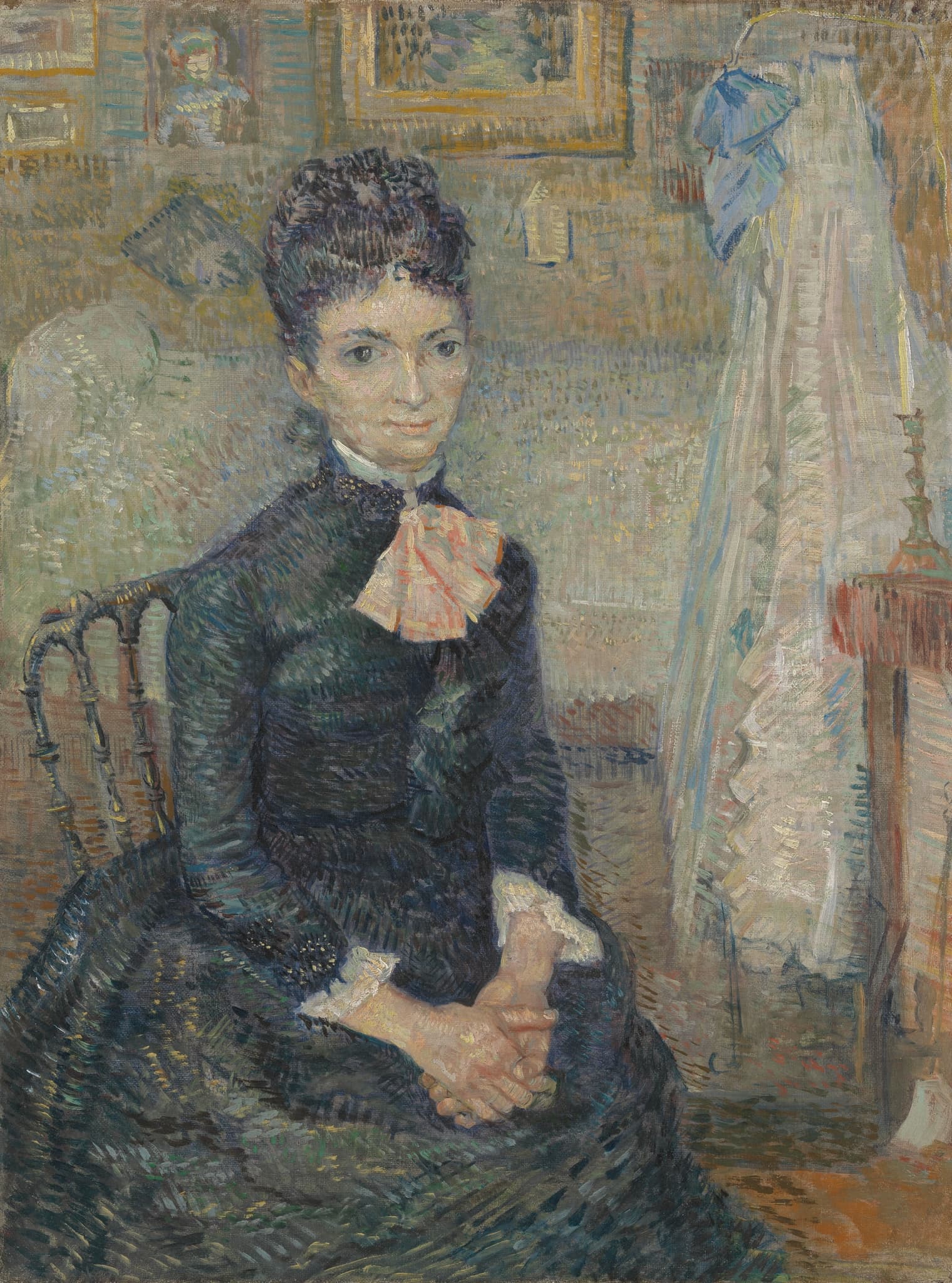
Portrait of Léonie Rose Charbuy-Davy
Vincent van Gogh, 1887 • Oil on canvas
Read full analysis of Portrait of Léonie Rose Charbuy-Davy →Valuation Analysis
Conclusion: Using direct, recent comparables from Vincent van Gogh’s Paris period (1887), we estimate a hypothetical market value of $20–50 million for Portrait of Léonie Rose Charbuy‑Davy, with the most likely outcome in the low–mid $30 millions. The painting is in the Van Gogh Museum and has not traded publicly, so this is an insurance‑style estimate rather than a market‑tested price [1].
Comparable anchors: Two highly relevant 1887 benchmarks set the midline: Christie’s New York sold Coin de jardin avec papillons (1887) for $33.185 million in May 2024, and Christie’s Hong Kong sold Les canots amarrés (1887) for roughly $32.2 million with fees in September 2024 [4][5]. At the upper end of the Paris‑period spectrum, Sotheby’s achieved $62.71 million in November 2025 for Romans parisiens (1887), a masterpiece still life from the same year that reflects peak desirability among 1887 subjects [3]. The overall Van Gogh ceiling remains the $117.2 million landscape record from 2022, which frames the outer bound for trophy‑level works [2].
Positioning this portrait: Created in spring 1887, the picture belongs to Van Gogh’s formative Paris phase, marked by Divisionist, pointillist touch and a brighter palette. As a portrait of a non‑iconic sitter, it typically prices below the artist’s landmark self‑portraits, Dr. Gachet, Madame Ginoux, or late Arles/Saint‑Rémy subjects. That subject‑matter discount is balanced by the scarcity and desirability of well‑finished Paris‑period oils, as evidenced by the 2024 results. On a weighted basis, these factors support a central value in the low–mid $30 millions, with downside nearer the high‑teens/low‑$20 millions if the work presents as more reserved in color or finish, and upside into the $40–50 millions only if the canvas shows exceptional chromatic vitality, condition, and a strong exhibition/literature record.
Market context: After a softer 2024, late‑2025 Modern/Impressionist results rebounded, with blue‑chip buyers active at the top end. Asia’s appetite is material (underscored by the 2024 Hong Kong result), while New York evening sales remain the deepest venue for guarantee‑backed placements [5]. Within this environment, an 1887 Van Gogh portrait would be positioned below the absolute trophies yet well within the eight‑figure tier supported by fresh‑to‑market 1887 oils.
Assumptions and use: This range assumes good, unrestored structural condition; clear, undisputed authenticity; and comprehensive provenance and literature. If those criteria are satisfied—and if offered in a major New York evening sale with appropriate marketing—$30–40 million is a reasonable expectation, with the broader $20–50 million band accommodating subject‑specific and condition‑driven variance [2][3][4][5].
Key Valuation Factors
Art Historical Significance
Medium ImpactPainted in Paris in 1887, the portrait sits at a pivotal juncture when Van Gogh assimilated Neo‑Impressionist color and Divisionist brushwork. While not an apex subject (e.g., self‑portraits, Dr. Gachet), it reflects the crucial stylistic evolution that immediately precedes Arles. Works from this phase document the artist’s transition to a bolder palette and broken color, which are foundational to his mature style. That evolutionary importance supports strong demand for well‑finished examples. However, because this is a portrait of a lesser‑known sitter rather than a canonical motif, its art‑historical pull is best characterized as significant but not singular, warranting a valuation below the top‑tier landscape, cypress, and iconic portrait subjects.
Period and Subject Appeal
Medium ImpactThe 1887 Paris period is actively collected and has recently proven resilient at auction, with multiple 1887 oils achieving low‑to‑mid eight figures. Portraiture by Van Gogh commands a premium when the sitter is iconic, the palette is vivid, and the handling is resolved. Here, the sitter is not widely known, which moderates trophy appeal relative to the best‑known portraits. Nonetheless, Paris‑period portraiture is scarce on the market, and when coupled with Divisionist color and a humane, intimate mood, it remains highly desirable. This factor pushes the estimate toward the $30m+ midpoint when color, expression, and finish are strong, and toward the lower $20m–$30m zone if the work reads as quieter or more restrained.
Provenance, Literature, and Exhibition
High ImpactThe painting is held by the Van Gogh Museum (Vincent van Gogh Foundation), implying bulletproof provenance, deep scholarly documentation, and likely inclusion in key catalogues and exhibitions. That museum‑grade status reinforces authenticity and academic significance, attributes that top‑tier buyers prize. While the work has not traded and is unlikely to be deaccessioned, the museum association strengthens a hypothetical market case: should it ever be offered (or insured for loan), the dossier quality would reduce risk discounts and support aggressive bidding. Extensive exhibition and literature history, if confirmed in the museum file, would further raise confidence and could justify pricing at or above the mid‑range of the estimate.
Condition and Technical State
High ImpactVan Gogh’s 1887 surfaces can be delicate due to layered, broken color. A clean, stable canvas with intact impasto, no structural compromise (e.g., no invasive relining), and minimal retouch is critical to sustaining pricing in the $30m+ range. Cosmetic issues—yellowed varnish, abrasion, or pronounced restoration—can quickly shift outcomes downward by multiple millions. Conversely, a fresh‑looking surface with compelling color saturation and legible Divisionist touch magnifies visual impact and marketability. Our range assumes sound condition consistent with museum care; a recent conservation and technical report (IRR, X‑ray, pigment analysis) would be expected in a formal appraisal and could nudge the estimate higher if results confirm excellent stability and minimal intervention.
Sale History
Portrait of Léonie Rose Charbuy-Davy has never been sold at public auction.
Vincent van Gogh's Market
Vincent van Gogh remains among the most coveted blue‑chip artists, with exceptionally thin supply as most masterpieces reside in museums. The auction record stands at $117.2 million for Orchard with Cypresses (1888), set at Christie’s in 2022. Recent results confirm depth across periods, with an 1887 still life, Romans parisiens, realizing $62.71 million at Sotheby’s in 2025, and other 1887 Paris oils achieving roughly $32–33 million in 2024. Mature 1889–1890 works have reached $70–$80+ million in recent cycles, underscoring robust demand for top subjects and strong condition. Collectors prize clear provenance, high color, and finished handling; comparably, lesser subjects or compromised condition trade at meaningful discounts, though still firmly in eight figures for authentic oils.
Comparable Sales
Romans parisiens (Piles de romans parisiens et roses dans un verre)
Vincent van Gogh
Same artist and Paris 1887 period; a peak still life from Van Gogh’s pointillist/Divisionist experiments. Serves as an upper‑bound for top‑tier 1887 works even though it is not a portrait.
$62.7M
2025, Sotheby's New York
Corner of a Garden with Butterflies (Coin de jardin avec papillons)
Vincent van Gogh
Same artist and year (1887), executed in Paris with pointillist touches; mid‑size, finished canvas. A close price signal for attractive 1887 oils.
$33.2M
2024, Christie's New York
~$34.2M adjusted
Moored Boats (Les canots amarrés)
Vincent van Gogh
Same artist and year (1887); vibrant Paris‑period subject with Divisionist influence; recent high‑profile sale indicating demand level for 1887 works.
$32.2M
2024, Christie's Hong Kong
~$33.2M adjusted
Street Scene in Montmartre (Scène de rue à Montmartre)
Vincent van Gogh
Same artist and year (1887); Paris subject with figures. Indicates pricing for less iconic 1887 oils versus top still lifes/garden scenes.
$15.4M
2021, Sotheby's Paris (with Mirabaud-Mercier)
~$18.2M adjusted
Head of a Woman (Gordina de Groot)
Vincent van Gogh
Same artist and genre (portrait of a non‑iconic sitter). Earlier (1885) pre‑Paris study; shows market discount for darker, earlier portraits compared with 1887 Paris works.
$5.8M
2023, Christie's London
~$6.3M adjusted
Still Life, Vase with Daisies and Poppies (Nature morte, vase aux marguerites et coquelicots)
Vincent van Gogh
Same artist; late (1890) mature still life with vibrant palette, widely coveted. Useful ceiling benchmark showing what trophy‑quality Van Gogh canvases can achieve.
$61.8M
2014, Sotheby's New York
~$82.8M adjusted
Current Market Trends
The Modern/Impressionist segment has reasserted leadership after a softer 2024, with late‑2025 sales signaling renewed risk appetite for canonical names. Quality polarization persists: fresh, institution‑grade works with strong narratives attract aggressive bidding, while lesser examples underperform. Asia’s buyer base remains important (e.g., strong Hong Kong results for 1887 Van Goghs), but New York evening sales continue to deliver the deepest liquidity and strongest guarantee structures. Against this backdrop, well‑presented Paris‑period Van Gogh oils have clustered in the low‑to‑mid eight figures, with masterpiece‑level examples stretching well above. Estimate discipline and condition transparency are key determinants of performance in the current environment.
Study print
Study this painting as a print
Pair the full artwork with a museum-style study sheet focused on one meaningful detail.
Sources
- Van Gogh Museum – Portrait of Léonie Rose Charbuy-Davy (gallery text PDF)
- The Art Newspaper – Van Gogh record: Orchard with Cypresses sells for $117m (2022)
- Sotheby’s – The 10 Most Valuable Lots Sold by Sotheby’s in 2025 (incl. Romans parisiens)
- Christie’s – 20th Century Evening Sale totals $413.3m (includes Coin de jardin avec papillons, 1887)
- South China Morning Post – Van Gogh’s Les canots amarrés sells in Hong Kong (2024)