How Much Is Still Life with Bible Worth?
Last updated: May 20, 2026
Quick Facts
- Methodology
- comparable analysis
Based on recent sales of closely comparable Van Gogh still lifes and 1887 Paris‑period oils, Still Life with Bible is valued at $45–65 million. Its museum‑grade provenance and deep art‑historical significance support this range, while its 1885 Dutch‑period palette places it below the artist’s most commercially coveted Arles/Saint‑Rémy trophies.
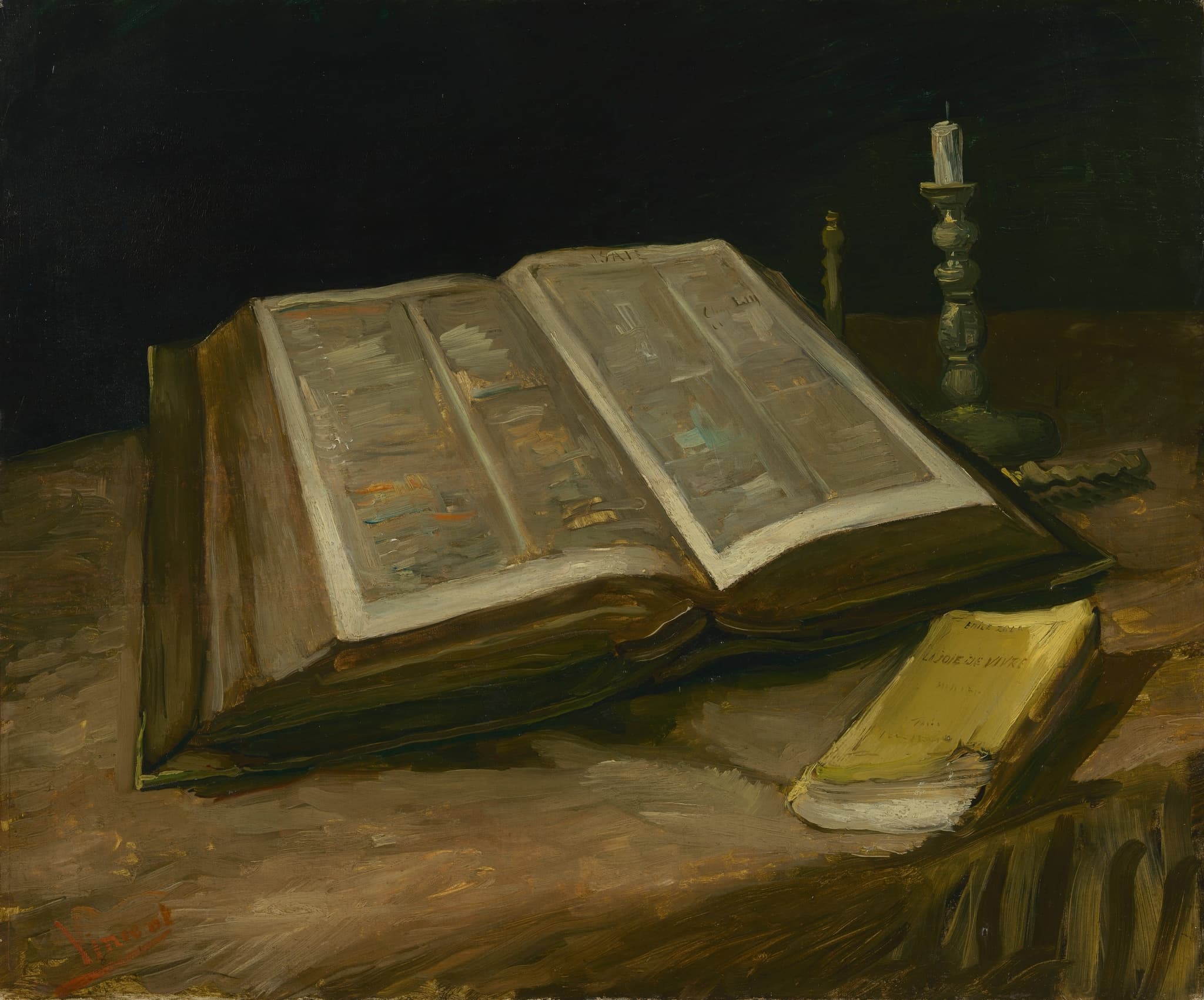
Still Life with Bible
Vincent van Gogh, 1885 • Oil on canvas
Read full analysis of Still Life with Bible →Valuation Analysis
Work and context. Vincent van Gogh’s Still Life with Bible (Nuenen, October 1885; 65.7 × 78.5 cm) has remained in the Van Gogh family line and today belongs to the Vincent van Gogh Foundation, on view at the Van Gogh Museum, Amsterdam. It has never been publicly sold and is widely discussed for its symbolism—an opened family Bible beside Émile Zola’s La Joie de Vivre and an extinguished candle—painted shortly after the death of van Gogh’s father [1].
Comparable analysis and pricing corridor. Recent market evidence frames a clear corridor for major van Gogh oils. At the top, Christie’s set the artist’s auction record with Orchard with Cypresses (1888) at $117.2m, underscoring premiums for mature, brightly colored Arles works [2]. Van Gogh still lifes can command ~$60m+: Vase with Daisies and Poppies (1890) made $61.8m [3], and the Paris‑period Romans parisiens (1887) achieved $62.7m in 2025 [4]. By contrast, strong but non‑trophy 1887 oils have transacted in the ~$23–33m band—e.g., Jardin devant le Mas Debray at $23.3m (2023) and Coin de jardin avec papillons at $33.2m (2024) [5][8]. Against these anchors, an earlier, darker Dutch‑period still life of major biographical weight and substantial size rationally places between the mid‑tier 1887 group and the $60m+ late still‑life peaks. This supports a fair market and insurance indication of $45–65 million.
Upward and downward pressures. Upward factors include blue‑chip name recognition with extreme scarcity of museum‑caliber oils; rich provenance (unbroken family/Van Gogh Foundation line); large, resolved composition; and exceptional scholarly resonance that extends beyond decorative appeal [1]. Downward pressures are principally commercial: the Nuenen period’s somber tonality and pre‑Arles idiom typically command a discount relative to the luminous Arles/Saint‑Rémy icons. While the painting was briefly involved in the Van Gogh Museum’s April 1991 theft and reported to have sustained tearing before swift recovery, professional conservation and current museum display suggest stabilized condition; a current technical/condition dossier would still be prudent for a formal appraisal [6].
Market context. Following a selective 2024, the high end rebounded in 2025, with Impressionist and Post‑Impressionist material showing the strongest growth as top‑quality consignments returned. The market remains polarized: exceptional, fresh works by canonical artists attract deep bidding, while non‑trophy material clears more selectively [7]. Within this environment, Still Life with Bible would likely draw focused competition from global collectors for its rarity, provenance, and narrative power, while pricing below the colorful late still lifes and far below the Arles landscape record.
Key Valuation Factors
Art Historical Significance
High ImpactPainted in October 1885 after the death of van Gogh’s father, Still Life with Bible is central to scholarship on the artist’s evolving views on faith, modernity, and filial ties. The juxtaposition of the open family Bible, Zola’s La Joie de Vivre, and an extinguished candle has become a touchstone for interpreting the psychological and thematic arc of van Gogh’s early career. Its substantial size and carefully staged composition elevate it beyond a didactic exercise into a fully resolved statement work. While Dutch‑period paintings are less chromatically exuberant than later Arles/Saint‑Rémy icons, this canvas’s biographical and symbolic force gives it outsized weight within the oeuvre, sustaining demand among connoisseurs and institutions that prize narrative depth and documentary importance.
Period and Aesthetic Appeal
Medium ImpactThe work belongs to the Dutch (Nuenen) period, characterized by earth-toned palettes and subdued lighting—aesthetics that typically command a discount to the high‑chroma Arles/Saint‑Rémy masterpieces. For many collectors, van Gogh’s market apex aligns with the brighter, more expressive canvases of 1888–90. That said, this painting’s scale, legibility, and dramatic staging mitigate the usual Nuenen discount. It also foreshadows the artist’s growing engagement with modern life through the inclusion of Zola’s novel, linking the piece conceptually to later still lifes of books and flowers. The net effect is strong curatorial and connoisseur appeal, even if color‑driven trophy buyers tend to pay premiums for later, more decorative pictures.
Provenance and Institutional Status
Medium ImpactThe painting’s unbroken descent from Vincent to Theo, through Jo van Gogh‑Bonger and Vincent Willem, and its ultimate transfer to the Vincent van Gogh Foundation (now at the Van Gogh Museum) create gold‑standard provenance with exceptional documentary integrity. This lineage reduces due‑diligence risk and adds brand‑level assurance to any hypothetical transaction. Conversely, institutional ownership and Dutch heritage oversight make actual deaccession highly unlikely, effectively limiting immediate marketability. For valuation, however, this provenance supports a pricing premium in a sale scenario and strengthens the case for a robust insurance benchmark, since comparable quality and certainty of title are exceptionally rare in the private market.
Condition and Conservation
Medium ImpactContemporary reports note the painting was among works stolen in April 1991 and sustained tearing before rapid recovery; museum‑standard conservation has since stabilized the work [6]. As always with van Gogh oils, a current technical packet (UV/IR imaging, x‑ray, varnish/retouch mapping) is material to pricing. In a sale context, clean structural condition and sympathetic, well‑documented restoration would support placement at the upper end of the range; conversely, significant structural interventions, discoloration, or aged varnish layers that impede legibility could require a discount. Given its continuous museum care, baseline expectations are positive, but final placement within the corridor would hinge on a fresh, independent condition review.
Market Liquidity and Comparables
High ImpactRecent results set a coherent framework: late, colorful van Gogh still lifes have achieved ~$60m+ (e.g., 1890 Vase with Daisies and Poppies at $61.8m; 1887 Romans parisiens at $62.7m), while quality but non‑trophy 1887 oils have transacted near $23–33m [3][4][5][8]. The overall ceiling is far higher for prime Arles landscapes (record $117.2m) [2]. Against this backdrop, Still Life with Bible’s earlier date and somber tonality warrant a discount to late still lifes, but its scale, narrative gravitas, and impeccable provenance argue for a premium to mid‑tier 1887 examples. This balance supports $45–65m today, with sale‑specific terms (guarantees, location, timing) and condition likely to determine where within the band it clears.
Sale History
Still Life with Bible has never been sold at public auction.
Vincent van Gogh's Market
Vincent van Gogh occupies the rarefied top tier of the global art market, with exceptionally limited supply of museum‑grade oils and persistent, trophy‑level demand. The artist’s auction record stands at $117.2 million for Orchard with Cypresses (Arles, 1888), illustrating the premium for mature, high‑chroma works [2]. Still lifes can also reach the $60m band, as seen with Vase with Daisies and Poppies (1890) at $61.8m and Romans parisiens (1887) at $62.7m [3][4]. While buyers prize freshness, provenance, and condition, competition for canonical subjects remains global and intense, with deep participation from US, Europe, and Asia. Collectors are selective, but best‑in‑class examples continue to command strong, often record prices when well presented.
Comparable Sales
Romans parisiens (Piles de romans parisiens et roses dans un verre)
Vincent van Gogh
Same artist; close in date (1887 vs. 1885); still life with a prominent book/novel motif that rhymes with the Bible/reading theme; strong recent benchmark for Van Gogh still lifes.
$62.7M
2025, Sotheby's New York
Still Life, Vase with Daisies and Poppies (Nature morte, vase aux marguerites et coquelicots)
Vincent van Gogh
Same artist; still life subject; later (Auvers, 1890) and vibrantly colored example that sets an upper still‑life benchmark for Van Gogh at auction.
$61.8M
2014, Sotheby's New York
~$83.4M adjusted
Coin de jardin avec papillons
Vincent van Gogh
Same artist; painted 1887 (Paris) immediately after the Nuenen period; calibrates pricing for mid‑size oils from the transitional, more market‑favored palette, informing a discount for an 1885 dark still life.
$33.2M
2024, Christie's New York
~$33.5M adjusted
Les canots amarrés
Vincent van Gogh
Same artist; 1887 Paris-period oil; demonstrates current willingness-to-pay for non‑trophy 1887 subjects and the breadth of geographic demand (Asia), useful as a mid‑tier anchor.
$32.4M
2024, Christie's Hong Kong
~$32.7M adjusted
Jardin devant le Mas Debray
Vincent van Gogh
Same artist; 1887 Paris period; sold at the low estimate, indicating the floor for decent‑quality, non‑iconic subjects—helpful when discounting for an earlier, darker Nuenen still life.
$23.3M
2023, Sotheby's New York
~$24.5M adjusted
Orchard with Cypresses (Verger avec cyprès)
Vincent van Gogh
Same artist; Arles, 1888; the current auction record—used as an upper bound anchor for blue‑chip Van Gogh oils; highlights the premium for mature, brightly colored subjects vs. Dutch‑period works.
$117.2M
2022, Christie's New York
~$127.7M adjusted
Current Market Trends
After a selective 2024, the high end rebounded in 2025 with Modern/Impressionist and Post‑Impressionist categories recording the strongest value growth as top‑quality consignments returned. The market remains polarized: masterpieces with impeccable provenance and condition attract multiple bidders and strong pricing, while secondary material can require sharper estimates or guarantees to clear. Within this context, van Gogh’s most compelling works continue to lead evening sales and private transactions, buoyed by cross‑category demand from new and established collectors. This “trophy effect” supports robust pricing for museum‑grade pieces—especially those with strong narratives and institutional histories—even as buyers maintain heightened selectivity on period, palette, condition, and rarity [7].
Study print
Study this painting as a print
Pair the full artwork with a museum-style study sheet focused on one meaningful detail.
Sources
- Van Gogh Museum – Still Life with Bible (collection record)
- The Art Newspaper – Van Gogh record: Orchard with Cypresses sells for $117m (2022)
- UPI – Van Gogh’s Vase with Daisies and Poppies sells for $61.8m (2014)
- The Art Newspaper – Two Van Gogh records smashed; Paris-period painting at $62.7m (2025)
- Christie’s Press – 20th Century Evening Sale results: Coin de jardin avec papillons (2024)
- The Washington Post – 20 stolen Van Goghs are quickly located (1991 theft report)
- Art Basel & UBS – The Art Market Report 2026 (high-end rebound and polarization)
- The Art Newspaper – Sotheby’s Modern Evening Auction results (2023): Jardin devant le Mas Debray at $23.3m