How Much Is The Potato Eaters Worth?
Last updated: May 20, 2026
Quick Facts
- Methodology
- extrapolation
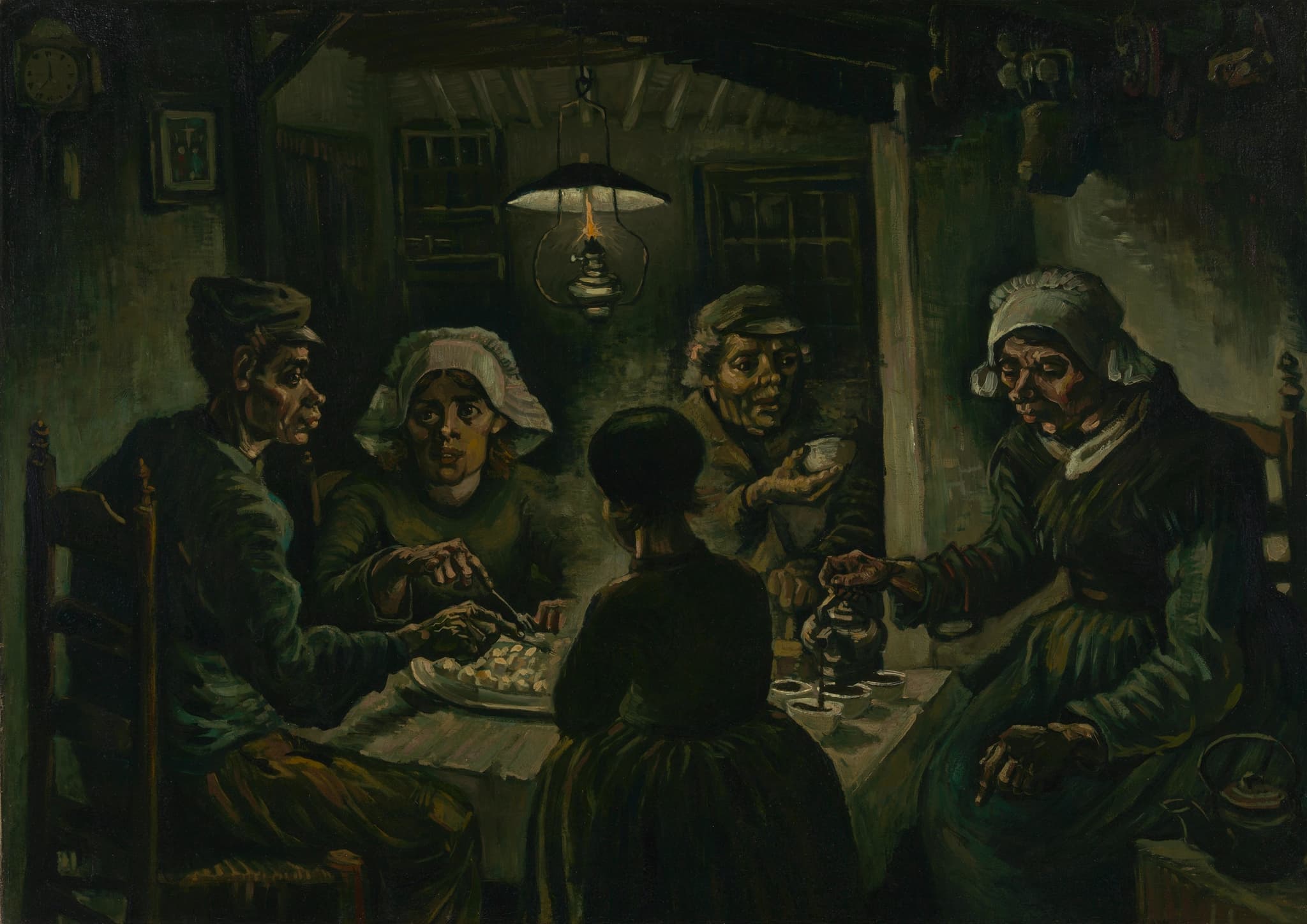
Indicative market value for Vincent van Gogh’s The Potato Eaters (1885, final oil) is $150–300 million. This range extrapolates from the artist’s $117.18 million auction record and applies a rarity and importance premium appropriate to a museum‑grade, first‑masterpiece of exceptional fame.
Valuation Analysis
Value conclusion: $150–300 million (USD). The Potato Eaters is Van Gogh’s first fully realized masterpiece and one of his most reproduced images. In a well‑orchestrated sale, it would command a trophy‑level result well above the artist’s current public auction record of $117.18 million for Orchard with Cypresses (2022), reflecting both its canonical status and extreme scarcity of equivalents in private hands [1].
Object status and scarcity: The final 1885 oil painting is held by the Vincent van Gogh Foundation at the Van Gogh Museum, Amsterdam; it has no modern auction history and is effectively off‑market, which heightens perceived rarity and “once‑in‑a‑generation” value should it ever be offered [2]. A related oil sketch is in the Kröller‑Müller Museum, underscoring that all core iterations of this subject reside institutionally, further compressing supply [3]. The work’s notoriety was even highlighted by its brief inclusion in the 1991 Van Gogh Museum theft, a media event that reaffirmed the painting’s cultural salience (no valuation was involved) [5].
Benchmarking and extrapolation: We anchor the low end of the range to the artist’s record price of $117.18 million (Christie’s, 2022) and the demonstrated breadth of demand for prime Van Goghs in 2021–2025, including a still‑life high of $62.7 million in 2025 for Romans parisiens at Sotheby’s [1][6]. From these benchmarks, we apply an “importance premium” for The Potato Eaters as a keystone, multi‑figure composition central to Van Gogh’s development. Given trophy‑market dynamics and cross‑category competition for canonical names, a $150–300 million framing is justified for this unique, museum‑caliber subject.
Qualitative demand factors: While the painting’s darker palette and somber realism differ from the high‑chroma Arles icons that often set price peaks, its art‑historical centrality (“first masterpiece”), fame, and deep scholarly and exhibition visibility offset any decorative headwinds at the top of the market. Buyers at this level prize narrative significance and cultural impact alongside visual appeal; The Potato Eaters delivers both in abundance.
Market context: After a selective 2024, the high end rebounded in 2025 with renewed appetite for blue‑chip trophies and tightly curated evening sales. Modern and Impressionist/Post‑Impressionist categories maintained substantial market share, and competition intensified for universally recognized masterpieces by brand‑name artists [4]. Within this context, The Potato Eaters would be positioned as a cross‑category, institution‑level prize capable of exceeding the artist’s existing record in a competitive setting.
Note: This is an educational, non‑appraisal indication derived from public information. Final pricing in a real transaction would calibrate to condition, timing, venue, and sale design (including guarantees and irrevocable bids).
Key Valuation Factors
Art Historical Significance
High ImpactThe Potato Eaters is widely recognized as Van Gogh’s first fully realized masterpiece and a cornerstone of his Nuenen period. It is the artist’s most ambitious early multi‑figure composition and a critical bridge to the innovations that followed in Paris and Arles. Its textbook status in scholarship and exhibitions means the painting carries narrative weight far beyond typical market comparables. Works that define an artist’s trajectory command premiums because they are irreplaceable touchstones for museums and leading private collections. Among museum‑held Van Goghs, it sits near the very top for historical importance and recognizability, supporting a valuation that meaningfully exceeds the artist’s recent public auction record for later, more decorative works.
Rarity and Supply Constraints
High ImpactThe final 1885 oil is owned by the Vincent van Gogh Foundation and on permanent loan to the Van Gogh Museum, with no modern auction record. Core variants (including the oil sketch) are also institutionally held, leaving essentially no substitutable supply. When a masterpiece of this stature is hypothetically modeled for price, scarcity exerts outsized influence: the perceived ‘never again’ nature of the opportunity drives competition from cross‑category buyers. At the very top of the market, rarity premiums can double or more the price relative to less canonical, more frequently traded works. The painting’s institutional status, plus the near‑total absence of like‑for‑like alternatives, pushes valuation toward the top end.
Market Benchmarks and Trophy Dynamics
High ImpactVan Gogh’s $117.18m auction record (2022) sets a clear floor for a museum‑grade, universally recognized masterwork. Recent results show sustained depth for prime Van Goghs, with a still‑life record of $62.7m in 2025 and multiple sales above $20–70m across periods. For cross‑category trophies by blue‑chip names, competitive evening‑sale staging, global outreach, and guarantee structures have consistently produced nine‑figure outcomes. Against this backdrop, a canonical, once‑in‑a‑generation Van Gogh of indisputable importance should rationally surpass the current record, especially if offered fresh, with ironclad title logistics, and in New York during peak season. These factors justify the $150–300m extrapolated range.
Aesthetic Appeal vs. Importance
Medium ImpactThe Potato Eaters’ palette and subject are darker and less overtly decorative than the chromatic intensity of Arles and Saint‑Rémy works that often power top prices. This can modestly narrow the bidder base among décor‑driven collectors. However, at the highest level of connoisseurship, art‑historical primacy and cultural resonance outrank ‘wall power.’ The painting’s centrality to Van Gogh’s evolution and its iconic status compensate for the relative sobriety of its palette. The net effect may be a slightly wider range of possible outcomes than for a sun‑drenched Arles landscape—but with a higher ceiling, given its narrative weight and museum‑grade stature.
Sale History
The Potato Eaters has never been sold at public auction.
Vincent van Gogh's Market
Vincent van Gogh commands one of the strongest global markets, with limited supply of prime paintings and most masterpieces in museums. The artist’s current auction record is $117.18 million for Orchard with Cypresses (Christie’s, 2022), and high‑quality works across periods routinely achieve $20–70+ million. Fresh, exhibition‑star material continues to attract cross‑category trophy buyers, exemplified by the 2025 $62.7 million result for Romans parisiens at Sotheby’s. The market is polarized—secondary‑quality or recently re‑traded works face selectivity—yet demand for best‑in‑class Van Goghs remains deep. For a universally recognized, museum‑caliber icon, pricing is expected to rise above the current record in a competitive, well‑managed sale.
Comparable Sales
Orchard with Cypresses (Verger avec cyprès)
Vincent van Gogh
Same artist; oil on canvas; prime Arles-period masterwork of similar scale and market stature; serves as the current auction record and a top-tier trophy benchmark.
$117.2M
2022, Christie's New York
~$131.2M adjusted
Cabanes de bois parmi les oliviers et cyprès
Vincent van Gogh
Same artist; oil on canvas; late 1889 Saint-Rémy period; blue-chip, highly desirable subject and palette. Useful for calibrating demand for prime-period landscapes versus darker, earlier works.
$71.3M
2021, Christie's New York
~$86.3M adjusted
Jeune homme au bleuet
Vincent van Gogh
Same artist; oil on canvas; 1890 portrait (figure subject) offering guidance for figural Van Goghs. Smaller scale and later period, but relevant for demand for iconic portraiture.
$46.7M
2021, Christie's New York
~$56.5M adjusted
Piles de romans parisiens et roses dans un verre (Romans parisiens)
Vincent van Gogh
Same artist; oil on canvas; record for a Van Gogh still life and high-water mark for Paris-period works. Shows current (2025) trophy-level liquidity for top-quality Van Gogh.
$62.7M
2025, Sotheby's New York
Laboureur dans un champ (Ploughman in the Field)
Vincent van Gogh
Same artist; oil on canvas; 1889 Saint-Rémy painting of substantial scale and importance, widely exhibited. A strong proxy for major, museum-grade Van Goghs selling at auction.
$81.3M
2017, Christie's New York
~$109.0M adjusted
Portrait of Dr. Gachet
Vincent van Gogh
Same artist; oil on canvas; one of the artist’s most iconic portraits and a long-standing benchmark for Van Gogh masterpieces. Though older, it anchors trophy-level pricing for top-tier, canon-defining works.
$82.5M
1990, Christie's New York
~$206.3M adjusted
Current Market Trends
After a selective 2024, top‑end liquidity strengthened in 2025 as blue‑chip trophies led rebounds in public auctions. Modern and Impressionist/Post‑Impressionist maintained substantial category share, and competitive tension concentrated around canon‑defining names. Guarantees and irrevocable bids continued to underwrite confidence for major consignments, while Asia’s role as a demand node expanded even as New York remained the deepest venue for nine‑figure lots. Buyers displayed heightened discernment, rewarding fresh‑to‑market, museum‑quality works and applying discounts to secondary‑quality material. In this environment, a culturally iconic, institution‑level Van Gogh would be positioned to clear decisively above prior artist records.
Study print
Study this painting as a print
Pair the full artwork with a museum-style study sheet focused on one meaningful detail.
Sources
- Christie’s Press Release: Paul G. Allen Collection totals $1.62B; Van Gogh record at $117.18m
- The Vincent van Gogh Gallery: The Potato Eaters (1885) – ownership and details
- Kröller-Müller Museum: The Potato Eaters (oil sketch)
- Art Basel & UBS Global Art Market Report 2025
- Los Angeles Times: 1991 Van Gogh Museum theft coverage
- Sotheby’s: New York Sales, November 2025 (includes Van Gogh still-life record)