How Much Is The Siesta Worth?
Last updated: June 25, 2026
Quick Facts
- Methodology
- comparable analysis
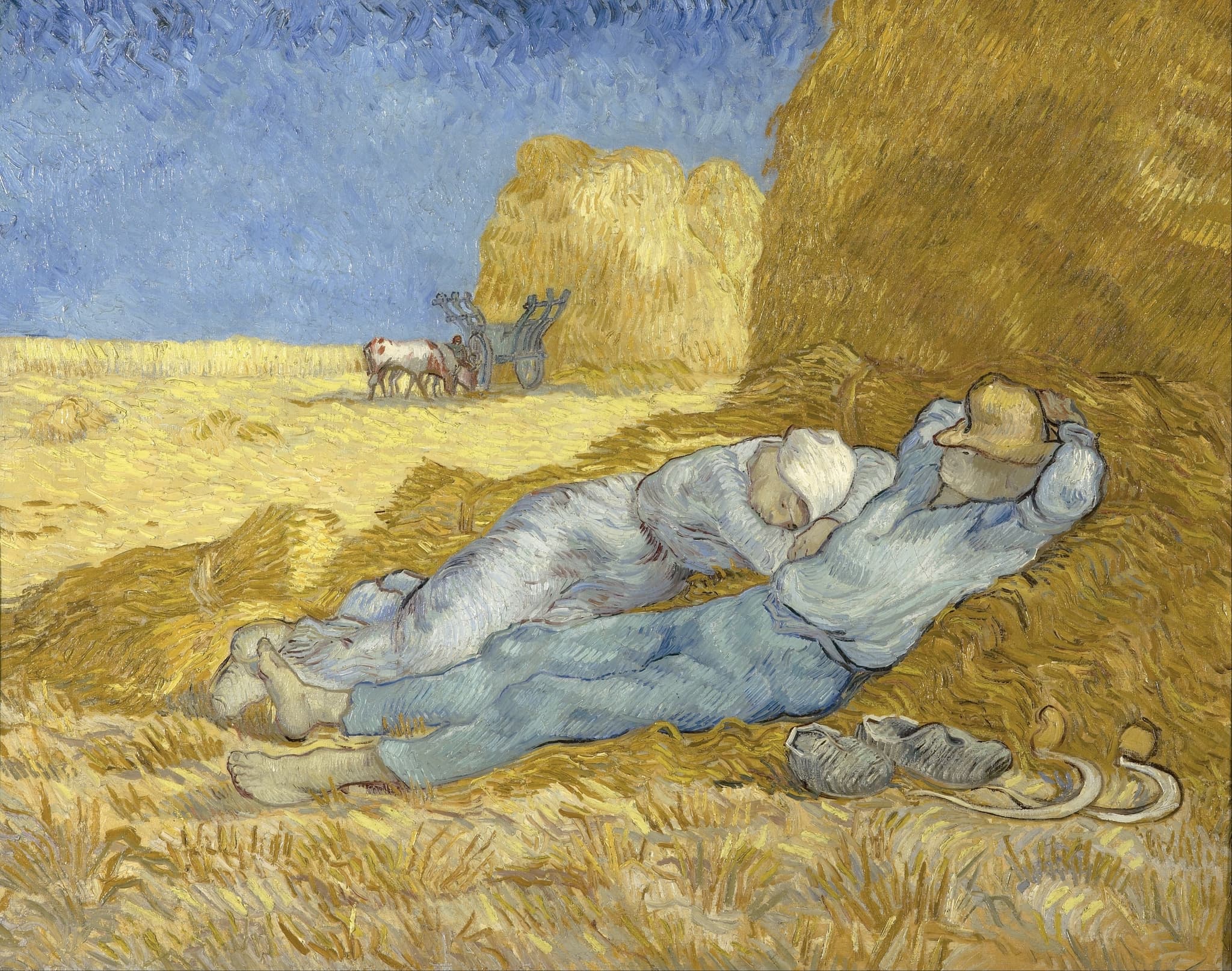
The Siesta (La méridienne, after Millet), 1889–1890, is a major Saint-Rémy oil by Vincent van Gogh held by the Musée d’Orsay. Based on prime late-1880s comparables and tempered by its “after Millet” status, a confident hypothetical fair-market range today is $80–120 million.
Valuation Analysis
Conclusion: The Siesta (La méridienne, after Millet), 1889–1890, oil on canvas (73 x 91 cm), is a museum-caliber Saint-Rémy-period van Gogh with deep scholarly visibility, currently in the French national collection at the Musée d’Orsay [1]. If hypothetically offered with clear, transferable title and top-tier condition, the work would command approximately $80–120 million. This range is anchored to late-1880s Provence oil benchmarks while applying a prudent discount for its explicit “after Millet” designation.
Method and key comparables: The upper boundary of van Gogh’s late-1880s market was reset by Orchard with Cypresses (1888) at $117.18 million (Christie’s, Paul Allen Collection, 2022) [2]. Within Saint-Rémy oils directly adjacent in date/subject, pricing has clustered from the low $50 millions to low $80 millions: Champs près des Alpilles (1889) realized $51.915 million (Christie’s, 2022) [4], while the more coveted Laboureur dans un champ (1889) achieved $81.31 million (Christie’s, 2017). The Cox Collection’s Cabanes de bois parmi les oliviers et cyprès (1889) brought $71.35 million in 2021 (Christie’s) [3]. These establish a robust floor for first-rate Saint-Rémy landscapes and figure-in-landscape subjects.
Subject/period positioning: The Siesta belongs to van Gogh’s celebrated Saint-Rémy cycle and is a large, color-rich canvas. However, it is a translation “after Millet,” a factor that the market historically prices below equally strong, wholly original compositions from Arles/Saint-Rémy. The proposed $80–120 million band therefore sits: (i) well below the artist’s current peak for an iconic, original Arles subject [2], yet (ii) above or bracketing top results for non-iconic but first-rate Saint-Rémy oils [3][4]. Its scale, painterly quality, and institutional stature justify the upper half of the Saint-Rémy range; the “after” status prudently moderates the ceiling.
Provenance/availability and legal context: The Musée d’Orsay record confirms early-20th-century provenance and state acquisition in 1952; the work has remained in the French national collection, where holdings are generally inalienable under the Code du patrimoine (L.451‑5) [1][5]. As such, this valuation is necessarily hypothetical. If offered, clear title/export and an A‑condition report would be pivotal. Given fresh-to-market scarcity of museum-grade Van Goghs, genuine competition among global buyers could push results toward the upper bound.
Bottom line: Taking into account period, scale, quality, scholarship, and adjacent Saint-Rémy comparables—counterbalanced by the “after Millet” factor—the most defensible present-day fair-market indication is $80–120 million, with upside potential in a trophy-driven, well-staged sale.
Key Valuation Factors
Art Historical Significance
High ImpactPainted in 1889–1890 at Saint-Rémy, The Siesta belongs to van Gogh’s mature Provence period, a pinnacle of his career. While it is a reinterpretation after Jean-François Millet, van Gogh’s Saint-Rémy ‘after’ works are central to his artistic program of exploring color, structure, and emotional intensity through admired masters. The composition’s lyrical repose, saturated palette, and confident brushwork exemplify late van Gogh. Its sustained presence in major exhibitions and literature via the Musée d’Orsay reinforces scholarly weight. Within the oeuvre, it is not an absolute icon (e.g., Sunflowers, Dr. Gachet), but it is a highly significant museum-grade canvas from a critical phase of production, warranting strong market standing.
Period and Subject Positioning
Medium ImpactCollectors prize Arles and Saint-Rémy subjects with signature motifs—orchards, cypresses, wheat fields, bedrooms, portraits—most of all. The Siesta’s rural labor theme resonates with van Gogh’s empathy for peasant life and aligns with the season’s agrarian cycle in Provence. However, the explicit “after Millet” status typically trades at a discount to equally strong, wholly original Saint-Rémy compositions. Balancing these forces, the work’s late date, classic Provençal atmosphere, and large format propel demand, while the ‘after’ designation tempers the ceiling relative to the artist’s most iconic originals. Net impact on value is medium: supportive, but not at the apex.
Provenance, Literature, and Institutional Status
High ImpactThe painting’s early 20th‑century ownership, 1932 Paris auction appearance, and 1952 acceptance by the French state confer exceptional pedigree. Decades of stewardship by the Louvre/Jeu de Paume and now the Musée d’Orsay ensure deep literature and exhibition history with rigorous curatorial oversight. Such institutional anchoring reduces attribution risk and enhances global recognizability—key drivers of competitive bidding at the top end. Although French national holdings are generally inalienable, for valuation purposes this profile supports the upper half of the Saint‑Rémy market range, as buyers pay premia for works with authoritative provenance and sustained museum exposure.
Market Benchmarks and Liquidity
High ImpactVan Gogh’s late‑1880s oils remain among the most liquid and internationally competed works in the Modern canon. The current auction record stands at $117.18m for an 1888 Arles oil (Orchard with Cypresses) [2]. High‑quality Saint‑Rémy oils have realized $71.35m (Cabanes de bois…, 1889) and $51.915m (Champs près des Alpilles, 1889), while a prime original subject, Laboureur dans un champ (1889), reached $81.31m. These form a reliable pricing spine for The Siesta. Given sustained trophy demand and scarcity of A‑caliber Van Goghs, a well‑staged sale with third‑party support could readily situate this work in the $80–120m range, with competition determining final placement.
Sale History
Galerie Georges Petit, Paris (Charles Pacquement sale)
Early public auction appearance; subsequently with Galerie E. Bignou and Mme Fernand Halphen. Price not publicly documented in accessible records.
Vincent van Gogh's Market
Vincent van Gogh’s market is one of the deepest and most international in art. The artist’s current auction record is $117.18 million for Orchard with Cypresses (Christie’s, 2022), reaffirming nine‑figure appetite for prime Arles works. Late-1880s oils from Arles and Saint‑Rémy consistently dominate van Gogh’s price distribution, with top Saint‑Rémy examples achieving $70–80+ million. Robust private demand and institutional visibility sustain liquidity across categories, including still lifes and landscape drawings that have recently set category records. While the market is selective, best‑in‑class, fresh‑to‑market works with strong provenance and condition continue to attract global competition and, when properly staged, can challenge prior benchmarks.
Comparable Sales
Orchard with Cypresses (Verger avec cyprès)
Vincent van Gogh
Same artist; late-1880s Provence landscape oil with strong market resonance; sets the top-of-market cap for first-rate, original Arles-period compositions.
$117.2M
2022, Christie's New York
~$128.5M adjusted
Cabanes de bois parmi les oliviers et cyprès
Vincent van Gogh
Same artist; Saint-Rémy (1889) oil closely aligned in period and subject (cypresses/olives). Though smaller, it is a strong period landscape and a practical floor marker for late-1880s Provence oils.
$71.3M
2021, Christie's New York
~$84.5M adjusted
Champs près des Alpilles
Vincent van Gogh
Same artist; Saint-Rémy (1889) field view—very close in date, subject type and mood; useful mid-range benchmark for non-iconic but first-rate Provence oils.
$51.9M
2022, Christie's New York
~$57.0M adjusted
Laboureur dans un champ (Ploughman in the Field)
Vincent van Gogh
Same artist; Saint-Rémy (1889) oil with a labor-in-the-fields theme akin to The Siesta’s rural subject; demonstrates premium for prime, original Saint-Rémy compositions.
$81.3M
2017, Christie's New York
~$106.5M adjusted
L’Allée des Alyscamps
Vincent van Gogh
Same artist; Arles (1888) oil, similar scale and high visual appeal. While earlier (Arles) and more iconic, it brackets the upper tier for large, sought-after Provence canvases.
$66.3M
2015, Sotheby's New York
~$89.8M adjusted
Still Life, Vase with Daisies and Poppies (Nature morte, Vase aux marguerites et coquelicots)
Vincent van Gogh
Same artist; late (1890) oil with strong commercial appeal. Different subject (still life) but useful to gauge late‑career pricing for first‑rate oils with broad collector demand.
$61.8M
2014, Sotheby's New York
~$83.8M adjusted
Current Market Trends
The upper tier of the Impressionist/Post‑Impressionist market remains a ‘flight to quality’: buyers compete aggressively for scarce, canonical works while mid‑tier material is more price‑sensitive. After some cooling in 2024, renewed trophy consignments have reinforced depth at the high end, with blue‑chip names (including van Gogh) leading marquee evening sales. Guarantor structures and third‑party support are now standard, stabilizing outcomes for major lots. Against this backdrop, late‑1880s van Goghs—especially Arles/Saint‑Rémy oils with strong provenance—remain among the most reliable performers, with nine‑figure potential for iconic originals and high eight to low nine figures for first‑rate, non‑iconic or ‘after’ compositions.
Study print
Study this painting as a print
Pair the full artwork with a museum-style study sheet focused on one meaningful detail.
Sources
- Musée d’Orsay – La méridienne (La sieste) object record
- The Art Newspaper – A Van Gogh record: Orchard with Cypresses soars to $117m at Paul Allen auction
- Christie’s Press – The Cox Collection and 20th Century Evening Sales achieve $751.9m
- The Art Newspaper – Christie’s evening sales hit $831m as market roars back
- Legifrance – Code du patrimoine, Article L451-5 (inalienability of public collections)