The Siesta

by Vincent van Gogh

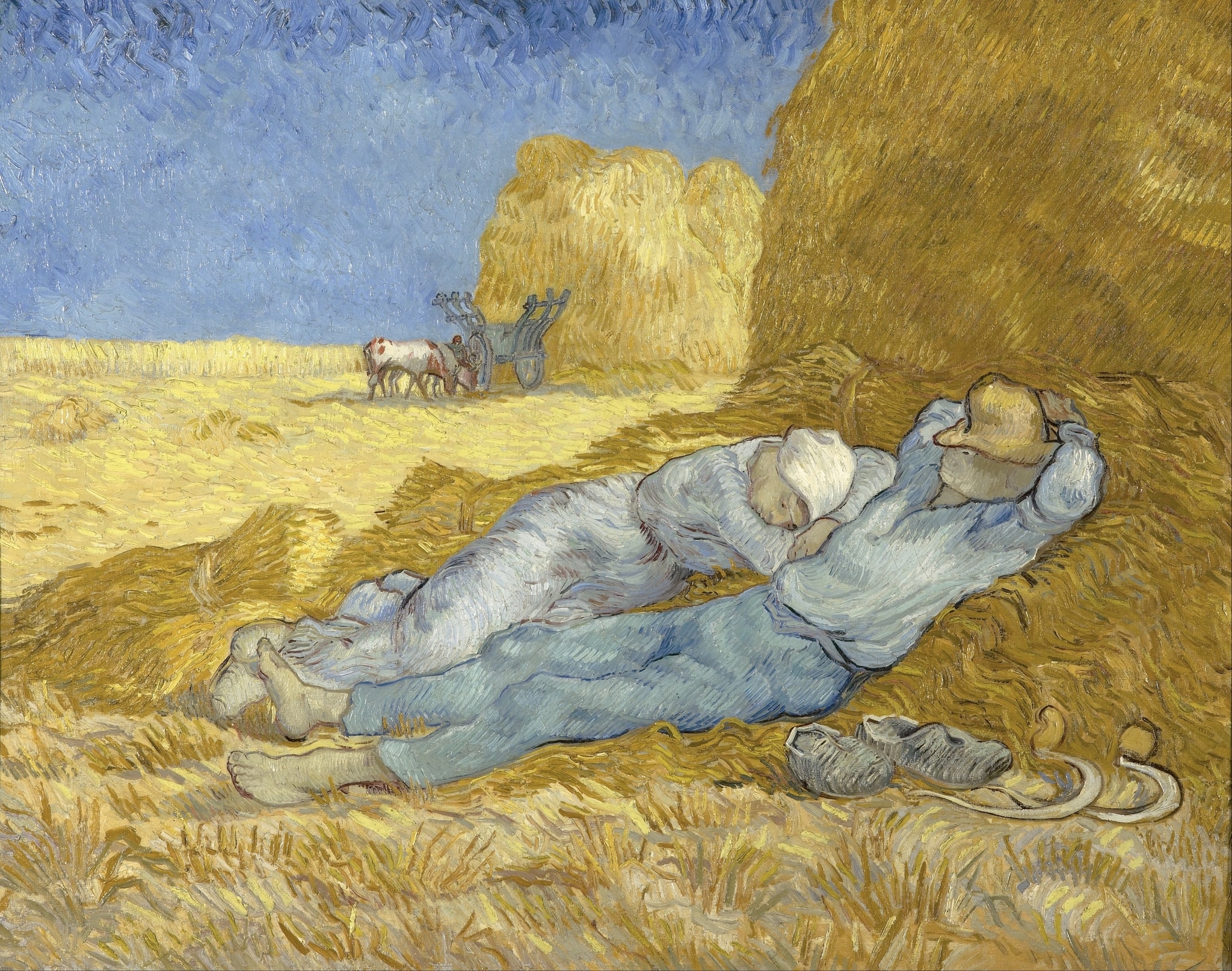
The Siesta renders a midday pause as a scene of dignified repose: two harvesters sleep curved against a haystack while their scythes and shoes rest idle in the straw. Van Gogh’s complementary blue–yellow orchestration turns heat and light into rhythm, holding rest and labor in delicate equilibrium [1]. Painted at Saint‑Rémy as a color "translation" after Millet, it transforms a humble genre motif into an emblem of human need within work’s demands [1][3].
💰

Market Value

$80-120 million

How much is The Siesta worth?

Study Print Studio

Create a personal study print

Build a companion study sheet around the part of this painting that speaks to you most. Choose a detail, shape an interpretation, and walk away with something personal and display-worthy.

Fast Facts

Year
1889–1890
Medium
Oil on canvas
Dimensions
73 × 91 cm
Location
Musée d’Orsay, Paris
See all Vincent van Gogh paintings in Paris
The Siesta by Vincent van Gogh (1889–1890) featuring Sleeping harvesters (paired bodies), Haystack as shelter, Scythes, Discarded shoes

Click on any numbered symbol to learn more about its meaning

Meaning & Symbolism

Van Gogh builds the painting on a set of purposeful oppositions. The resting pair, swaddled in cool blue garments, lie like commas against the towering haystack whose ochers and golds bleed into the field; the chromatic counterpoint of blue‑violet and yellow‑orange is not decorative but structural, cooling the body at the center of heat and glare 1. Nearby, the still‑life of scythes and rough shoes spells out the suspension of effort, while far left the ox‑cart idles with its team, miniature and patient, a witness that the day’s work is only paused, not abandoned. The sky itself participates: short, vibrating strokes turn air into a visible medium of summer fatigue, a soft percussion above the crisp, sun‑pounded stubble. Every element is subordinated to a single proposition—that repose is lawful at noon—so that the haystack becomes both landscape and sanctuary, a makeshift architecture of rest raised by the harvest itself 14. The painting’s authority derives from van Gogh’s decision to remake Jean‑François Millet’s composition through color. At Saint‑Rémy, restricted in subjects and models, he worked from a wood engraving after Millet’s Four Times of the Day, describing his procedure as translating into another language, that of color what monochrome had conveyed in light and dark 123. In The Siesta that translation is exacting: van Gogh keeps Millet’s narrative armature—the intertwined figures, the scythes, the cart—“jusque dans les détails,” yet he claims the scene as his own by turning contrast into meaning 1. The blue clothing cools the sleepers and signals companionship; the yellow field is both taskmaster and pillow; the tiny, waiting oxen inscribe time, reminding us that noon is an interval within a larger rural liturgy. Read within van Gogh’s agrarian symbolism, the harvest setting echoes Gospel metaphors of sowing and reaping, where cycles of effort and pause bear spiritual weight; the noon rest functions as a ritualized intermission in that sacred calendar 4. The image thus refuses sentimentality: fatigue is not pitied but honored, and the peasant couple’s curved bodies articulate a grammar of mutual dependence—two forms completing a single contour of necessary sleep. This makes The Siesta pivotal for understanding why van Gogh’s Saint‑Rémy “copies” are in fact modern experiments in authorship. By translating Millet’s moral exemplar into a high‑keyed, complementary scheme, he converts borrowed composition into personal vision, using brushwork to render climate, labor, and mercy palpable at once 13. The result is a compact ethics of color: blue offers relief, yellow insists on heat, and their friction produces calm. In the foreground, the tools lie like commas; in the distance, the cart is a colon—punctuation that structures the day’s sentence. Between those marks the sleepers breathe, and the painting declares that this breath is not a break from meaning but its measure. That is the meaning of The Siesta and why The Siesta is important: it demonstrates how color can legislate value, turning a pause in work into a human right within the vast economy of sun, field, and time 124.

Explore Deeper with AI

Ask questions about The Siesta

Popular questions:

Powered by AI • Get instant insights about this artwork

💬 Ask questions about this artwork!

Interpretations

Formal Analysis: Chromatic Thermodynamics

Rather than illustrate rest, van Gogh engineers it optically: the complementary blue‑violet/yellow‑orange scheme turns color into climate control, making the garments read as a cooling membrane against radiant straw. Short, vibratory strokes convert sky into palpable heat-haze, while dense, directional impasto in the stubble amplifies glare by contrast. This is not anecdotal finish but structural design—color contrasts carry narrative load, regulating sensation across the canvas field. The still-life tools, rendered with heavier contour and cooler shadows, anchor the eye in a lower-temperature zone, from which the gaze ascends into sun-saturated golds. In this way, van Gogh composes a thermal gradient that performs the subject: rest materializes where complementaries equilibrate, and the picture’s affect—relief within heat—emerges from paint handling itself 1.

Source: Musée d’Orsay

Symbolic Reading: Rural Sabbath at Noon

Read through van Gogh’s agrarian symbolism, the meridienne functions like a lay Sabbath compacted into an hour: a sanctified recess inside the harvest’s liturgy. Scholars have shown how the artist aligns peasant labor with Gospel parables of sowing and reaping, investing fieldwork with eschatological overtones. Here, the haystack becomes a makeshift altar of rest and the ox‑cart’s pause inscribes communal timekeeping that exceeds utility. The scythes and shoes operate as emblems, not props—indices of toil laid down under a tacit moral dispensation to cease. Noon, therefore, is not neutral clock-time but consecrated interval, a rite of permission within cyclical labor that confers dignity rather than pity on fatigue 41.

Source: Judy Sund, The Art Bulletin; Musée d’Orsay

Authorship & Medium: Translation, Not Copy

Van Gogh’s procedure—working from Lavieille’s wood engraving after Millet—foregrounds intermedial translation as authorship. Retaining Millet’s iconographic armature “jusque dans les détails,” he relocates meaning from tonal modeling (print) to chromatic construction (oil). This shift reassigns moral clarity from narrative sequence to color logic, where complementary tensions legislate value. Such “translating into another language” anticipates modern debates on appropriation: fidelity at the level of composition coexists with radical difference at the level of ontology (ink on paper versus light‑saturated pigment). The result claims autonomy without disavowing source—a model of ethical borrowing in which citation is explicit and innovation is carried by medium-specific means 13.

Source: Musée d’Orsay; Saint Louis Art Museum

Social History: The Politics of Pause

Millet’s peasants were long read as moral exemplars; van Gogh intensifies that register by making the pause itself the protagonist. The foreground tools-as-still-life stage a temporary de-commodification of the body: labor power is withdrawn, not wasted. The waiting ox‑cart, scaled small yet legible, testifies that production will resume; thus the image argues for rest as right within the rural economy. By refraining from sentimental misère and refusing heroic postures, the canvas humanizes agricultural tempo, proposing an ethic of measured work rather than relentless extraction. In this lens, the painting participates in 19th‑century debates on peasant dignity by picturing time—who owns it, who pauses it—as a social good embedded in custom 31.

Source: Saint Louis Art Museum; Musée d’Orsay

Psychological Interpretation: Asylum Constraints, Interior Weather

At Saint‑Rémy, winter scarcity of models pushed van Gogh toward prints after Millet, a practice he called sustaining and clarifying. The Siesta thus doubles as self‑regulation: by reconstructing a rural noon from monochrome into saturated color‑climate, he externalizes an inner thermostat at a moment of psychic volatility. The exactness of the borrowed composition supplies cognitive scaffolding, while chroma and brushwork become sites for affective authorship—cool blues dampen agitation; rhythmic strokes entrain breathing. Translation here is therapeutic: a constrained source enables expansive sensation. In this biographical light, the painting’s equilibrium is hard‑won, a crafted mental weather where heat and rest are reconciled on the canvas so they might be rehearsed in mind 21.

Source: Van Gogh Museum; Musée d’Orsay

Related Themes

About Vincent van Gogh

Vincent van Gogh (1853–1890) developed a radical, emotion‑driven use of color after moving from Paris to Arles in 1888, seeking southern light and an artists’ community. In Arles he created the Sunflowers series to decorate the Yellow House ahead of Gauguin’s visit. His late work fused impasto, high chroma, and symbolic motifs that shaped modern painting [2][5].
View all works by Vincent van Gogh

More by Vincent van Gogh
Café Terrace at Night by Vincent van Gogh

Café Terrace at Night

Vincent van Gogh (1888)

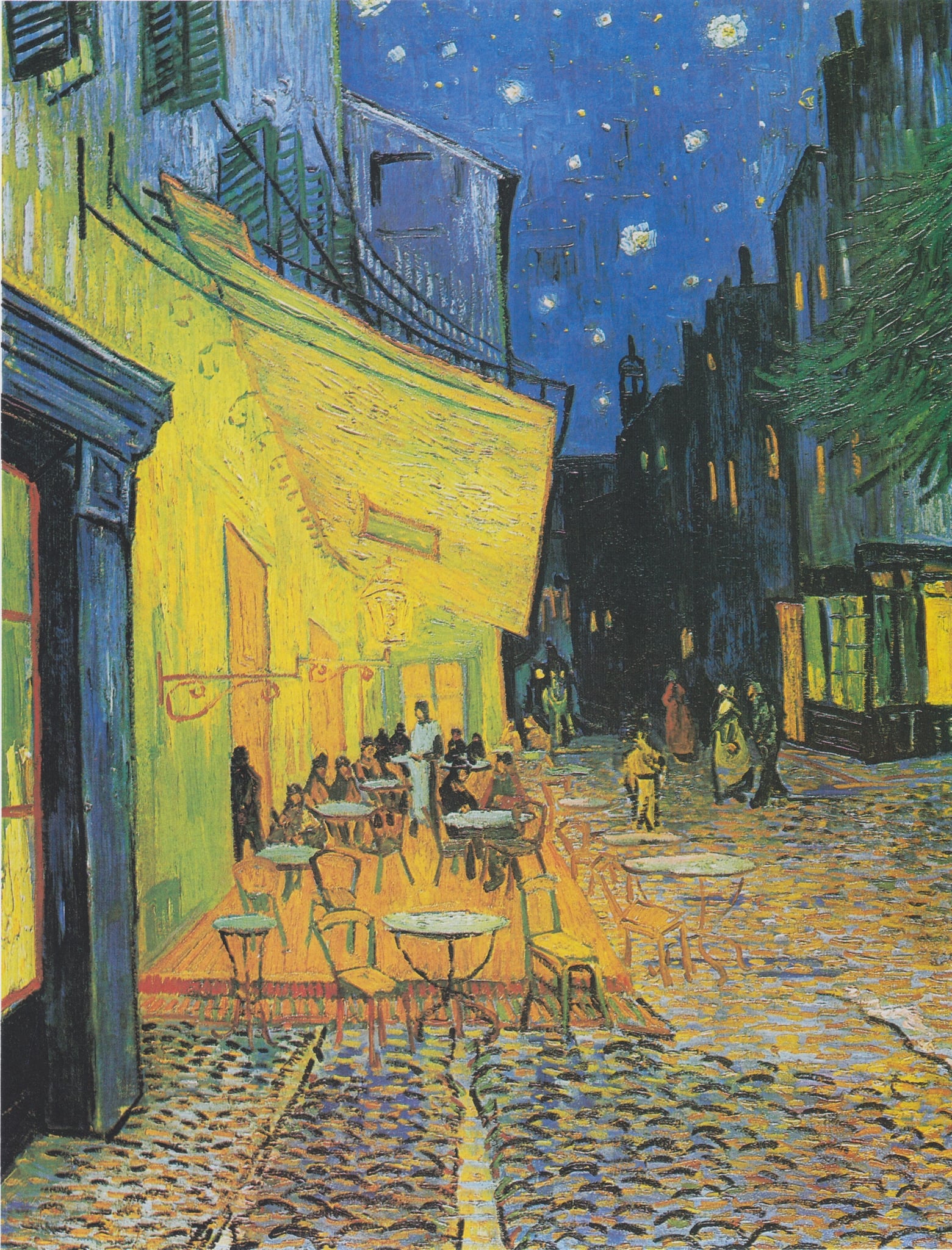
In Café Terrace at Night, Vincent van Gogh turns nocturne into <strong>luminous color</strong>: a gas‑lit terrace glows in yellows and oranges against a deep <strong>ultramarine sky</strong> pricked with stars. By building night “<strong>without black</strong>,” he stages a vivid encounter between human sociability and the vastness overhead <sup>[1]</sup><sup>[2]</sup>.
Red Cabbages and Onions by Vincent van Gogh

Red Cabbages and Onions

Vincent van Gogh (1887)

In Red Cabbages and Onions, Vincent van Gogh turns everyday produce into a drama of <strong>complementary color</strong> and <strong>restless brushwork</strong>. Hot red contours cinch violet cabbages and pale yellow bulbs against a cool, striated blue table, while a mustard‑yellow patch in the upper right tilts the space and sharpens the chromatic clash. The result asserts ordinary food as a locus of <strong>resilience</strong> and <strong>experimentation</strong> <sup>[1]</sup><sup>[2]</sup>.

Irises by Vincent van Gogh

Irises

Vincent van Gogh (1889)

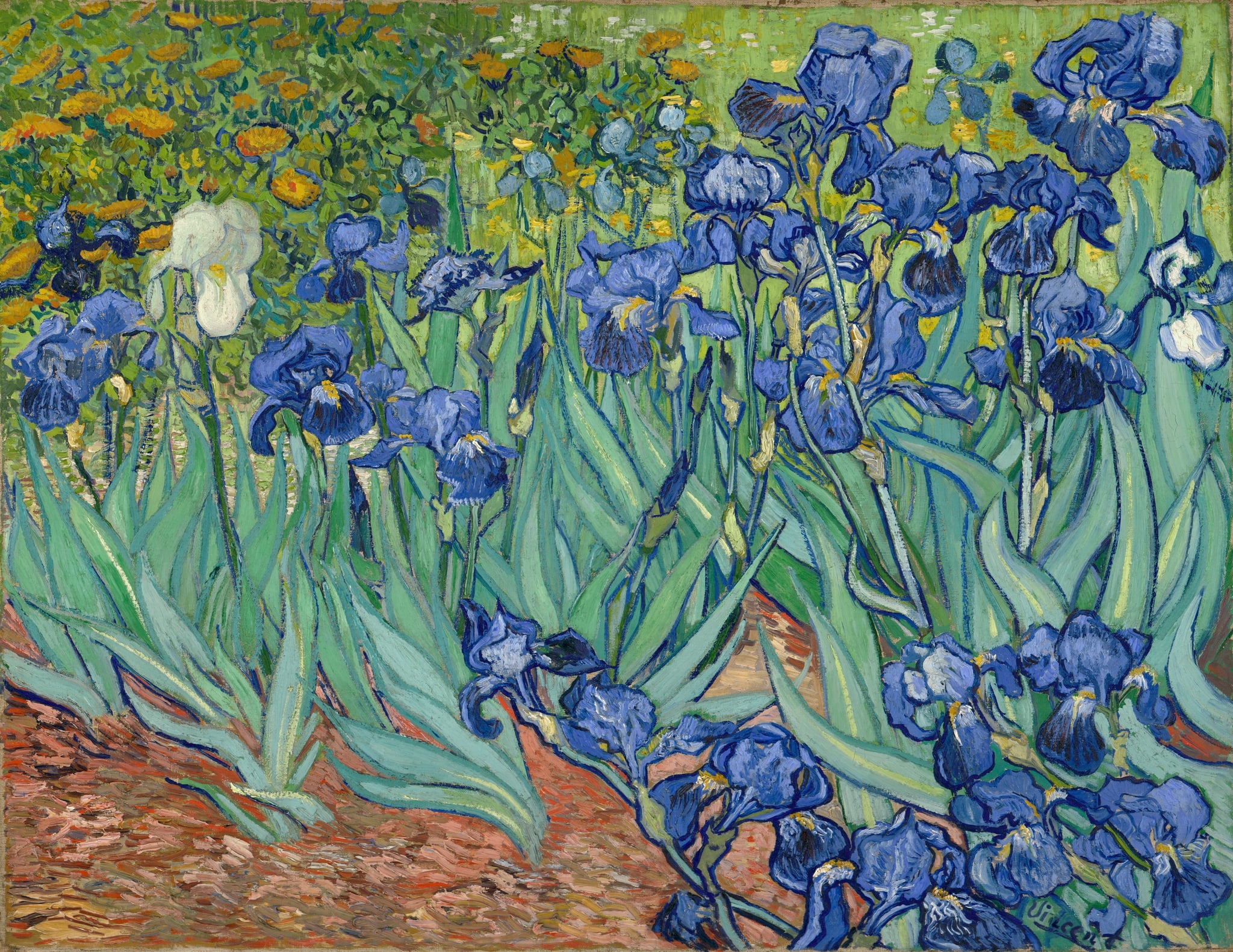
Painted in May 1889 at the Saint-Rémy asylum garden, Vincent van Gogh’s <strong>Irises</strong> turns close observation into an act of repair. Dark contours, a cropped, print-like vantage, and vibrating complements—violet/blue blossoms against <strong>yellow-green</strong> ground—stage a living frieze whose lone <strong>white iris</strong> punctuates the field with arresting clarity <sup>[1]</sup><sup>[2]</sup>.
Sunflowers by Vincent van Gogh

Sunflowers

Vincent van Gogh (1888)

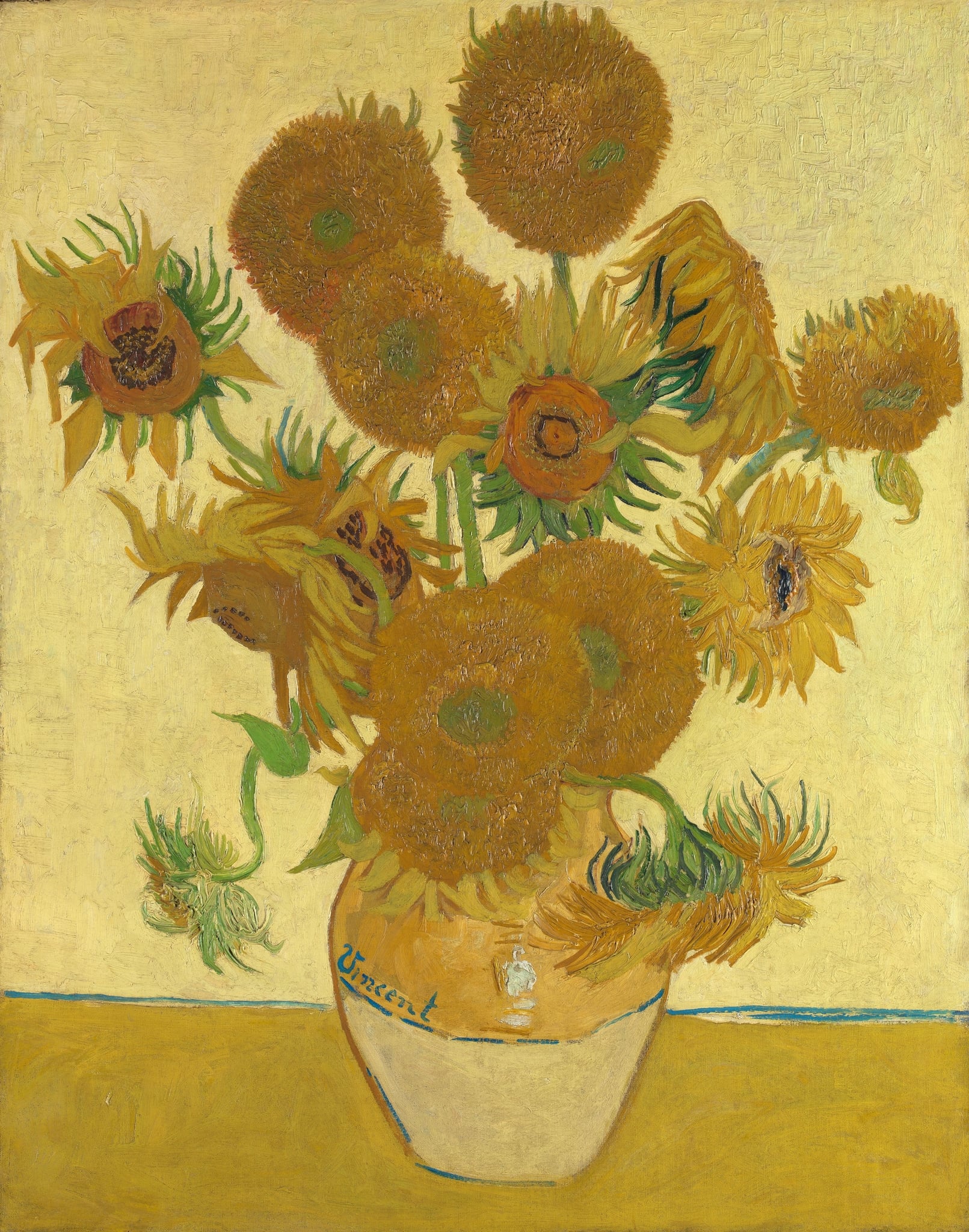
Vincent van Gogh’s Sunflowers (1888) is a <strong>yellow-on-yellow</strong> still life that stages a full <strong>cycle of life</strong> in fifteen blooms, from fresh buds to brittle seed heads. The thick impasto, green shocks of stem and bract, and the vase signed <strong>“Vincent”</strong> turn a humble bouquet into an emblem of endurance and fellowship <sup>[1]</sup><sup>[2]</sup>.

Garden with Courting Couples: Square Saint-Pierre by Vincent van Gogh

Garden with Courting Couples: Square Saint-Pierre

Vincent van Gogh (1887)

In Garden with Courting Couples: Square Saint-Pierre, Vincent van Gogh turns a small Montmartre park into a stage where <strong>spring</strong>, <strong>intimacy</strong>, and <strong>urban leisure</strong> converge. Short, shimmering strokes fuse pink chestnut blossoms, curving paths, and paired figures into one pulse of <strong>renewal</strong> and <strong>togetherness</strong> <sup>[1]</sup><sup>[2]</sup>.

In the Café: Agostina Segatori in Le Tambourin by Vincent van Gogh

In the Café: Agostina Segatori in Le Tambourin

Vincent van Gogh (1887 (Jan–Mar))

Van Gogh casts Agostina Segatori at a tiny, tambourine‑like café table, turning Le Tambourin into a <strong>stage of modern life</strong>. Cool greens and greys make the red <strong>flame‑plume hat</strong> and the foaming <strong>beer</strong> flare, while folded arms and a set‑aside <strong>parasol</strong> register private fatigue amid public display <sup>[1]</sup><sup>[2]</sup><sup>[3]</sup>.