How Much Is Imperial Fritillaries in a Copper Vase Worth?
Last updated: June 25, 2026
Quick Facts
- Methodology
- comparable analysis
Imperial Fritillaries in a Copper Vase (1887) is a museum‑caliber, Paris‑period van Gogh still life with exceptional art‑historical visibility and deep market appeal. Based on recent top van Gogh benchmarks and direct still‑life comparables, a realistic hypothetical estimate today is $100–150 million, assuming standard museum‑grade condition and elite sale presentation.
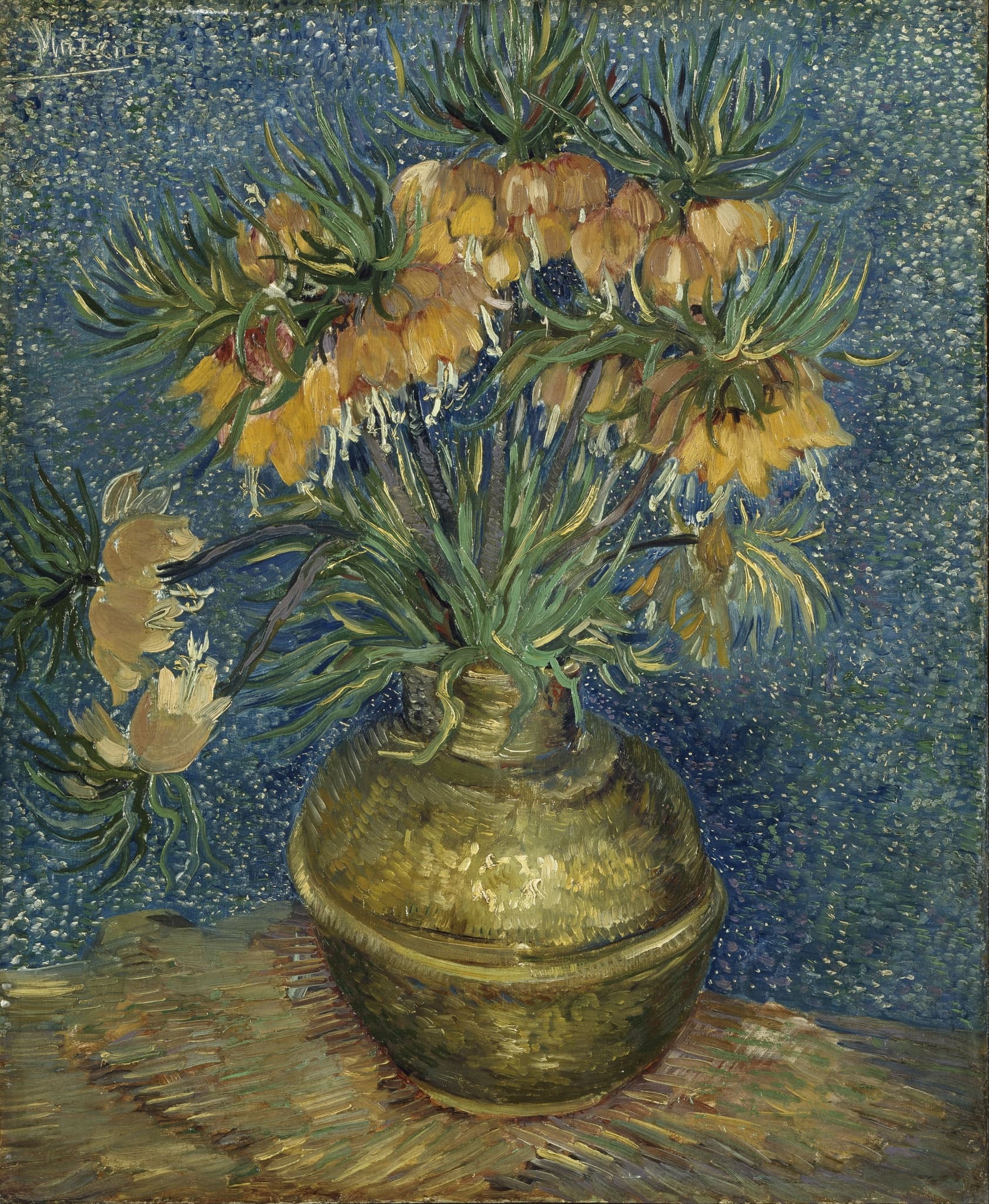
Imperial Fritillaries in a Copper Vase
Vincent van Gogh, 1887 • Oil on canvas
Read full analysis of Imperial Fritillaries in a Copper Vase →Valuation Analysis
Work and context. Vincent van Gogh’s Imperial Fritillaries in a Copper Vase (1887; 73.3 × 60 cm; F 213) is a signature Paris‑period floral still life, celebrated for its high‑impact complementary contrasts (orange blossoms against a blue, pointillist‑inflected ground). The painting entered France’s national collection via the 1911 Camondo bequest and is now at the Musée d’Orsay, where it enjoys extensive literature and exhibition history—firmly establishing its canonical status within the oeuvre [1].
Benchmarking and comps. The upper bound for van Gogh at auction is $117.18 million for an Arles landscape, Orchard with Cypresses (Christie’s, 2022) [2]. Within the still‑life and Paris‑period corridor, two anchors are decisive: (i) Piles de romans parisiens et roses dans un verre (Parisian Novels, 1887), which achieved $62.71 million at Sotheby’s in 2025—a record for a Paris‑period work and for a van Gogh still life [4]; and (ii) Still Life, Vase with Daisies and Poppies (1890), a museum‑level floral canvas that sold for $61.77 million at Sotheby’s in 2014, implying a materially higher figure in today’s dollars [3]. Additional 1887 adjacencies confirm depth: Coin de jardin avec papillons brought $33.19 million at Christie’s in 2024 [6], and a major work on paper realized $29.4 million in 2026 [5].
Positioning this picture. Among van Gogh’s Paris still lifes, Imperial Fritillaries stands near the apex in scale, chromatic audacity, and scholarly resonance. Its instantly recognizable blue‑orange polarity, confident facture, and sustained institutional visibility drive a robust “trophy premium.” Relative to Parisian Novels (books and blooms) at $62.71 million, Imperial Fritillaries offers a purer, more iconic floral subject, greater image recognition, and a longer, high‑profile museum presence—characteristics that translate directly into bidding depth at the very top end. While it does not cross into the absolute pantheon of the late Arles/Saint‑Rémy/Auvers icons, it sits just beneath that summit—in a zone where nine‑figure prices are supportable when scarcity, provenance certainty, and elite global demand converge.
Conclusion and range. Synthesizing these comparables and the artist’s current record, a fair, current‑market hypothetical estimate for Imperial Fritillaries in a Copper Vase is $100–150 million, assuming standard museum‑grade condition and optimal sale orchestration (global marketing, New York evening platform, and competitive financial terms). This brackets the $62–83+ million empirical floor for top van Gogh still lifes and acknowledges the demonstrated nine‑figure ceiling for first‑rank van Gogh trophies [2–4,6]. As a French national holding, the work is effectively inalienable; the range presented is a rigorous market proxy for benchmarking and insurance purposes rather than an indicator of sale likelihood [1].
Key Valuation Factors
Art Historical Significance
High ImpactPainted in Paris in spring 1887, Imperial Fritillaries captures van Gogh’s pivotal engagement with contemporary color theory and Neo‑Impressionist optics. The bold complementary schema—orange fritillaries against a modulated blue ground—demonstrates a confident command of chromatic contrast that anticipates his Arles breakthroughs. The work’s sustained institutional presence (Louvre/Jeu de Paume/Orsay), extensive bibliography, and frequent reproduction have cemented it as a benchmark Paris‑period still life. As a result, its art‑historical weight is far above routine floral subjects: it epitomizes a key developmental chapter in van Gogh’s trajectory and functions as a touchstone for scholarship, connoisseurship, and public recognition alike.
Market Rarity and Trophy Appeal
High ImpactTop‑tier van Goghs of this scale, quality, and visual impact are exceptionally scarce on the market; many are in museums. Paris‑period still lifes of commanding presence appear only rarely at public auction, and when they do, they attract deep, cross‑regional bidding. Imperial Fritillaries offers a quintessential, instantly legible floral image and a vivid palette—attributes that resonate with the broadest collector base. Scarcity at this level compounds trophy competition, with multiple geographies (U.S., Europe, Asia, Middle East) prepared to chase canonical van Goghs. This rarity premium justifies a decisive step‑up from mid‑eight‑figure still‑life comps into a confident nine‑figure band.
Comparable Sales Evidence
High ImpactRecent results define a robust framework: Orchard with Cypresses set the artist’s auction peak at $117.18m; the Paris‑period still‑life record reached $62.71m in 2025; and a major 1890 floral still life achieved $61.77m in 2014 (implying a higher current‑dollar value). Additional 1887 works have sold in the $30m+ range, validating demand even for secondary subjects. Against these, Imperial Fritillaries’ higher art‑historical profile and image recognition argue for a premium. The $100–150m estimate brackets the established still‑life floor and recognizes the demonstrated ability of true van Gogh trophies to command nine figures under competitive conditions.
Provenance, Exhibition, and Institutional Prestige
High ImpactThe painting’s early 20th‑century passage into the French national collection via the Camondo bequest confers exceptional provenance integrity and scholarly visibility. Decades of display at the Louvre/Jeu de Paume and now the Musée d’Orsay enhance its reputational capital. While national‑collection status makes an actual sale unrealistic, the same institutional cachet and documented history enhance hypothetical market value: they neutralize authenticity and title risk, provide rich literature and exhibition credentials, and strengthen the picture’s global recognizability. In a trophy‑driven segment where buyers prize certainty and prestige, these attributes contribute materially to a nine‑figure outcome.
Sale History
Imperial Fritillaries in a Copper Vase has never been sold at public auction.
Vincent van Gogh's Market
Van Gogh sits at the apex of the Modern market with unrivaled brand recognition and sustained demand from global trophy buyers. His auction record—$117.18 million for Orchard with Cypresses (Christie’s, 2022)—anchors a mature top end, while strong late landscapes and portraits routinely command $70–80+ million. Still lifes have proven exceptionally liquid, with a 2014 floral canvas taking $61.77 million and a Paris‑period still life reaching $62.71 million in 2025. Supply is chronically thin as many masterpieces reside in museums, intensifying competition for the few blue‑chip works that surface. Collectors prize fresh, iconic subjects, pristine condition, and bullet‑proof provenance, all of which can catalyze nine‑figure results.
Comparable Sales
Piles de romans parisiens et roses dans un verre (Parisian Novels)
Vincent van Gogh
Same artist; painted in 1887 (Paris period). A still life that set a record for Van Gogh’s Paris‑period still lifes. Close in date, genre, and market segment to Imperial Fritillaries.
$62.7M
2025, Sotheby's New York
Still Life, Vase with Daisies and Poppies (Nature morte, vase aux marguerites et coquelicots)
Vincent van Gogh
Same artist; floral still life on canvas. Although from 1890 (Auvers), it is the closest recent auction proxy for Van Gogh’s flowers‑in‑a‑vase motif and museum‑caliber still‑life demand.
$61.8M
2014, Sotheby's New York
~$83.4M adjusted
Coin de jardin avec papillons (Garden Corner with Butterflies)
Vincent van Gogh
Same artist; painted in 1887 (Paris period). Vivid nature study reflecting Neo‑Impressionist influence—close in date and coloristic sensibility to Imperial Fritillaries, though not a vase still life.
$33.2M
2024, Christie's New York
~$34.2M adjusted
Orchard with Cypresses
Vincent van Gogh
Same artist; 1888 Arles landscape and the current Van Gogh auction record. Not a still life but an essential upper‑bound benchmark for trophy‑level pricing.
$117.2M
2022, Christie's New York
~$128.9M adjusted
Cabanes de bois parmi les oliviers et cyprès
Vincent van Gogh
Same artist; 1889 Saint‑Rémy landscape from a blue‑chip period. Provides a high‑value anchor for first‑rank Van Gogh works, even if the subject differs from a still life.
$71.3M
2021, Christie's New York
~$84.9M adjusted
Laboureur dans un champ (Ploughman in the Field)
Vincent van Gogh
Same artist; 1889 Saint‑Rémy masterwork with strong auction performance. Useful for bracketing the high end for top‑tier canvases.
$81.3M
2017, Christie's New York
~$106.5M adjusted
Current Market Trends
The late‑19th‑century Impressionist/Post‑Impressionist segment has reasserted leadership as a ‘safe haven,’ with buyers concentrating capital in canonical names. After a broadly selective 2024, trophy appetite re‑accelerated in late 2025, setting new period and category highs and confirming depth for museum‑caliber lots. Within van Gogh’s market, recent sales show strong absorption across media and periods, with Paris‑period works achieving new benchmarks and broader demand evident in multiple regions. The high end remains bifurcated—exceptional works outperform, while secondary material is price‑sensitive—but for top‑quality, fresh consignments with strong narratives, competitive bidding and nine‑figure outcomes are fully supportable.
Study print
Study this painting as a print
Pair the full artwork with a museum-style study sheet focused on one meaningful detail.
Sources
- Musée d’Orsay – Fritillaires, couronne impériale, dans un vase de cuivre
- Christie’s Press – Paul G. Allen Collection: Orchard with Cypresses ($117.18m)
- Artnet News – Van Gogh’s ‘Vase with Daisies and Poppies’ Sells for $61.8 Million
- Sotheby’s – The 10 Most Valuable Lots Sold by Sotheby’s in 2025 (includes ‘Parisian Novels’, $62.71m)
- The Art Newspaper – Sotheby’s Modern Evening Sale (La moisson en Provence, $29.4m)
- The Art Newspaper – Christie’s Modern Evening Sale (Coin de jardin avec papillons, $33.2m)