Imperial Fritillaries in a Copper Vase

by Vincent van Gogh

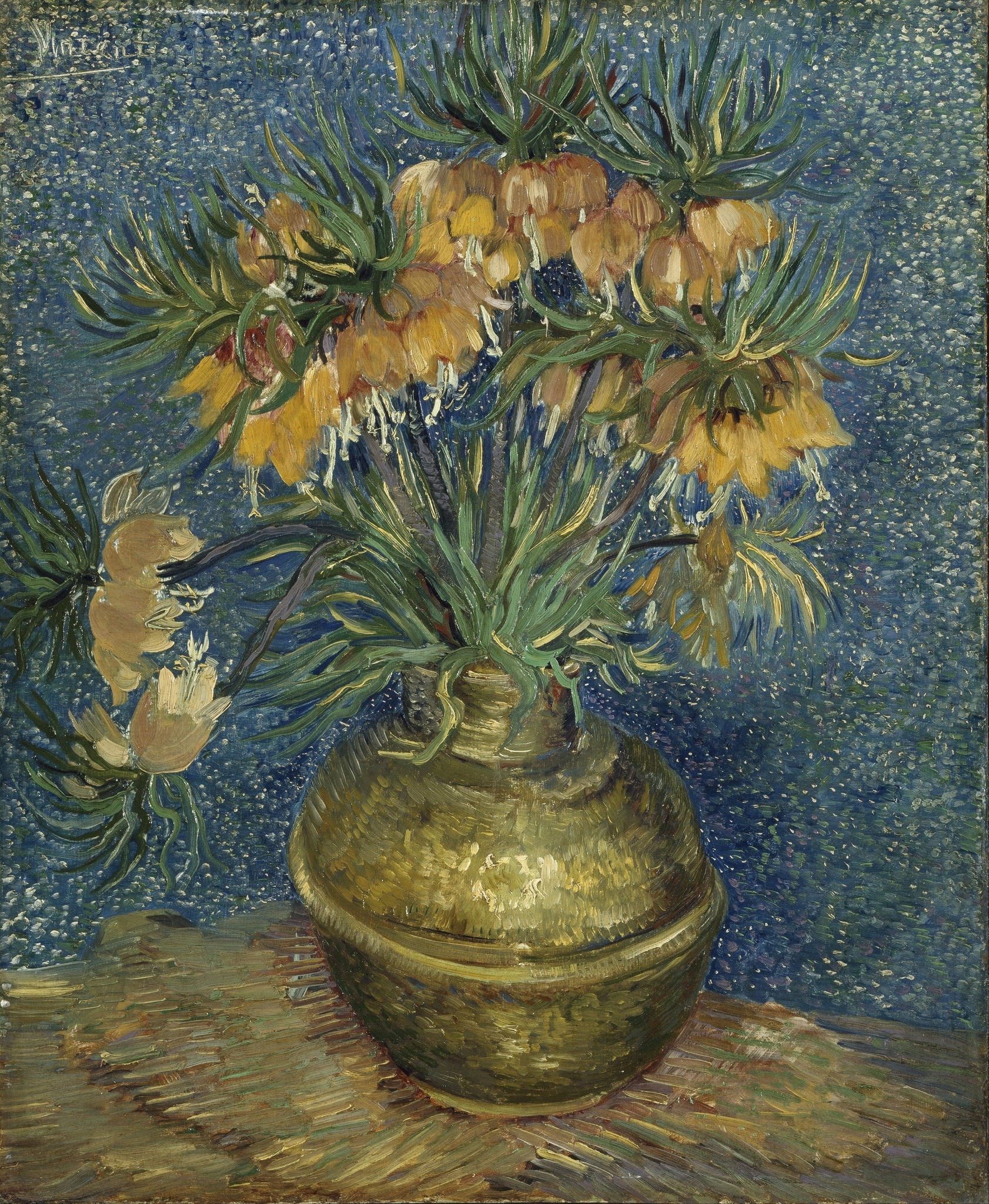
A blaze of orange crown‑imperials arcs from a rounded copper vase against a stippled, breathing blue field. Van Gogh orchestrates a charged blue–orange counterpoint to turn still life into living force, where metal seems warm and air seems cool, and the flowers bow yet radiate power.

Study Print Studio

Create a personal study print

Build a companion study sheet around the part of this painting that speaks to you most. Choose a detail, shape an interpretation, and walk away with something personal and display-worthy.

Fast Facts

Year
1887
Medium
Oil on canvas
Dimensions
73.3 × 60.0 cm
Location
Musée d’Orsay, Paris
See all Vincent van Gogh paintings in Paris
Imperial Fritillaries in a Copper Vase by Vincent van Gogh (1887) featuring Crown‑imperial flowers (Fritillaria imperialis), Copper vase, Stippled blue field, Blue–orange complement

Click on any numbered symbol to learn more about its meaning

Meaning & Symbolism

Van Gogh builds the picture as a drama of opposites converted into harmony. The fritillaries—pendant, flame‑colored bells ringed by spiky green crowns—bow in multiple clusters, yet their downward tilt reads as strength tempered by humility rather than droop or decay. Their orange, touched with saffron and russet, erupts against a high‑key blue ground laid in small, separated touches; that speckled atmosphere is not a strict pointillé but an adaptive, restless field that makes the bouquet seem to press forward in shallow space 12. The vase is a low, swelling copper pot whose faceted highlights—ocher, olive, and yellow whites—appear to ripple with the room’s light, while the tabletop beneath is cross‑hatched in ochers and greens that tilt and sway. The signature “Vincent” at the upper left anchors authorship even as the background flickers—an assertion of self amid optical shimmer. What results is less a transcription of objects than a meditation on transfiguration: ordinary vessels and seasonal blooms become engines of radiance when placed in complementary opposition, blue versus orange, cool air versus warm metal 13. The painting’s stakes are both personal and historical. In Paris, van Gogh encountered Impressionism and the emergent Divisionist color science of Seurat and Signac; he experimented with separated touches and complementary contrasts without submitting to formula 234. Here, he confines the dotting to the background, keeps the bouquet and vase in energetic, varied strokes, and orchestrates an intentional blue–orange scheme to heighten chromatic vibration—a choice the Musée d’Orsay emphasizes as the canvas’s structural device 1. This selective adoption declares independence: color theory is a tool, not a cage. The crown‑imperial itself, a spring bulb with a natural ‘crown’ of leaves and pendant bells, arrives in its proper season—hence the dating to spring 1887—and brings long‑standing associations with dignity and protective majesty; its bowed blossoms invite a reading of majesty in modesty, though such symbolism should be held lightly, as it is not documented in van Gogh’s letters for this work 15. The anecdote that he offered flower pictures to Agostina Segatori as bouquets “that would last forever” clarifies his aim: the cut flower becomes an enduring gift of color and feeling, a painted substitute for perishable life 1. Why Imperial Fritillaries in a Copper Vase is important is that it condenses van Gogh’s Paris breakthrough into a single, highly finished still life. The dotted blue halo is a laboratory for optical mixing; the hot‑cold confrontation animates the entire surface; the form—heavy copper belly, elastic leaves, bell‑flowers like inverted flames—proves that structure and sensation can coexist without hierarchy 1234. The picture also models a strategy he would deploy repeatedly: use complementary pairs to charge emotion without narrative, letting color carry meaning. In this sense, the canvas is both a love letter to modern color and a quiet ethics of looking—beauty standing upright even as it bows. Its legacy is a pathway from Paris experiment to Arles intensity, where the same principles would erupt into sunflowers and night skies; here, in a copper pot, they already burn steadily, testing how far paint can push light before it becomes pure feeling 24.

Explore Deeper with AI

Ask questions about Imperial Fritillaries in a Copper Vase

Popular questions:

Powered by AI • Get instant insights about this artwork

💬 Ask questions about this artwork!

Interpretations

Historical Context

In Paris (1886–88), van Gogh encountered Seurat and Signac’s divisionist experiments, but he selectively internalized their methods. Imperial Fritillaries shows a strategic split: the background’s small, separated touches test optical mixture, while the bouquet and copper pot retain varied, gestural strokes, rejecting doctrinaire pointillé. This calibrated adoption—what the Musée d’Orsay calls a deliberate blue–orange armature—places him inside the Neo‑Impressionist conversation without ceding autonomy. The Met’s overview underscores how many late‑1880s painters probed color science; van Gogh’s move is to treat it as instrumental rather than programmatic, staging a still life (not a leisure scene) as a site of chromatic research. The result is a Paris‑period crucible where theory, seasonality, and subject modesty combine to catalyze his later Arles breakthroughs 132.

Source: Musée d’Orsay; The Met; Van Gogh Museum Journal 2002

Formal Analysis

The canvas orchestrates competing materialities—the specular warmth of copper and the cool, granular atmosphere of the dotted blue ground. Van Gogh exploits complementary contrast to compress depth: the orange bells advance while the stippled blue vibrates, creating a shallow, pressurized space that makes the bouquet feel near. Faceted highlights on the vase (ocher to yellow‑white) act like small mirrors, sampling surrounding hues and re‑radiating them, a modern riff on reflective color. By confining divisionist texture to the ground and letting leaves and blossoms flicker with broader strokes, he builds a hierarchy of mark‑types that guides seeing: optical buzz behind, plastic coherence before. The work thus demonstrates how color contrast, edge activity, and surface modulation can replace contour drawing as primary structure 124.

Source: Musée d’Orsay; Van Gogh Museum Journal 2002; Van Gogh Museum

Symbolic Reading

The crown‑imperial (Fritillaria imperialis) brings built‑in connotations—its leafy ‘crown’ and pendant bells historically suggest dignity and, in some traditions, humility or protective majesty. Van Gogh’s bowed clusters read less as decay than deferential vigor, threading power through restraint. Yet the symbolism should be handled cautiously: the Orsay notes no direct iconographic claims or confirming letters for this canvas. What is documented is seasonality—the plant’s spring bloom helps date the work to April–May 1887—so any imperial or passion symbolism remains plausible but unproven intention. Still, placing a “crowned” flower in a copper vessel amplifies warm authority toned by modest form, allowing viewers to sense quiet sovereignty without narrative emblems 15.

Source: Musée d’Orsay; Futura Sciences (botanical reference)

Psychological Interpretation

Émile Bernard recalled van Gogh offering Agostina Segatori flower pictures that would “last forever,” turning her café into an “artificial garden.” Read through this lens, Imperial Fritillaries is a consolation machine: perishable blooms are converted into durable, high‑key color that resists time and withering. The painting negotiates ephemerality and endurance—cut stems bow, yet their chroma burns on, secured by complementary structure. Van Gogh’s selected pointillist ground can be felt as emotional weather: a restless, flickering blue that both frames and tests the bouquet’s resilience. The act of gifting a still life becomes an ethics of care by other means—color as affective permanence, sustaining attachment beyond the life of the flowers and, perhaps, beyond the stability of relationships 1.

Source: Musée d’Orsay

Authorship and Method

The prominently inscribed “Vincent” stakes identity within a shared experimental field. Against Signac’s systematization, van Gogh asserts that color theory is a tool, not a cage: he localizes divisionism, varies hue freely, and chooses a still life to test chromatic law outside Neo‑Impressionism’s typical leisure urbanity. This is authorship as method—claiming a personal right to bend a movement’s procedures to expressive ends. The Van Gogh Museum’s accounts of his Paris “color revelation” after Delacroix further clarify this stance: complementary shocks are felt structure, not mere optics. In this light, the canvas reads as a signature argument about modern painting: originality resides in how one modulates systems, not in abandoning them 142.

Source: Musée d’Orsay; Van Gogh Museum; Van Gogh Museum Journal 2002

Related Themes

About Vincent van Gogh

Vincent van Gogh (1853–1890) developed a radical, emotion‑driven use of color after moving from Paris to Arles in 1888, seeking southern light and an artists’ community. In Arles he created the Sunflowers series to decorate the Yellow House ahead of Gauguin’s visit. His late work fused impasto, high chroma, and symbolic motifs that shaped modern painting [2][5].
View all works by Vincent van Gogh

More by Vincent van Gogh
Café Terrace at Night by Vincent van Gogh

Café Terrace at Night

Vincent van Gogh (1888)

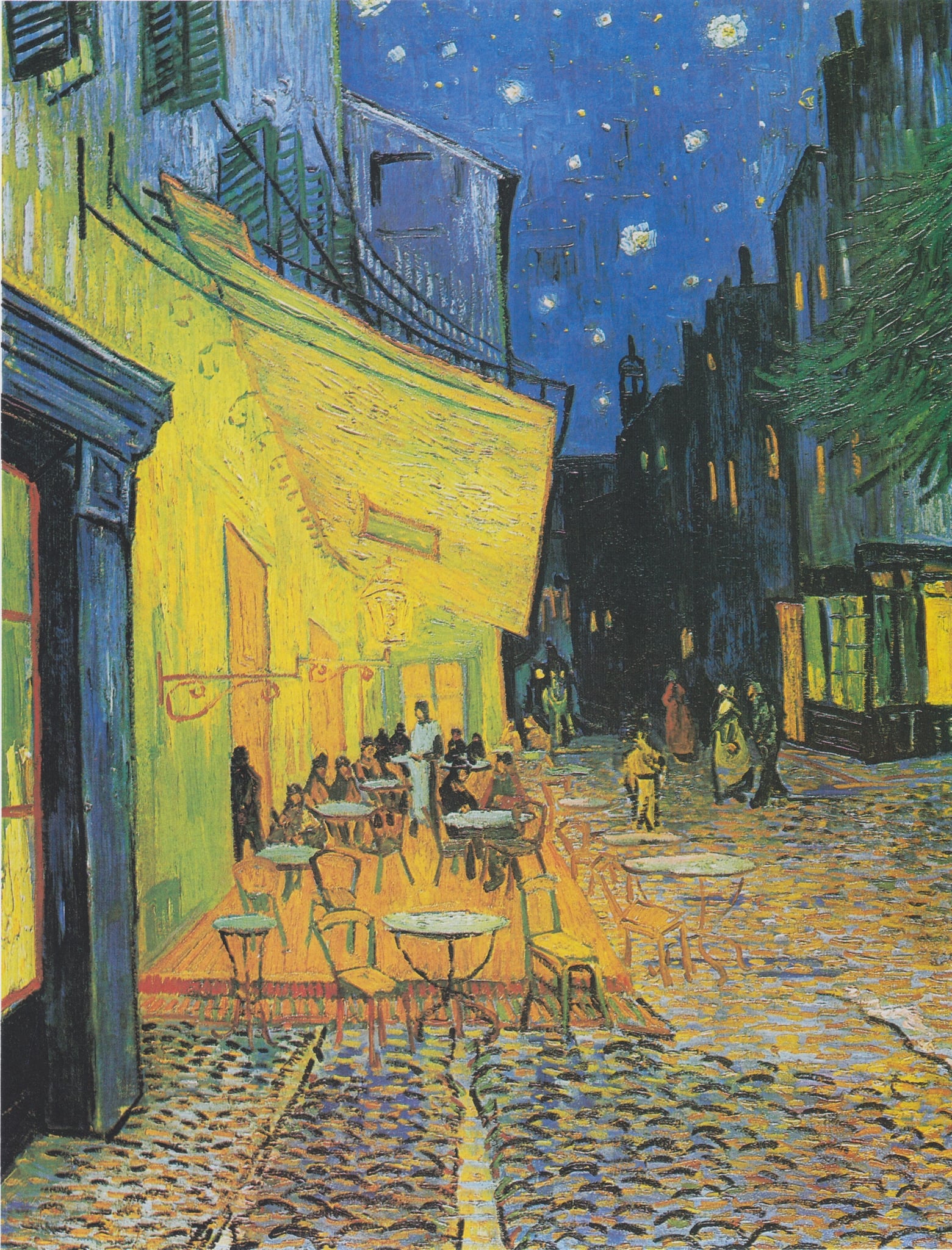
In Café Terrace at Night, Vincent van Gogh turns nocturne into <strong>luminous color</strong>: a gas‑lit terrace glows in yellows and oranges against a deep <strong>ultramarine sky</strong> pricked with stars. By building night “<strong>without black</strong>,” he stages a vivid encounter between human sociability and the vastness overhead <sup>[1]</sup><sup>[2]</sup>.
Red Cabbages and Onions by Vincent van Gogh

Red Cabbages and Onions

Vincent van Gogh (1887)

In Red Cabbages and Onions, Vincent van Gogh turns everyday produce into a drama of <strong>complementary color</strong> and <strong>restless brushwork</strong>. Hot red contours cinch violet cabbages and pale yellow bulbs against a cool, striated blue table, while a mustard‑yellow patch in the upper right tilts the space and sharpens the chromatic clash. The result asserts ordinary food as a locus of <strong>resilience</strong> and <strong>experimentation</strong> <sup>[1]</sup><sup>[2]</sup>.

Irises by Vincent van Gogh

Irises

Vincent van Gogh (1889)

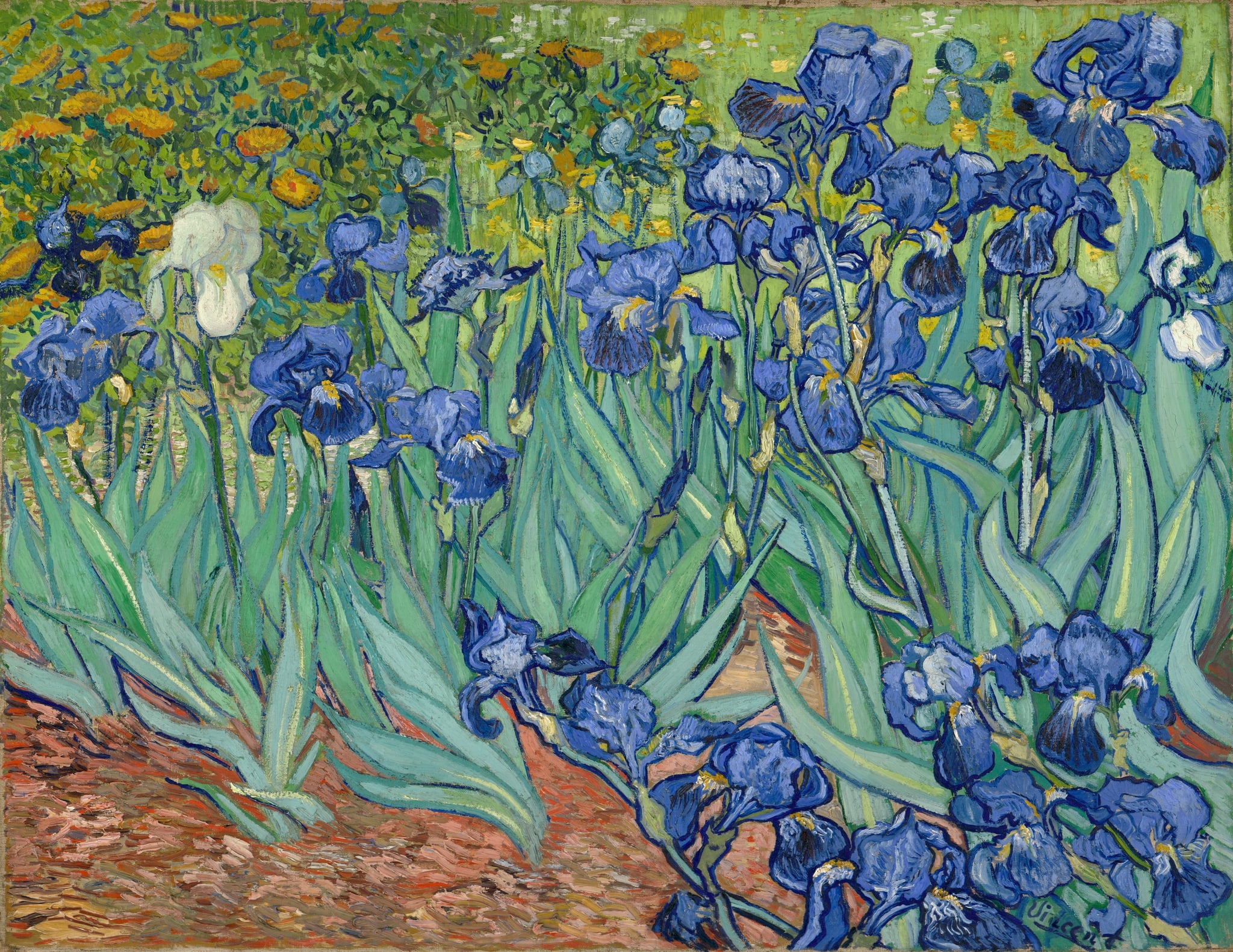
Painted in May 1889 at the Saint-Rémy asylum garden, Vincent van Gogh’s <strong>Irises</strong> turns close observation into an act of repair. Dark contours, a cropped, print-like vantage, and vibrating complements—violet/blue blossoms against <strong>yellow-green</strong> ground—stage a living frieze whose lone <strong>white iris</strong> punctuates the field with arresting clarity <sup>[1]</sup><sup>[2]</sup>.
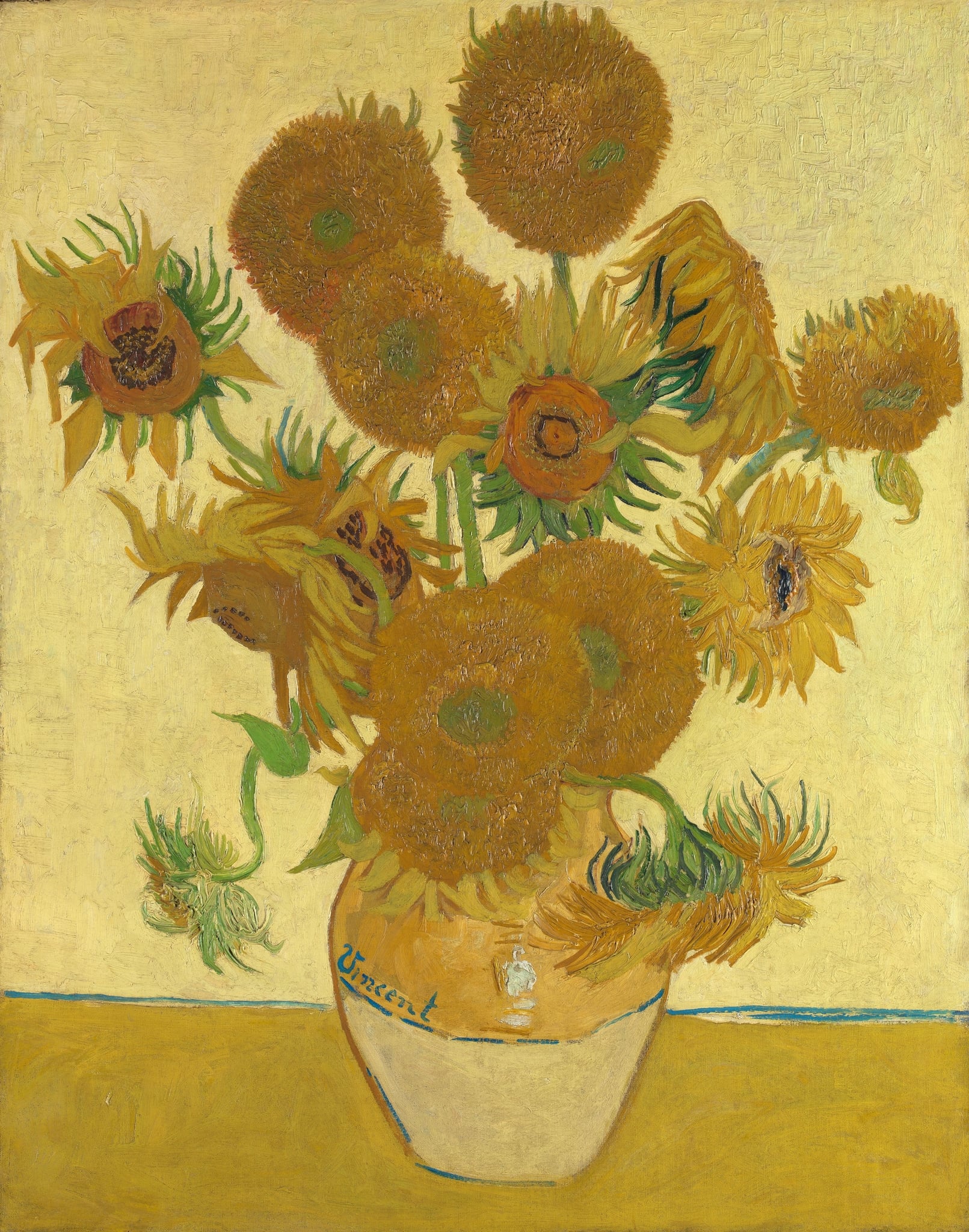
Sunflowers by Vincent van Gogh

Sunflowers

Vincent van Gogh (1888)

Vincent van Gogh’s Sunflowers (1888) is a <strong>yellow-on-yellow</strong> still life that stages a full <strong>cycle of life</strong> in fifteen blooms, from fresh buds to brittle seed heads. The thick impasto, green shocks of stem and bract, and the vase signed <strong>“Vincent”</strong> turn a humble bouquet into an emblem of endurance and fellowship <sup>[1]</sup><sup>[2]</sup>.

Garden with Courting Couples: Square Saint-Pierre by Vincent van Gogh

Garden with Courting Couples: Square Saint-Pierre

Vincent van Gogh (1887)

In Garden with Courting Couples: Square Saint-Pierre, Vincent van Gogh turns a small Montmartre park into a stage where <strong>spring</strong>, <strong>intimacy</strong>, and <strong>urban leisure</strong> converge. Short, shimmering strokes fuse pink chestnut blossoms, curving paths, and paired figures into one pulse of <strong>renewal</strong> and <strong>togetherness</strong> <sup>[1]</sup><sup>[2]</sup>.

In the Café: Agostina Segatori in Le Tambourin by Vincent van Gogh

In the Café: Agostina Segatori in Le Tambourin

Vincent van Gogh (1887 (Jan–Mar))

Van Gogh casts Agostina Segatori at a tiny, tambourine‑like café table, turning Le Tambourin into a <strong>stage of modern life</strong>. Cool greens and greys make the red <strong>flame‑plume hat</strong> and the foaming <strong>beer</strong> flare, while folded arms and a set‑aside <strong>parasol</strong> register private fatigue amid public display <sup>[1]</sup><sup>[2]</sup><sup>[3]</sup>.