Windows, screens, and how to look
Both artists teach modern habits of seeing shaped by glass, signage, and display. Warhol makes painting behave like media: serial, fast, and designed to circulate. Hopper makes painting a singular architecture of attention, built to slow looking and stage interior life through light and distance.
Comparison frame: How do Warhol and Hopper rewire painting for a world of windows and screens—one by turning images into repeatable inventory, the other by building one-off stages for attention?
Quick Comparison
| Topic | Andy Warhol | Edward Hopper |
|---|---|---|
| What a picture is | A reproducible image in a run (shelf, grid, strip). | A one-off stage for a precise, engineered moment. |
| Source and method | Photographic publicity, ads, and news; silkscreen and repetition. | Observed studies composited into an invented whole; oil painting. |
| Light as structure | Silver grounds and high-contrast screens echo the silver screen and print. | Fluorescent and electric light shape space, color, and mood. |
| Composition logic | Grids, stacks, and serial runs keep attention at the surface. | Frontal facades and thresholds regulate access and distance. |
| Viewer’s role | Scanner or shopper moving across a display. | Watchful outsider held at the window or aisle. |
| Experience of time | Fast, repeatable, and iterable; meaning in recurrence. | Slow, unrepeatable pause; meaning in a held instant. |
| Everyday modern subject | Branding, celebrity, catastrophe as media images. | Storefronts, interiors, signage, and urban quiet. |
| Installation/Display | Wall-to-wall serial display (Ferus logic). | Self-contained canvases like single theater frames. |
Shared Ground
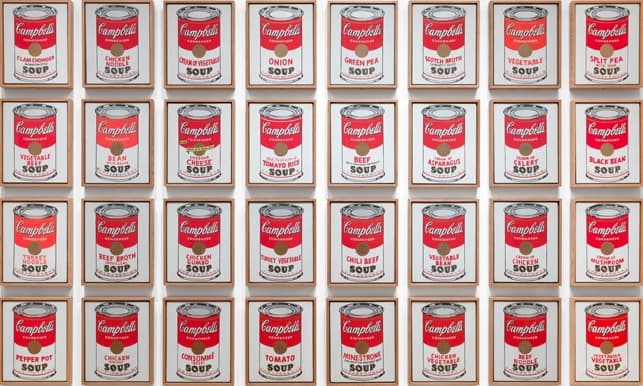
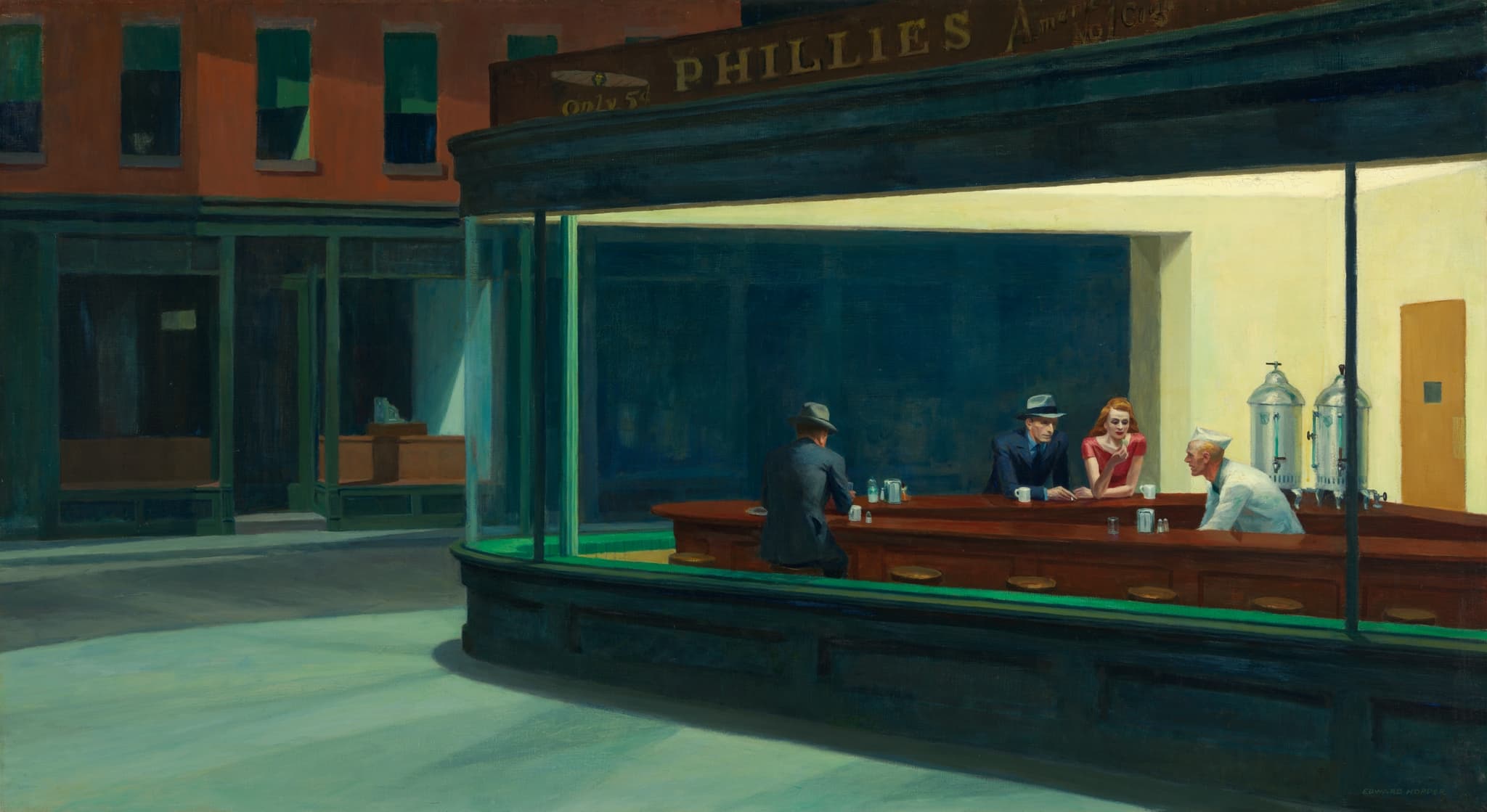
Warhol and Hopper meet on the ground of modern looking. Each treats painting as a lab for vision shaped by glass, signage, and screens. Hopper builds scenes framed by windows and thresholds that place us outside, looking in; a diner’s curved glass or a theater’s aisle makes spectatorship the subject. Warhol imports the already-public image—packages, stars, press photos—onto canvas and installs them in rows and runs, teaching us to scan laterally like shoppers or moviegoers. In both, composition regulates access and distance: Hopper often removes the obvious way in (the missing door of a famous diner), while Warhol’s grids, stacks, and repeats keep us at the surface of images meant to circulate rather than disclose interior life.
Artificial light is their shared instrument. Hopper’s fluorescent wash organizes space and feeling, from the green glow of a counter to the hush of darkened streets. Warhol’s silver grounds and high-contrast screens mimic cinema’s silver screen and the blunt legibility of print. Both convert ordinary modern culture into subject matter: Hopper turns a block of storefronts or a movie house into lucid, emptied architectures; Warhol turns a grocery label or a publicity still into a serial icon. Together they show painting’s unexpected adaptability to a world mediated by panes, bulbs, and broadcast—how pictures can model not only what we see but how we see it.
Decisive Difference
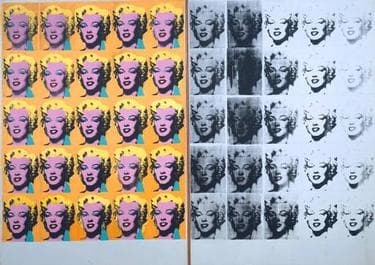
Warhol makes painting operate like a media machine. He chooses images already built for repetition—package labels, studio stills, wire photos—and screens them at life scale, then repeats them until aura itself becomes a question. In Campbell’s Soup Cans, variety is reduced to flavor text inside a fixed template; in Triple Elvis [Ferus Type], a star flickers across a silver field like a filmstrip; in Marilyn Diptych, color glamour erodes into monochrome attrition. The method foregrounds misregistration, ink clogs, and fading pulls as meaning: mechanical artifacts become the new touch. Display is part of the work—runs and grids installed edge to edge, asking us to read paintings as inventory, not windows. Seeing, in Warhol, is fast, flat, and serial, a lesson in how modern images circulate and persuade.
Hopper makes painting a one-off architecture of attention. He composites observed fragments into carefully adjusted spaces—enlarging a restaurant, subtracting a door, fine-tuning fixtures—so that vantage and light choreograph how we infer inner states. Early Sunday Morning distills a row of shops into a frontal, planar facade; New York Movie turns a theater’s half-light and usher’s posture into an ethics of looking; Nighthawks seals figures behind curved glass and fluorescent glare, making entry impossible and attention necessary. Cinema is Hopper’s subject but not his method: he paints its moods without surrendering painting to reproduction. Seeing, in Hopper, is slow and singular, a discipline of staying with one moment until architecture, light, and gesture disclose their pressures. Put simply: Warhol trains us to see as media sees; Hopper trains us to notice what media overlooks.
Paired Works
Storefront vs Shelf
Focus question: How do a row of emptied storefronts and a row of canned flavors convert looking into scanning?
Campbell's Soup Cans vs Early Sunday Morning
Cinema as Subject vs Cinema as Method
Focus question: What changes when a movie house is painted once, versus when a movie idol is printed in sequence?
Triple Elvis [Ferus Type] vs New York Movie
![Triple Elvis [Ferus Type]](/_next/image?url=https%3A%2F%2Fstorage.googleapis.com%2Fsite-images-programmatic%2Fpaintings%2F1771915343451-6gzg8m.jpg&w=3840&q=75&dpl=dpl_ASiQPiqukSad84i91Tcm2dUShHhL)
Sealed Room vs Endless Grid
Focus question: How do light and repetition shape presence in a single room versus across a wall of images?
Why This Comparison Matters
The comparison explains two durable ways contemporary culture asks us to look. Warhol anticipates the feed: images arrive preformatted, optimized for speed, meant to be scanned in series. He turns that fact into content, exposing how repetition manufactures belief and wears images out. Hopper counters with a discipline of attention. He composes cities and interiors that slow perception until light, thresholds, and posture start to speak. Each artist is persuasive because each is faithful to a different modern truth: life is mediated by systems of display, and yet experience still crystallizes in single, unrepeatable moments.
Learning to toggle between these modes matters now, when screens organize most seeing. Warhol sharpens literacy about circulation—how branding, celebrity, and catastrophe gain force by repeating. Hopper sharpens literacy about presence—how architecture and technology script feeling in a room. Reading them together equips viewers to navigate the present: to recognize the seductions of serial images and to defend the value of focused, time-rich looking.
Related Links
Sources
- MoMA Collection: Campbell's Soup Cans (1962)
- MoMA Slideshow: Warhol's Elvis paintings and silver grounds
- Smarthistory: Andy Warhol, Marilyn Diptych
- Whitney: Edward Hopper and New York
- Art Institute of Chicago: Nighthawks
- PBS American Masters: What's missing from Nighthawks
- MoMA Magazine: Warhol's 'machine' approach
- Walter Benjamin: The Work of Art in the Age of Mechanical Reproduction (MIT PDF)
- Whitney audio: Hopper and modern light
- MoMA Inside/Out: Serial/Singular—Warhol's Soup Cans installation
- MoMA Collection: Edward Hopper, New York Movie