Clarity that Withholds
Both painters use plainspoken realism, then make that very clarity fail at the crucial moment. Hopper tests how glass, light, and plan structure contact inside a believable scene. Magritte tests how images and words structure meaning inside a believable picture. Together they show that the most legible images can be the most withholding.
Comparison frame: How do Hopper’s staged architectures and Magritte’s staged obstructions use clarity to make seeing itself the subject?
Quick Comparison
| Topic | Edward Hopper | Rene Magritte |
|---|---|---|
| What their clarity tests | How real spaces regulate contact | How images and words construct meaning |
| Primary device | Architecture + light edited from observation | Deadpan staging + a single obstruction (text, veil, apple) |
| Nature of barrier | Optical/architectural: glass, corners, missing doors | Conceptual/representational: occlusions, inscriptions, picture-within-picture |
| World-building | Continuous, credible rooms; scale and plan adjusted for mood | Calm stage where one impossibility rewires the scene |
| Viewer’s role | Late passerby or eavesdropper pressed to the pane | Reader of a proposition parsing image, object, and name |
| Mass-culture borrowing | Cinema: noir angles, fluorescent glare | Advertising: caption-like layout, chart clarity |
| Typical effect | Psychological distance within believable space | Epistemic doubt about what an image can tell |
Shared Ground
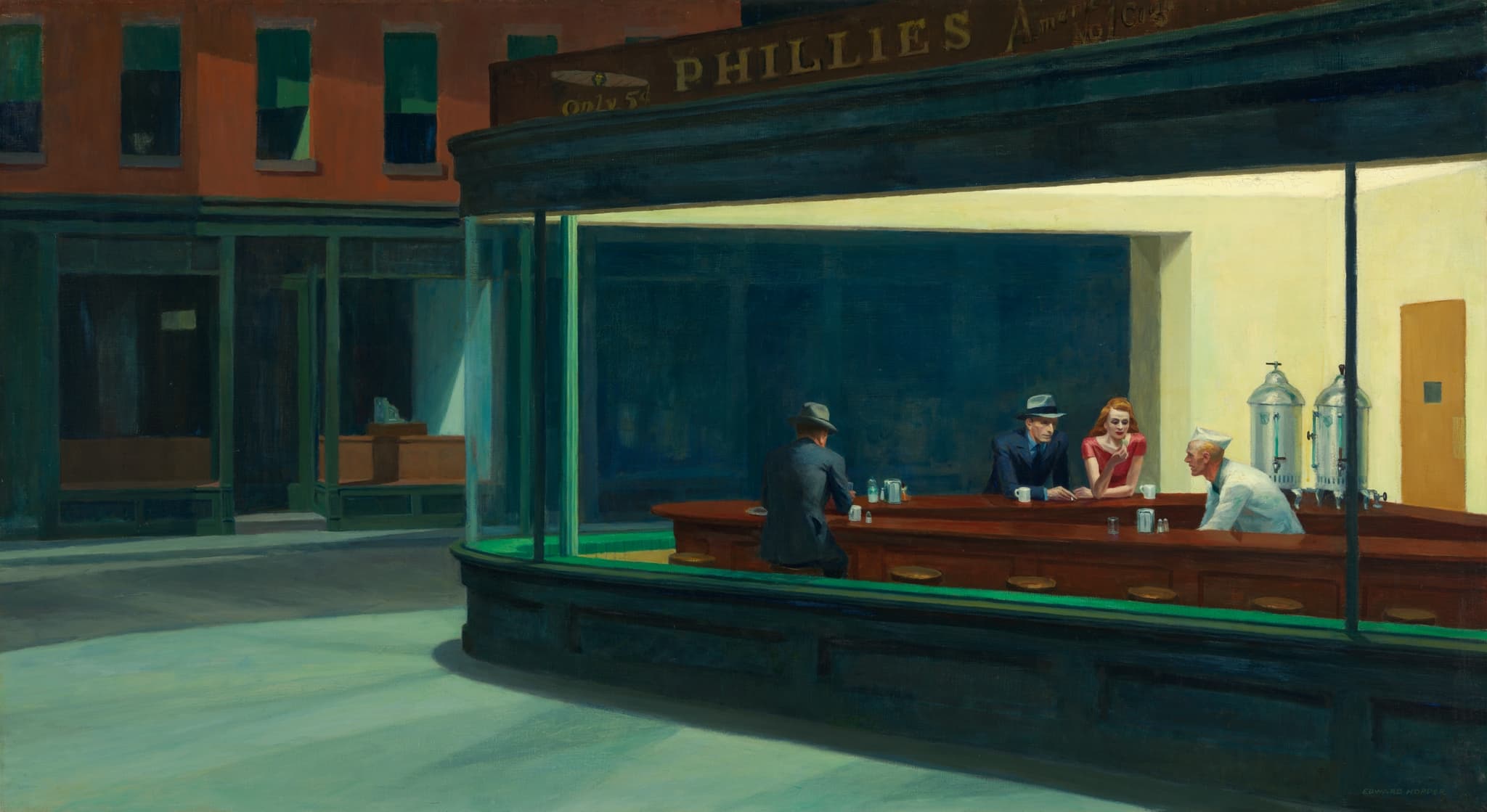
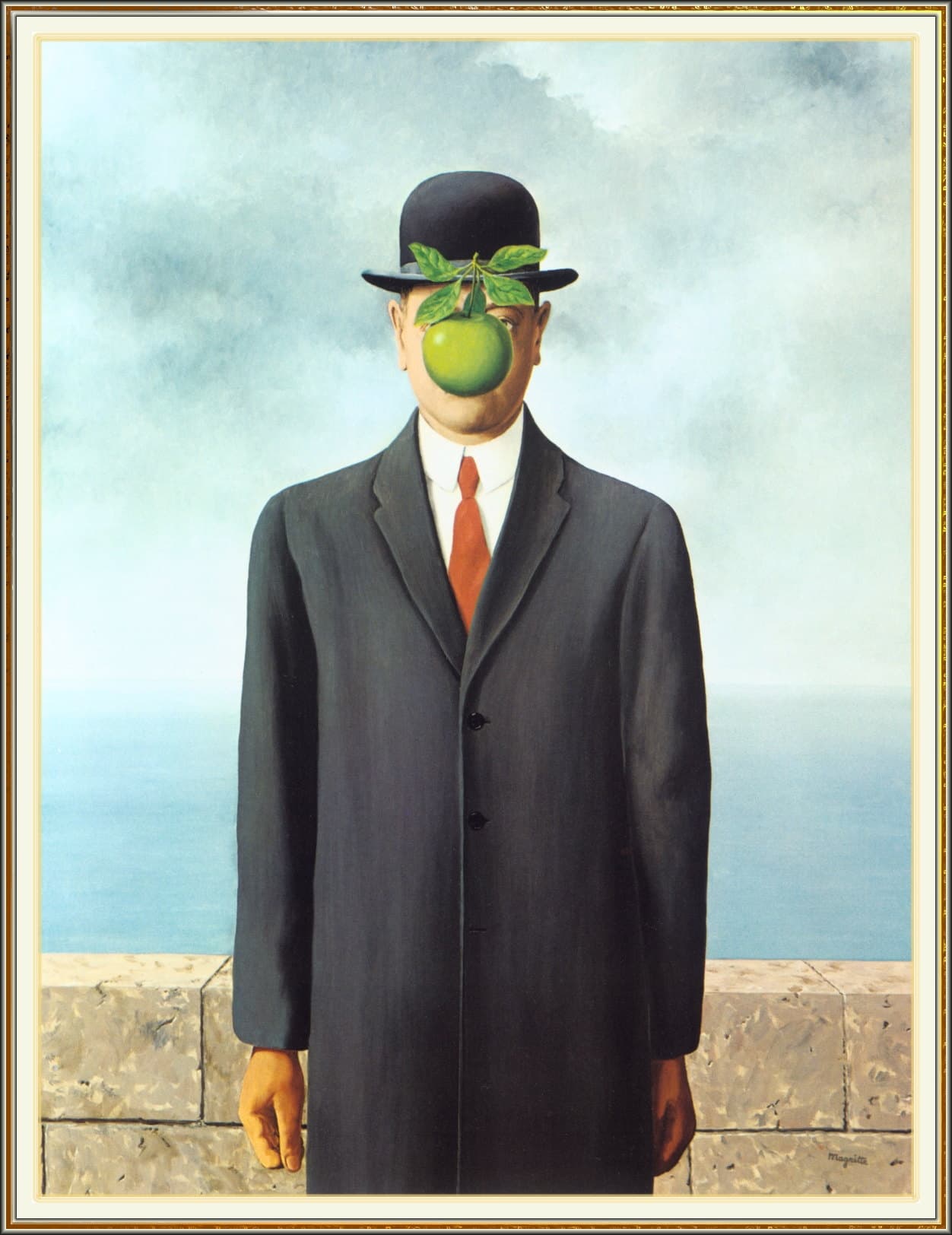
Hopper and Magritte meet on the ground of lucid realism used against itself. Their scenes are made from everyday parts—city corners, counters, bowler hats, apples—rendered with a clean finish that promises legibility. Then each artist converts that promise into a test of perception. Hopper engineers vantage, plan, and early fluorescent light so that seeing becomes a predicament. In Nighthawks the curved, seamless glass and the missing entrance bind four figures under a clinical glow while keeping the viewer outside. Everything is visible; access is not. Magritte similarly builds a plain stage and inserts a decisive obstruction. In This is Not a Pipe an ad-like image and a neat inscription refuse to coincide; in The Son of Man a hovering apple blocks a face; in The Human Condition a canvas before a window fuses the view with its depiction.
Both artists borrow mass-culture rhetorics to heighten this clarity: Hopper adapts cinema’s framing and nocturnal lighting; Magritte adopts the layout and captioning of advertisement. In each case the picture becomes a device for looking at looking. The worlds they depict are not chaotic but exact, pared, and still, so that the single pressure point—the glass, the caption, the apple—carries philosophical weight. The shared ground is a lucid strangeness of the ordinary: when everything is in focus, what remains unreachable? Their paintings answer by staging impediments to contact and knowledge inside images that seem, at first, to explain everything.
Decisive Difference
Hopper treats painting as an observational construction. He builds credible space from real light, plan, and vantage, then edits scale and layout to intensify mood without breaking the world’s continuity. The physics hold; the edits clarify. In Nighthawks he enlarged the restaurant, sealed the corner with glass, and flooded the counter with greenish fluorescent light so the room governs behavior. Barriers are architectural and optical: glass, length of counter, angles of bodies. The viewer’s position—like a late passerby—is ethical as much as visual: you can watch, not join. His drawings show how figures, fixtures, and street cuts were tuned until the scene felt inevitable. Hopper’s clarity is a phenomenology of shared space: how proximity, light, and plan shape what contact can be.
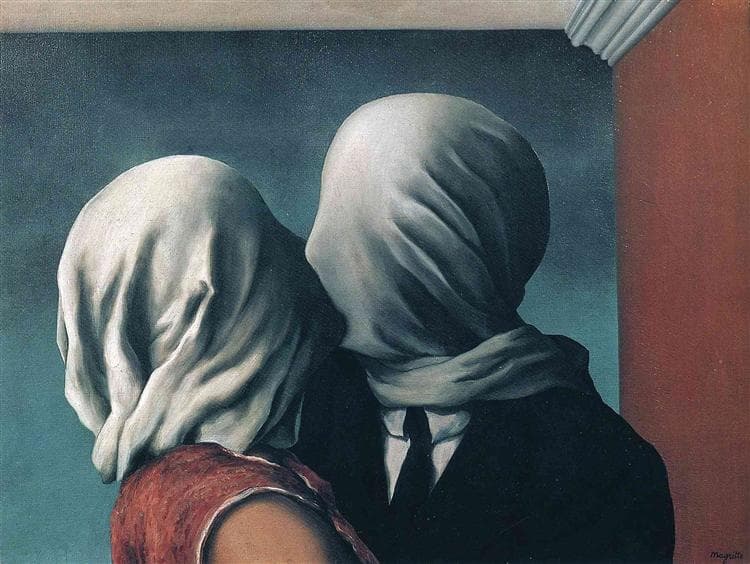
Magritte treats painting as a proposition about representation. He builds a calm, neutral stage and inserts a single device that separates image, word, and thing. This is Not a Pipe states, with deadpan authority, that depiction is not identity; The Human Condition collapses window and canvas to show how “the view” may already be a picture; The Lovers and The Son of Man assert that visibility may conceal. The barrier is categorical—between seeing and knowing—rather than spatial. The viewer becomes a reader of rules: what does a picture mean when it tells you it is not what it shows? Put simply: Hopper tests how we inhabit a real scene; Magritte tests how pictures and language make any scene mean.
Paired Works
Intimacy Made Opaque
Focus question: How do architecture and veils make closeness unreadable?
What a Face Can Give
Focus question: When a face is present or blocked, what kind of information are we offered?
The Window’s Job
Focus question: Is a window for seeing someone, or for proving how pictures work?
Room in New York vs The Human Condition
Why This Comparison Matters
This pairing clarifies two durable modern questions. First: how does clarity—bright light, crisp edges, familiar objects—shape our access to other people? Hopper’s answer is spatial and ethical: architecture and illumination organize contact, often limiting it. Second: how do pictures and words produce meaning in the first place? Magritte’s answer is categorical: image, name, and thing never coincide, and visibility can conceal. Seeing these answers side by side shows why mid‑century art moved confidently between realist description and conceptual demonstration. It also equips viewers for contemporary media, where cinematic framings and ad‑like captions still promise legibility while steering interpretation. Hopper trains us to notice the terms of entry into a scene; Magritte trains us to question whether the scene, or its caption, is what it appears to be. Together they offer a calm, precise toolkit for looking—at paintings, photographs, screens, and city life.
Related Links
Sources
- Art Institute of Chicago, Nighthawks (curatorial entry)
- Art Institute of Chicago, Nighthawks microsite (cinematic framing, light, process)
- Whitney Museum of American Art, Study for Nighthawks
- LACMA, René Magritte, The Treachery of Images
- Encyclopaedia Britannica, The Treachery of Images (Foucault’s calligram reading)
- MoMA, René Magritte, The Lovers
- National Gallery of Art, The Human Condition
- SFMOMA, Magritte: The Fifth Season (bowler-hatted figure as alter ego)