Two modern classicisms, two engines of construction
Cézanne and Seurat both replace Impressionist spontaneity with systems that make everyday subjects legible and monumental. Each treats color as structure and classicizes modern life—bathers, landscapes, and leisure—by subordinating anecdote to order. The decisive split lies in the unit and temporality of construction: Cézanne’s planes compress time spent looking; Seurat’s points and contours enforce an optical, measured stillness.
Comparison frame: How do Cézanne’s planes and Seurat’s points each teach us to build what we see?
Quick Comparison
| Topic | Georges Seurat | Paul Cézanne |
|---|---|---|
| Constructive unit | Short, planar strokes; warm–cool planes articulate volume. | Divisionist touches (points/dashes) for optical mixture; firm contours. |
| How time enters | Sequential looking compressed into one surface; purposeful “misalignments.” | Moment held in designed stillness; frieze layouts unify time. |
| Color’s job | Warm–cool modulation builds form; color equals structure. | Complementaries and optical mixture intensify light; borders tune the field. |
| Compositional grammar | Interlocking planes; architectonic figure–landscape (Bathers). | Friezes, profiles, measured spacing (Asnières, La Grande Jatte, Sideshow). |
| Typical subjects | Still life, bathers, Mont Sainte‑Victoire as labs of perception. | Leisure, riverbanks, circuses—modern tableaux of order. |
| Proof of method | IR shows planned tilts in The Basket of Apples; serial Sainte‑Victoire. | Re‑dotting Asnières; painted dot‑borders on La Grande Jatte, Gravelines. |
| Legacy | Catalyst for Cubism: planes become analytic structure. | Neo‑Impressionism: optical law shaping design and later abstraction. |
Shared Ground
Cézanne and Seurat share a program: turn painting into a system for seeing, not a transcript of events. They monumentalize ordinary subjects—bathers, quiet leisure, still life, landscape—by suppressing anecdote and installing a lucid order. Both borrow classical devices to stabilize the modern: Seurat’s profile poses and friezes confer sculptural poise on suburban banks and fairground stages; Cézanne’s bathers and trees interlock as an architectonic vault, a measured rite rather than a story. In each case, time is stilled into relations that can be read, compared, and tested.
Color is the structural medium for both. Seurat constructs light through divisionism: discrete touches of near‑complements laid side by side, calibrated to mix in the eye, and, when needed, tuned by painted borders that bring the entire field into optical accord. Cézanne builds solidity from calibrated warm–cool shifts and a constructive brushstroke, letting planes of color articulate volume without theatrical chiaroscuro. The effect in each is not decor but order: hue becomes geometry.
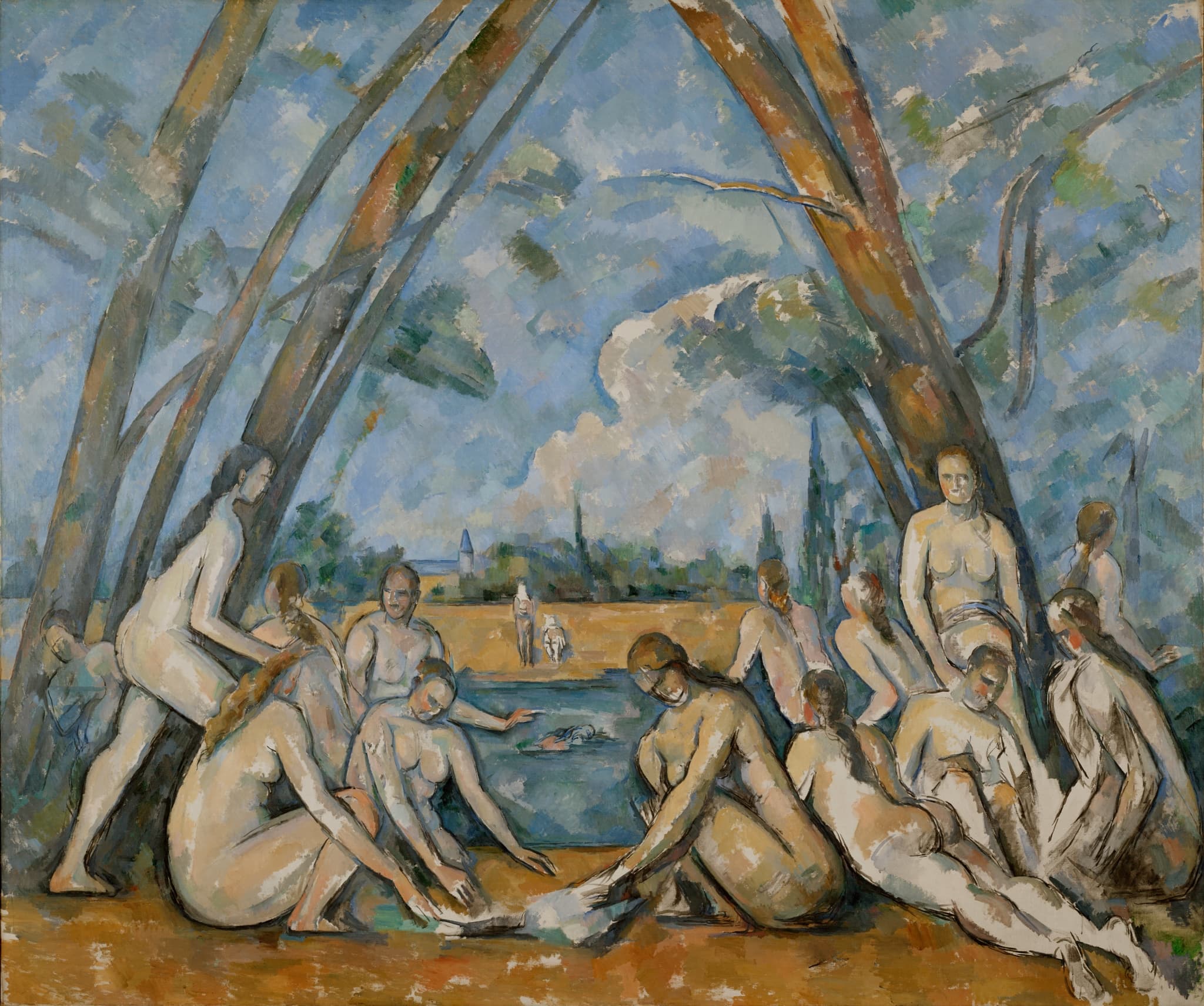
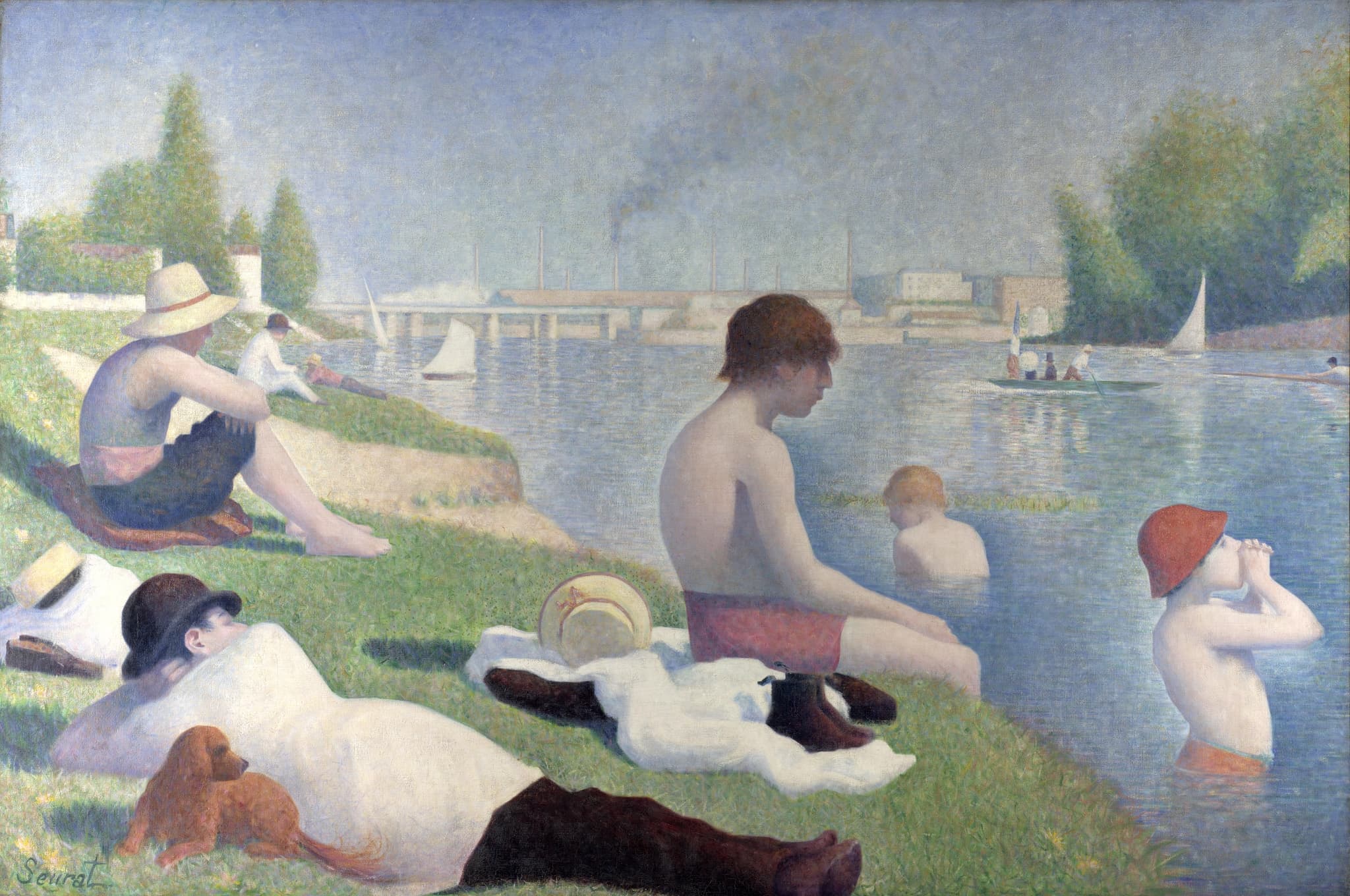
Compare Cézanne’s Bathers—bodies and trees forming a triangular canopy—with Seurat’s Bathers at Asnières—workers arrayed as a poised frieze against bridges and chimneys. Or match Mont Sainte‑Victoire to Seurat’s Gravelines seascape: each turns nature into a legible structure. In stillness and scale, both artists offer a modern classicism: grounded, empirical, and committed to clarity over anecdote.
Decisive Difference
The decisive difference is the constructive unit and the kind of time each unit admits. For Cézanne, the basic unit is the plane—laid by short, faceted strokes and stabilized by warm–cool modulations. Planes are how perception is built: edges tilt, viewpoints drift, and small disagreements are kept in play so the canvas can compress sequential looking into a single, durable order. Conservation imaging of The Basket of Apples confirms that the leaning bottle and misaligned tabletop were set from the outset; they are not errors but a record of seeing assembled over time.
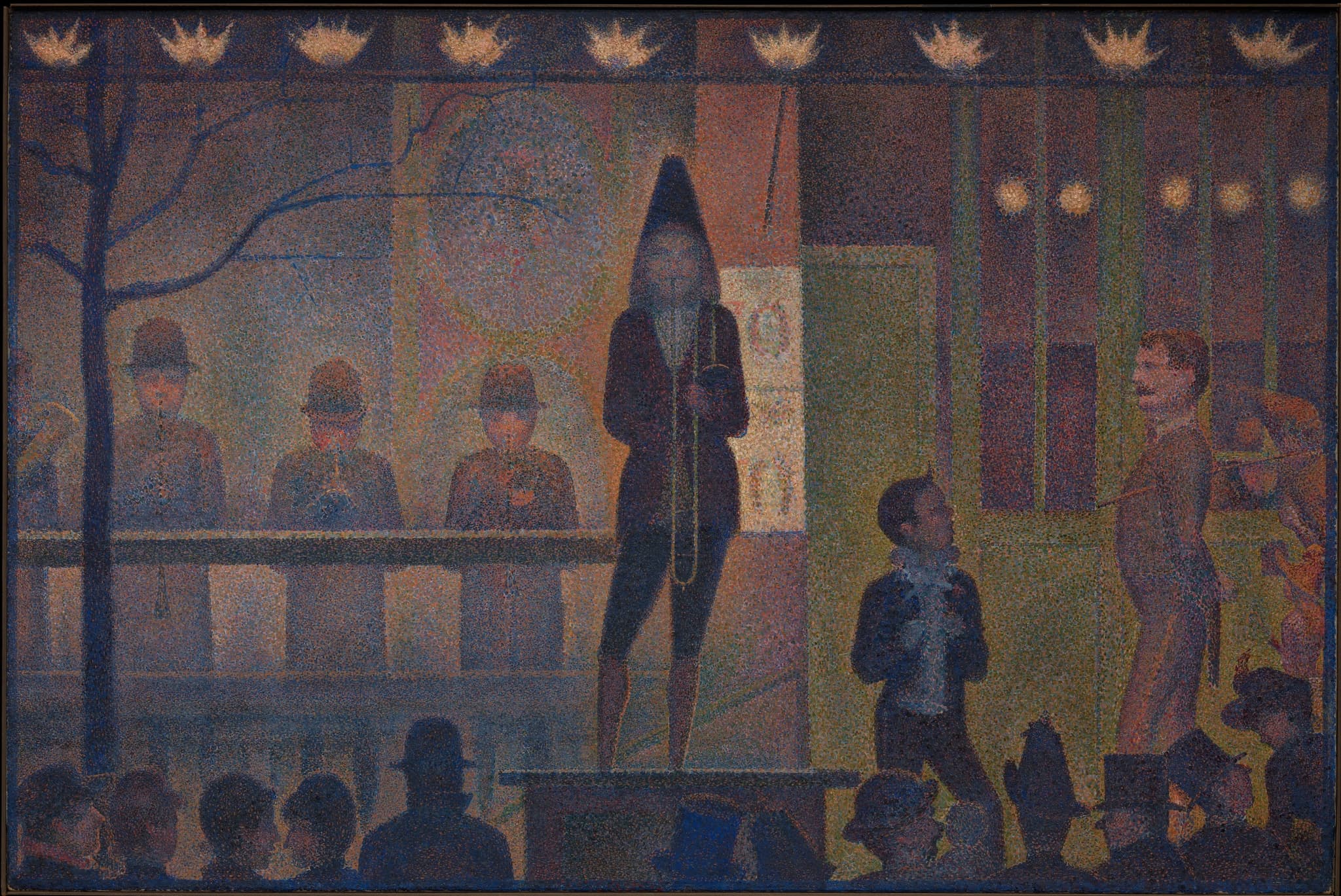
For Seurat, the unit is the discrete touch—points and small dashes—governed by optical law. He composes for the eye’s mixture of complements, then regularizes the whole with frieze designs and, where needed, painted dot‑borders. The result is a cooled, measured stillness: Bathers at Asnières and Circus Sideshow hold figures like reliefs under a continuous, tuned light. Even after finishing, Seurat could return to a large canvas to re‑dot passages and adjust borders to bring the entire field into optical equilibrium.
Put simply: Cézanne tests perception as lived construction; Seurat tests vision as optical grammar. Cézanne’s planes invite time to accumulate; Seurat’s points and contours suspend time in a designed now. That is why Cézanne becomes the wellspring of Cubism’s analytic planes, while Seurat anchors Neo‑Impressionism’s ideal of scientific color married to classical design.
Paired Works
Same subject, opposite engines: Bathers
Focus question: What changes when bathers are built by color‑planes rather than color‑points?
Bathers by Paul Cézanne: Geometry of the Modern Nude vs Bathers at Asnières
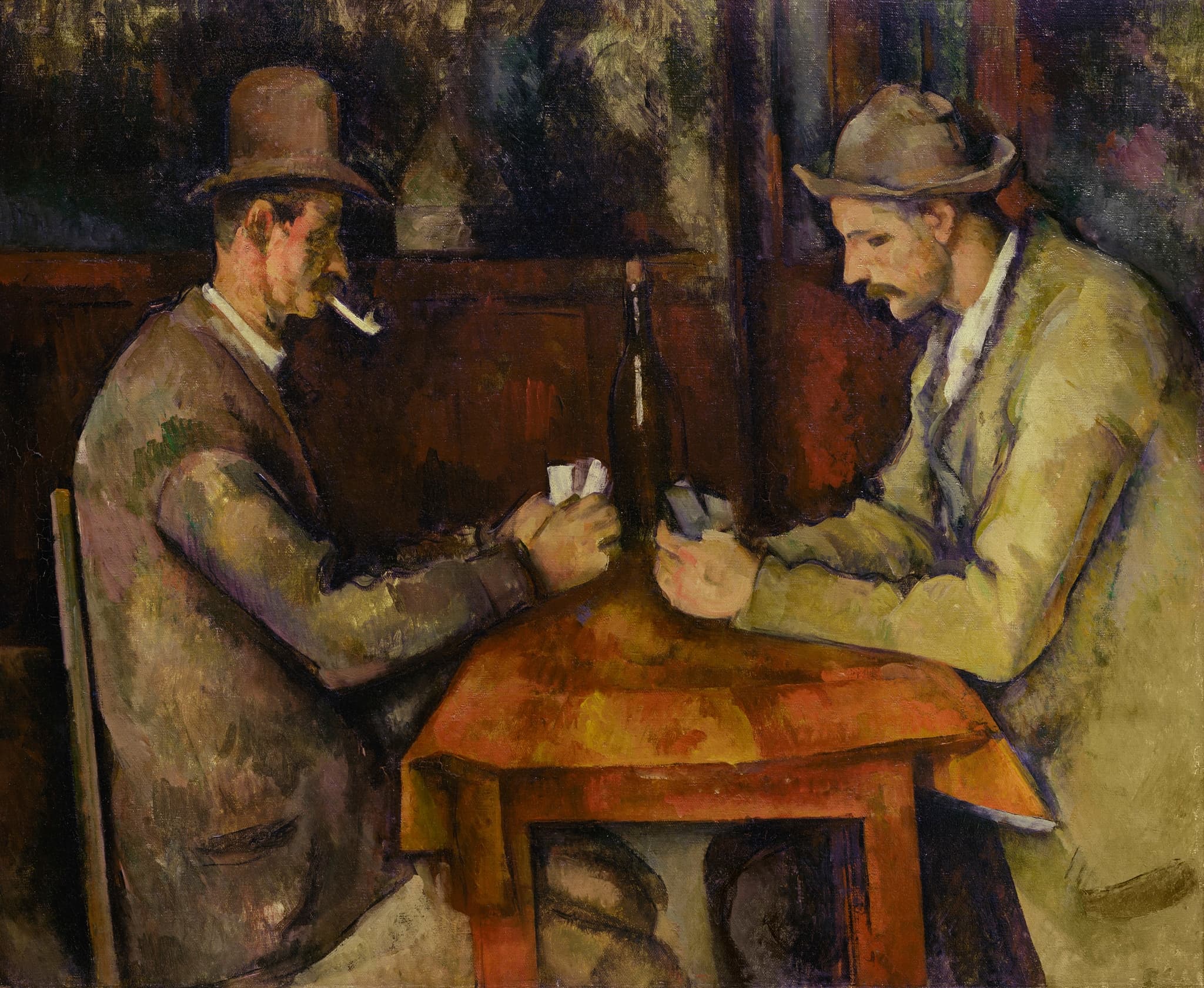
Rituals of attention: café table vs sideshow stage
Focus question: How do facture and lighting shape concentration in ordinary leisure?
The Card Players by Paul Cézanne | Equilibrium and Form vs Circus Sideshow (Parade de cirque)
Landscape engineered
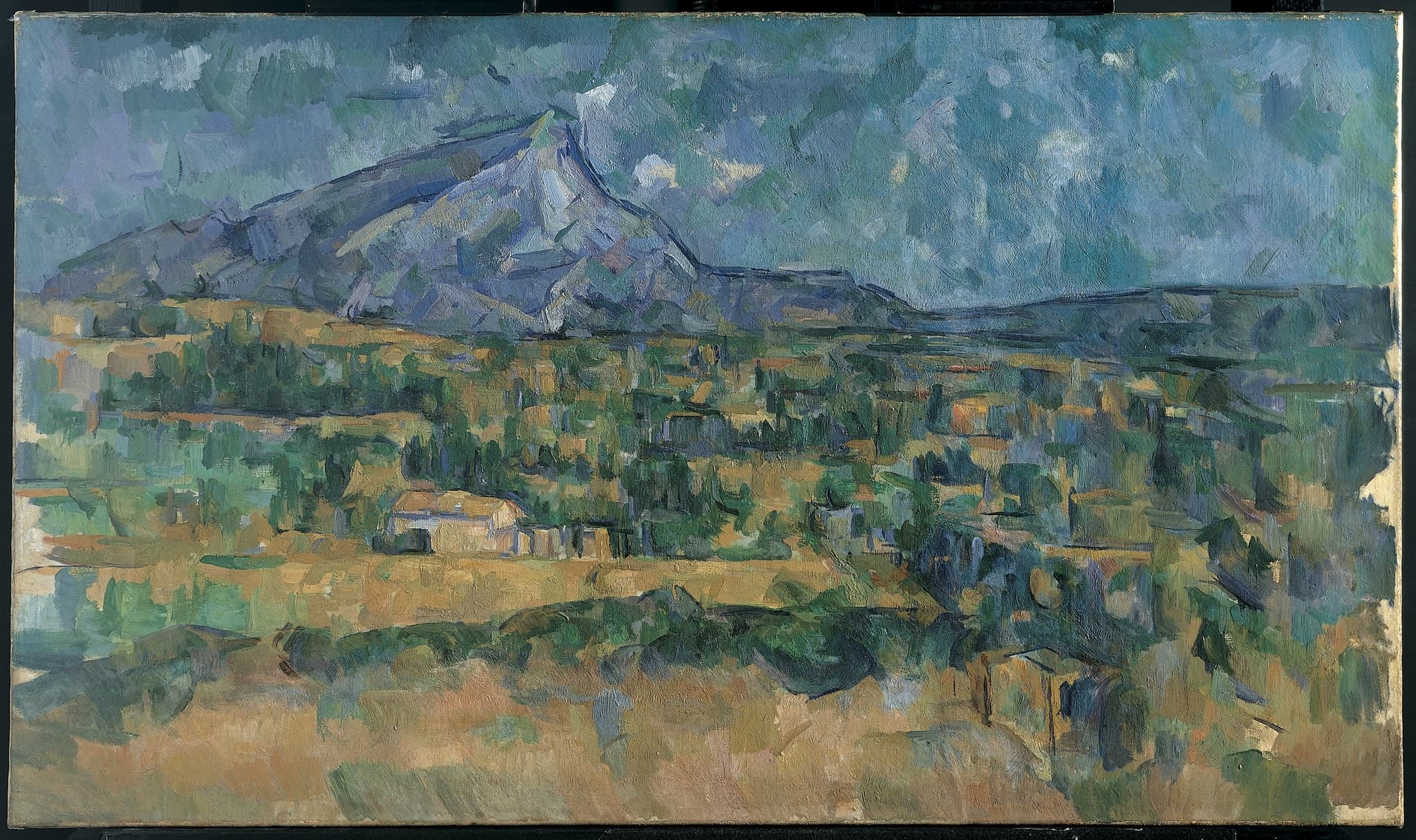
Focus question: How does each painter turn nature into a legible system?
Mont Sainte-Victoire vs The Channel of Gravelines, Grand Fort-Philippe
Why This Comparison Matters
This pairing clarifies two durable models for modern painting. Cézanne shows how a picture can be built from the act of looking itself: planes and warm–cool shifts compress successive glances into a single, stable order. Seurat shows how a picture can be built from a grammar of optics and design: discrete touches, complements, and frieze compositions yield a poised, unified field.
Those choices ripple forward. Cézanne’s constructive planes become the scaffolding of Cubism, where volumes are analyzed and reassembled. Seurat’s chromatic and compositional discipline anchors Neo‑Impressionism and informs later ideas of visual design—from color theory in studios to the measured poise of graphic modernism. For a reader wondering “who sees the world more clearly,” the answer is that clarity takes different forms: Cézanne’s is phenomenological and time‑rich; Seurat’s is optical and law‑bound. Knowing the difference lets you read both artists—and much of 20th‑century art—with sharper eyes.
Related Links
Sources
- Art Institute of Chicago, Seurat and the Making of La Grande Jatte
- National Gallery (London), Bathers at Asnières
- National Gallery Technical Bulletin 24 (2003), Seurat’s Painting Practice
- Art Institute of Chicago, A Harmony Parallel to Nature (IR evidence for Cézanne)
- National Gallery Technical Bulletin (2008), Ways of Making in Cézanne’s Paintings
- The Met, Seurat’s Circus Sideshow (exhibition/object entries)
- Philadelphia Museum of Art, Mont Sainte‑Victoire
- The Met, Cubism Essay
- National Galleries of Scotland, Pointillism/Divisionism
- Maurice Merleau‑Ponty, Cézanne’s Doubt