Color as Order vs Color as Memory
Both reinvent painting as a mental space built by color. Matisse uses color to construct present‑tense harmony, while Chagall turns it into the aura of remembered life, stacking ritual and myth inside one frame. Seen together, they show how modern color can be either an ordered system or a vessel for memory.
Comparison frame: How do Matisse and Chagall turn color into a way of seeing—one as ordered harmony, the other as living memory?
Quick Comparison
| Topic | Henri Matisse | Marc Chagall |
|---|---|---|
| Core purpose of color | Aura of memory and faith; color marks presence and devotion | Constructs a self‑sufficient order of relations among hues |
| How space is built | Montage and anti‑gravity; vignettes embedded within forms | Flat planes and drawn reserves organize a level, rhythmic field |
| Sense of time | Layered, mnemonic simultaneity; past and present cohabit | Present‑tense calm; studio time suspended and clarified |
| Role of the figure | Emissaries/guardians (fiddler, villagers) carry communal memory | Identity staged through chromatic masks and arabesque contour |
| Music as model | Klezmer fiddler as spiritual and social binder | Dance/Music reduce sound to planar chords and rhythm |
| Self‑portrait by other means | Village as narrative self‑portrait (I and the Village) | Studio as mental map and absent self (The Red Studio) |
| Use of avant‑garde devices | Cubist/Orphic facets bent to story and belief | Fauvist saturation refined into decorative‑structural clarity |
Shared Ground
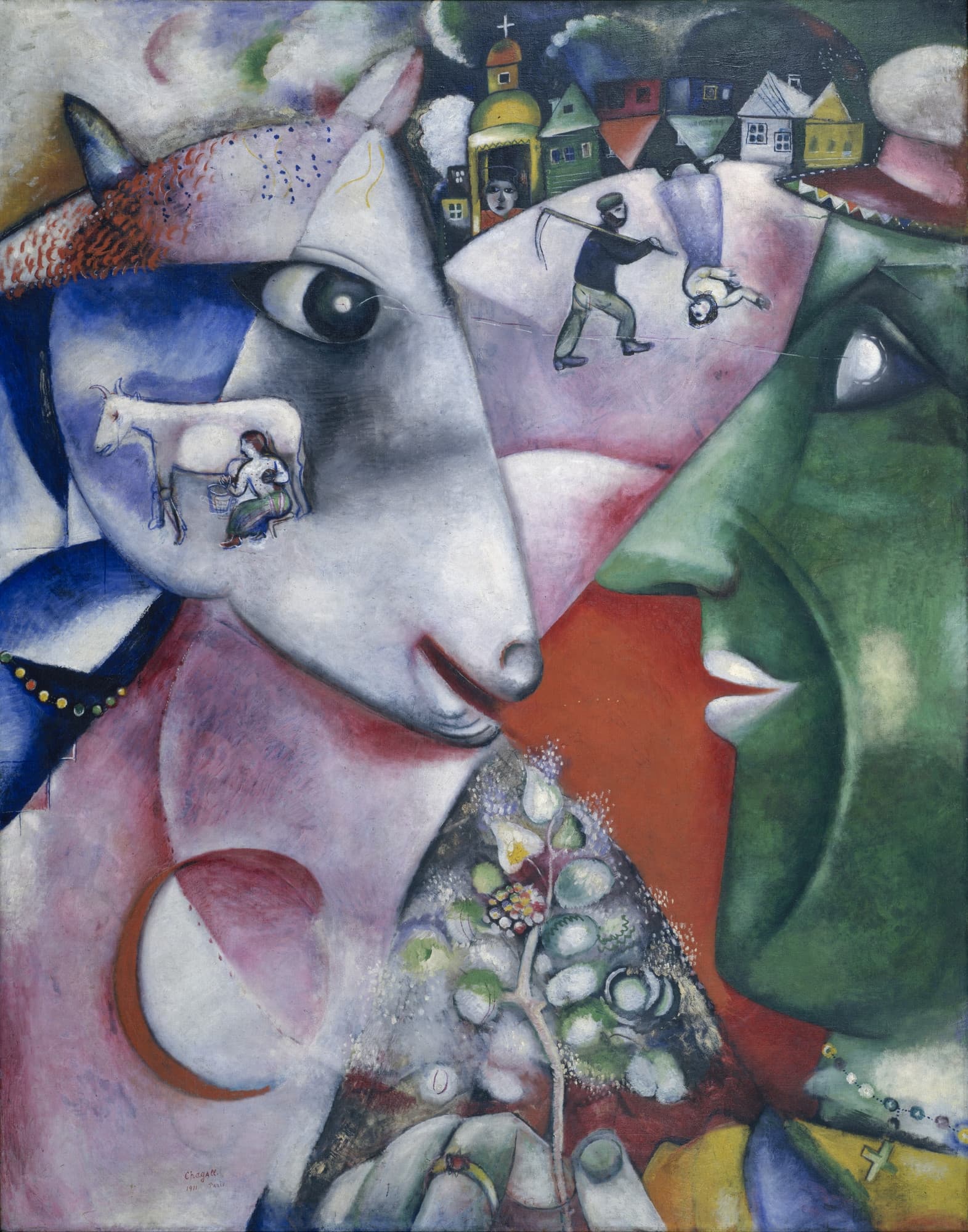
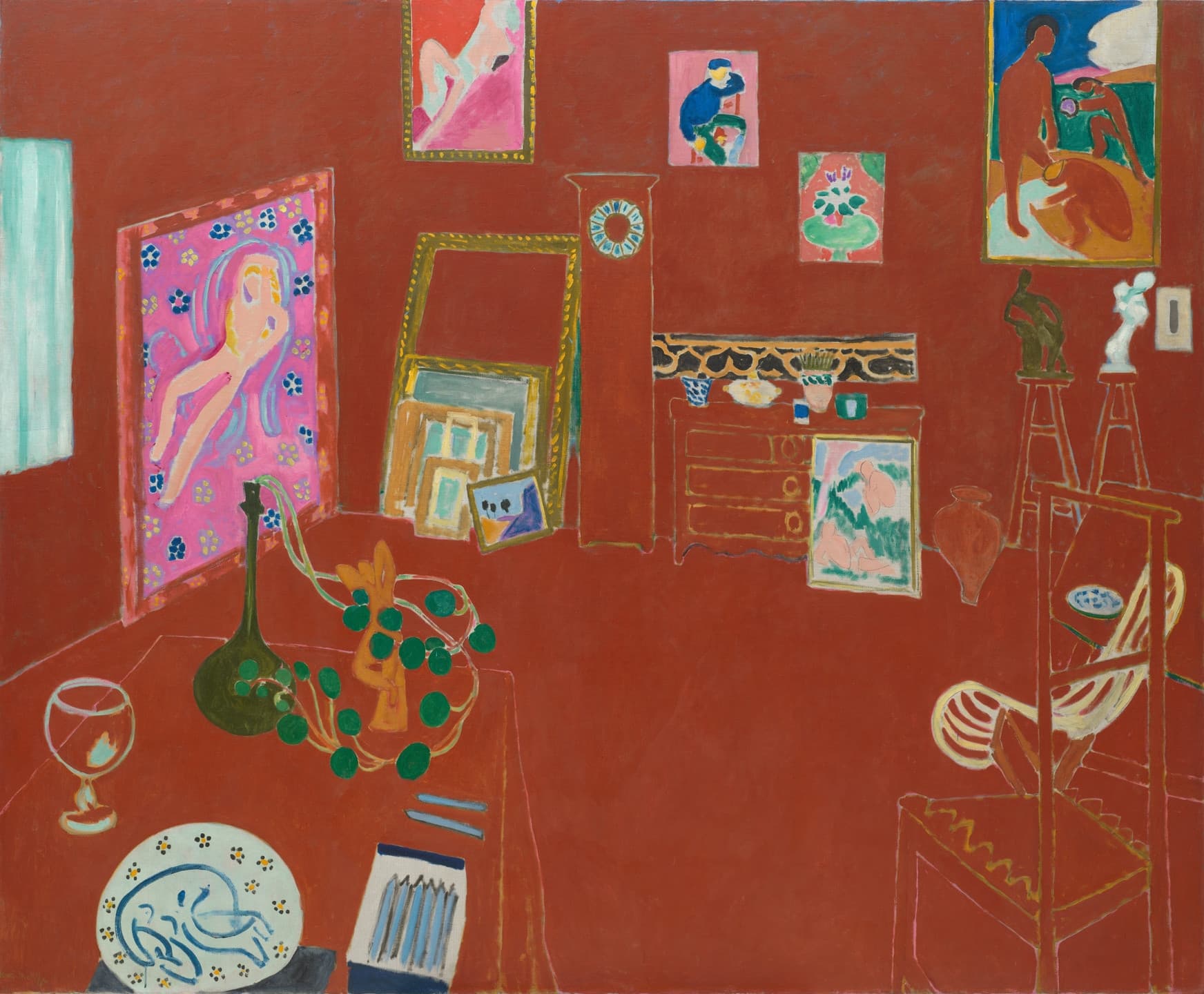
Both artists treat color not as garnish but as the main builder of pictorial reality. In Henri Matisse’s The Red Studio (1911), a continuous red field collapses walls, floor, and furniture into a single chromatic atmosphere; line survives as slender, unpainted edges that read like drawing. In Marc Chagall’s I and the Village (1911), prismatic greens, whites, and reds knit together a pact between villager and animal, while floating figures and embedded scenes compress lived experience into one tableau. In each case, color organizes how the eye moves and how the mind understands the scene.
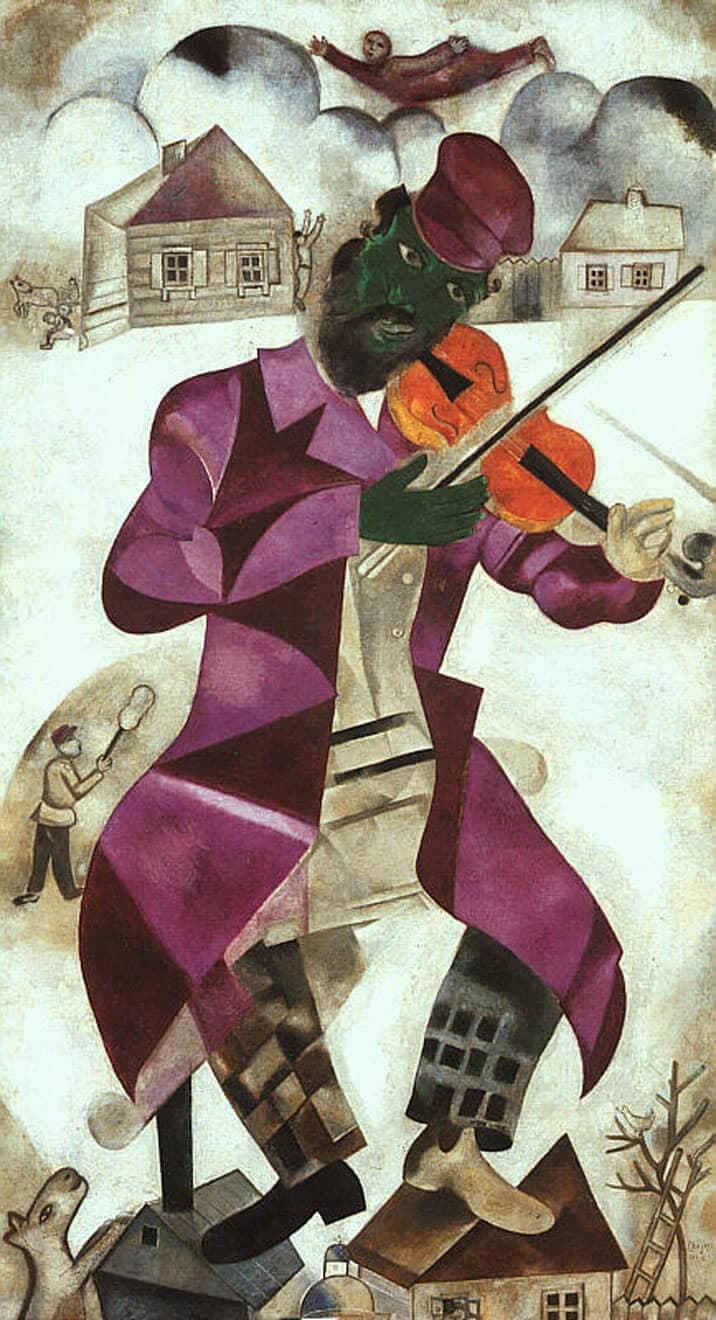
Both also recast painting as a mental or musical space. Matisse thematizes this overtly in large commissions such as Dance and Music, where simplified bodies and chords of red, green, and blue define rhythm rather than narrative detail. Chagall turns the klezmer fiddler into a generative force: in The Green Violinist (1923–24), music literally spans rooftops, binding community and season. Perspective, in both hands, yields to experience—Matisse to a serene, calibrated equilibrium inside the studio; Chagall to dream‑logic simultaneity in and above the village. The result is a shared conviction that painting can stage time and feeling directly, with color as the instrument that carries both structure and sensation.
Decisive Difference
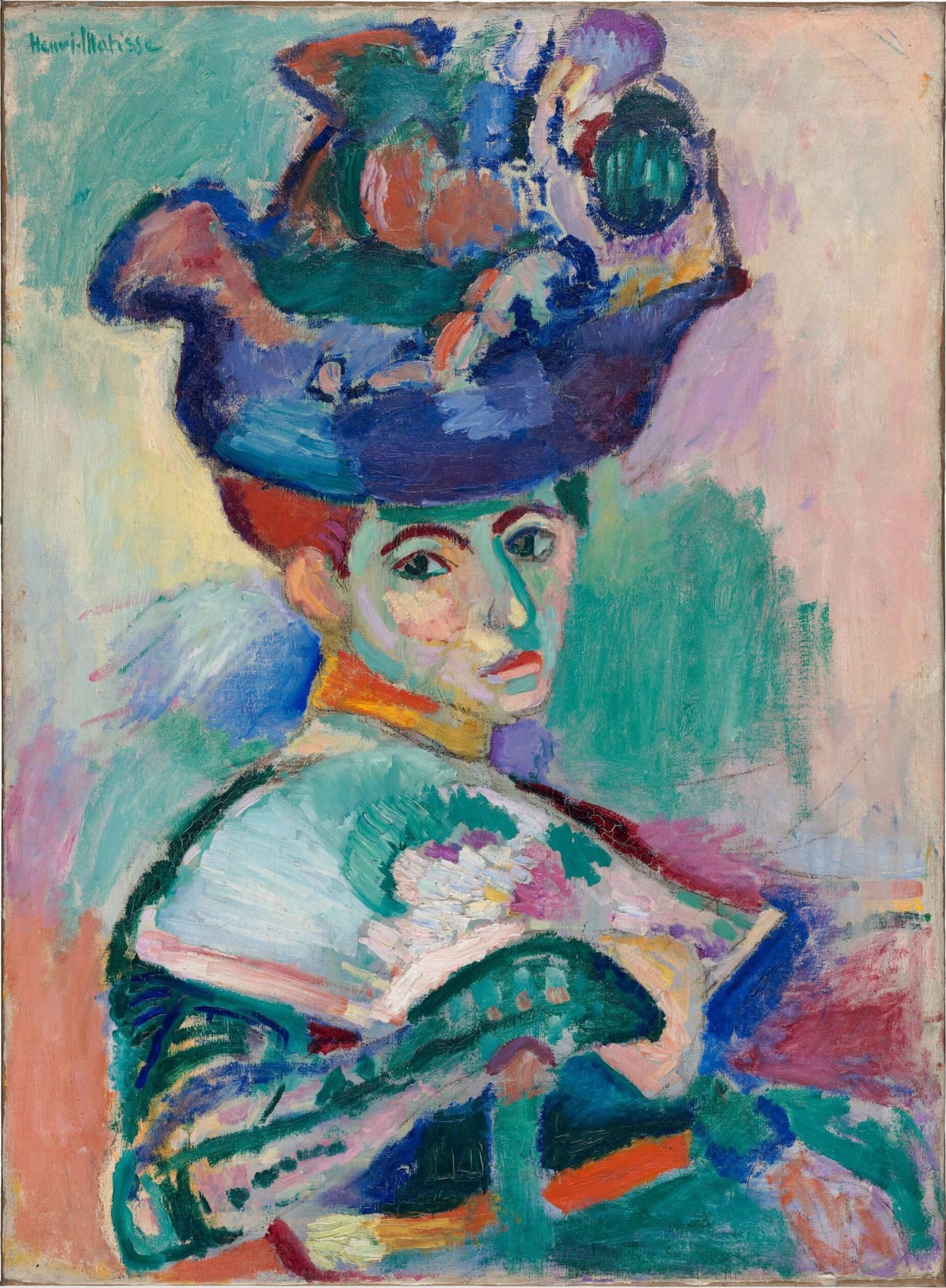
Their split lies in what color is asked to do. For Matisse, color constructs an autonomous, present‑tense order. The Red Studio confirms this at every turn: the red was applied late, submerging an earlier, more conventional room so that furniture and architecture persist as delicate reserves. The artworks inside the painting keep their distinct palettes, asserting art’s primacy over ordinary space; a handless clock freezes time. Even in a portrait like Woman with a Hat (1905), chromatic wedges model identity as a public stance, not a psychological excavation. Color’s job is to establish relations that make the picture cohere and calm, independent of description.
For Chagall, color radiates memory and belief. In I and the Village, a green‑cheeked face, an animal’s inner vignette, and anti‑gravity figures visualize a simultaneity of labor, ritual, and affection. The Green Violinist amplifies this logic: the fiddler’s non‑natural green is an aura, a guardian presence that bridges earth and sky while Cubist/Orphic facets vibrate to his rhythm. Chagall absorbs avant‑garde structure but redirects it toward narrative devotion—the picture becomes a mnemonic icon where times and places coexist. In brief: Matisse remakes seeing as harmony among colors in the present; Chagall remakes seeing as a layered chorus of memory, myth, and everyday ritual.
Paired Works
1911: Studio order vs village simultaneity
Focus question: What changes when color replaces description in the same year?
I and the Village vs The Red Studio
Faces that aren’t flesh
Focus question: Does unnatural color describe a person or a stance?
The Green Violinist vs Woman with a Hat
Painting like music
Focus question: How does music organize space?
Why This Comparison Matters
Setting Matisse beside Chagall clarifies two durable models for modern painting. One asks color to build an autonomous order that the viewer inhabits as a present tense; the other asks color to carry layered memory so that the viewer reads a lived world across time. This is more than a stylistic split. It maps different ethics of looking: Matisse trains attention on relations within the picture, where clarity and balance are the truth being offered; Chagall invites recognition across fragments, where belief and recollection hold a community together.
Seeing these logics at work helps decode much twentieth‑century art. Fields of near‑monochrome, decorative cadence, and studio scenes owe a debt to Matisse’s constructive color. Montage, symbolic palettes, and floating figures that refuse linear perspective extend Chagall’s mnemonic space. The comparison equips viewers to ask a sharper question of any painting that prioritizes color: Is this color making a world to dwell in now, or is it summoning a world remembered?
Related Links
Sources
- MoMA: Marc Chagall, I and the Village (object page)
- MoMA: Henri Matisse, The Red Studio (object page)
- MoMA Magazine: Discovering The Red Studio (2022 conservation study)
- MoMA: Henri Matisse (artist overview; color as construction)
- SFMOMA: Henri Matisse, Woman with a Hat (object page)
- The State Hermitage Museum: Henri Matisse, Music (1910)
- YIVO Encyclopedia: Marc Chagall (Hasidic roots and GOSET stage work)
- Guggenheim Store/Collections: Marc Chagall, The Green Violinist