Henri Matisse vs Paul Cézanne
Both painters treat a canvas as a built order, not a transcription of appearances. Each makes color do structural work and recalibrates space so looking itself becomes the subject. Their split is in tempo and emphasis: Cézanne consolidates many glances into durable form; Matisse seeks an all‑at‑once unity engineered by color.
Comparison frame: How do Cézanne’s constructed seeing and Matisse’s constructed color remake what a painting asks our eyes to do?
Quick Comparison
| Topic | Henri Matisse | Paul Cézanne |
|---|---|---|
| Core aim (in their words) | “A harmony parallel to nature” built from sustained looking | “Construction by means of color”; an art of balance and serenity |
| Color’s job | Measures and models volume via warm–cool modulation; constructive strokes | Architect of space itself; high‑key planes and reserves organize the whole |
| Time in the picture | Accretive: multiple viewpoints and purposeful misalignments register sequential seeing | Suspended: unity achieved at once; The Red Studio’s clock lacks hands |
| Space strategy | Depth by stitched planes; convex volumes hold the field together | Flattened, near‑continuous fields; pattern and hue set cadence |
| Typical motifs, worked in series | Still lifes; Mont Sainte‑Victoire; late Bathers | Windows, interiors, studio views; Arcadian nudes |
| Stabilizers | Vertical axes (bottles, trunks) act as plumb lines within instability | All‑over chromatic veils; “reserve” drawing keeps furniture legible |
| Orientation | Motifs read from nature, solidified on canvas | Room/window as mental map ordered by color |
Shared Ground
Cézanne and Matisse start from the same renegotiation of what painting is for: not mimesis, but construction. Cézanne formulates it as a “harmony parallel to nature,” a picture that stands beside the world with its own internal order. Matisse, in Notes of a Painter, calls for “construction by means of color” and an art of balance and serenity. In both, perception—how a canvas organizes looking—becomes the subject.
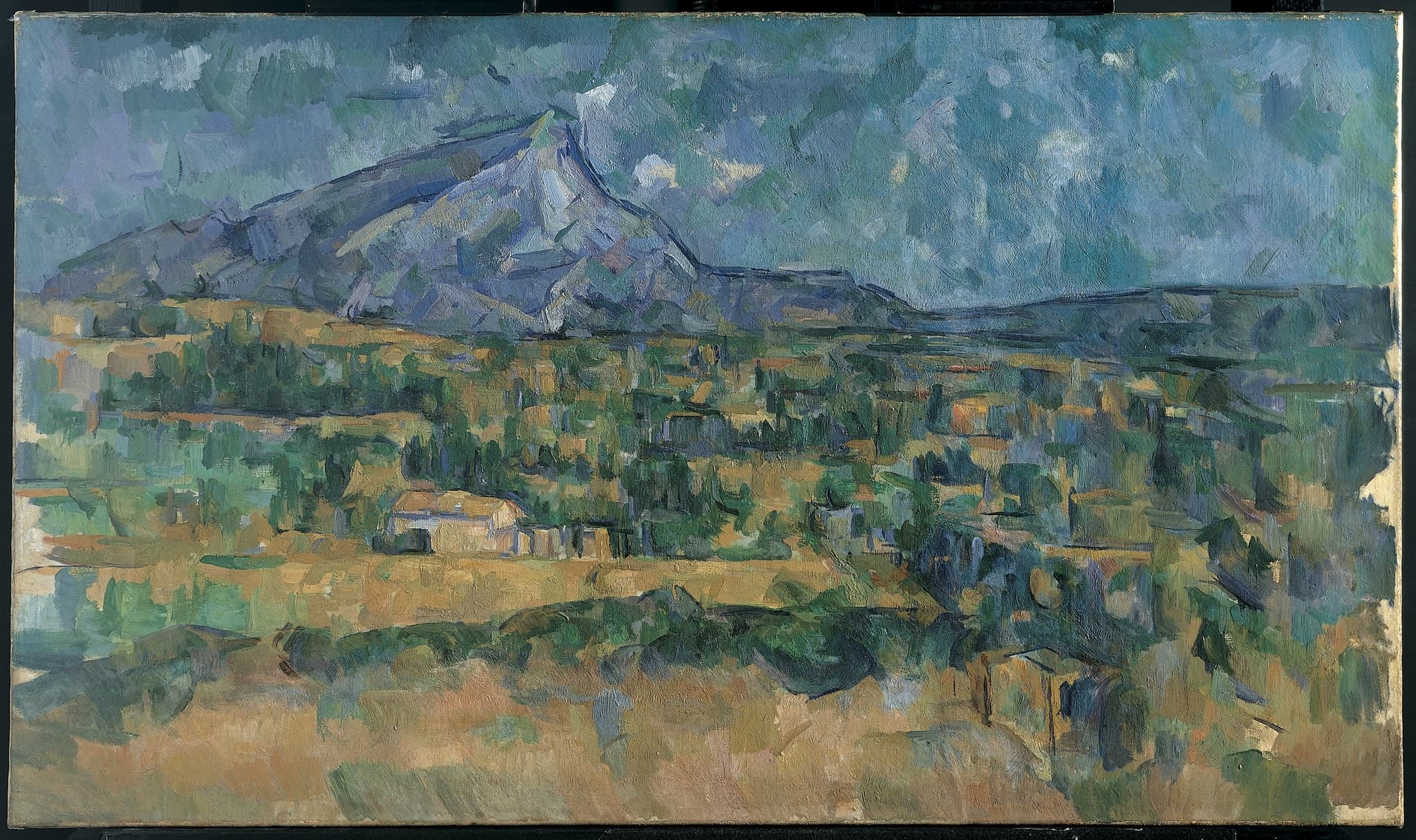
Color carries structure. Cézanne’s short, aligned touches and warm–cool modulations build convex forms and negotiated depth in still lifes and landscapes; apples, bottles, and the facets of Mont Sainte‑Victoire are modeled by temperature rather than theatrical light. Matisse raises the stakes: high‑key fields and reserves make furniture hover, weld windows to rooms, and let color dictate spatial relations, as in The Red Studio or Open Window, Collioure.
Space is re‑pacted. Cézanne stitches multiple views into one surface so tables kink, rims shift, and mountains breathe in planar seams—a legible map of seeing over time. Matisse flattens and rhythms space so pattern and hue carry the cadence of a room or landscape. Both work serially on chosen motifs—Cézanne’s still lifes and Sainte‑Victoire; Matisse’s interiors and Arcadias—letting form surface through iteration.
The lineage is direct. Matisse studied Cézanne closely, bought Three Bathers in 1899, and absorbed the structural lessons highlighted by the 1907 Cézanne retrospective. From that shared ground, each forged a rigorous, different way to make a painting hold together.
Decisive Difference
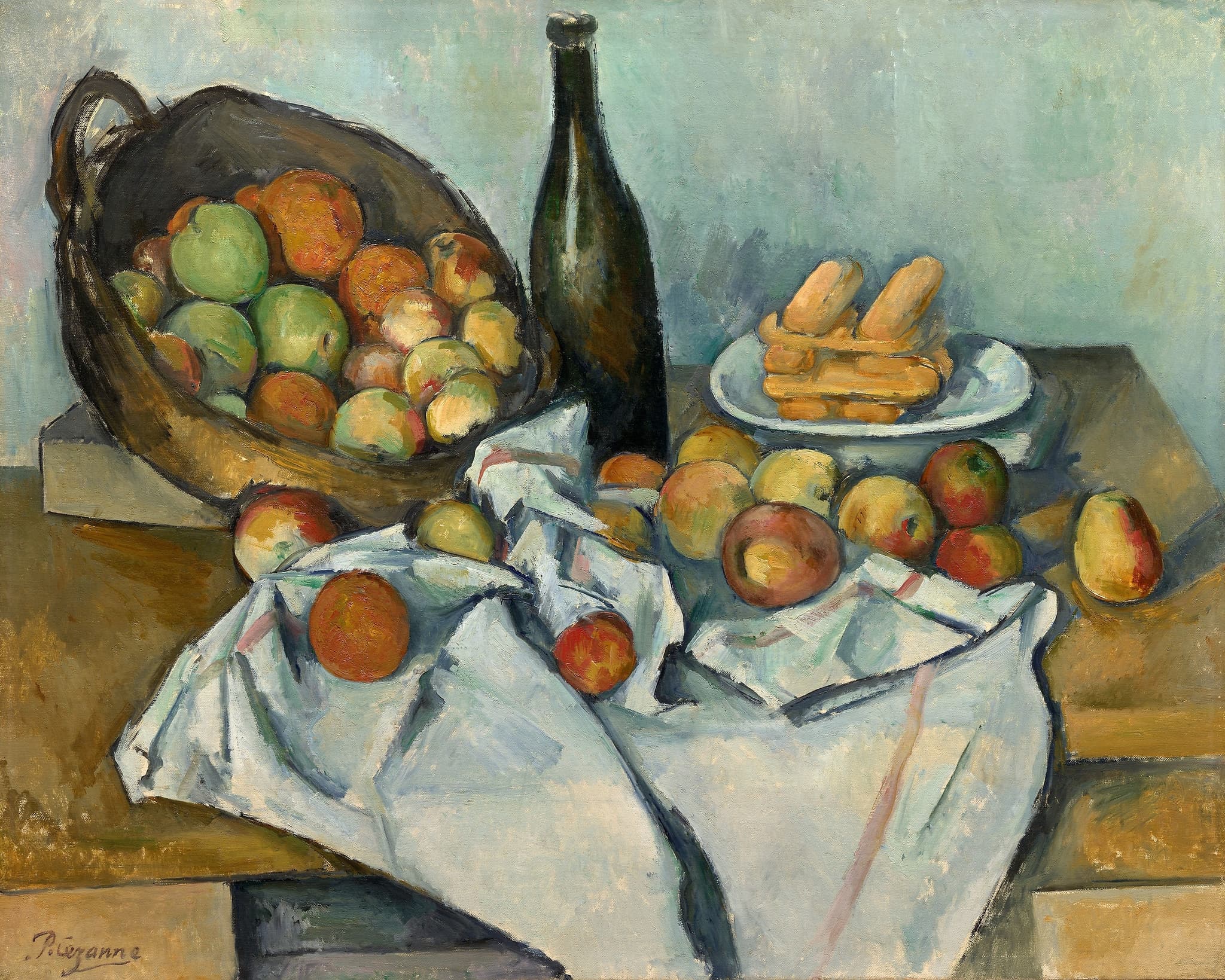
The clearest split is how time and unity enter the picture. Cézanne builds a canvas as the sum of many calibrated glances. Edges kink, planes disagree, and forms are adjusted into equilibrium: The Basket of Apples makes you feel the eye shifting between views as the tabletop refuses to align. Mont Sainte‑Victoire measures recession through warm–cool intervals so depth is argued into being. Time accumulates; unity is earned.
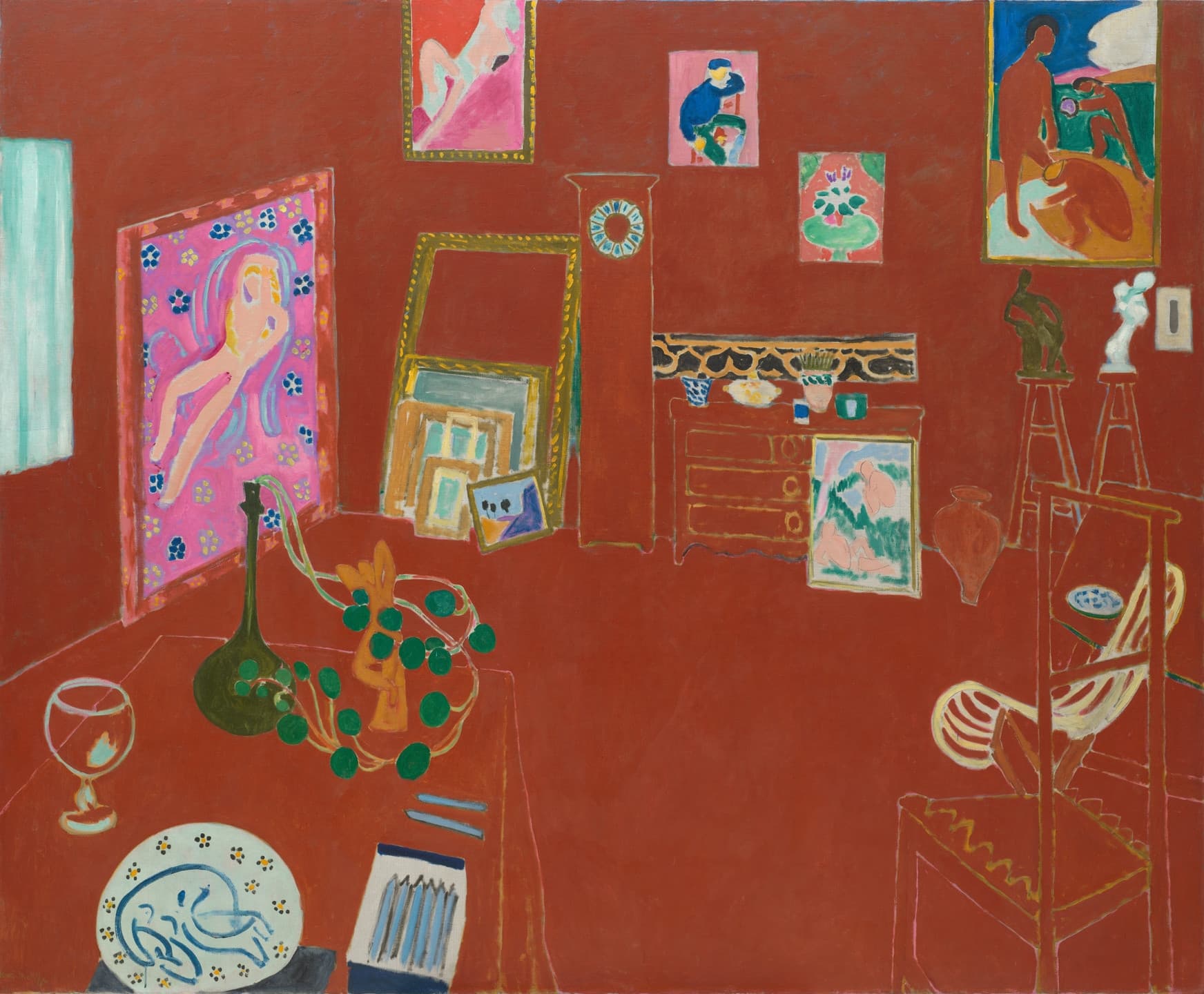
Matisse tends to suspend ordinary time by establishing a chromatic order at once. In The Red Studio a late, saturating veil of Venetian red fuses walls, floor, and air; furniture remains as reserved lines, and the clock literally has no hands. Unity arrives as a field condition, with artworks and color islands punctuating a present tense. In portraits like The Green Stripe, a single chromatic incision organizes the head; hue, not tonal modeling, carries form.
That difference reframes “nature” versus “mind‑space.” Cézanne’s method returns to a motif read from nature and consolidated into a solid order on canvas. Matisse often converts the studio, window, or Arcadia into a mental map where color is the architect of relations. Both seek harmony; Cézanne stabilizes looking over time, while Matisse states a logic that makes time feel paused inside color.
Paired Works
Pastoral architecture vs chromatic Arcadia
Focus question: How does Cézanne’s vaulted, weight‑bearing nude scene become Matisse’s flowing chromatic field?
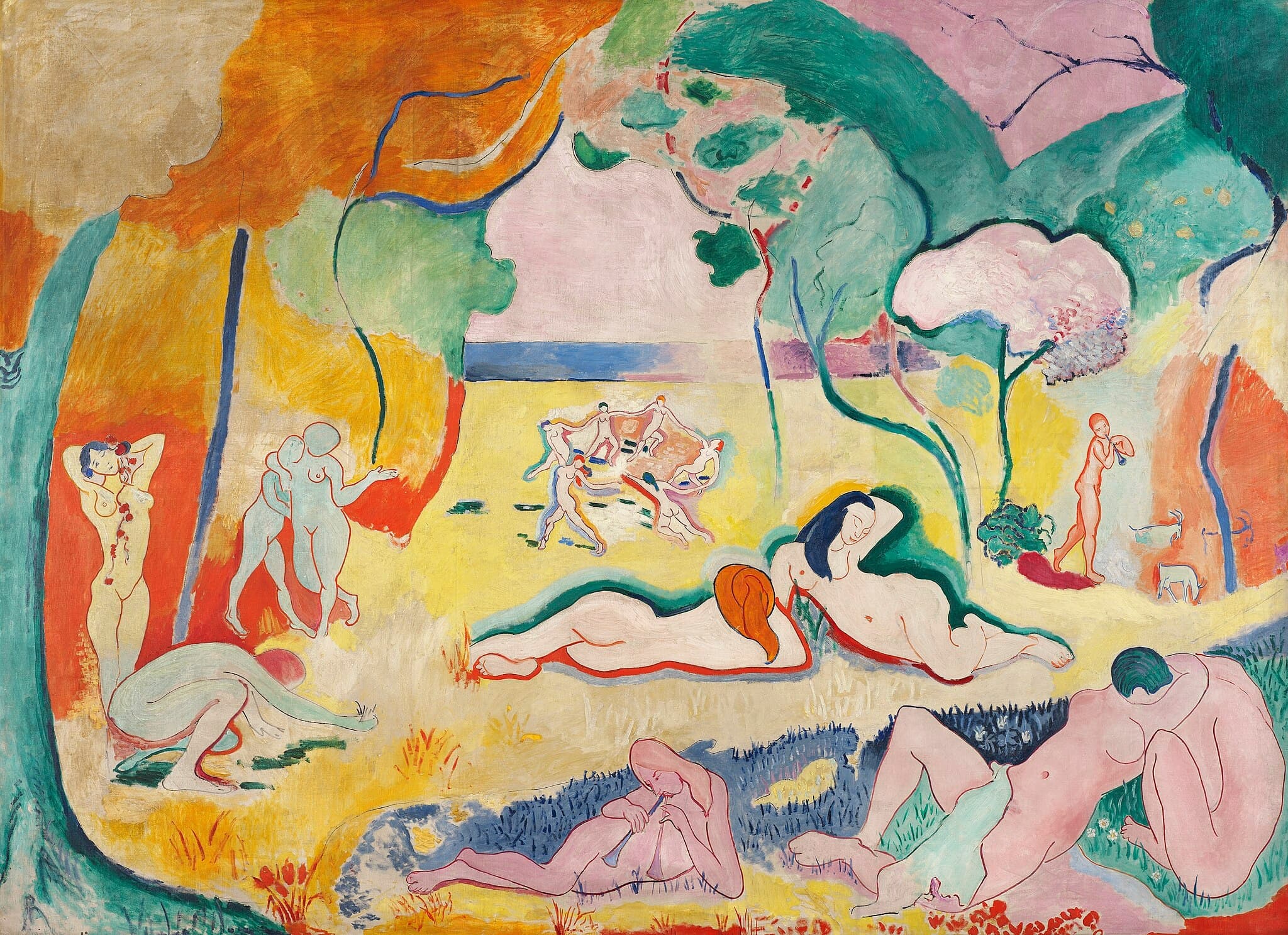
The Large Bathers vs Le Bonheur de Vivre (The Joy of Life)
What holds a picture together?
Focus question: Negotiated volume over time, or an all‑over chromatic field at once?
The Basket of Apples vs The Red Studio
Portraits as tests of color‑structure
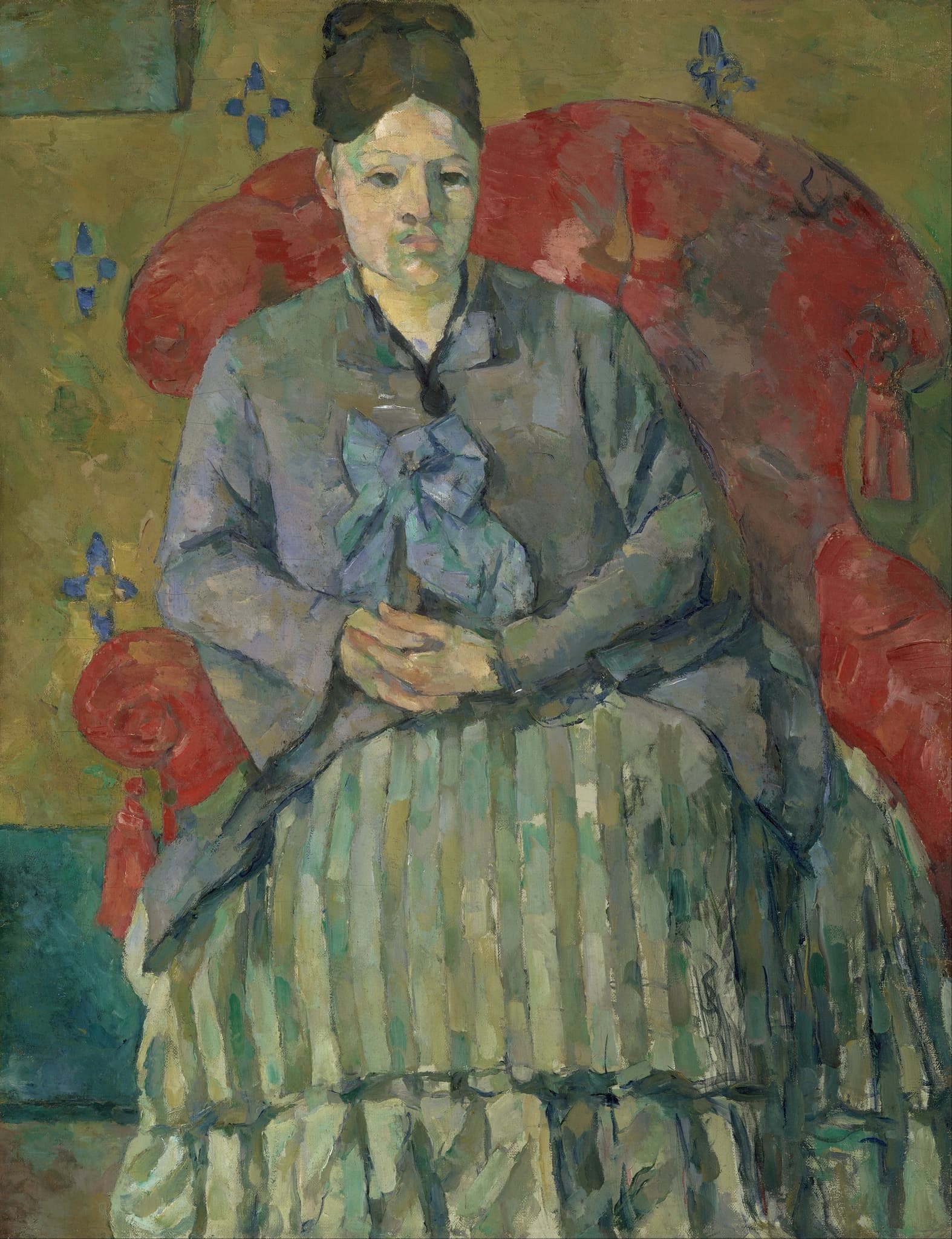
Focus question: How does each artist ask color to build a face?
Madame Cézanne in a Red Armchair vs Portrait of Madame Matisse (The Green Stripe)
Rewriting landscape space
Focus question: Measured recession by color‑built planes, or decorative compression that welds inside and out?
Mont Sainte-Victoire vs Open Window, Collioure
Why This Comparison Matters
This pairing clarifies two durable paths modern painting took after Impressionism. Cézanne shows how to build a solid order from the flux of looking—color as a measuring device, planes that negotiate depth, unity earned by revision. Matisse shows how color can be the architect of space—fields that suspend clock time, reserves and patterns that let an interior read as a mental map. Seeing them together explains why twentieth‑century art could split toward analytic structure (Cubism’s debt to Cézanne’s constructed seeing) and toward chromatic architecture (from Matisse to color‑field painting). It also helps a viewer read the pictures properly. A skewed tabletop in Cézanne is not an error but a record of sequential attention; a room drowned in red is not decor but a spatial decision that changes how objects relate. The comparison is a practical guide: when a painting seeks harmony, ask whether it is stabilized over time or stated all at once—and watch how color shoulders the load.
Related Links
Sources
- Art Institute of Chicago – Cézanne’s “harmony parallel to nature”; Matisse’s Notes of a Painter
- The Met – Paul Cézanne (overview essay)
- The Met – Mont Sainte‑Victoire (object page)
- MoMA – The Red Studio (object page)
- Nature – Technical study of Matisse’s The Red Studio (2022)
- National Gallery of Art – Open Window, Collioure
- Smarthistory – Cézanne, The Large Bathers
- Smarthistory – Matisse, Le Bonheur de vivre
- Petit Palais – Cézanne, Three Bathers (Matisse’s 1899 purchase)
- Philadelphia Museum of Art – Cézanne and Beyond (context for 1907 retrospective’s impact)
- MoMA – Cézanne’s Still Life with a Basket of Apples (discussion of multiple viewpoints)
- Google Arts & Culture – Portrait of Madame Matisse (The Green Line)