Event vs Language
Both artists turn painting from depicting objects to organizing forces. Pollock makes process legible as a centerless field of gestures that fix an event in matter. Kandinsky builds a teachable grammar of points, lines, and calibrated colors. The shared ground is abstraction; the split is how you’re asked to perceive it.
Comparison frame: How do Pollock’s all‑over fields and Kandinsky’s geometric scores ask us to see painting—one as an event to inhabit, the other as a language to read?
Quick Comparison
| Topic | Jackson Pollock | Wassily Kandinsky |
|---|---|---|
| What a painting is | A fixed trace of actions and fluid behavior—an event you witness. | A constructed syntax of forms and colors—a language you learn to read. |
| What line does | Index of bodily motion and gravity; poured vectors inscribe action. | Vector in a system; line expresses directed force within point–line–plane. |
| Composition | All‑over, centerless field; figure/ground largely suspended. | Articulated modules with conducting diagonals and focal nodes. |
| Color logic | Industrial enamels; contrasts arise from density, overlap, and sheen. | Calibrated behaviors: yellow advances, blue recedes, red warms; used syntactically. |
| Method | Floor‑based pouring; jets tuned by height, speed, viscosity. | Measured construction; compass, ruler, staves—Bauhaus discipline. |
| Viewer’s task | Inhabit and scan; feel rhythm across a saturated field. | Read relations; parse modules and intervals like a score. |
| Spatial effect | Shallow, continuous skin that engulfs peripheral vision. | Shallow but articulated depth; push–pull zones stabilized by circles. |
| Process visibility | Process is content (Namuth films; controlled strands, not accident). | Theory is content (published grammar of form and color behavior). |
Shared Ground
Pollock and Kandinsky meet on a decisive premise: painting should manifest forces, not describe things. Each redirects attention from objects to relations—how line, color, and interval conduct energy across a surface. Kandinsky theorizes this as inner necessity and the dynamics of point, line, and plane; Pollock enacts it through poured trajectories that make motion, gravity, and tempo visible. In both, line stops being contour and becomes vector, a carrier of direction and stress. Color likewise behaves rather than merely decorates, setting up pushes, pulls, and equilibria that the eye experiences as tensions and releases.
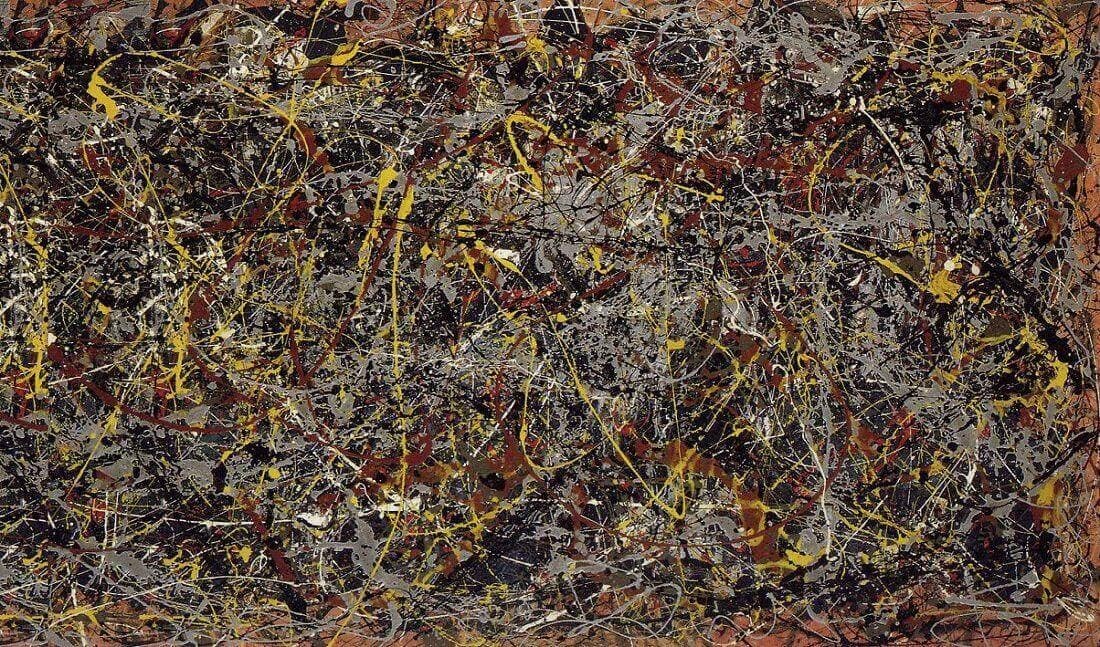
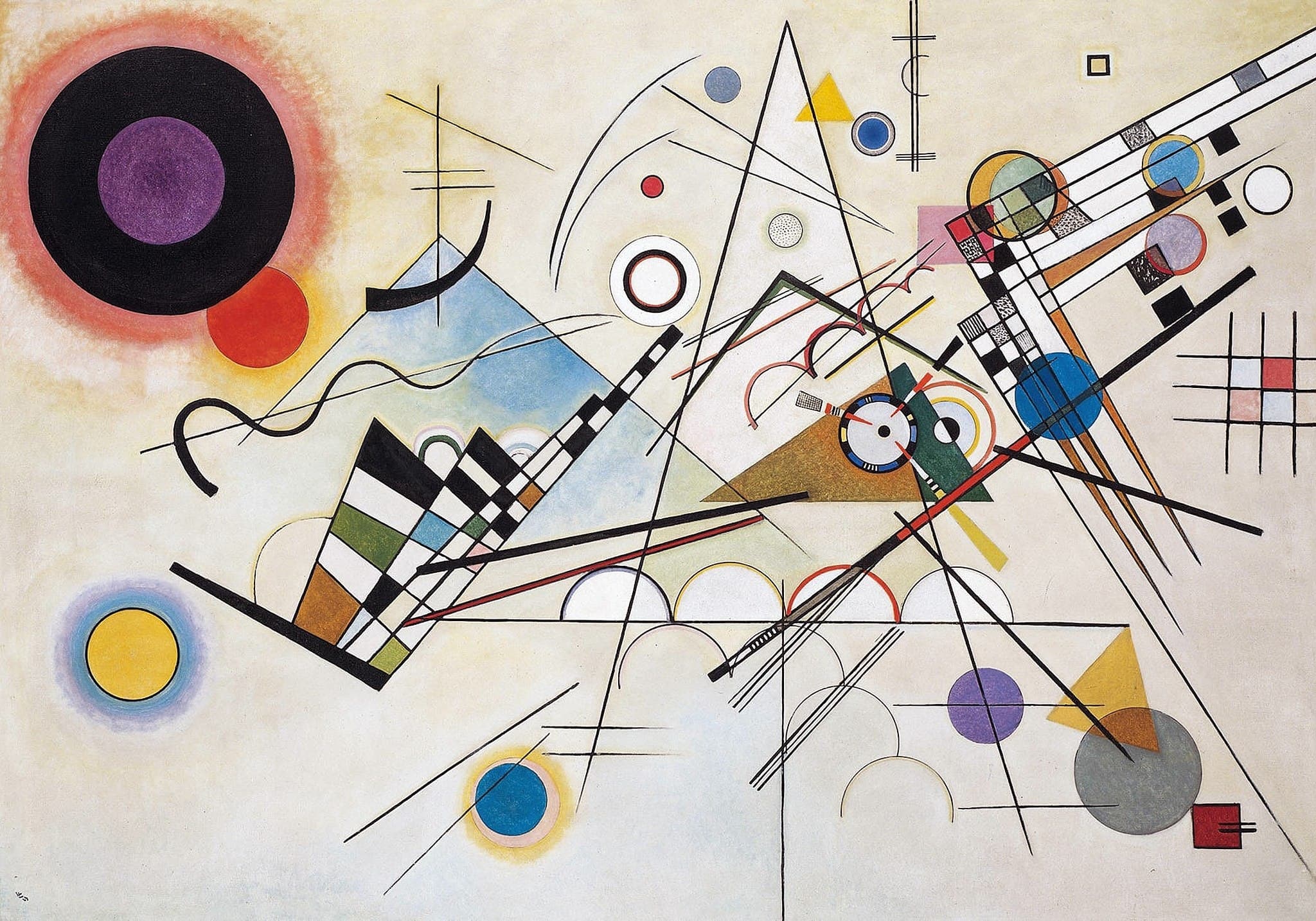
They also invent new ways of looking that unseat the classical center. Pollock’s all‑over webs in works like No. 5, 1948 and Autumn Rhythm distribute charge to every inch of the support, so scanning replaces focal fixation. Kandinsky disperses attention differently: Composition VIII and Yellow‑Red‑Blue spread interest through interlocking geometries—circles, diagonals, checkerboards—organized like a musical score. Music is a shared model: Pollock’s layered gestures read temporally as rhythms and reprises; Kandinsky explicitly composes counterpoint in color and form. Across both practices, the canvas becomes a stage where energies unfold and are orchestrated for the eye, asking viewers to track dynamics rather than to name depicted objects.
Decisive Difference
For Pollock, a painting is an event you witness after the fact. Laying canvases on the floor, he poured and flung industrial enamels in controlled jets, adjusting height, speed, and viscosity to keep strands coherent. The work’s meaning lies in that accumulation of actions and in the physics of fluid behavior fixed on the surface. The all‑over field suppresses figure/ground and any privileged “main clause,” so seeing becomes immersive and peripheral. You read time in layers and crossings—episodes of motion recorded as material fact—rather than by following a path set by a central motif.
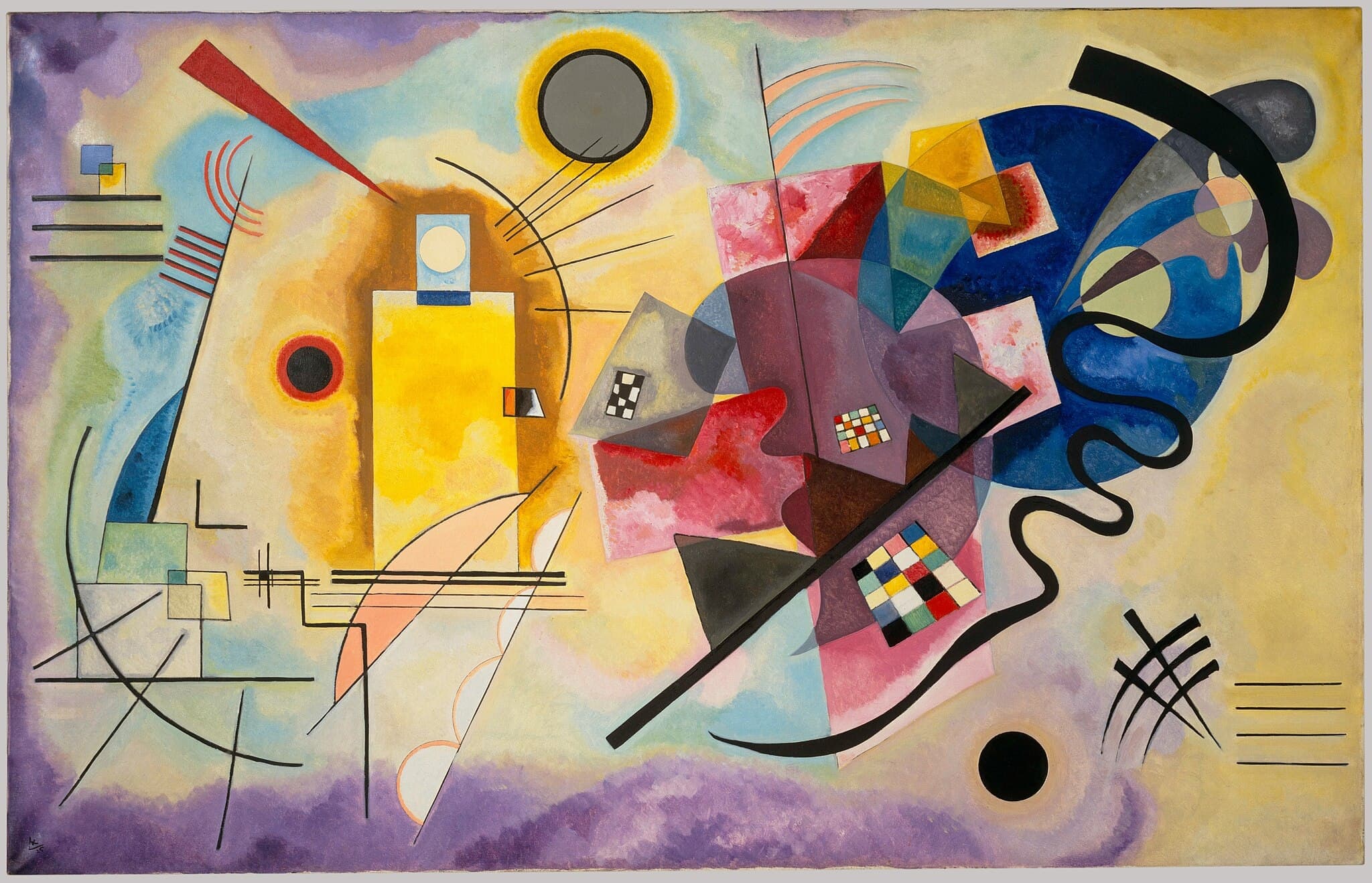
For Kandinsky, a painting is a language you learn. He assigns roles to points, lines, circles, and calibrated colors—yellow advancing, blue receding, red warming—so forms behave in legible ways aimed at spiritual effect. Diagonals conduct attention; modules repeat and vary like measures; circles stabilize as reservoirs of rest. Works such as Composition VIII and Yellow‑Red‑Blue are intelligible scores: you parse relations, weigh accents, and feel cadence within a built syntax. The upshot is perceptual: Pollock invites immersion in a centerless web; Kandinsky trains analysis through organized intervals. Both mobilize energy, but one is enacted process made visible, the other an instructive grammar designed to be read.
Paired Works
Equalized Field vs Articulated Grammar
Focus question: What changes when a painting asks you to roam evenly instead of to read modules?
No. 5, 1948 vs Composition VIII
Event Layers vs Conducted Color
Focus question: Do you experience time as a performance trace or as a composed sequence?
Number 1, 1950 (Lavender Mist) vs Yellow-Red-Blue
Monumental Totality, Two Ways
Focus question: How is a sense of the whole built—by webbing or by orchestration?
Autumn Rhythm (Number 30) vs Composition VIII
Why This Comparison Matters
This pairing clarifies two durable models for non‑objective art. If Pollock shows how process and material behavior can be the subject—an event stabilized as surface—Kandinsky shows how abstract elements can communicate through a constructed grammar. That difference affects how we look: immersion versus instruction, roaming versus reading. It also travels beyond painting. Designers and architects borrow Kandinsky’s calibrated pushes, pulls, and conducting diagonals when structuring attention; filmmakers and choreographers draw on Pollock’s sense of field and tempo when building environments you feel more than parse. Understanding the split helps decode much of 20th‑century abstraction without clichés: not “emotion versus geometry,” but two distinct ways to make forces intelligible. Learn to recognize them, and large, difficult canvases stop being opaque—they become navigable worlds.
Related Links
Sources
- Wassily Kandinsky, Point and Line to Plane (Bauhausbücher 9, 1926; Eng. trans. 1947)
- Wassily Kandinsky, Concerning the Spiritual in Art (1911; Eng. 1914)
- Physics Today: Painting with drops, jets and sheets (fluid dynamics of Pollock)
- MoMA: Pollock on working on the floor; method and materials
- Harold Rosenberg, The American Action Painters (1952)
- Clement Greenberg, American‑Type Painting (1955) and the all‑over field
- Guggenheim Bilbao: Teacher’s Guide — Kandinsky, Composition 8
- Centre Pompidou: Kandinsky, Yellow‑Red‑Blue (1925)
- National Gallery of Art: Jackson Pollock, Number 1, 1950 (Lavender Mist)
- Smarthistory: Pollock, Autumn Rhythm (Number 30), 1950
- MoMA: Hans Namuth’s photos/films of Pollock at work
- Guggenheim: Kandinsky at the Bauhaus, 1922–1933