Child Symbolism
Across art history, the figure of the child commonly signifies innocence, renewal, and the continuity of family life. Artists often use the small stature of a child to calibrate human scale within expansive settings, especially gardens and landscapes. Their presence can quietly turn a view of nature into a scene of lived domesticity.
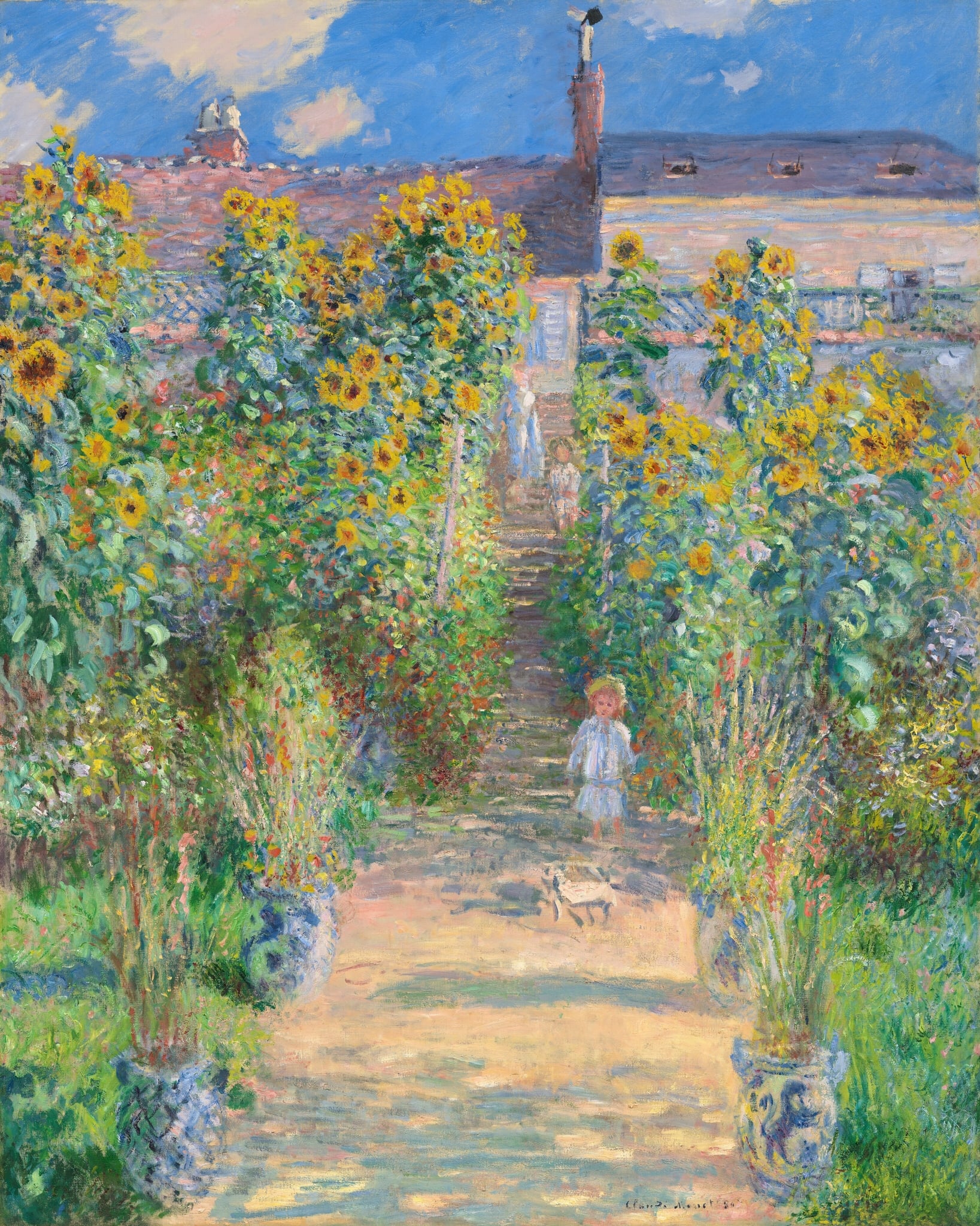
Child in The Artist's Garden at Vétheuil
In Claude Monet’s The Artist’s Garden at Vétheuil (1881), a child pauses with a dog on the sunlit path that climbs between towering sunflowers toward a modest house. The figure signals the garden’s status as a domestic sanctuary and supplies a human measure within the profusion of cultivated nature; blue-and-white jardinieres anchor the foreground, and Monet’s quick, broken strokes make leaves and shadows tremble. In this setting, the child concentrates themes of innocence and family continuity, quietly joining everyday life to the radiant scene.