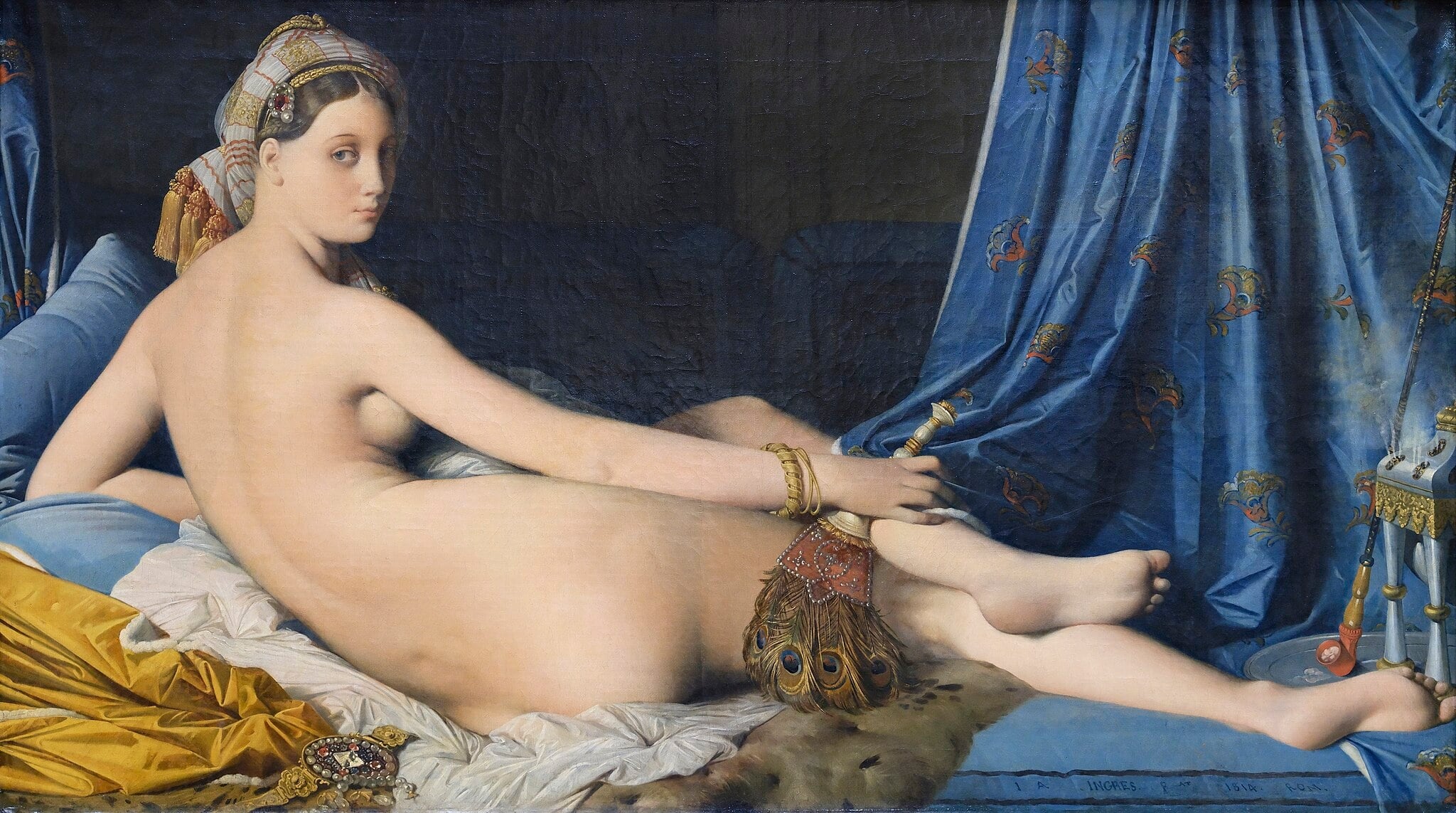
Hookah (water pipe) Symbolism
A hookah, or water pipe, is a smoking apparatus historically linked to social leisure in the Middle East and South Asia. In European art of the 18th and 19th centuries—especially within Orientalist painting—it often serves as a visual shorthand for sensual indulgence, luxury, and an exoticized interior. As a prop, it marks setting and mood as much as character, signaling a world of languor and decorative refinement.
Hookah (water pipe) in The Great Odalisque
In Jean-Auguste-Dominique Ingres’s The Great Odalisque (1814), the hookah appears alongside a turban, peacock-feather fan, and blue curtain to anchor the scene in an Orientalist setting. The water pipe amplifies the painting’s mood of languid, sensual leisure, complementing the figure’s elongated, idealized body and the cool, enamel-like finish. Commissioned by Caroline Murat and shown at the Salon of 1819, the work deploys the hookah as a symbolic prop rather than a narrative object, helping to codify an exoticized, private interior and positioning the reclining nude as a remote object of contemplation.