Man’s deep blue jacket Symbolism
In painting, a man's deep blue jacket often functions as a cool chromatic anchor—a dense ultramarine field that steadies composition and throws nearby reds and pinks into relief. In 19th-century art, especially among Impressionists, widely available synthetic ultramarine provided sharp value contrast and atmospheric shade, shaping form and cooling sunlit flesh. As a symbol, it reads as a stabilizing counterpoint amid motion.
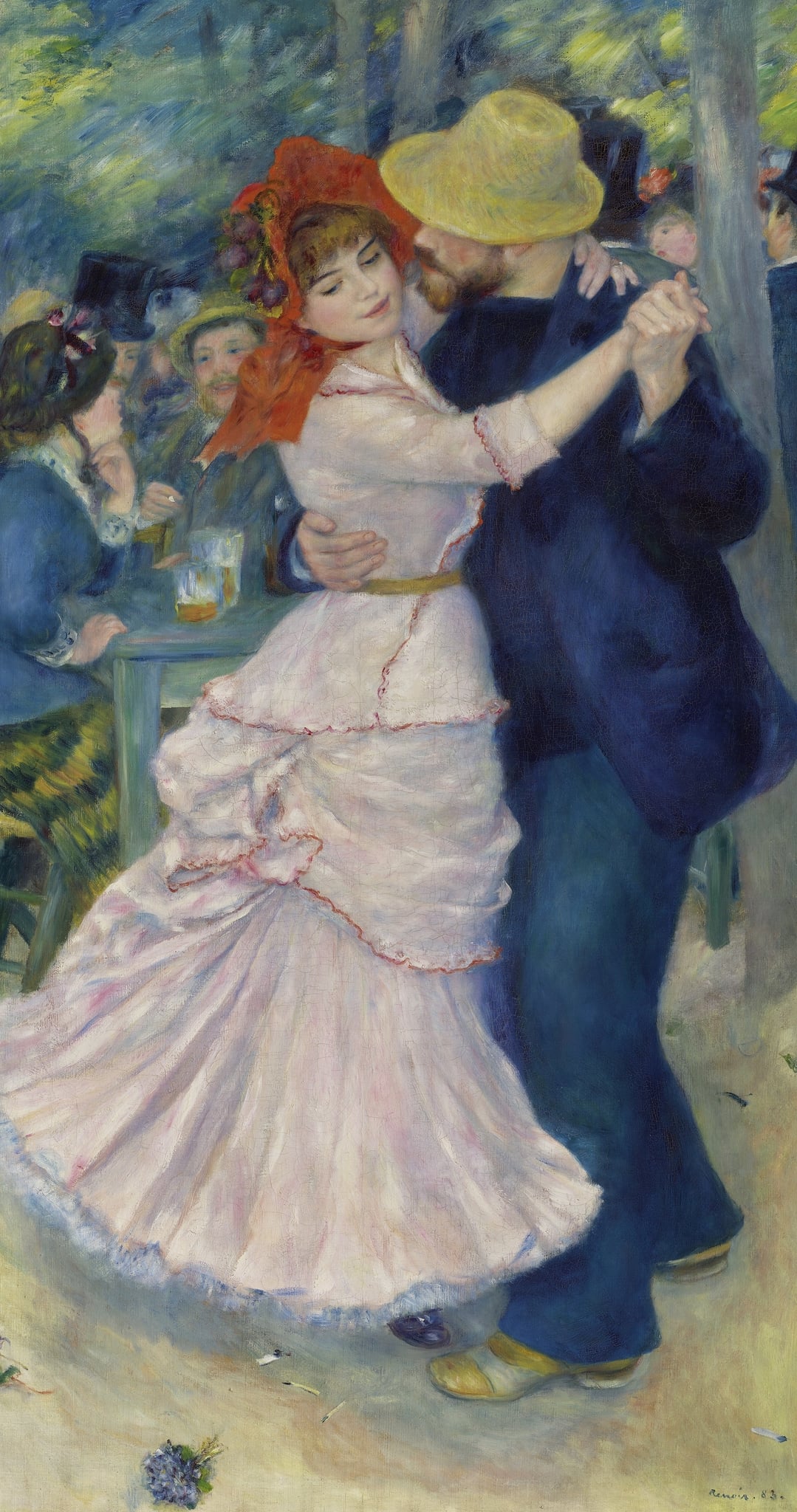
Man’s deep blue jacket in Dance at Bougival
In Pierre-Auguste Renoir's Dance at Bougival (1883), the male dancer's deep blue jacket becomes the composition's cool mass and visual ballast. Its ultramarine tone counterbalances the warm register—the woman's rose dress and the flare of her scarlet bonnet—so that warm skin and fabric read against shade. As the couple turns, this concentrated block of blue grounds their movement and concentrates the scene's energy, helping convert a crowded suburban dance into an intimate, focused moment.