Rumbled white cloth with red stripe Symbolism
In still life painting, a rumpled white cloth with a red stripe is more than a backdrop: it animates space, measures balance, and makes the act of seeing feel extended over time. In Paul Cézanne’s practice, its “whiteness” is built from varied strokes of color, while the stripe serves as a clear visual axis that organizes the scene. The folds register flux, turning drapery into a record of perception as much as a setting for objects.
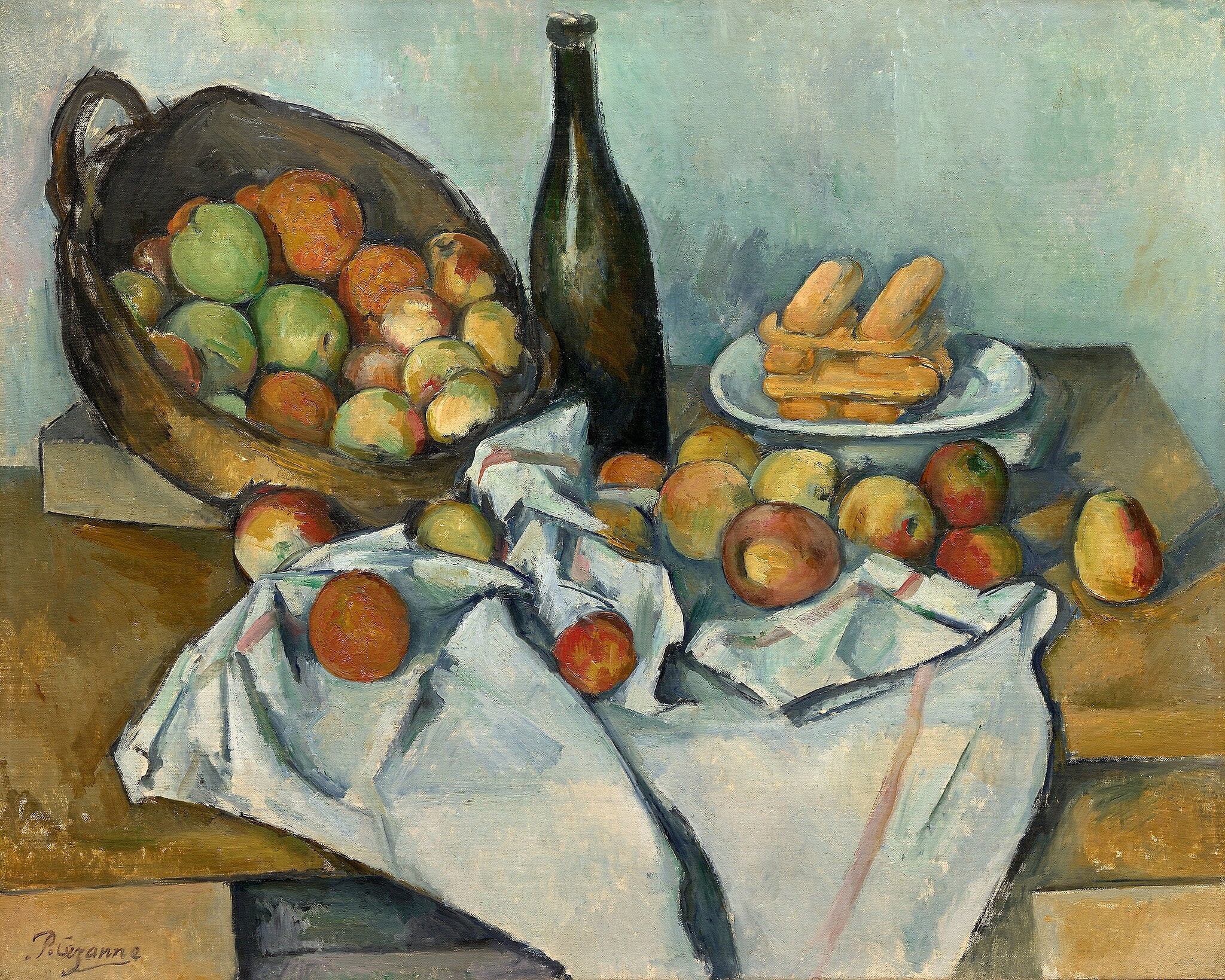
Rumbled white cloth with red stripe in Still Life with a Basket of Apples
In Paul Cézanne’s Still Life with a Basket of Apples (c. 1893, AIC range 1887–1900), the rumpled white cloth surges like a ridge across the table, knitting the forward-tilting basket, leaning bottle, and scattered fruit into a single, dynamic field. Cézanne’s constructed color lets the white emerge from modulated hues, and the red stripe tracks the cloth’s folds, acting like a measure that accentuates the painting’s purposeful misalignments.
As the eye follows the pleats and stripe, the still life becomes an inquiry into how perception unfolds over time. In this work, the cloth is both stage and protagonist: it stabilizes and destabilizes at once, making balance, temporality, and vision palpable in the very fabric of the scene.