Still Life with a Basket of Apples

by Paul Cézanne

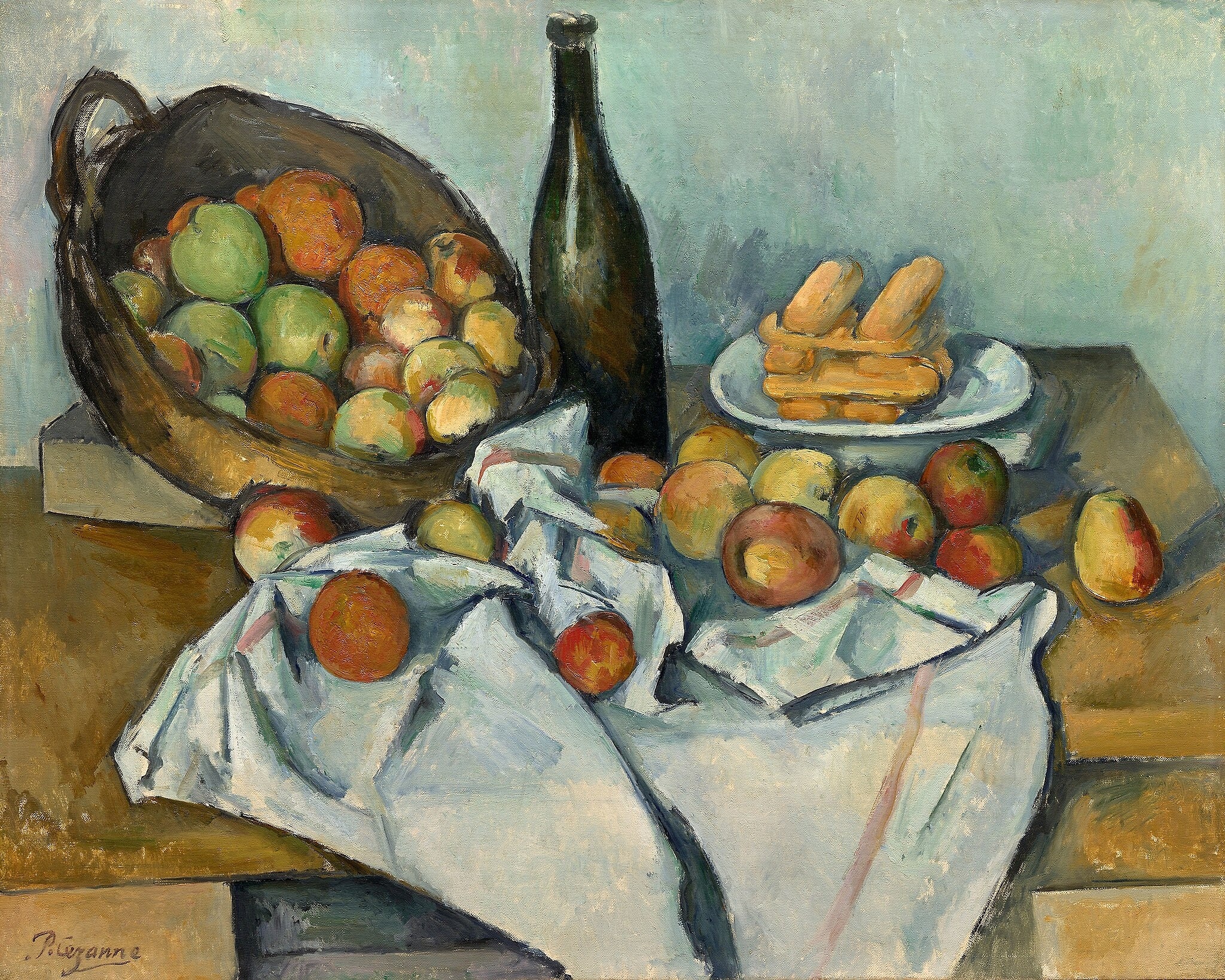
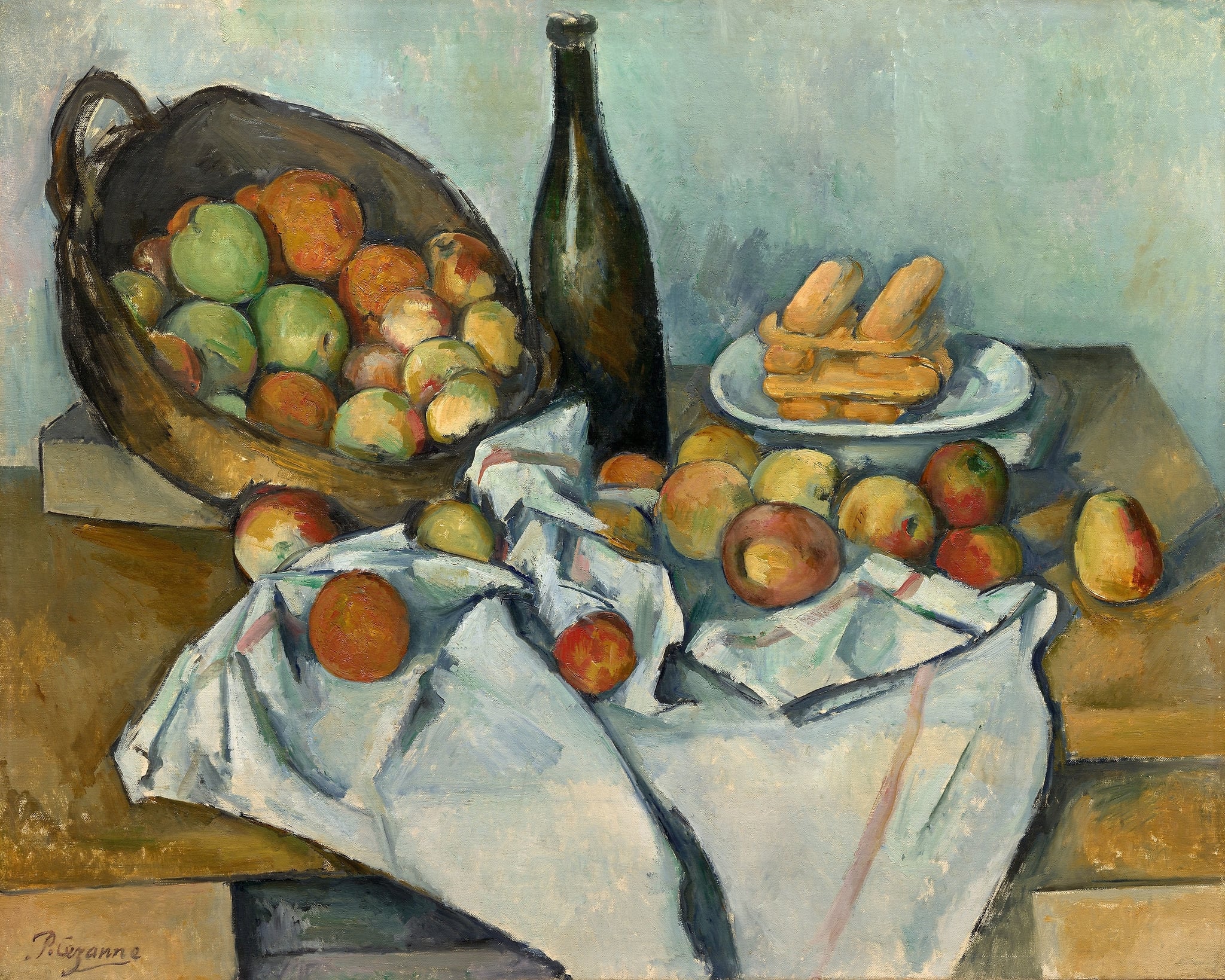
Paul Cezanne’s Still Life with a Basket of Apples stages a quiet crisis of balance: a basket tilts forward, a dark bottle leans, and a rumpled cloth surges like a ridge across the table. Through purposeful misalignments and constructed color, the painting turns ordinary fruit into an inquiry into how we see over time [1][3].

Fast Facts

Year
c. 1893 (AIC range 1887–1900)
Medium
Oil on canvas
Dimensions
65 × 80 cm
Location
Art Institute of Chicago, Chicago
Still Life with a Basket of Apples by Paul Cézanne (c. 1893 (AIC range 1887–1900)) featuring Tilting wicker basket, Apples, Leaning dark bottle, Rumbled white cloth with red stripe

Click on any numbered symbol to learn more about its meaning

Meaning & Symbolism

Cezanne converts a tabletop into a system of counterweights. At left, the wicker basket packed with mottled green, yellow, and red apples is propped on a small block yet still lurches toward us; at center, a tall, near-black bottle rises as a wavering axis; at right, oval biscuits stack on a plate that we read from two vantage points at once. The white cloth across the foreground kinks into peaks and troughs, its “whiteness” pieced from cool blues, greens, and violets, with a vermilion stripe that wanders independently of the folds. Each element is positioned to challenge stability, and conservation imaging shows that the leaning bottle, the misaligned front edge of the table, and the sliding viewpoints were drawn in from the start—formal ruptures that are the engine of the composition, not afterthoughts 12. In place of academic perspective, Cezanne constructs a field where forms are built by short, faceted strokes and chromatic shifts. Apples become units of measure: round, weighty, and slightly bruised, they register pressure where cloth bunches against them and throw color into neighboring shadows. Rather than model them by shadow alone, Cezanne turns hue into structure—greens chilled with blue, reds warmed with ochre—so volume emerges as a balance of temperatures. The result is a picture that feels observed across moments: the biscuits seem seen from above, the basket from slightly below, the tabletop from an angle that will not reconcile. These inconsistencies are not errors; they map how looking actually unfolds—glances stitched together into a single surface. Smarthistory rightly calls them purposeful errors; they propel the work beyond imitation into an account of perception itself 3. This constructive vision is why the painting became foundational for the twentieth century. Cezanne’s oft-cited aim to make “a harmony parallel to nature” is realized here by letting the painting’s internal order—the push and pull of edges, tilts, and color—stand beside the world rather than mimic it 14. The abundance that verges on spill, the bottle that will not stand straight, and the tabletop whose planes refuse to meet convert a humble snack into a meditation on equilibrium under strain. Critics from Meyer Schapiro to T. J. Clark have argued that Cezanne uses apples to test how meaning forms in the studio: not as symbols pinned to a code, but as instruments for constructing a durable order under the pressure of time and looking 35. Phenomenologists saw the same lesson: vision, as Merleau-Ponty put it, is ambiguous and lived; Cezanne paints that unfolding, not its photographic residue 6. In this canvas, the forward-thrust basket invites a maximal face of fruit to the eye, the cloth’s ridges modulate light like small horizons, and the bottle’s dark spine binds the scene even as it drifts. That paradox—binding while drifting—defines the painting’s narrative. It tells us that seeing is an act of continual recalibration. By making construction visible, Still Life with a Basket of Apples demonstrates how painting can hold multiple moments in one frame and, in doing so, lays the groundwork for the structural experiments of Fauvism and Cubism 134.

Explore Deeper with AI

Ask questions about Still Life with a Basket of Apples

Popular questions:

Powered by AI • Get instant insights about this artwork

💬 Ask questions about this artwork!

Interpretations

Technical/Conservation Lens

Infrared reflectography and pigment analysis show that Cézanne’s so‑called “instabilities” were scripted from the outset: the leaning bottle, the misaligned table edge, and the dual viewpoints on the biscuit plate appear in the underdrawing, not as late corrections. Pigments in the cloth—emerald green, viridian, Prussian blue, ultramarine—intermix with lead white to build “whiteness” chromatically, while the vermilion border was added late, wandering apart from the folds like an independent vector. These findings ground the painting’s perceptual drama in process: color is not a skin but a structural agent, and perspective is orchestrated through cumulative, faceted strokes rather than optical rules. Conservation thus corroborates a core claim of modernism here: the picture is a made thing, its tensions engineered to be felt as we look 2.

Source: Art Institute of Chicago (Conservation/Science)

Phenomenology of Perception

Merleau‑Ponty’s reading of Cézanne helps clarify why the picture “refuses” a single vantage. Vision, for phenomenology, is lived and ambiguous—assembled across glances and over time. The apple becomes a unit of temporal seeing: its volume is not fixed by chiaroscuro but stabilized through temperature shifts (cool greens against warmed reds), as if perception were constantly recalibrating. The basket’s forward tilt, the bottle’s wavering axis, and the plate viewed from two heights do not misrepresent space; they chart the itinerary of looking. In this frame, The Basket of Apples is less a still life than a present‑tense event of vision, where the canvas registers how objects appear, vanish, and reappear within our perceptual field—a thesis that later modernisms will radicalize 45.

Source: Maurice Merleau‑Ponty; T. J. Clark

Genealogy to Fauvism and Cubism

Cézanne’s substitution of chromatic construction for linear perspective, and his willingness to fracture the tabletop into non‑converging planes, becomes a method that Fauves intensify via saturated color and that Cubists systematize into faceted form. The bottle’s dark spine acts as a drifting axis around which local tilts negotiate balance—precisely the kind of relational counterweighting that Cubism will generalize across the whole picture field. Smarthistory underscores these as purposeful errors, not naiveties; the Art Institute situates the canvas within Cézanne’s late style and its 1895 Vollard reception, the moment Paris recognized his structural program. The work thus functions as a toolbox for twentieth‑century experiments: planes unmoored from single viewpoint, hue as architecture, and objects as modules in a constructed order 13.

Source: Smarthistory; Art Institute of Chicago

Reception and Exhibition History

The painting’s inclusion in Ambroise Vollard’s 1895 one‑man show helped recalibrate Cézanne’s status from eccentric provincial to architect of modern painting. That turn in reception hinged on what the canvas makes legible: a studio practice that converts a humble snack into a meditation on order under strain, with the signature (“P. Cézanne”) marking a rare assertion of authorship. In Paris, critics and artists encountered not an anecdote of domesticity but an image whose internal necessity—tilts, chromatic scaffolding, and disjunctive viewpoints—seemed to promise a durable alternative to Salon naturalism. The Art Institute’s record, framing the date around c. 1893, aligns the work with this late recognition, where Cézanne’s still lifes became exemplars for a generation seeking structure beyond impressionistic flux 1.

Source: Art Institute of Chicago

Psychoanalytic/Cultural Subtext

Meyer Schapiro famously warned against reducing Cézanne’s apples to displaced sexuality, yet he acknowledged their erotic and classical resonances within Western culture. In The Basket of Apples, the fruit’s tactile roundness, mottled skin, and the basket’s abundance that verges on spill invite a secondary register of desire—suggestive but never allegorically fixed. Crucially, Schapiro argues that still life’s manipulability makes it the arena where Cézanne tests freedom and construction: objects become compliant actors in an exploration of order, not symbols coded to a program. The result is a tension between sensual plenitude and structural discipline, where any erotic charge is folded back into the work’s main task: forging a harmony parallel to nature through painterly means 61.

Source: Meyer Schapiro; Art Institute of Chicago

Related Themes

About Paul Cézanne

Paul Cézanne (1839–1906) pursued a solid, durable pictorial order that shaped later modernism. In the 1890s in Provence, he developed series like Mont Sainte‑Victoire, the Bathers, and The Card Players, refining forms into stable masses and chromatic structures that influenced Cubism [1][5].
View all works by Paul Cézanne

More by Paul Cézanne

The Card Players by Paul Cézanne | Equilibrium and Form by Paul Cézanne

The Card Players by Paul Cézanne | Equilibrium and Form

Paul Cézanne

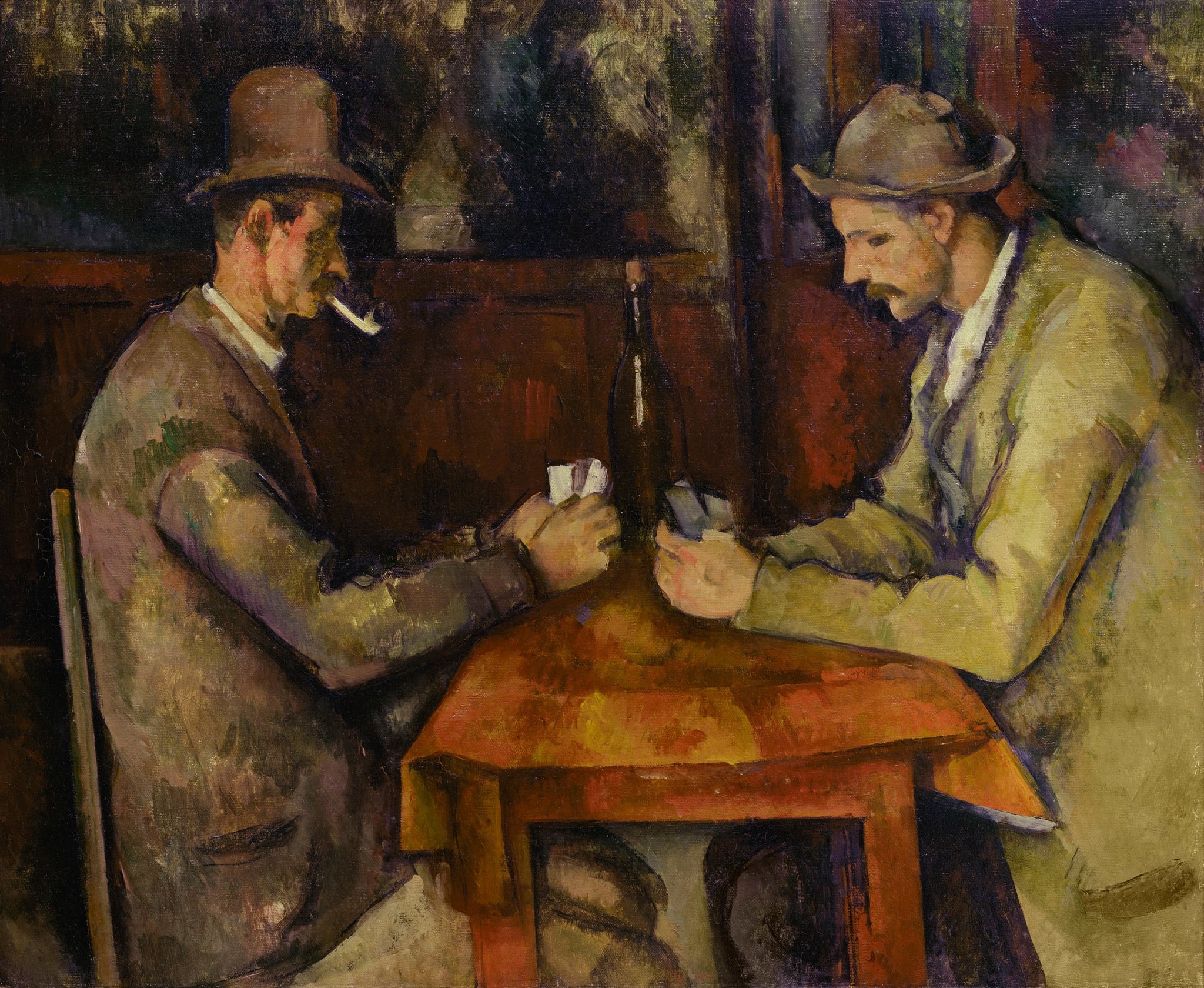
In The Card Players, Paul Cézanne turns a rural café game into a study of <strong>equilibrium</strong> and <strong>monumentality</strong>. Two hated peasants lean inward across an orange-brown table while a dark bottle stands upright between them, acting as a calm, vertical <strong>axis</strong> that stabilizes their mirrored focus <sup>[2]</sup><sup>[3]</sup>.

Bathers by Paul Cézanne: Geometry of the Modern Nude by Paul Cézanne

Bathers by Paul Cézanne: Geometry of the Modern Nude

Paul Cézanne

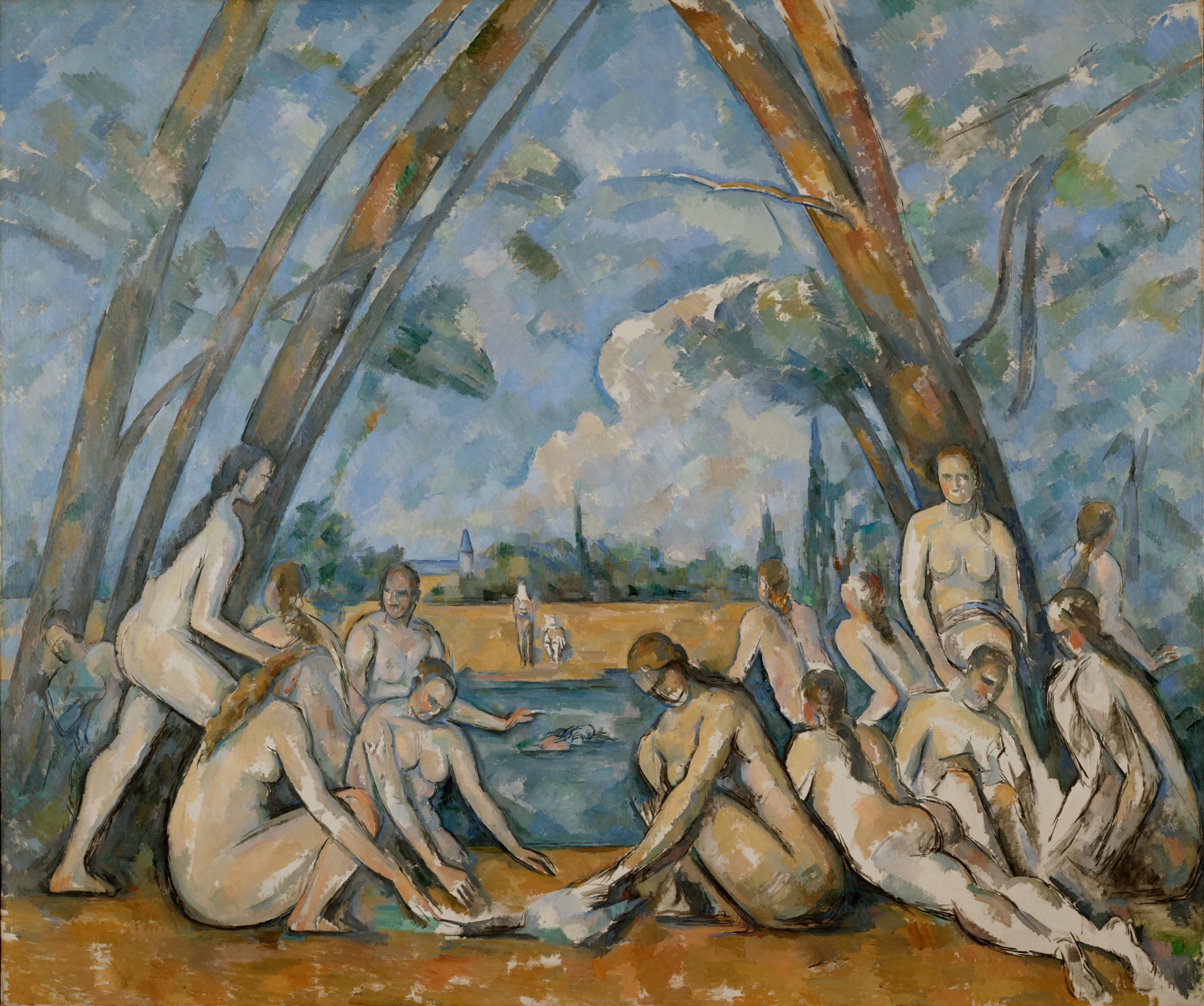
In Bathers, Paul Cézanne arranges a circle of generalized nudes beneath arching trees that meet like a <strong>natural vault</strong>, staging bathing as a timeless rite rather than a specific story. His <strong>constructive brushwork</strong> fuses bodies, water, and sky into one geometric order, balancing cool blues with warm ochres. The scene proposes a measured <strong>harmony between figure and landscape</strong>, a culmination of Cézanne’s search for enduring structure <sup>[1]</sup><sup>[2]</sup>.

The House of the Hanged Man by Paul Cézanne

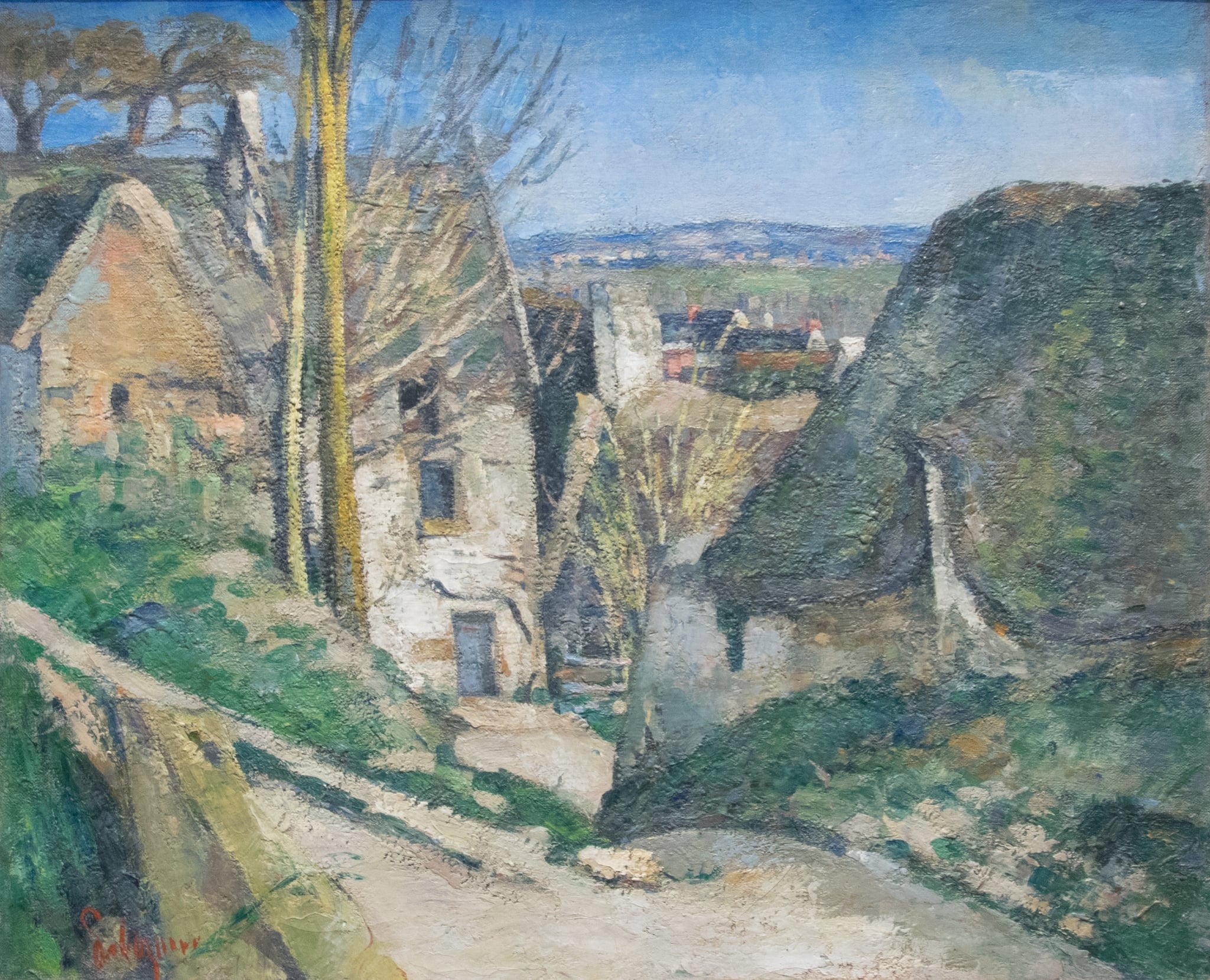
The House of the Hanged Man

Paul Cézanne (1873)

Paul Cézanne’s The House of the Hanged Man turns a modest Auvers-sur-Oise lane into a scene of <strong>engineered unease</strong> and <strong>structural reflection</strong>. Jagged roofs, laddered trees, and a steep path funnel into a narrow, shadowed V that withholds a center, making absence the work’s gravitational force. Cool greens and slate blues, set in blocky, masoned strokes, build a world that feels both solid and precarious.

The Basket of Apples by Paul Cézanne

The Basket of Apples

Paul Cézanne (c. 1893)

Paul Cézanne’s The Basket of Apples stages a quiet drama of <strong>balance and perception</strong>. A tilted basket spills apples across a <strong>rumpled white cloth</strong> toward a <strong>dark vertical bottle</strong> and a plate of <strong>biscuits</strong>, while the tabletop’s edges refuse to align—an intentional play of <strong>multiple viewpoints</strong> <sup>[1]</sup><sup>[2]</sup><sup>[3]</sup>.

Still Life with Apples and Oranges by Paul Cézanne

Still Life with Apples and Oranges

Paul Cézanne (c. 1899)

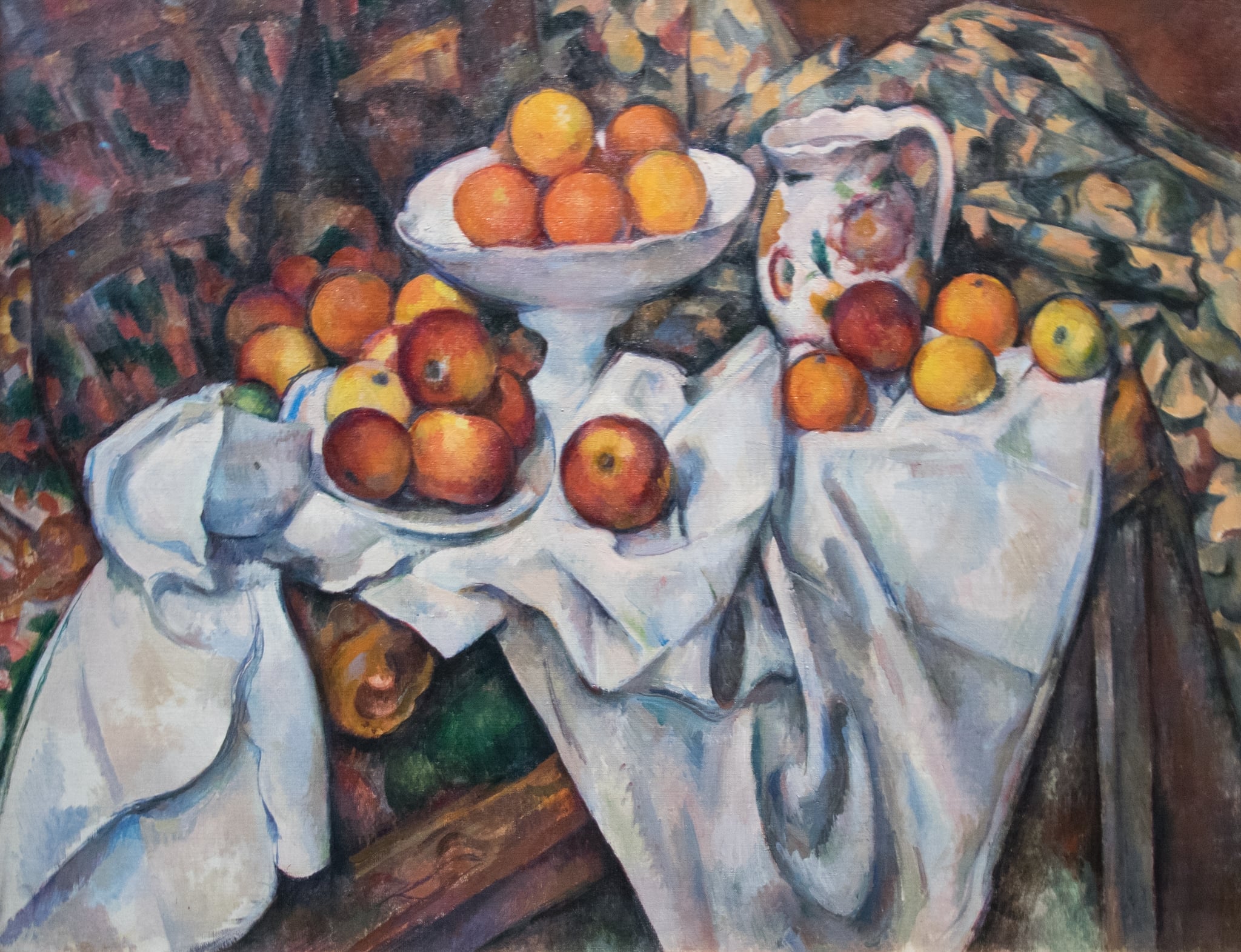
Paul Cézanne’s Still Life with Apples and Oranges builds a quietly monumental world from domestic things. A tilting table, a heaped white compote, a flowered jug, and cascading cloths turn fruit into <strong>durable forms</strong> stabilized by <strong>color relationships</strong> rather than single‑point perspective <sup>[1]</sup><sup>[2]</sup>. The result is a still life that feels both solid and subtly <strong>unstable</strong>, a meditation on how we construct vision.
Mont Sainte-Victoire by Paul Cézanne

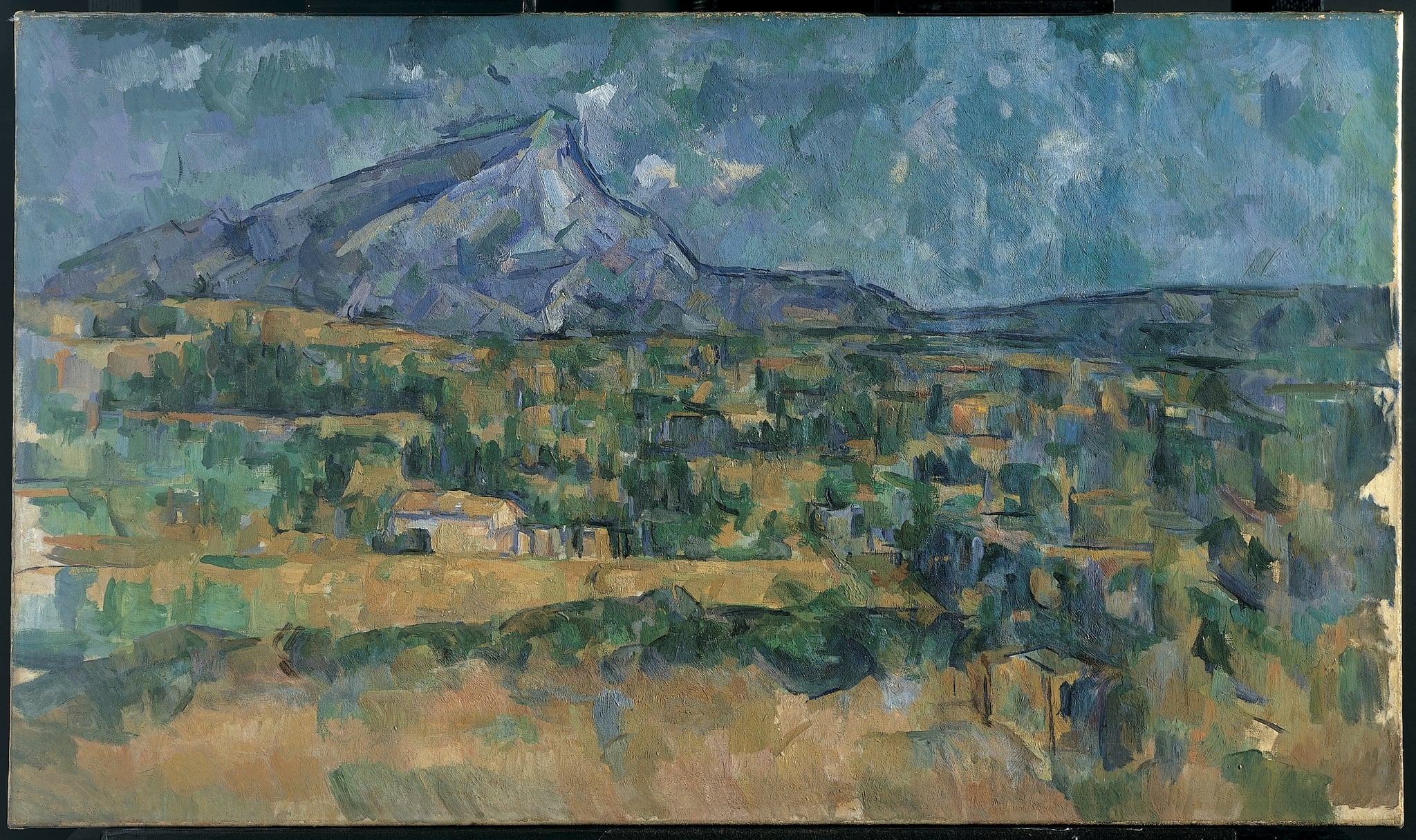
Mont Sainte-Victoire

Paul Cézanne (1902–1906)

Cézanne’s Mont Sainte-Victoire renders the Provençal massif as a constructed order of <strong>planes and color</strong>, not a fleeting impression. Cool blues and violets articulate the mountain’s facets, while <strong>ochres and greens</strong> laminate the fields and blocky houses, binding atmosphere and form into a single structure <sup>[2]</sup><sup>[4]</sup>.