Most Expensive Andrew Wyeth Paintings
Andrew Wyeth occupies a singular place in the American art market: neither wholly modernist nor purely regional, his paintings command institutional reverence and robust collector demand because they combine technical exactitude, emotional restraint, and an evocative sense of place. At the apex sits Christina’s World, routinely valued in the $100–150 million range and emblematic of Wyeth’s ability to transform a simple scene into an almost mythic meditation. A tier below, canvases like Day Dream (about $20–28 million) and Ericksons ($13–22 million) underscore how narrative intimacy and provenance drive competitive bidding, while Above the Narrows ($10–18 million) and The Intruder ($8–12 million) demonstrate the market premium for works that crystallize Wyeth’s sparse, haunting aesthetic. Even pieces with broader price bands—Wind from the Sea ($3,000,000–$12,000,000), Maidenhair ($500,000–$2,500,000), Trodden Weed ($300,000–$1,200,000), Adam ($250,000–$1,000,000) and Black Velvet ($250,000–$800,000)—are collectible for their rarity, condition and exhibition history. Whether driven by museums, foundations or private patrons, Wyeth’s market standing reflects a rare combination of technical mastery, storytelling and cultural nostalgia.

$100-150 million
Held by MoMA since 1949, its $100–150M estimate is derived from Wyeth’s tempera auction record and top‑tier American Realist trophy‑sale benchmarks.

$20-28 million
Anchored to Christie’s $23,290,000 sale on 2022‑11‑10 and Helga‑sitter provenance, this estimate reflects exhibition history and typical volatility for top‑tier Wyeth temperas.
$13.0-22.0 million
Christie’s 2007 $10,344,000 Ericksons sale and its Virginia Museum of Fine Arts accession anchor the $13.0–22.0M present‑day market estimate.

$10.0M–$18.0M
Christie’s $6,914,500 2009 result for Above the Narrows serves as the primary anchor for the $10.0–18.0M estimate after market adjustments.
$8-12 million
Christie’s $5.75M 2007 realized price anchors the $8–12M estimate for The Intruder, with condition or provenance gaps pushing it toward the low end.
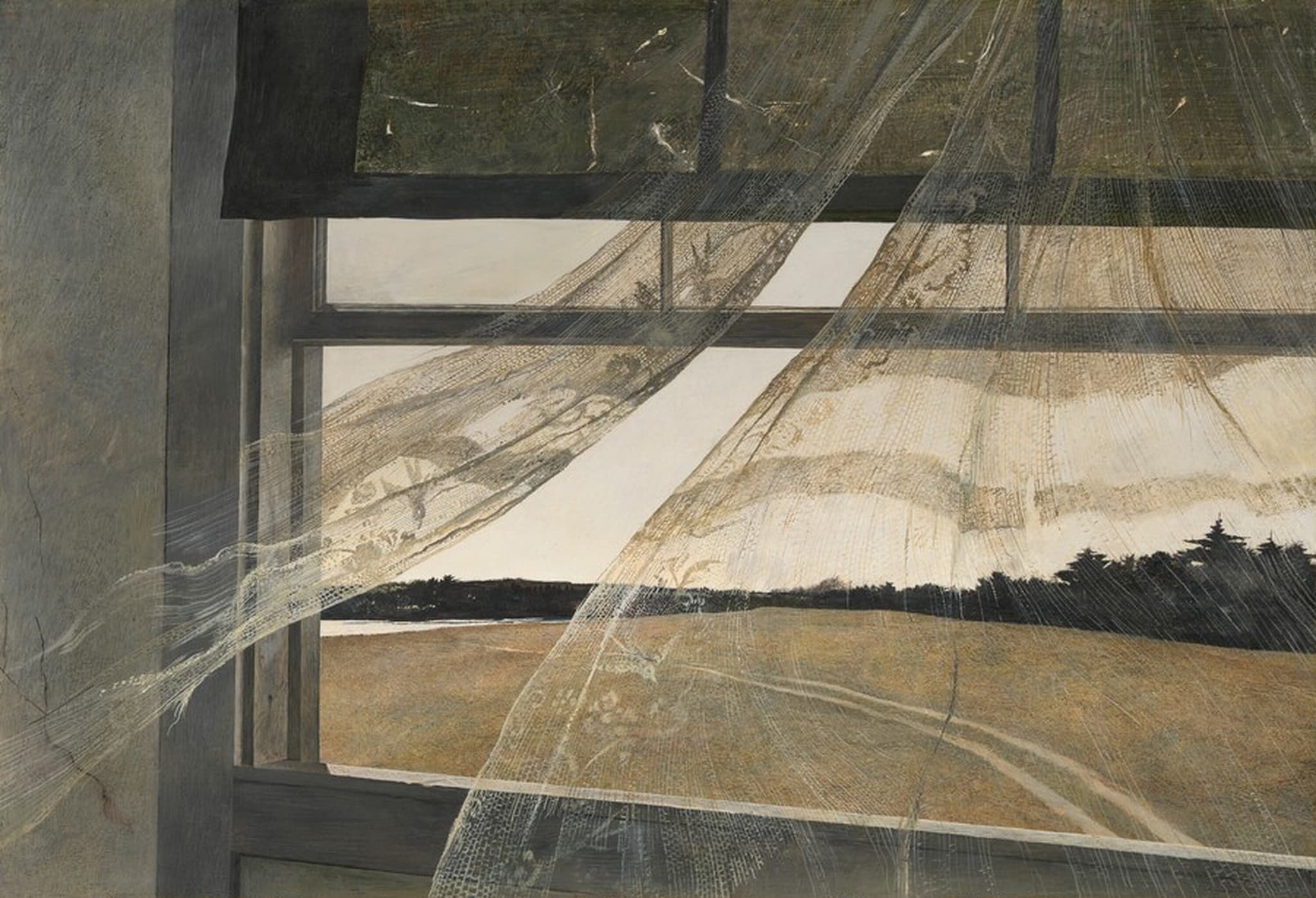
$3,000,000–$12,000,000
Its canonical status and National Gallery of Art ownership mean Wind from the Sea, offered as a museum‑quality tempera, could realistically command $3–12M depending on condition and sale format.
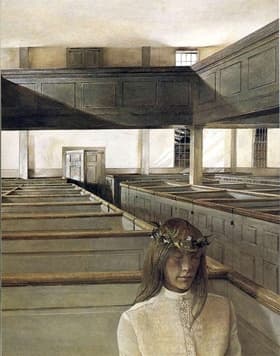
$500,000–$2,500,000
Documented Wyeth/Foundation provenance and tempera‑on‑panel comparables place Maidenhair in a $500K–2.5M auction band, determined mainly by size, condition, and catalogue/literature presence.

$300,000-$1,200,000
Confirmed Wyeth‑family provenance and museum‑loan exhibition history support a $300K–1.2M estimate for Trodden Weed, moderated by its modest 20×18.25″ size and lack of auction record.
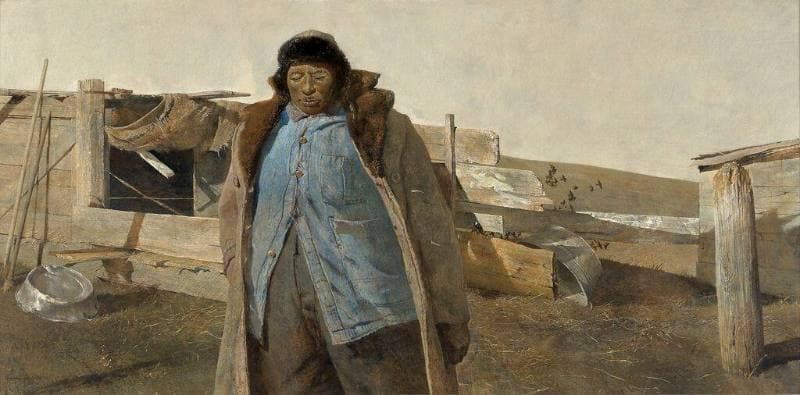
$250,000–$1,000,000
Held by the Brandywine River Museum with no public auction record, Adam’s $250K–1M hypothetical range is based on medium, dimensions, and institutional provenance.
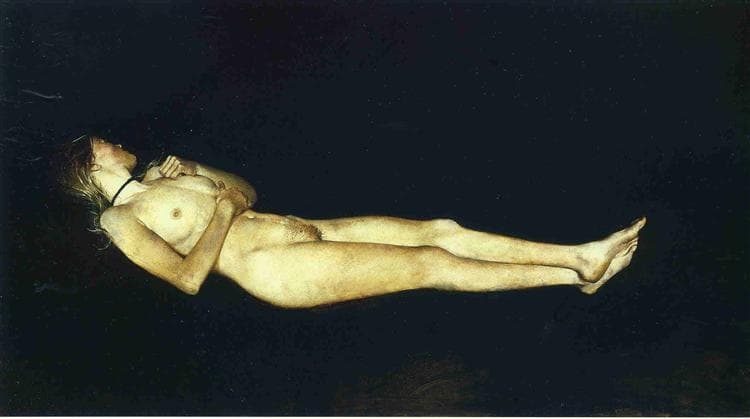
$250,000–$800,000
Based on Helga works‑on‑paper comparables and documented exhibition history, Black Velvet’s $250K–800K estimate reflects size, medium, and absence of a public‑sale record.
What Drives Value in Andrew Wyeth's Work
Egg tempera on panel and peak-period temperas
Wyeth’s market is dominated by egg‑tempera panels produced in his peak periods: late 1940s–1960s and mature later temperas. Works like Christina’s World (1948), Above the Narrows (1960) and Ericksons (1973) show that tempera panels—because they exemplify Wyeth’s signature technique—sit at the top of his price spectrum. Auction evidence (Day Dream as a tempera record) and repeated premium pricing for temperas show medium and period are primary, artist‑specific determinants.
Iconic image status and cultural recognition
Certain Wyeth images function as cultural touchstones whose name recognition creates a trophy premium uniquely large for this artist. Christina’s World is the paradigmatic example—museum ownership plus global recognition elevates hypothetical pricing well above typical Wyeth comparables. Similarly, highly recognized compositions from his oeuvre (major temperas reproduced in monographs) draw broader buyer pools and atypical bidding dynamics for Wyeth, pushing top examples into entirely different market bands.
Sitter/series provenance (the Helga effect)
Authenticated works tied to a single, famous sitter or series—most importantly the Helga paintings—command outsized interest in Wyeth’s market. Day Dream (a Helga tempera) established a market ceiling for Helga panels, while Helga drybrush pieces like Black Velvet still carry a material premium versus unrelated studies. The Helga cache’s narrative and exhibition history make authenticated Helga works relatively scarce and highly sought among Wyeth collectors, often trumping other comparable attributes.
Museum ownership, exhibition history and market scarcity
Institutional provenance is unusually powerful for Wyeth because many of his best temperas are museum‑held (MoMA’s Christina’s World, NGA’s Wind from the Sea, VMFA’s Ericksons, Crystal Bridges’ promised gifts). Museum accession both validates scholarship and removes works from circulation, creating scarcity. When a museum deaccessions or a museum‑validated work appears, competitive bidding and institutional interest frequently push realizations far above normal Wyeth comparables.
Market Context
Andrew Wyeth maintains a durable, tiered auction market: his 2022 tempera Day Dream (Christie’s) set the record at $23.29 million and underscored continued appetite for museum‑quality temperas, while works on paper provide deep, liquid mid‑market trading in the mid‑five to low‑six‑figure range. Recent years saw a post‑2022 normalization with a 2024 high‑end contraction but firmer confidence during marquee 2025 sales; demand remains strongest for Chadds Ford and coastal Maine subjects. Institutional ownership and scholarship—from Brandywine and the VMFA to the Farnsworth—support long‑term interest, but top results are driven case‑by‑case by provenance, exhibition history, condition and sale timing. Overall the market is disciplined and reliable: steady mid‑market liquidity with temperas achieving premiums when offered as museum‑quality trophies.