How Much Is Silver Car Crash (Double Disaster) Worth?
Last updated: February 24, 2026
Quick Facts
- Last Sale
- $105.4M (2013, Sotheby's New York)
- Methodology
- comparable analysis
Current fair market value for Andy Warhol’s Silver Car Crash (Double Disaster) is estimated at $120–180 million (buyer’s premium–inclusive). This range is anchored by the work’s own $105.445 million auction result in 2013 and reinforced by the $85.35 million achieved by a closely related 1963 Car Crash in 2022, while pricing below the $195 million Marilyn record.
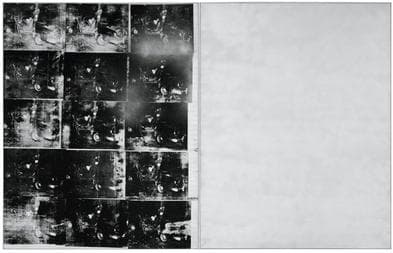
Silver Car Crash (Double Disaster)
Andy Warhol, 1963 • Silkscreen ink and silver spray paint on canvas; diptych
Read full analysis of Silver Car Crash (Double Disaster) →Valuation Analysis
Conclusion: Based on direct sale history for this exact painting, closely related series results, and the current appetite for museum-caliber Pop masterpieces, the fair market value of Andy Warhol’s Silver Car Crash (Double Disaster), 1963, is $120–180 million (inclusive of buyer’s premium). This is a trophy-level, museum-grade work from Warhol’s seminal Death and Disaster cycle, combining monumental scale with the rare diptych format and the signature silver field.
Primary anchors: The definitive benchmark is the same painting’s auction at Sotheby’s New York on November 13, 2013, at $105,445,000 with fees, setting Warhol’s record at the time [1]. A recent in-series proxy—White Disaster (White Car Crash 19 Times) (1963)—achieved $85,350,500 at Sotheby’s in November 2022, confirming deep demand for A+ Car Crash pictures even in a selective market [2]. The artist’s current high-water mark, Shot Sage Blue Marilyn (1964) at $195,000,000 (Christie’s, May 2022), establishes an upper bound for blue-chip 1960s Warhol icons and situates Silver Car Crash just below the Marilyn tier yet at the apex of the Death and Disaster canon [3].
Rarity, significance, scale: Executed in the prime Warhol year of 1963, Silver Car Crash (Double Disaster) is among the largest and most important Car Crash works. Its diptych structure—one panel an austere silver “void,” the other a repeating catastrophic image—embodies the series’ conceptual core and is rarer than single-panel formats. At its last public appearance, it was described as the last work of its scale in private hands, with sister works in major institutions, a scarcity that commands a premium over other high-value Warhol subjects [1].
Market context: Although the broader top-end auction market cooled in 2023–2024, the late‑2025/2026 environment shows renewed selectivity favoring canonical, historically anchored masterpieces. The Art Basel & UBS Global Art Market reporting underscores that while overall volumes fluctuated, liquidity remained for singular, best-in-class works—precisely the profile of this picture [4]. Against that backdrop, the 2013 result for this exact work, the 2022 White Disaster comp, and the Marilyn ceiling triangulate a robust nine-figure range today.
Key sensitivities: Outcome will pivot on condition (especially silkscreen passages and silver spray fields), provenance presentation, and sale strategy (venue, third‑party guarantee, and timing). Exemplary condition and multiple engaged trophy buyers could push results above midpoint; any restoration or surface instability may compress pricing. Strategically staged, this work should attract cross‑category bidders and institutions, justifying the $120–180 million bracket.
Key Valuation Factors
Art Historical Significance
High ImpactCreated in 1963, Silver Car Crash (Double Disaster) sits at the heart of Warhol’s Death and Disaster series, widely regarded as one of the most important bodies of work in postwar art. The diptych’s tense dialogue between a repeated catastrophic image and a silver ‘void’ panel captures Warhol’s core concerns—mass media, repetition, trauma, and spectatorship. Its monumental scale and rigorous composition make it a canonical statement on violence and image culture. Within Warhol’s oeuvre, it ranks immediately after the Marilyns and Soup Cans in cultural salience, and at the pinnacle within the Car Crash subset. This level of art-historical centrality consistently commands premiums from both private collectors and institutions.
Rarity and Scale
High ImpactThe work’s sheer size (approximately 105 x 164 inches overall) and rare diptych construction distinguish it even within the top tier of 1963 Disaster pictures. Sister works of comparable scale reside in museum collections, and at the time of its 2013 sale, this painting was described as the last of its magnitude in private hands. That scarcity meaningfully elevates value versus single‑panel Car Crashes or later-period icons: collectors seeking an A+ museum-caliber Warhol have very few opportunities at this level. With supply this constrained, pricing is set less by incremental comparables and more by the willingness of a handful of global buyers to compete for a truly singular object.
Market Evidence and Comps
High ImpactThree anchors triangulate today’s value: (i) this exact painting achieved $105.445 million in 2013, establishing a durable floor for a masterpiece of this caliber; (ii) the closely related White Disaster (1963) realized $85.35 million in 2022, confirming depth for A+ Car Crash works in a selective market; and (iii) the 2022 $195 million Marilyn provides an upper bound for prime 1960s Warhols. Cross‑series 1960s icons such as Triple Elvis and Four Marlons in the $70–80+ million range further support a nine‑figure context. Together, these data points justify a premium positioning for Silver Car Crash within a $120–180 million bracket today.
Provenance, Condition, and Sale Strategy
Medium ImpactThe painting’s distinguished provenance and prior high-profile sale enhance credibility and buyer confidence, but present-day condition is decisive. Stability of the silkscreen layers, the silver spray paint fields, and the diptych joins should be verified via a current condition report and imaging. At this echelon, marketing, timing, and a well-calibrated third‑party guarantee can shift outcomes by tens of millions. In exemplary condition, with global outreach and strong pre-sale positioning, competitive bidding can lift the result above the midpoint of the range; conversely, material conservation or title issues could compress pricing closer to the lower bound.
Sale History
Sotheby's New York (Contemporary Art Evening Sale)
Andy Warhol's Market
Andy Warhol remains a blue‑chip bellwether with deep global liquidity across paintings, works on paper, and prints. While the artist’s overall auction peaks often track macro cycles, demand for prime 1960s subjects—Marilyns, Flowers, and Death & Disaster—has stayed robust, with the 2022 $195 million Marilyn cementing his standing at the very top of the market. Prints and multiples provide steady velocity and on‑ramps for new collectors, while unique works from the early 1960s are increasingly supply‑constrained. Institutions and leading private collections continue to prioritize best‑in‑class examples with ironclad provenance and exhibition histories. In short, quality and series matter most; when they align, Warhols still command intense competition and nine‑figure potential.
Comparable Sales
Silver Car Crash (Double Disaster)
Andy Warhol
Identical work; same medium, scale, date and series. Direct anchor for current valuation.
$105.4M
2013, Sotheby's New York
~$144.9M adjusted
White Disaster (White Car Crash 19 Times)
Andy Warhol
Same 1963 Death & Disaster series and car‑crash subject; monumental, museum‑grade example sold recently.
$85.4M
2022, Sotheby's New York
~$93.3M adjusted
Green Car Crash (Green Burning Car I)
Andy Warhol
Key 1963 Car Crash from the same Death & Disaster corpus; long‑standing benchmark price for the subject.
$71.7M
2007, Christie's New York
~$110.7M adjusted
Triple Elvis [Ferus Type]
Andy Warhol
Same early‑1960s peak period; large‑scale, instantly recognizable trophy with deep market following; cross‑series anchor.
$81.9M
2014, Christie's New York
~$110.8M adjusted
Four Marlons
Andy Warhol
Mid‑1960s icon with comparable ‘trophy’ status and scale; useful cross‑series price reference for top 1960s Warhols.
$69.6M
2014, Christie's New York
~$94.1M adjusted
Shot Sage Blue Marilyn
Andy Warhol
Artist’s 1964 masterpiece and all‑time Warhol auction record; sets an upper bound for prime 1960s Warhol valuations.
$195.0M
2022, Christie's New York
~$213.3M adjusted
Current Market Trends
The top end of the Post‑War and Contemporary market has been selective since 2023, with fewer blockbuster consignments and greater emphasis on quality, provenance, and pricing discipline. By late 2025 and into 2026, confidence improved for museum-grade trophies, and private sales gained share. Blue-chip canon—particularly iconic 20th‑century works—continues to attract cross‑category buyers when staged with guarantees and global marketing. In this context, a prime 1963 Warhol Disaster of monumental scale fits current demand: rare, institutionally validated, and culturally indelible. Execution risk remains in timing and strategy, but buyer depth for singular Warhol masterpieces persists.
Study print
Study this painting as a print
Pair the full artwork with a museum-style study sheet focused on one meaningful detail.