How Much Is Figure with Meat Worth?
Last updated: June 3, 2026
Quick Facts
- Methodology
- comparable analysis
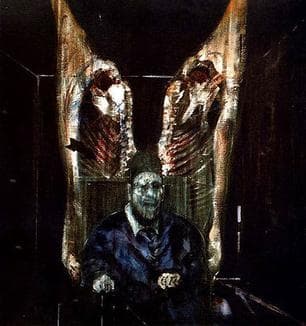
Figure with Meat (1954) is held in the Art Institute of Chicago and has no modern public auction record. If hypothetically offered, a reasoned preliminary market estimate is USD 40,000,000–80,000,000; the final outcome would depend on condition, provenance/deaccession constraints, sale venue and market timing.
Valuation Analysis
Scope and context: This valuation treats Francis Bacon's Figure with Meat (1954) as a hypothetical market offering. The work is in the permanent collection of the Art Institute of Chicago (accession no. 1956.1201) and has no recorded modern auction sale, so the analysis below relies on public comparables, exhibition/provenance indicators and standard market conventions for canonical mid‑century single‑panel Bacons [1].
Comparable evidence: Bacon's auction ceiling is set by triptychs (e.g., Three Studies of Lucian Freud, Christie’s 2013), while single‑panel heads, popes and portrait studies have recently traded in the multi‑tens of millions. Representative single‑panel comparables include high‑quality sales in the ~$30M–$55M band; notably Study for Portrait of Lucian Freud (1964) realized in the low‑to‑mid $50M range at Sotheby’s in 2022, demonstrating that single panels can reach the low‑fifties with optimal condition and provenance [2]. Figure with Meat’s 1954 date, canonical subject (Velázquez/Pope motif combined with the carcass/meat motif) and museum provenance position it toward the upper tier of single‑panel comparables.
Why USD 40–80M: The lower bound (≈USD 40M) reflects scenarios with condition issues, restrictive donor/deaccession constraints, subdued buyer turnout or an off‑peak sale format. The upper bound (≈USD 80M) assumes excellent documented condition, clean and compelling provenance, no legal or donor restrictions, top‑tier evening‑sale placement and robust competitive bidding from both private and institutional buyers. The range recognizes that while Bacon triptychs occupy the absolute top market bracket, museum‑prominent single panels can attract aggressive bids that push them above typical single‑panel medians.
Principal value drivers and risks: The critical determinants are (1) the conservation/condition record (relinings, retouching, structural integrity), (2) any donor covenants or legal restraints tied to deaccession, (3) sale format and seasonality, and (4) the presence or absence of multiple competing deep‑pocket bidders. Each of these can swing a final price materially; condition and provenance are especially impactful.
Recommended next steps: To convert this preliminary band into a sale‑grade appraisal, obtain the museum’s full accession and conservation records, commission a technical condition report, and solicit pre‑sale estimates from the postwar/modern specialists at Christie’s, Sotheby’s and Phillips. If you require a formal insurance or replacement figure, engage a credentialed appraiser or the museum’s insurer for a written valuation.
Conclusion: Based on public comparables, subject importance and institutional provenance, the responsible preliminary market estimate today is USD 40,000,000–80,000,000. This is an evidence‑based, conservative to optimistic band that remains contingent on the condition/provenance and sale circumstances described above.
Key Valuation Factors
Art Historical Significance
High ImpactFigure with Meat (1954) occupies an important place in Bacon's mid‑1950s practice, combining his adaptation of Velázquez’s 'Pope' iconography with the visceral carcass/meat motif that recurs in his work of that period. The painting is widely reproduced in Bacon literature and appears in major exhibition histories, which amplifies scholarly recognition and collector desirability. Works that are both visually iconic and demonstrably central to an artist’s development attract institutional attention and confident private buyers. Scholarly prominence therefore supports a premium relative to less documented or derivative single panels: it raises both the floor (by reducing attribution/title risk) and the potential ceiling (by increasing competitive bidding).
Provenance & Museum Ownership
High ImpactOwnership by the Art Institute of Chicago (Accession no. 1956.1201) confers immediate provenance clarity and institutional validation—both positive for market perception. At the same time, museum ownership makes market availability unlikely and, if a deaccession were proposed, could introduce legal, donor and reputational constraints that limit buyer pools and attract public scrutiny. In market terms this is double‑edged: institutional provenance generally supports higher estimates when selling, but deaccession mechanics can cap competitive dynamics or force controlled sale scenarios. For valuation, clean museum provenance elevates demand expectations but sale feasibility must be confirmed.
Condition & Conservation
High ImpactTechnical condition is frequently the single most decisive variable for high‑value works. Structural issues (tears, distortions), historical relinings, invasive inpainting, or unstable paint layers materially reduce buyer confidence and can lower market estimates by tens of percent. Conversely, an unambiguous conservation record and recent conservation work performed to museum standards will support higher presale estimates and stronger bidding. A complete technical assessment (including x‑ray/infrared if needed) is a prerequisite for any sale‑grade estimate and can move a valuation materially in either direction.
Market Comparables & Auction Evidence
High ImpactBacon’s auction market shows clear tiering: triptychs occupy the highest bracket (often >US$80M–>US$140M) while single‑panel heads and popes typically trade in the US$30M–US$55M band in recent major‑house sales. Several single‑panel works have achieved low‑to‑mid‑fifties at auction in strong markets. Figure with Meat’s date, subject matter and museum provenance map it to the upper end of the single‑panel cohort; accordingly comparables support an expectation that, absent adverse factors, it would realistically compete within the proposed US$40–80M band.
Market Liquidity & Timing
Medium ImpactHigh‑end liquidity and buyer appetite vary with macroeconomic conditions, auction calendar placement and competing offers. Canonical Bacons remain desirable to a narrow group of deep‑pocket collectors and institutions; selling during a high‑visibility season in New York or London with active pre‑sale interest maximizes outcomes. Conversely, off‑season timing, geopolitical/currency instability, or constrained liquidity among ultra‑high net worth buyers can compress realized prices. Private treaty sales are an alternative but depend on access to strategic buyers; timing and venue selection are therefore important tactical considerations.
Sale History
Figure with Meat has never been sold at public auction.
Francis Bacon's Market
Francis Bacon is a blue‑chip post‑war artist with a deep, tiered market. His triptychs set the auction ceiling (records in the high tens to low hundreds of millions), while high‑quality single panels consistently realize multi‑tens of millions. Demand is driven by scarcity of canonical works, institutional collecting priorities and a concentrated private collector base. Auction houses and private dealers actively compete for top examples; provenance and condition are decisive. Overall, Bacon’s market is robust but stratified: top triptychs command the peak prices, and well‑documented canonical single panels occupy a very strong mid‑market.
Comparable Sales
Three Studies of Lucian Freud
Francis Bacon
Bacon's auction record — a high‑profile triptych that demonstrates the top ceiling for Bacon at auction; useful to show triptych premium versus single panels.
$142.4M
2013, Christie's New York
~$197.5M adjusted
Triptych (1976)
Francis Bacon
Major‑house triptych sale from 2008 — reinforces that triptychs command substantially higher prices than single panels.
$86.3M
2008, Sotheby's New York
~$129.4M adjusted
Triptych Inspired by the Oresteia of Aeschylus (1981)
Francis Bacon
Recent (2020) high‑value triptych sale showing continued demand for Bacon triptychs in major auctions.
$84.5M
2020, Sotheby's New York
~$105.5M adjusted
Study for Portrait of Lucian Freud (1964)
Francis Bacon
High‑quality single‑panel Bacon; directly comparable in format and market tier to Figure with Meat — shows single panels can reach low‑to‑mid $50M nominally.
$52.7M
2022, Sotheby's London
~$58.1M adjusted
Study for a Head (1952)
Francis Bacon
Early‑1950s single‑panel head study — similar period/subject to Figure with Meat and demonstrates single panels clearing ~$50M in strong markets.
$50.4M
2019, Sotheby's New York
~$63.7M adjusted
Pope with Owls (c.1958)
Francis Bacon
Mid‑range single‑panel sale (late 1950s) — useful as a lower‑end single‑panel comparable to show market banding within the 1950s works.
$33.0M
2021, Phillips New York
~$39.3M adjusted
Current Market Trends
Blue‑chip post‑war/modern art remains selective but resilient: canonical works continue to attract global bidders, though broader macroeconomic volatility (interest rates, liquidity) can reduce transaction frequency and compress some outcomes. Auction houses emphasize curated evening sales and private‑treaty transactions; buyers are selective and competitive for museum‑quality pieces. For Bacon, museum‑quality, well‑provenanced works retain strong appeal but realized prices will be sensitive to timing and buyer liquidity.
Study print
Study this painting as a print
Pair the full artwork with a museum-style study sheet focused on one meaningful detail.