How Much Is Study for Portrait of Pope Innocent X Worth?
Last updated: June 3, 2026
Quick Facts
- Insurance Value
- $200.0M (Author's estimate (replacement value))
- Methodology
- comparable analysis
Study after Velázquez’s Portrait of Pope Innocent X (1953) by Francis Bacon is an A+ ‘Screaming Pope’ and one of the most iconic single canvases in postwar art. If it were to come to market, a fair auction-context estimate is $120–180 million, reflecting an icon-and-scarcity premium that could surpass any prior price for a single-panel Bacon and potentially challenge the artist’s overall auction record.
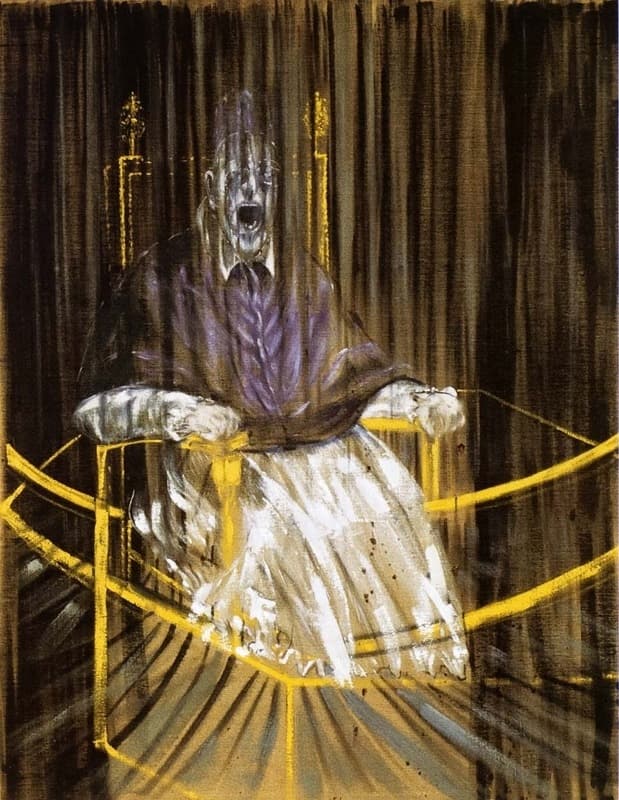
Study for Portrait of Pope Innocent X
Francis Bacon, 1953 • Oil on canvas
Read full analysis of Study for Portrait of Pope Innocent X →Valuation Analysis
Conclusion: A fair-market, auction-context estimate for Francis Bacon’s Study after Velázquez’s Portrait of Pope Innocent X (1953; Des Moines Art Center; CR 53-02) is $120–180 million. This is a flagship, early ‘Screaming Pope’—arguably the most recognized single-image in Bacon’s oeuvre—held in a U.S. museum with stellar provenance and publication history [1].
Method: The range is derived from top single-panel Bacon comparables, anchored by the strongest recent one-panel results ($52.8m for Study for Portrait of Lucian Freud, 1964; $52.16m for Figure in Movement, 1976) and the longer-standing $70.0m Portrait of George Dyer Talking (1966), then adjusted upward for subject/icon status, period primacy (early 1950s), and scarcity [3][5][7]. Within the same iconography, a 1956 ‘Pope’ achieved $27.55m in 2007—about $42m in today’s dollars—confirming baseline demand for the theme even at lesser significance than the 1953 Des Moines canvas [6]. The unsold but ambitiously estimated 2017 ‘Red Pope’ (published at £60–80m) further signals where the trade pitches prime papal imagery in the current era [4].
Why this sits at the very top of Bacon’s single-canvas market: The 1953 Des Moines Pope is a canonical, museum-grade image from Bacon’s defining series, painted at the peak moment when the Velázquez paradigm fused with Bacon’s cage, curtain, and scream leitmotifs. Among single panels, it occupies the same cultural tier as the artist’s highest-profile triptychs. Bacon’s overall auction record remains $142.4m for the 1969 Freud triptych [2]; however, this particular Pope’s art-historical weight and ubiquity in scholarship and reproduction justify an icon premium that plausibly extends the top end of single-panel pricing into nine figures, bridging toward the triptych record band.
Market positioning and execution: Blue-chip, masterpiece-grade Bacons consistently attract globally diversified demand, guarantees, and cross-category buyers. While 2024–2026 sales showed selective bidding for mid-tier works, best-in-class trophies continued to clear strongly; the 2023 $52.16m single-panel result underscores current depth at the high end [5]. Given the subject, date, and institutional cachet, a fully marketed sale would likely secure a third-party guarantee near the midpoint of the range and aim higher on competitive bidding.
Caveat: The work is museum-held and has no public auction history; this is a market-informed indication, not a formal appraisal. Replacement (insurance) value would typically be set above FMV to reflect irreplaceability.
Key Valuation Factors
Art Historical Significance
High ImpactThis 1953 ‘Screaming Pope’ is among the most reproduced and discussed images of the 20th century, a fulcrum of Bacon’s project to re-make portraiture through psychological intensity. It crystallizes his dialogue with Velázquez while asserting a wholly modern icon: the enthroned figure dissolved by fear, confinement, and motion. Scholarship consistently places this canvas at the center of Bacon’s legacy; it is the work many viewers and collectors picture when they think of Bacon. Its presence in countless books, exhibitions, and surveys ensures cross-generational recognition that translates into superior bidding depth and enduring value, distinct from more episodic market fashion. As a canonical image, it commands an icon premium.
Period and Subject Quality
High ImpactPainted in 1953, this canvas sits in Bacon’s prime early-1950s period, when the visual grammar of cages, veils, and the scream reached maturity. Among Pope variants, the Des Moines work is a fully resolved, large-format single panel that synthesizes the essential elements—throne, curtains, vibration, and the existential cry. Works from this narrow window carry a notable premium versus later iterations. The ‘Pope’ subject itself is the signature theme by which Bacon is known globally, akin to Picasso’s Harlequin or Warhol’s Marilyn. In valuation terms, a prime-year, A+ example of this subject outranks nearly all single-panel alternatives, including most 1960s portraits, in cultural charge and collector priority.
Scarcity and Provenance
High ImpactTrue substitutes for this painting are effectively unavailable. The best early-1950s Popes are locked in institutions or long-held private collections. The Des Moines canvas carries exemplary provenance—from early UK gallery ownership to major U.S. collectors and then into a museum collection—plus extensive publication and exhibition histories. Museum ownership confers an additional scarcity premium because such works very rarely re-enter the market; if one did, it would be treated as a once-in-a-generation opportunity by top buyers. This scarcity underpin is one reason valuation extends well beyond typical single-panel comparables and supports a range that can challenge the artist’s top benchmarks even without the triptych’s scale.
Market Comparables and Pricing Power
High ImpactRecent single-panel Bacons have achieved $52–53m (1964 Lucian Freud portrait; 1976 Figure in Movement), while the long-standing 2014 Portrait of George Dyer Talking reached about $70m. Within the same iconography, a 1956 Pope sold for $27.55m in 2007 (≈$42m today), indicating durable demand for the theme across cycles. The 2017 ‘Red Pope’ was pitched at £60–80m despite going unsold, showing where the trade positions top papal imagery. Against these benchmarks, the 1953 Des Moines Pope merits a substantial icon-and-scarcity uplift, justifying a nine-figure estimate that sits between the strongest single-panel results and Bacon’s $142.4m triptych record, with potential to surpass the latter in a perfect competitive scenario.
Sale History
Study for Portrait of Pope Innocent X has never been sold at public auction.
Francis Bacon's Market
Francis Bacon is a blue-chip, postwar master with deep institutional support and a global collector base. His auction record is $142.4 million for Three Studies of Lucian Freud (1969) at Christie’s New York (2013), among the highest prices ever achieved for postwar art. Single-panel trophies have repeatedly sold in the $50–70 million zone, including Study for Portrait of Lucian Freud (1964) at £43.4m/$52.8m and Figure in Movement (1976) at $52.16m. Demand concentrates around canonical subjects (Popes, Freud, Dyer) and prime periods (early 1950s; mid-1960s). While day-to-day bidding can be selective, masterpiece-grade Bacons continue to attract guarantees and international competition, with private sales often used for top lots.
Comparable Sales
Study for Portrait II (1956) [Pope]
Francis Bacon
Closest subject/period match: single-panel 'Pope' from the mid-1950s, directly tied to the Velázquez Innocent X lineage.
$27.5M
2007, Christie's London
~$42.3M adjusted
Portrait of George Dyer Talking (1966)
Francis Bacon
Landmark single-panel portrait; long the benchmark price for a Bacon single panel, indicating the ceiling for iconic imagery.
$70.0M
2014, Christie's London
~$94.1M adjusted
Study for Portrait of Lucian Freud (1964)
Francis Bacon
Record-level single-panel Bacon in recent years; canonical subject and closest recent trophy for a single canvas.
$52.8M
2022, Sotheby's London
~$57.5M adjusted
Figure in Movement (1976)
Francis Bacon
Recent high-price single-panel Bacon; strong late-period benchmark for single-canvas demand.
$52.2M
2023, Christie's New York
~$54.4M adjusted
Portrait of George Dyer Crouching (1966)
Francis Bacon
Recent single-panel portrait of a marquee sitter; shows 2024 price sensitivity yet robust demand for prime subjects.
$27.7M
2024, Sotheby's New York
~$28.3M adjusted
Three Studies of Lucian Freud (1969) [Triptych]
Francis Bacon
Artist auction record; though a triptych (format difference), it anchors trophy-level appetite for Bacon’s most iconic imagery.
$142.4M
2013, Christie's New York
~$194.5M adjusted
Current Market Trends
The postwar British/School of London segment has remained a resilient pillar of the blue‑chip market. After the broader art market softened in 2024, late‑2025 and early‑2026 evening sales showed stabilizing demand and renewed depth for high-quality consignments. For Bacon specifically, recent headline prices for single panels clustered in the $16–28m band, with standout exceptions near $50m+, reflecting tighter risk appetite but solid liquidity. Trophy-caliber, museum-grade works still command strong guarantees and cross-category bidding, while mid-tier material faces disciplined pricing. In this context, an A+ early‑1950s ‘Screaming Pope’ would be treated as a once‑in‑a‑generation offering and priced at a premium that reaches into the nine‑figure range.
Study print
Study this painting as a print
Pair the full artwork with a museum-style study sheet focused on one meaningful detail.
Sources
- Des Moines Art Center — eMuseum: Study after Velázquez’s Portrait of Pope Innocent X (1953)
- CNBC — Bacon triptych sells for record $142.4 million
- The Independent — Francis Bacon’s Study for Portrait of Lucian Freud sells for £43.4m (Sotheby’s London, 2022)
- Artsy — Christie’s notches $84 million sale despite no takers for $60 million Bacon (2017 Red Pope estimate)
- Christie’s — Marquee Week New York results (Figure in Movement, 1976, $52,160,000)
- Christie’s Press Release (Feb 8, 2007) — Study for Portrait II (1956) achieves £14,020,000 ($27,549,300)
- Christie’s Press (Feb 13, 2014) — Portrait of George Dyer Talking achieves £42,194,500 (~$70,042,870)