Study for Portrait of Pope Innocent X

by Francis Bacon

Francis Bacon’s Study for Portrait of Pope Innocent X converts a seat of power into a cage of panic: a pontiff pinned in a golden space‑frame, mouth wrenched open beneath a torrent of vertical strokes. Violets, blacks, and acidic yellows turn vestments into a shroud, while the white robe flares like a spectral residue.

Study Print Studio

Create a personal study print

Build a companion study sheet around the part of this painting that speaks to you most. Choose a detail, shape an interpretation, and walk away with something personal and display-worthy.

Fast Facts

Year
1953
Medium
Oil on canvas
Dimensions
153 x 118 cm
Location
Des Moines Art Center, Des Moines, Iowa
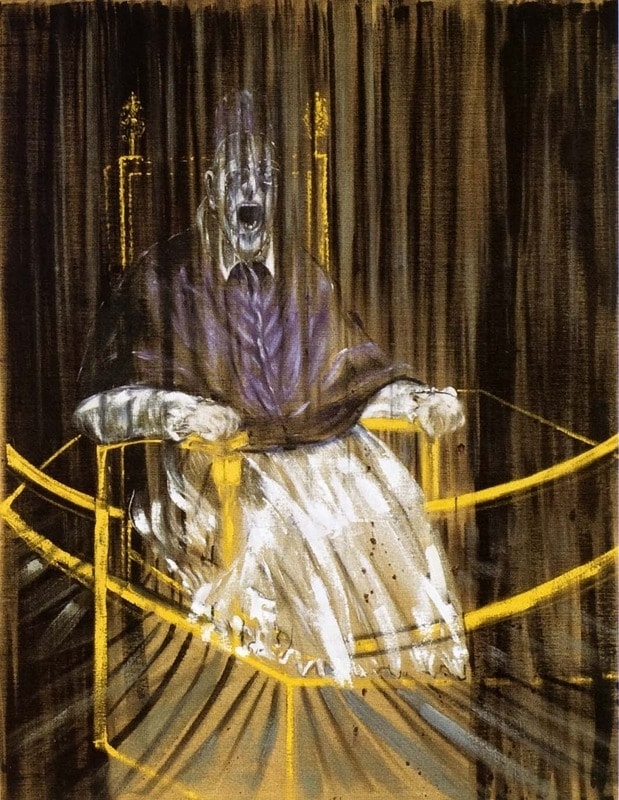
Study for Portrait of Pope Innocent X by Francis Bacon (1953) featuring Yellow space-frame (cage), Vertical veil/drips, Open mouth (silent scream), Throne and gripped armrests

Click on any numbered symbol to learn more about its meaning

Meaning & Symbolism

Bacon weaponizes the apparatus of portraiture against its usual function. The bright yellow perspective lines that scaffold the chair do not stabilize sovereign presence; they diagram a vitrine‑prison that clinically displays and simultaneously confines the sitter 5. The pope’s forearms clutch the armrests as if bracing against an impact, but those supports are absorbed into the same geometric circuitry that traps him, converting the throne into a device of subjugation. Across the head and torso, Bacon drags heavy vertical strokes—curtain, rain, or bars—so that the figure is both staged and strangled by visibility. This downpour of paint interferes with recognition: the face dematerializes into greys and violets, the jaw cranks open, and the mouth becomes a black aperture that emits a silent scream—audible to the eye, but smothered by the enclosing frame and veil 146. Where liturgical purple should guarantee sanctity, Bacon stains it until it reads as bruise; where papal white should promise purity, it flares like a ghostly after‑image, skidding across the lap in slashed highlights and drips. The black field is not empty background but an active pressure that pushes the body forward while the curtain pushes it back, suspending the figure in a contradictory weather of forces—a hallmark of Bacon’s “logic of sensation” 6. By choosing this subject, Bacon challenges the historical authority of Velázquez’s Innocent X, a canonical emblem of papal self‑possession. He famously worked from reproductions rather than the original, freeing him to dismantle the model’s poise and recompose it as raw affect 147. The scream, linked to Bacon’s archive of photographic and cinematic shocks, overrides speech and doctrine alike; it is not a story but an event that grips the nervous system 46. In this conversion, the pope becomes an everyman of modernity—a body isolated under institutional display and technological glare, more patient than potentate. The yellow cage evokes the modern booth, the glass box, the clinical frame, while the rain‑curtain recalls theater machinery; together they turn the chapel into a stage of exposure, a place where ritual can no longer cover over contingency and fear 358. What remains is a paradox: the more spectacular the presentation—the gleaming armature, the spotlighted whites—the more naked the vulnerability it reveals. That is the core of the meaning of Study for Portrait of Pope Innocent X: it insists that beneath regalia and ceremony lies fragility, and that power itself may be a posture held against the pressure of inarticulate forces. This is also why Study for Portrait of Pope Innocent X is important: it set a benchmark for postwar figurative painting, showing how an image can wrest authority from its pedestal and return it, trembling, to the human condition 1348.

Explore Deeper with AI

Ask questions about Study for Portrait of Pope Innocent X

Popular questions:

Powered by AI • Get instant insights about this artwork

💬 Ask questions about this artwork!

Interpretations

Medium Reflexivity: Appropriation as Re-Authorship

Bacon’s title announces the maneuver: “Study after Velázquez.” Working from reproductions rather than the Roman original, he treats the Old Master not as a sacrosanct template but as a pliable matrix to be unmade and remade. This mediated approach severs aura from object and foregrounds painting as an act of translation rather than transcription—an epistemic wager on copies over presence. The result is a portrait that bleeds the authority of Velázquez into a new regime of affect: smeared purples, a mouth unmoored from speech, and a stagey armature that confesses its own construction. In this sense, Bacon’s “after” is not derivative; it is re‑authoring through stress, abrasion, and delay—the modern image acknowledging that it arrives through screens before it reaches the canvas 123.

Source: The Estate of Francis Bacon; The Guardian (Cumming); Cleveland Museum of Art

Philosophy of Sensation: Forces, Not Forms

Following Deleuze, the painting is a theater of forces rather than a picture of things. Pigment is organized to transmit sensation: vertical striations produce vibratory fields; the black ground exerts pressure that seems to thrust the figure forward even as the curtain pushes back; the open mouth is not narrative but a pictorial event—a zone where flesh and background exchange intensities. Color becomes a logic: bruise‑violet against acidic yellow lines, whites that burn as after‑images. Space is diagrammed, not described; the cage is a set of vectors pinning sensation to a site. In this reading, Bacon’s pope is a nervous system exposed, where representation cedes to the direct hit of sensation—neither sacred portrait nor satire, but a machine for feeling the scream 4.

Source: Gilles Deleuze, Francis Bacon: The Logic of Sensation

The Space‑Frame: Display, Confinement, Surveillance

Rina Arya’s account of Bacon’s “space‑frame” clarifies how those bright yellow lines function as more than perspective: they are an apparatus that both locates and incarcerates the body. As a quasi‑modernist scaffold, the frame signals exhibition—think vitrine, glass booth, clinical bay—while its tight geometry produces psychic stasis. In the pope, the chair merges with this circuitry so thoroughly that support and restraint become indistinguishable. The figure is hyper‑visible yet unreachable, a specimen under conditions of modern surveillance. This double valence—display and detention—modernizes Velázquez’s throne into a mechanism that manufactures isolation, transforming papal presence into a study in captivity and control within a rigorously diagrammed room 510.

Source: Rina Arya, “Frames of meaning: the space‑frame in Bacon”; Des Moines Art Center

Cinematic Mouth: From Eisenstein to Painterly Scream

Bacon’s archive included film stills from Eisenstein’s Battleship Potemkin; the gaping “screaming nurse” becomes a transferable schema for affect. In the pope, the mouth detaches from speech and doctrine, becoming a dark aperture that broadcasts fear without sound. Scholarship notes how Bacon generalizes this cinematic shock into a painterly motif: the oral cavity as both wound and speaker, an organ of exposure intensified by glassy veils that mute acoustics even as they heighten visibility. The result is paradoxical: a silent scream that the eye “hears,” an affective short‑circuit where cinema’s instantaneity is slowed into the sticky time of oil paint—prolonging terror into an enduring image of modern anguish 27.

Source: The Guardian (Cumming); Neuroaesthetics study on Bacon’s sources (PMC)

Unsettling the Sacred: Liturgical Color, Veil, and Anti‑Epiphany

Read the work through theology and you find a counter‑liturgy. The papal purples are bruised, the whites glare like forensic light; the veil that should signify mystery becomes an obstruction, turning revelation into anti‑epiphany. As Oxford’s Literature & Theology analysis shows, Bacon scrambles the semiotics of Christian iconography: vesture no longer guarantees sanctity but advertises bodily vulnerability; the cathedralesque setting becomes a stage of exposure rather than a site of sacrament. Far from simple blasphemy, the image dramatizes the failure of ritual to contain contingency—the sacred is not abolished but rendered precarious, a flicker of faith buffeted by forces stronger than icon and office alike 8.

Source: Oxford Academic: Literature & Theology

Leadership as Isolation: The Burdened Sovereign

From a leadership‑studies perspective, Bacon’s pope models authority as alienation. Beatriz Acevedo contrasts Velázquez’s composed pontiff with Bacon’s enclosed, screaming figure to argue that institutional power entails burden and exposure rather than sheer charisma. The seat of command appears as a device that fixes the leader in place, the public glare transforming person into emblem and emblem into prisoner. Here, display does not consolidate legitimacy; it corrodes it, revealing a subject caught between performance and collapse. In postwar modernity, Bacon suggests, the leader is less sovereign than patient—a body subject to spectacle, organizational pressure, and the psychic costs of rule, a reading that resonates with the painting’s claustrophobic space‑frame 95.

Source: Beatriz Acevedo, Leadership (SAGE); Rina Arya

Related Themes

About Francis Bacon

Francis Bacon (1909–1992) was an Irish-born British painter whose postwar practice fused existential intensity with distorted figuration in claustrophobic interiors. A central figure of the School of London, he pursued serial formats and space-frames to probe sensation, chance, and psychological exposure [5].
View all works by Francis Bacon

More by Francis Bacon