Study from Innocent X

by Francis Bacon

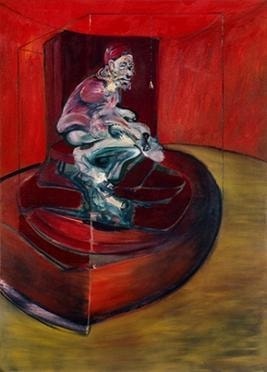
Francis Bacon’s Study from Innocent X recasts the papal portrait as an image of enthroned vulnerability. Hemmed by thin cage-lines on a curved stage-like dais, the red-suffused figure trembles between flesh and regalia, turning authority into exposure [1][3].

Study Print Studio

Create a personal study print

Build a companion study sheet around the part of this painting that speaks to you most. Choose a detail, shape an interpretation, and walk away with something personal and display-worthy.

Fast Facts

Year
1962
Medium
Oil on canvas
Dimensions
198 x 141.5 cm
Location
Private collection
Study from Innocent X by Francis Bacon (1962) featuring Cage-lines (vitrine), Curved stage-like dais, Open, smeared mouth (mute scream), Liquefied vestments/flesh

Click on any numbered symbol to learn more about its meaning

Meaning & Symbolism

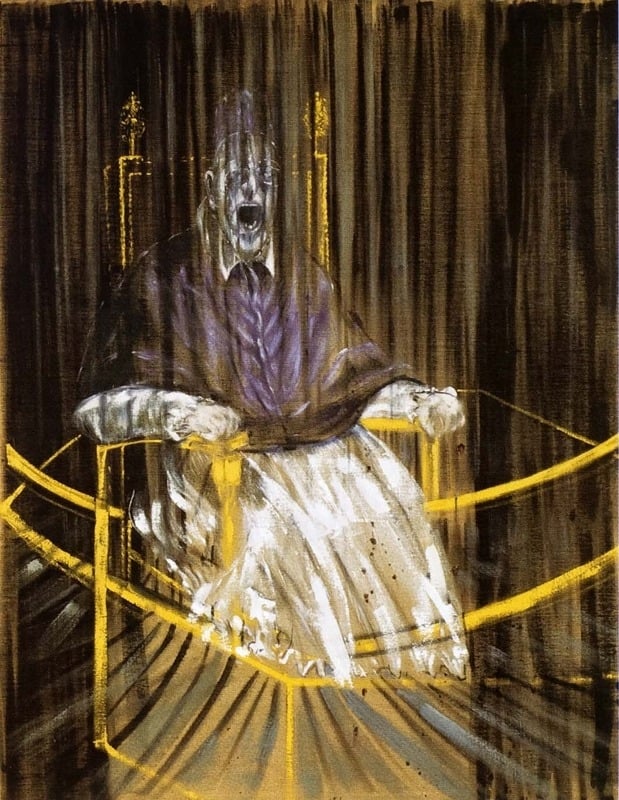
Study from Innocent X seizes the Baroque prototype and strips it of equanimity, staging a figure who is both enthroned and confined. The transparent, rectilinear cage-lines that skim the red walls and slice across the curved dais seal the Pope inside a display, transforming courtly presentation into containment. The dais itself—arched like a theatrical platform—doubles as a trap: it elevates while tightening the noose of visibility, forcing the body into exposure beneath a stark, clinical glare that flattens the surrounding red chamber. Within this enclosure, the face and hands lose anatomical certainty, dissolving into smears and gashes of paint; the open, dragged mouth reads as a mute scream, an affect Bacon sought to paint rather than any anecdotal horror. The vestments, instead of conferring dignity, cling like liquefied flesh; the seated body appears to quiver, half-skeletal, half-meat, a composite of authority and decay. The red field—ranging from velvet-curtain crimson to coagulated blood—overheats the space, compressing air and heightening claustrophobia. Bacon’s diagrammatic cage, as theorized by Deleuze, isolates the Figure from narrative while intensifying sensation, so that the painting does not tell a story; it conducts force directly to the nervous system 3. Neuroaesthetic accounts help explain why the blurred mouth and warped facial schema strike with such immediacy: they violate learned face-recognition patterns and trigger visceral alarm, amplifying the work’s shock without relying on illustrative gore 4. Against Velázquez’s composed statecraft, Bacon asserts a postwar allegory of authority under siege. Here, the chair, robes, and dais become instruments of exposure, turning pageantry into predicament. In leadership terms, Bacon shows the image of power as a machine that manufactures isolation: the more spectacular the staging, the more solitary and fragile the sitter becomes 56. This inversion is not satire but ontology—an insistence that modern power wears a mask that cannot contain anxiety, guilt, or mortality. The clinical light, the pooled black voids in the recesses of the set, and the tight geometry of the enclosure insist that nothing exists beyond this chamber of judgment; the world outside is inaccessible, the audience sealed off. By working from reproductions and imposing framing devices that mimic screens and vitrines, Bacon emphasizes mediation itself—the papal image as a copy in circulation, estranged from flesh yet returning obsessively to it 12. The painting’s achievement—and why Study from Innocent X is important—is to wrench a canonical symbol into the late twentieth century’s psychic climate, where spectacle exposes rather than protects, and where the marks of paint declare that sovereignty is only a temporary armature for a body that trembles. Bacon’s Pope does not govern space; he vibrates within it, held fast by the very apparatus that should guarantee his authority. The result is not blasphemy but metaphysics: a vision of power as a posture that cannot outlast sensation, a throne recast as a cage in which the human animal endures the light.

Explore Deeper with AI

Ask questions about Study from Innocent X

Popular questions:

Powered by AI • Get instant insights about this artwork

💬 Ask questions about this artwork!

Interpretations

Phenomenology of Sensation (Deleuze)

Rather than narrating ecclesial power, this canvas engineers a field of forces that seize the body. Deleuze argues Bacon’s rectilinear enclosures function as a “diagram” that extracts the Figure from story into pure sensation, converting the papal type into a relay for pressures that buckle flesh—hence the shuddering hands, the open, dragged mouth, and the charged chromatic field. The so‑called cage is less prison than a conductor that intensifies presence: it “places” the body while short‑circuiting mimesis, so the picture “does not tell a story; it conducts force directly to the nervous system.” The 1962 work radicalizes this by fusing stage, dais, and glare into an apparatus of impact, where color behaves like temperature and the mouth becomes a site of unvoiced energy, a “scream” without anecdote 2.

Source: Gilles Deleuze, Francis Bacon: The Logic of Sensation

Neuroaesthetics: Why Bacon’s Faces Shock

Neuroscientific accounts help explain the painting’s visceral jolt. Human face perception relies on stable configural cues; Bacon’s smeared facial schema, displaced mouth, and blurred hands violate those predictive templates, triggering error signals linked to alarm and arousal. The effect is immediate and pre‑reflective—viewers register a bodily response before cognition supplies meaning. Crucially, such shock does not depend on gore; it stems from the systematic derangement of facial regularities and limb articulations, intensified by a saturated, near‑monochrome red ground that narrows attentional bandwidth to the Figure. This aligns with Bacon’s aim to paint the “scream” rather than horror: the work targets perception itself, making sensation the subject while the papal signifiers (chair, mozzetta) merely scaffold the neural hit 32.

Source: Frontiers in Human Neuroscience (Cinzia Di Dio et al.); Gilles Deleuze

Mediation and the Afterlife of Images

Bacon’s refusal to study the Velázquez in Rome and his reliance on reproductions recast this Pope as a mediated entity—“the papal image as a copy in circulation.” Flattened color zones, screen‑like cages, and vitrine effects simulate mechanical distance, acknowledging how authority now travels as photography and print. The painting thus behaves as medium reflexivity: an image about images, where citation and degradation of source become content. Seen against 1960s mass media, the work interrogates authorship and aura by stressing translational noise—how copying both estranges and reanimates a canonical type. The result is neither homage nor parody but a studio‑bound remake that treats mediation as the Pope’s new habitat, a chamber where sovereignty persists only as repeatable surface 17.

Source: The Estate of Francis Bacon (Catalogue Raisonné); Guggenheim Bilbao Teachers’ Guide

Leadership Imagery and the Crisis of Authority

Read through leadership studies, Bacon’s Pope images stage the spectacle of command as self‑undermining. The chair, robes, dais, and frontal illumination amplify display yet manufacture isolation, articulating a postwar skepticism toward institutional charisma. Rather than satiric caricature, the painting offers a structural allegory: the protocols that legitimate power (presentation, ritual, portraiture) also expose its fragility. This inversion—pageantry into predicament—anticipates late‑20th‑century media politics, where images of authority are endlessly copied, reframed, and contested. Bacon’s 1962 iteration, with its overheated crimson and vitrined geometry, visualizes authority’s performative stress test: the more it is staged, the more it trembles 614.

Source: Beatriz Acevedo, Leadership (SAGE); The Estate of Francis Bacon; Encyclopaedia Britannica

Theatricality, Display, and the Curved Set

The painting’s architecture reads as theater: a shallow, curved wall, a raised dais, and frontal glare. Period labels (“Red Pope on Dais,” “Man Dressed in Red on a Dais”) confirm how contemporaries registered this stagecraft. Yet Bacon twists theater into museology: the rectilinear “cage” doubles as a vitrine, suggesting the Pope is both actor and specimen. Such double coding collapses court ritual, lab display, and modern exhibition design, converting representation into exposure. The clinical light flattens depth, and the red field behaves like a curtain that never opens, suspending time into a continuous present. In this set, motion blur replaces gesture, and the enthroned body becomes an exhibit of vulnerability, not dominion 152.

Source: The Estate of Francis Bacon; Cleveland Museum of Art; Gilles Deleuze

Related Themes

About Francis Bacon

Francis Bacon (1909–1992) was an Irish-born British painter whose postwar practice fused existential intensity with distorted figuration in claustrophobic interiors. A central figure of the School of London, he pursued serial formats and space-frames to probe sensation, chance, and psychological exposure [5].
View all works by Francis Bacon

More by Francis Bacon