Francis Bacon
Biography
Themes in Their Work
Most Expensive Francis Bacon Paintings
Explore ranked valuations of Francis Bacon's most valuable works →
Featured Artworks
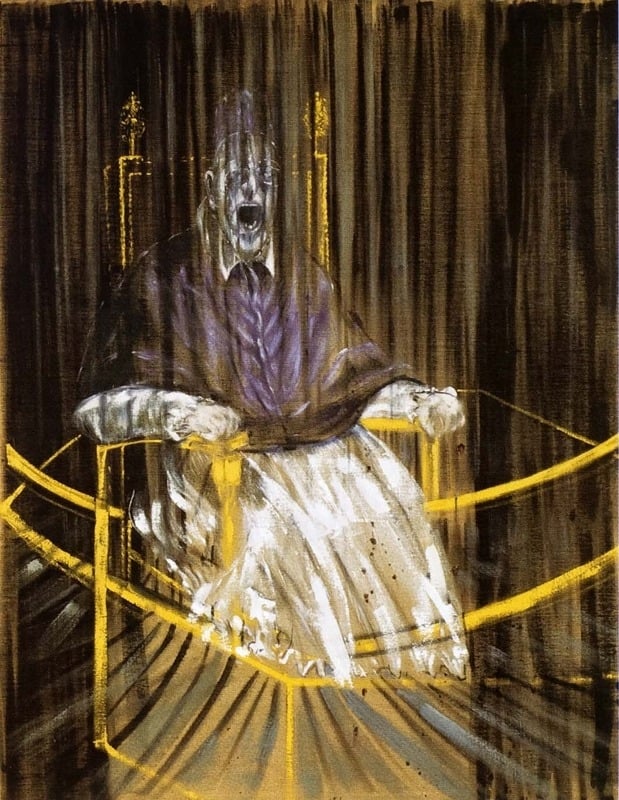
Study for Portrait of Pope Innocent X
Francis Bacon (1953)
Francis Bacon’s Study for Portrait of Pope Innocent X converts a seat of power into a <strong>cage of panic</strong>: a pontiff pinned in a golden <strong>space‑frame</strong>, mouth <strong>wrenched open</strong> beneath a torrent of vertical strokes. Violets, blacks, and acidic yellows turn vestments into a <strong>shroud</strong>, while the white robe flares like a spectral residue.
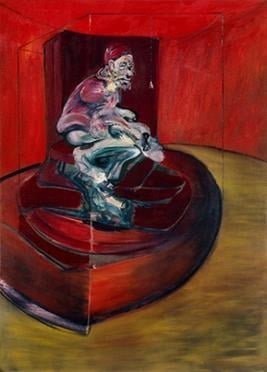
Study from Innocent X
Francis Bacon (1962)
Francis Bacon’s Study from Innocent X recasts the papal portrait as an image of <strong>enthroned vulnerability</strong>. Hemmed by thin <strong>cage-lines</strong> on a curved <strong>stage-like dais</strong>, the red-suffused figure trembles between flesh and regalia, turning authority into exposure <sup>[1]</sup><sup>[3]</sup>.
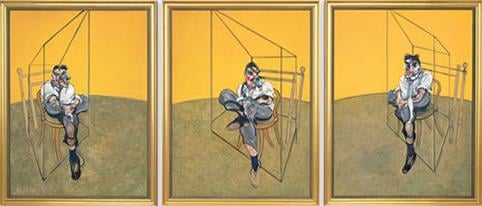
Three Studies of Lucian Freud
Francis Bacon (1969)
Francis Bacon’s Three Studies of Lucian Freud is a triptych that stages a friend-rival as a <strong>restlessly rotating presence</strong> within a geometric <strong>cage</strong> on a searing yellow ground. The smeared, mask-like head, crossed legs, rolled sleeves, and upturned brogues turn portraiture into a <strong>psychological performance</strong> rather than a likeness <sup>[2]</sup>.
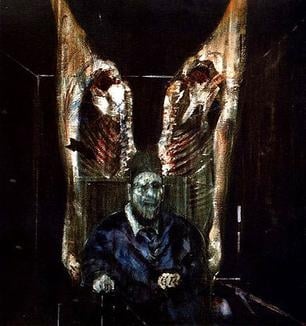
Figure with Meat
Francis Bacon (1954)
Francis Bacon’s Figure with Meat fuses a screaming pontiff with two flayed carcasses that hang like grotesque wings, locking power and flesh into the same dark box. Through <strong>cage-like lines</strong>, <strong>stage-lit isolation</strong>, and paint handled as <strong>raw meat</strong>, Bacon asserts a brutal equivalence: sanctity and sovereignty are only bodies destined to decay <sup>[1]</sup><sup>[2]</sup>.