Three Studies of Lucian Freud

by Francis Bacon

Francis Bacon’s Three Studies of Lucian Freud is a triptych that stages a friend-rival as a restlessly rotating presence within a geometric cage on a searing yellow ground. The smeared, mask-like head, crossed legs, rolled sleeves, and upturned brogues turn portraiture into a psychological performance rather than a likeness [2].

Study Print Studio

Create a personal study print

Build a companion study sheet around the part of this painting that speaks to you most. Choose a detail, shape an interpretation, and walk away with something personal and display-worthy.

Fast Facts

Year
1969
Medium
Oil on canvas
Dimensions
each panel: 197.8 × 147.6 cm
Location
Los Angeles County Museum of Art (LACMA), Los Angeles
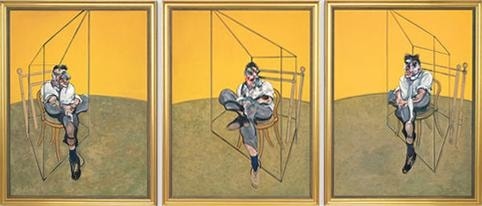
Three Studies of Lucian Freud by Francis Bacon (1969) featuring Geometric space-frame (cage), Cane-bottomed chair, Smeared, mask-like head, Crossed legs and upturned brogues (with navy socks)

Click on any numbered symbol to learn more about its meaning

Meaning & Symbolism

Bacon builds the image as a conflict between control and carnality. The crystalline space-frame, derived from studio furniture and photographic scaffolds, pins the seated figure like a specimen, mapping out an airless chamber where motion has coordinates and the gaze has jurisdiction 2. Within this rational cage, flesh becomes event: the head is dragged into a hybrid of mask and wound; the hands knot; the crossed legs torque into a defensive knot. Against the saturated yellow and ochre ground, which reads as a spotlit stage or convex arena, the sitter’s rolled sleeves, navy socks, and upturned brogues thrust outward, brazen and precarious at once 2. The cane-bottomed chair functions like a disciplinary device—support and restraint in one—so that every fidget registers as resistance. Bacon’s paint is not descriptive; it is procedural and performative, consolidating accident and intention to clinch an image that feels both seized and slipping away 2. The triptych format refuses a single truth. Bacon’s serial logic—left panel turning toward, center fronting the viewer, right panel hunching or turning away—rotates the sitter through anxious time, so that identity appears as a set of provisional stances rather than a stable core 2. This echoes the altarpiece without endorsing religion: the scale and threefold structure confer an aura of consecration while dismantling the unity that altarpieces traditionally guarantee 24. The result is a portrait as interrogation: three consecutive examinations under studio lights. Bacon’s reliance on photographs (notably John Deakin’s sessions with the sitter) sharpens this forensic mood; the studio becomes a lab where memory, rivalry, and desire are processed into images 23. Yet even as the cage orders space, the paint convulses: smeared features contradict the cage’s promise of clarity, insisting that what matters is not likeness but exposure, not recognition but pressure. The viewer is conscripted into this pressure, made to shuttle between panels, to test and retest the face that refuses to settle. In postwar Britain, where figuration had to justify itself against abstraction, Bacon answers by turning figure painting into an experiment in sensation. The yellow ground’s assertive flatness nods to the modern field, but Bacon contaminates it with human jeopardy—scuffs, arcs, and the curved horizon that cups the body like a stage or arena 2. The linear frame, often read as Bacon’s signature “space-frame,” does not simply trap; it charges the body, as if the figure were a coiled spring straining against its geometry 2. What looks like confinement becomes a generator of presence. In Three Studies of Lucian Freud, Bacon converts camaraderie and competition into pictorial voltage, proving that the portrait can still tell the truth—so long as truth is admitted to be multiple, time-bound, and subject to the violence of looking 129.

Explore Deeper with AI

Ask questions about Three Studies of Lucian Freud

Popular questions:

Powered by AI • Get instant insights about this artwork

💬 Ask questions about this artwork!

Interpretations

Photographic Mediation (Forensic Seeing)

Rather than painted from life, the triptych metabolizes John Deakin’s studio photographs into a composite of vantage points and props—the cane chair, the bed’s headboard—re-coded as linear scaffolds and spatial grids. This photographic dependency inflects the mood of interrogation: the studio reads as a lab where body, memory, and rivalry are processed under controlled conditions. Bacon’s practice of isolating and recombining negatives introduces a logic of selection, splicing, and delay, so that each panel feels like a print pulled from an ongoing experiment. The result is a portrait premised on evidence, not essence—on procedural proof rather than confession—tightening the work’s clinical atmosphere while explaining its serial restlessness and minute pose-shifts 23.

Source: Christie’s 2013 catalogue essay; Francis Bacon Estate

Liturgical Form Without Belief

Bacon’s triptych borrows the altarpiece armature—scale, threefold rhythm, frontal address—while refusing transcendence. As he told Sylvester, his commitment was to serial balance and visual testing, not doctrine. Yet form performs despite intention: the hinged sequence functions like secular stations of the face, conferring a quasi-devotional tempo to looking. Repetition here is not prayer but pressure: an empirical ritual that consecrates the act of viewing even as it dismantles unity. Exhibited and read within retrospective frames, the triptych stages a modern rite in which spectators shuttle panel to panel, adjudicating a truth that never consolidates. It is an altarpiece of contingency, sanctifying experiment rather than faith 26.

Source: Christie’s 2013 catalogue essay; Yale Center for British Art (1999 retrospective context)

Material Procedure as Subject

Bacon’s claim that his paint is procedural and performative names the work’s core reflexivity: facture is not a vehicle for likeness but the event that produces sensation. Dragged impastos, smeared cranial masks, and crisp diagrammatic lines are counter-programmed to collide, pitching viscera against geometry. This calibrated contingency—accident stabilized by armature—turns the canvas into a site where method is dramatized. In doing so, Bacon aligns figuration with the postwar stakes of medium-specific inquiry: he absorbs the chromatic field and stage-flatness of contemporaries while insisting on human jeopardy as the field’s charge. The sitter becomes the pretext for testing how paint can clinch an image at the brink of dissolution 2.

Source: Christie’s 2013 catalogue essay

Rivalry as Motor of Form

The work condenses a decade-plus of camaraderie and competition between Bacon and Freud into a tense choreography: crossed legs torque into defense, shoes jut like counters in a duel, the head smears where recognition would normally stabilize. Rivalry here is not anecdote but engine—an affect that structures pose, pacing, and even the triptych’s prosecutorial sequence. Contemporary accounts of their Soho entanglements, and later estrangement, clarify how mutual scrutiny sharpened each painter’s tactics. In Bacon’s case, competitive looking produces a portrait that withholds appeasement: a face refused, multiplied, and pressured, as if pitting artist and sitter (and, by extension, two painting programs) in a trial of means under studio lights 28.

Source: Christie’s 2013 catalogue essay; The Guardian (on Bacon–Freud rivalry)

Stagecraft and Chromatic Engineering

The saturated yellow/ochre ground doubles as stage and device: a convex arena that cups the body while flattening depth into a color field. Bacon exploits this field to heighten the figure’s risk—scuffs and arcs convert the plane into a sensor that registers every twitch. Christie’s links the golden palette to memories and to contemporaneous bullfight works, situating the triptych within a late-1960s turn to bold, theatrical chroma. The space-frame acts as lighting rig and proscenium, synchronizing Bacon’s dramaturgy of restraint with modernist flatness. Color here is not atmosphere; it is a pressure system that charges the figure as a live wire against an ostensibly indifferent ground, fusing stagecraft with sensation 27.

Source: Christie’s 2013 catalogue essay; University of Hull repository (space-frame scholarship)

Related Themes

About Francis Bacon

Francis Bacon (1909–1992) was an Irish-born British painter whose postwar practice fused existential intensity with distorted figuration in claustrophobic interiors. A central figure of the School of London, he pursued serial formats and space-frames to probe sensation, chance, and psychological exposure [5].
View all works by Francis Bacon

More by Francis Bacon