Figure with Meat
Study Print Studio
Create a personal study print
Build a companion study sheet around the part of this painting that speaks to you most. Choose a detail, shape an interpretation, and walk away with something personal and display-worthy.
Fast Facts
- Year
- 1954
- Medium
- Oil on canvas
- Dimensions
- 129 × 122 cm
- Location
- Art Institute of Chicago, Chicago
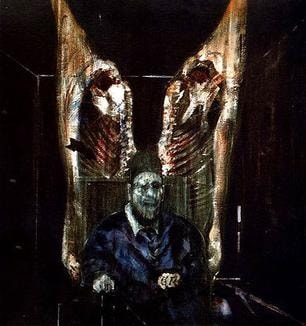
Click on any numbered symbol to learn more about its meaning
Meaning & Symbolism
Explore Deeper with AI
Ask questions about Figure with Meat
Popular questions:
Powered by AI • Get instant insights about this artwork
Interpretations
Historical Genealogy of Flesh
Source: Art Institute of Chicago; The Estate of Francis Bacon (Soutine/Bacon); Philadelphia Museum of Art (Rembrandt)
Stagecraft and the Specimen
Source: Art Institute of Chicago
Material Flesh: Facture as Ontology
Source: Art Institute of Chicago; The Estate of Francis Bacon (Soutine/Bacon)
The Cinematic Mouth and Neuro-Viscera
Source: Frontiers in Human Neuroscience; The Estate of Francis Bacon (Eisenstein source)
Negative Theology of Power
Source: Oxford University Press (Literature and Theology); Art Institute of Chicago
Related Themes
About Francis Bacon
More by Francis Bacon
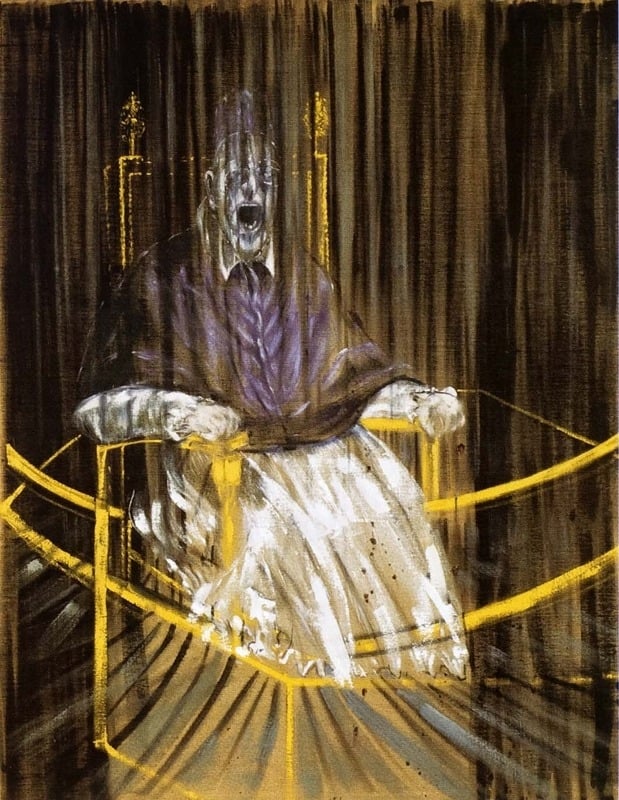
Study for Portrait of Pope Innocent X
Francis Bacon (1953)
Francis Bacon’s Study for Portrait of Pope Innocent X converts a seat of power into a <strong>cage of panic</strong>: a pontiff pinned in a golden <strong>space‑frame</strong>, mouth <strong>wrenched open</strong> beneath a torrent of vertical strokes. Violets, blacks, and acidic yellows turn vestments into a <strong>shroud</strong>, while the white robe flares like a spectral residue.
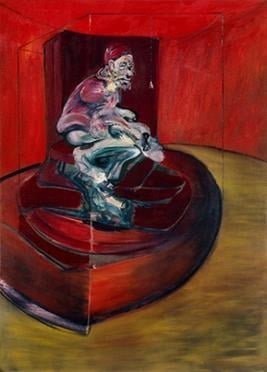
Study from Innocent X
Francis Bacon (1962)
Francis Bacon’s Study from Innocent X recasts the papal portrait as an image of <strong>enthroned vulnerability</strong>. Hemmed by thin <strong>cage-lines</strong> on a curved <strong>stage-like dais</strong>, the red-suffused figure trembles between flesh and regalia, turning authority into exposure <sup>[1]</sup><sup>[3]</sup>.
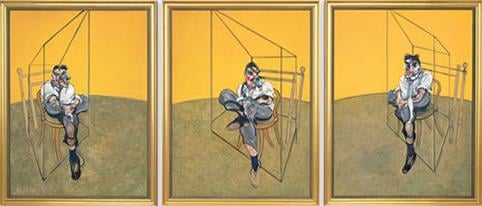
Three Studies of Lucian Freud
Francis Bacon (1969)
Francis Bacon’s Three Studies of Lucian Freud is a triptych that stages a friend-rival as a <strong>restlessly rotating presence</strong> within a geometric <strong>cage</strong> on a searing yellow ground. The smeared, mask-like head, crossed legs, rolled sleeves, and upturned brogues turn portraiture into a <strong>psychological performance</strong> rather than a likeness <sup>[2]</sup>.