How Much Is Three Studies of Lucian Freud Worth?
Last updated: June 3, 2026
Quick Facts
- Last Sale
- $142.4M (2013, Christie's New York)
- Methodology
- comparable analysis
Francis Bacon’s Three Studies of Lucian Freud (1969) is the artist’s definitive masterpiece and still his auction record, having sold for $142.4 million at Christie’s in 2013. Adjusted for inflation and supported by continued strength for top-tier Bacon triptychs and Freud subjects, a present fair‑market indication is $180–230 million.
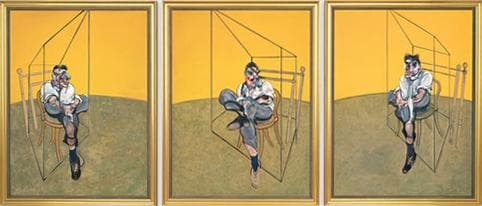
Three Studies of Lucian Freud
Francis Bacon, 1969 • Oil on canvas
Read full analysis of Three Studies of Lucian Freud →Valuation Analysis
Overview and anchor. Francis Bacon’s Three Studies of Lucian Freud (1969) remains the apex of the Bacon market and an icon of post‑war figurative painting. It set the artist’s standing auction record at Christie’s New York on November 12, 2013, achieving $142,405,000 with premium [1][2], with the buyer widely reported as Elaine P. Wynn [3]. In 2025, LACMA announced the work’s bequest and accession; it is now in the museum’s collection and on view [4]. This estimate therefore represents a hypothetical fair‑market range should the triptych re‑enter private trade.
Methodology. We anchor value to the last public price and adjust for time and market. On a CPI basis, $142.4m in late 2013 equates to roughly ~$203m in mid‑2026 dollars [8]. We then test that anchor against recent Bacon benchmarks: the only large, life‑size triptych to trade recently—Triptych Inspired by the Oresteia of Aeschylus (1981)—made $84.6m in 2020, reinforcing nine‑figure appetite for major triptychs even in a disrupted year [5]. Demand for prime Freud material remains deep: Study for Portrait of Lucian Freud (1964) fetched £43.4m (~$52.6m) in 2022 [6], while a small 1964 Freud head triptych achieved $30m later that year [7]. A prime‑period Self‑Portrait (1969) realized $34.62m in 2023, underscoring the period premium [9].
Positioning and drivers. The 1969 Lucian Freud triptych outranks these comparables on every axis that the market rewards: subject (Bacon’s closest peer and rival), format (monumental, life‑size triptych), period (late 1960s peak), cultural visibility, and market leadership (still the artist’s record) [1]. Supply of truly equivalent Bacon triptychs is vanishingly thin; when major triptychs do surface, they command a structural premium over single panels and small head triptychs. The work’s museum‑level prominence and now‑canonical status amplify buyer confidence and trophy appeal [4].
Range selection. Balancing the inflation‑adjusted 2013 anchor (~$203m), the demonstrated pricing hierarchy for Bacon triptychs versus single panels, and the sustained global demand for canonical post‑war trophies, an indicative fair‑market range today is $180–230 million. The low end reflects a conservative trophy floor under normalized liquidity; the high end contemplates robust competitive tension (including third‑party guarantee dynamics), favorable macro conditions, and currency tailwinds. Given its unmatched status within Bacon’s oeuvre, this work would be positioned to challenge the artist’s absolute high watermark if sold in optimal conditions [1][5][6][7][8][9].
Key Valuation Factors
Art Historical Significance
High ImpactThe triptych is one of Bacon’s most important and best-known images, depicting Lucian Freud—his friend, rival, and a central figure in post-war British art. Executed at life-size scale across three panels in 1969, it synthesizes Bacon’s signature concerns—distortion, psychological intensity, and the drama of the human figure—at the height of his powers. Its prominence in scholarship, reproduction, and exhibition history cements it as a canonical portrait of the 20th century. This unique combination of sitter, format, and period places it at the summit of Bacon’s oeuvre and confers lasting cultural cachet that translates directly into market leadership.
Scarcity of Equivalent Works
High ImpactLarge, life-size Bacon triptychs of top-tier subjects are exceptionally rare in private hands, and their supply is structurally limited. When major triptychs do surface, they attract deep competition, reflecting their status as the artist’s most prestigious format. By contrast, single panels and small head triptychs—though desirable—are more frequently available and price far lower. This scarcity dynamic creates a durable premium for museum-caliber triptychs like Three Studies of Lucian Freud, supporting a valuation far above the already-strong mid-eight-figure results seen for secondary formats and subjects.
Comparable Market Evidence
High ImpactThe work’s own 2013 price of $142.4m remains Bacon’s auction record and serves as a firm anchor. Inflation-adjusted to mid-2026, that baseline is approximately $203m. Recent evidence reinforces the hierarchy: the 1981 Oresteia triptych brought $84.6m (2020); a 1964 Lucian Freud single panel reached ~£43.4m/$52.6m (2022); and a small 1964 Freud head triptych made $30m (2022). These comparables, while strong, sit clearly below the 1969 life-size Freud triptych in subject, scale, and renown, supporting a current nine-figure estimate with headroom for a new peak in the right conditions.
Provenance, Exhibition, and Visibility
Medium ImpactThe triptych’s widely reported acquisition by Elaine P. Wynn after the 2013 sale and its 2025 bequest to LACMA have ensured exceptional visibility and institutional validation. Its consistent museum context and public display strengthen brand recognition and scholarly standing—factors that increase confidence among trophy buyers. While museum ownership limits near-term marketability, the work’s provenance narrative and curatorial endorsement would be accretive to value if it were hypothetically deaccessioned under optimal governance and sale structures.
Sale History
Christie's New York
Price includes buyer's premium; hammer $127,000,000; presale guidance around $85m; consignor listed as Acquavella LLC; buyer widely reported as Elaine P. Wynn.
Francis Bacon's Market
Francis Bacon is a blue‑chip, internationally collected post‑war master whose market is anchored by a handful of museum‑caliber triptychs and prime‑period portraits. His standing auction record is $142.4m (2013) for this very work. The upper tier of the market remains selective but robust: the monumental Oresteia triptych made $84.6m in 2020, while prime subjects like Lucian Freud and George Dyer consistently perform at the top of the single‑panel segment, typically in the $20–55m range depending on period, size, and quality. Recent seasons show resilient demand for best‑in‑class Bacons, with buyer depth from the US, Europe, and the Middle East. Supply—not appetite—is the main constraint for true masterpieces.
Comparable Sales
Triptych Inspired by the Oresteia of Aeschylus
Francis Bacon
Monumental, life-size triptych by Bacon; closest market proxy for large-format triptychs. Later period and different subject but strong indicator of pricing for A+ triptych format.
$84.6M
2020, Sotheby's New York
~$105.8M adjusted
Study for Portrait of Lucian Freud
Francis Bacon
Same sitter (Lucian Freud), prime mid-1960s period. Single-panel portrait evidencing the premium for the Freud subject.
$52.6M
2022, Sotheby's London
~$58.1M adjusted
Three Studies for Portrait of Lucian Freud
Francis Bacon
Same sitter and triptych structure; small-format head triptych versus the monumental 1969 work. Direct subject-and-format comp, scaled down.
$30.0M
2022, Sotheby's New York
~$33.0M adjusted
Self-Portrait
Francis Bacon
Prime-period 1969 work (same year), highly coveted subject category (self-portrait). Smaller single-panel format provides a period/quality benchmark.
$34.6M
2023, Christie's New York
~$36.8M adjusted
Three Studies for Portrait of Henrietta Moraes
Francis Bacon
Small-format 1960s portrait triptych of a signature sitter. Useful to triangulate the market for head triptychs versus the life-size 1969 Freud triptych.
$27.2M
2022, Sotheby's London
~$30.0M adjusted
Portrait of George Dyer Crouching
Francis Bacon
Prime subject (George Dyer) single-panel from the 1960s. Benchmarks demand for top-tier portrait subjects outside triptych format.
$27.7M
2024, Sotheby's New York
~$28.6M adjusted
Current Market Trends
The post‑war/School of London segment has stabilized after a 2023–2024 reset, with 2025 showing renewed growth at the very high end. Buyers have pivoted toward established blue‑chip names and historically important works, and the number of $10m+ lots has rebounded alongside tighter consignment curation. Within this context, canonical, institutionally recognized trophies—especially rare formats—continue to command strong competition and premium pricing. Bacon’s market exemplifies this selectivity: mid-tier works price rationally, while exceptional triptychs and prime 1960s portraits remain intensely contested, supported by global liquidity and third‑party guarantee structures at major houses.
Study print
Study this painting as a print
Pair the full artwork with a museum-style study sheet focused on one meaningful detail.
Sources
- Christie’s Post‑War & Contemporary Evening Sale Results (Nov 12, 2013)
- Forbes: The Most Expensive Art Ever Sold at Auction—Christie’s Record‑Breaking Sale
- CNBC: Revealed—Buyer of $142.4 Million Bacon Painting
- LACMA Press Release: Bacon’s Three Studies of Lucian Freud Bequeathed to LACMA (Sept 9, 2025)
- Bloomberg: Bacon Triptych Sells for $84.6 Million (June 30, 2020)
- Sotheby’s: A Jubilant Evening of Modern, Contemporary, and British Art (June 29, 2022)
- The Art Newspaper: Sotheby’s Contemporary Evening Auction, NY (Nov 17, 2022)
- U.S. Bureau of Labor Statistics Inflation Calculator
- Christie’s: May 2023 Marquee Week Results (Self‑Portrait, 1969)