How Much Is Study for Portrait (1977) Worth?
Last updated: June 3, 2026
Quick Facts
- Last Sale
- $49.8M (2018, Christie's New York)
- Methodology
- comparable analysis
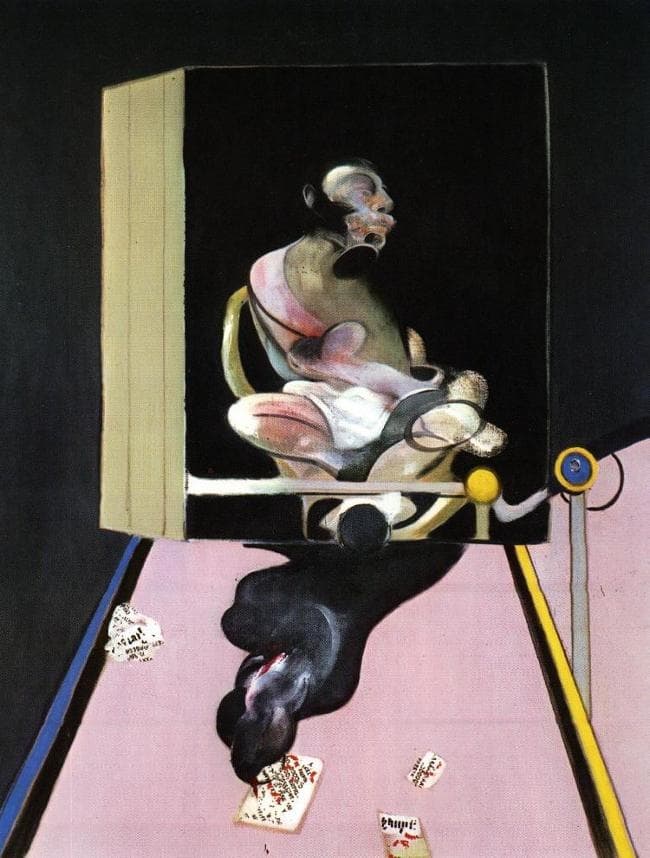
Based on the identical canvas' documented Christie’s sale (May 17, 2018, realized $49,812,500) and reinforced by high‑end single‑panel Bacon comparables, I value Francis Bacon’s Study for Portrait (1977) at $48–68M (as of June 2026). This range assumes catalogued status, clear Marlborough→Konow provenance and good condition.
Valuation Analysis
Valuation conclusion: I place the fair market value of Francis Bacon’s Study for Portrait (1977) at $48,000,000–$68,000,000 as of June 2026. The primary anchor is the identical canvas sold at Christie’s New York on 17 May 2018 (price realized $49,812,500), and the range is supported by later single‑panel Bacon comparables and prevailing market movement toward blue‑chip post‑war works [1][2].
Why this range: The 2018 Christie’s result for the same object provides direct, high‑quality price discovery; adjusting that result for inflation, auction house market dynamics, and corroborating late‑period Bacon sales yields a midline near $55–60M. Sotheby’s and Christie’s single‑panel Bacon sales in the 2022–2024 window transacted in the mid‑$40M to low‑$50M band, which supports a valuation that is modestly above the 2018 realized price when the work is in comparable excellent condition and offered with clean provenance [2].
Upward and downward drivers: Upside to the top of the range is driven by scale (this is a large single‑figure canvas), cataloguing and exhibition history, and clean Marlborough/Konow provenance as published in the Christie’s lot essay [1]. Downside scenarios that push toward the low end include condition issues, undisclosed restoration, disputed provenance, or a market environment that favors private/hybrid placements over competitive public auctions, which can compress visible hammer prices.
Confidence and caveats: Given that the identical work has a documented auction precedent, confidence in the headline range is strong provided the physical object available for valuation matches the Christie’s lot in authenticity, condition and provenance. If any of those factors differ materially, value can move outside the stated band. For insurance or formal sale planning I recommend obtaining: (1) a full condition report and conservation history; (2) confirmation of the Harrison catalogue‑raisonné entry; and (3) formal pre‑sale estimates from a major house (Christie’s/Sotheby’s) to capture current market appetite and potential guarantee/consignment structures.
Next steps: Secure high‑resolution images (recto/verso/stretcher/labels), a conservator’s report, and approach a major auction house for a written estimate. With those materials the present range can be tightened to a ±10% presale guide or a single-point insured valuation.
Key Valuation Factors
Art Historical Significance
High ImpactStudy for Portrait (1977) is a late‑period, large single‑figure Bacon. While Bacon’s triptychs occupy the very top of his market, large single‑figure studies from the 1970s are highly collectible when they are catalogued and linked to the artist’s documented output. The painting’s inclusion in Harrison’s catalogue raisonné (Vol. IV, no. 77‑03 as recorded by Christie’s) and any associated exhibition/bibliographic references materially support market confidence and desirability, sustaining value in the tens of millions. Canonical sitter links or major exhibition history would further increase its art‑historical weight and market ceiling.
Provenance & Exhibition History
High ImpactThe work’s provenance — acquired from Marlborough and held in the collection of Magnus Konow before the 2018 Christie’s offering — is a strong positive and was explicitly noted in the Christie’s lot essay. A clean, documented chain of ownership and public loans/exhibition history reduce buyer risk and typically elevate auction competitiveness and estimate ranges. Any gaps, private ownership disputes, or unverified transfers would materially depress market value and liquidity, so provenance verification is central to realizing the upper end of the range.
Condition & Conservation
High ImpactCondition is a primary value driver. Surface abrasion, inpainting, structural canvas repairs or unstable varnish can reduce competitive bidding and estimates by a material percentage. Conversely, a conservator’s report showing stable original paint surface and professional, documented treatment will preserve market value and buyer confidence. Because this valuation is anchored to a 2018 auction result, any difference in physical state between the sold lot and the present object (even minor) should be resolved with technical analysis prior to sale or insurance.
Comparative Market Evidence
High ImpactDirect precedent: the identical canvas sold at Christie’s in May 2018 for $49.8M, providing high‑quality price discovery. Secondary comparables include Sotheby’s 2022 single‑panel Bacon portrait results in the mid‑$40M to low‑$50M band. These comparables support a present‑day valuation modestly above the 2018 result after accounting for inflation and renewed institutional attention. The availability of competitive lots at major evening sales is a key determinant of realized price within the stated range.
Market Liquidity & Demand
Medium ImpactBacon remains blue‑chip and collectible, but liquidity at the top end is concentrated: a small number of buyers chase the best works. Institutional exhibitions and marquee acquisitions (recent museum activity) support demand, yet auction houses’ increasing use of private/hybrid sale mechanisms and fractionalisation can alter public price discovery. Strong marketing or guarantees from a major house will improve the chance of achieving the top of the range.
Sale History
Christie's New York (Post‑War & Contemporary Evening Sale)
Sotheby's London
Christie's New York
Francis Bacon's Market
Francis Bacon is a blue‑chip post‑war/modern artist whose market is defined by extreme scarcity at the very top (notably triptychs) and consistent strong performance for high‑quality single‑panel works. Public auction records include the $142.4M triptych sale (2013) and numerous single‑panel portraits in the mid‑tens to low‑fifties of millions in recent years. Institutional exhibitions and selective supply continue to support elevated price bands for canonical Bacon works; however, the secondary market is concentrated and infrequent at the highest levels.
Comparable Sales
Study for Portrait (1977)
Francis Bacon
Exact same work — direct auction precedent; large, well‑catalogued late‑period single‑panel Bacon.
$49.8M
2018, Christie's New York
~$58.4M adjusted
Three Studies of Lucian Freud (1969)
Francis Bacon
Same artist but a canonical triptych (highest public Bacon price) — establishes the top market ceiling for Bacon.
$142.4M
2013, Christie's New York
~$186.6M adjusted
Study for Portrait of Lucian Freud (1964)
Francis Bacon
Single‑panel Bacon portrait of a major sitter (Lucian Freud); similar period/market positioning and comparable realized price band.
$52.6M
2022, Sotheby's London
~$56.3M adjusted
Study of Red Pope 1962 (2nd version, 1971)
Francis Bacon
Late‑period single‑figure Bacon sold in the same market window (2022); shows mid‑$40M pricing for high‑quality single panels.
$46.3M
2022, Sotheby's New York
~$49.5M adjusted
Portrait of George Dyer Crouching (1966)
Francis Bacon
Single‑panel portrait of Bacon's frequent sitter George Dyer; lower realized price highlights dispersion by sitter, condition and provenance.
$27.7M
2024, Sotheby's New York
~$28.4M adjusted
Current Market Trends
As of mid‑2026 the top tier of the post‑war market shows selective recovery: museum exhibitions and high‑profile acquisitions have boosted institutional interest, while auction houses increasingly employ private placements and guarantees. Demand remains strong for well‑documented, museum‑quality Bacon works, but liquidity is concentrated and price discovery can be affected by sale mechanism and lot timing.