How Much Is Study for Portrait of Lucian Freud Worth?
Last updated: June 3, 2026
Quick Facts
- Last Sale
- $52.6M (2022, Sotheby's, London)
- Methodology
- recent sale
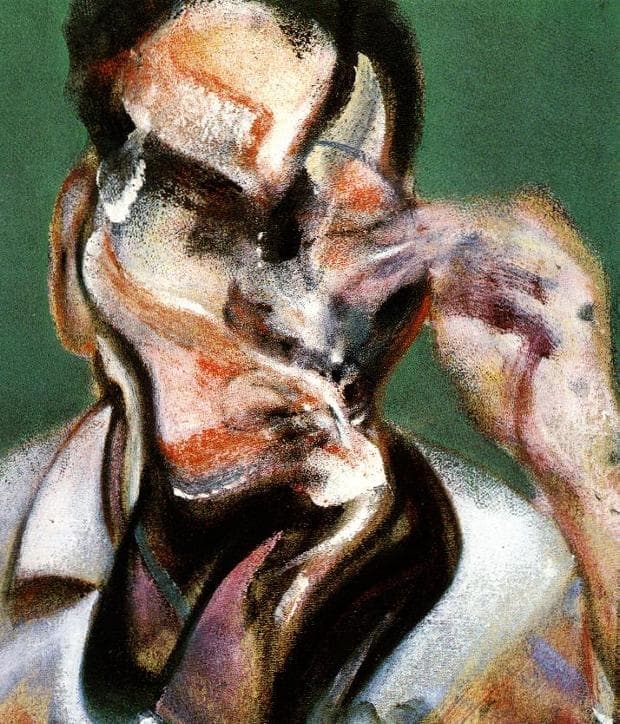
Anchored to the definitive public sale of the same canvas at Sotheby’s London (29 June 2022; realized ≈USD 52.6M), I place the current fair‑market value for Francis Bacon’s Study for Portrait of Lucian Freud (May 1964, CR 64‑06) at $45–70M. This valuation uses the 2022 realization as the primary benchmark, adjusted for provenance, condition, sale venue and present market dynamics.
Valuation Analysis
Valuation conclusion: Based on the definitive public sale of the identical canvas at Sotheby’s London on 29 June 2022 (catalogued Martin Harrison CR no. 64‑06), which realized approximately £43,336,000 (~USD 52.6M), this work’s market value as of June 2026 is estimated at $45–70 million. The approach relies on the recent‑sale anchor and adjusts for current market context, provenance/exhibition strength and condition [1].
The painting is a large, mid‑1960s Bacon portrait (198 × 147.5 cm; executed May 1964). The subject — Lucian Freud — and the date place the work squarely in a highly desirable segment of Bacon’s oeuvre. The lot’s published provenance (Marlborough Fine Art; The Hon. Colin Tennant; Galleria Galatea; European private collection since 1982–83) and exhibition history (Hamburg / Stockholm / Dublin, 1965) materially reduce attribution and provenance risk and increase institutional lendability, which supports higher price outcomes [4].
Market comparables reinforce the anchor. The exact canvas’ 2022 realization is the single most relevant data point; larger market context is provided by Bacon’s auction ceiling (Three Studies of Lucian Freud, 1969 — US$142.4M) and a string of mid‑period single‑panel results in the mid‑seven to low‑eight‑figure range in recent seasons. These comparables show a steep premium for canonical sitter subjects and large scale while indicating that single‑panel portraits commonly trade below triptych ceilings [2][3].
Price sensitivity is concentrated in three areas: (1) physical condition — any structural or aesthetic intervention since 2022 will adjust value materially; (2) sale placement — a promoted evening sale in New York or London with a guarantee or competitive bidding will push toward the top of the band; (3) legal/ export/ownership clarity — clean, continuous provenance is a positive multiplier. Under conservative sale conditions (limited marketing, condition issues, weaker regional demand) the painting would likely achieve near the lower end (~$45M). Under optimal circumstances (prime evening sale, stellar condition, active bidding) the work could exceed its 2022 realized figure and approach $70M or modestly higher.
Recommended next steps to firm a sale‑ready appraisal: obtain high‑resolution recto/verso photography and full provenance documentation; secure a current written condition report from an experienced conservator; obtain the Harrison raisonné entry and exhibition records; and request an in‑person review and pre‑sale estimate from an evening‑sale specialist at Sotheby’s/Christie’s/Phillips. This estimate is a market opinion anchored to the 2022 sale and should be refined after physical inspection and confirmation of provenance/condition [1][4].
Key Valuation Factors
Art Historical Significance
High ImpactFrancis Bacon’s portraits of Lucian Freud occupy a central place in the artist’s output and 20th‑century British art. The pairing of these two painters is culturally prominent; works that document this relationship (particularly canonical mid‑1960s portraits) are highly sought by museums and private collectors. As a mature mid‑1960s study bearing Bacon’s characteristic psychological intensity and painterly handling, this canvas has both scholarly and curatorial value. Institutional interest increases a work’s lendability and long‑term desirability, and that institutional demand is directly reflected in elevated buyer competition and price multiples at auction. In short, the painting’s art‑historical profile is a primary upward driver of value.
Provenance & Exhibition History
High ImpactThe published provenance (Marlborough Fine Art; The Hon. Colin Tennant; Galleria Galatea; European private collection since 1982–83) and contemporaneous exhibition record (Hamburg / Stockholm / Dublin, 1965) materially strengthen value by reducing attribution and legal risk and by increasing lender confidence. Clean, well‑documented provenance shortens due‑diligence timelines for institutions and high‑net‑worth buyers, increasing competitive bidding and enabling favorable sale strategies (evening sale placement, loan potential). Conversely, provenance gaps, ownership disputes or unclear export histories can substantially depress bid levels and restrict market pathways. For this work, existing documentation is a significant positive multiplier.
Condition & Conservation
High ImpactCondition is a decisive factor for a large Bacon canvas. Structural issues (stretcher or lining interventions), paint losses, overpaint or heavy cleaning can reduce sale value materially; conversely, a documented, minimal‑intervention conservation history preserves surface integrity and supports higher realizations. A formal written condition report (with UV, raking light and technical imaging as needed) is required to quantify risk. The 2022 sale implies acceptable condition at that time, but any subsequent damage, restoration or instability will change the valuation and can alter buyer appetite and insurability.
Market Comparables & Recent Sales
High ImpactThe single most relevant comparable is the exact public sale of this canvas at Sotheby’s in 2022 (realized ~USD 52.6M), which provides a primary anchor. The market ceiling is defined by Bacon’s 1969 Lucian Freud triptych (Christie’s, 2013; US$142.4M), demonstrating the premium for Freud‑related works. Other large mid‑period Bacon portraits and studies have traded in the $16–46M range in recent seasons, confirming dispersion by size, provenance and presentation. These auction results show strong buyer appetite for canonical examples and explain why a well‑marketed, museum‑quality single‑panel Bacon can achieve mid‑tens of millions to low‑seven‑figure tens.
Rarity, Size & Scale
Medium ImpactAt 198 × 147.5 cm this is a large, visually commanding canvas — size that enhances exhibition value and market desirability. Large mid‑1960s Bacon portraits on the market are relatively rare compared with smaller studio works, and that scarcity increases collector competition when they appear. Size also affects display utility for museums and private collectors and typically commands a premium. While not the sole determinant of price, rarity combined with scale consistently drives higher bids among blue‑chip buyers for Bacon’s most important portraits.
Sale History
Sotheby's, London
Francis Bacon's Market
Francis Bacon ranks among the top tier of post‑war British artists with a strong, concentrated market: a small number of canonical works (triptychs and key portraits) command extraordinary prices while a larger corpus of studies and smaller works sell at lower multiples. Bacon’s market is supported by institutional demand, deep private collector interest and limited supply of museum‑quality pieces. The artist’s auction record (Three Studies of Lucian Freud, 1969 — US$142.4M) establishes a high ceiling; nonetheless, single‑panel, mid‑period portraits routinely achieve multi‑million dollar results depending on provenance, condition and sale execution.
Comparable Sales
Study for Portrait of Lucian Freud
Francis Bacon
Same painting — direct market evidence; large 1964 Bacon portrait with strong provenance and exhibition history.
$52.6M
2022, Sotheby's, London
~$58.4M adjusted
Three Studies of Lucian Freud (Triptych, 1969)
Francis Bacon
Market record and ceiling for Bacon prices; a Lucian Freud triptych showing highest demand for Freud-related works.
$142.4M
2013, Christie's, New York
~$198.7M adjusted
Study of Red Pope 1962, 2nd version (1971)
Francis Bacon
Large, canonical early-1960s Bacon subject sold in the same market window — comparable scale and blue-chip status.
$46.3M
2022, Sotheby's, New York
~$51.4M adjusted
Portrait of George Dyer Crouching (1966)
Francis Bacon
Single-panel portrait of a principal Bacon sitter (George Dyer); similar period but a lower realised price — useful mid-market comparator.
$27.7M
2024, Sotheby's, New York
~$28.3M adjusted
Self-Portrait (1969)
Francis Bacon
Late-1960s Bacon single-panel self-portrait sold at a major house — indicates mid‑high single-panel pricing for comparable period works.
$34.6M
2023, Christie's, New York
~$36.9M adjusted
Current Market Trends
Through 2024–mid‑2026 the top‑end market for blue‑chip post‑war British artists has been selective but resilient: museum‑quality works attract strong bidding, houses use guarantees and private placements to manage risk, and regional centers (NY/London) alternate as optimal venues. Demand favors canonical works with clean provenance and exhibition histories while lower‑tier lots are more price‑sensitive. Macro liquidity and sale strategy (evening vs. day sale; guarantee use) will continue to determine near‑term outcomes for high‑value Bacons.
Sources
- Sotheby's – Study for Portrait of Lucian Freud (lot page, British Art: The Jubilee Auction, 29 June 2022)
- CNBC coverage of Christie's sale: Bacon triptych sells for record $142.4 million (2013)
- Artnet News – Sotheby’s London summer auction report (coverage including the 2022 sale)
- Martin Harrison, Francis Bacon: Catalogue Raisonné (entry CR no. 64‑06 reference and catalogue information)