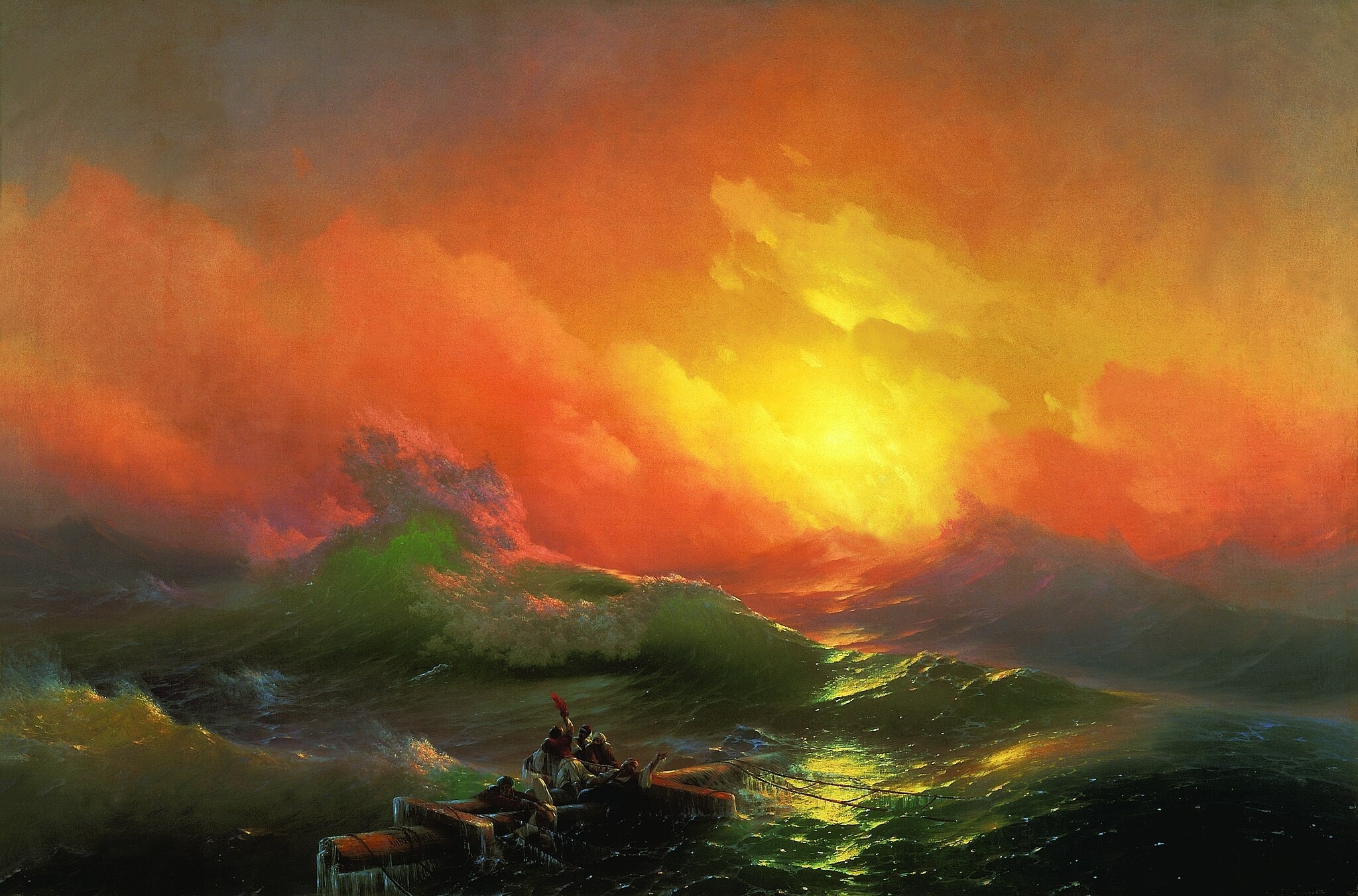
The Ninth Wave
The Ninth Wave stages a struggle between annihilation and deliverance on a heaving sea, where survivors cling to a cross‑shaped raft under a molten dawn. Aivazovsky turns light into a redemptive force, cutting a golden path across emerald waves that both threaten and guide the castaways [1][3].
Study Print Studio
Create a personal study print
Build a companion study sheet around the part of this painting that speaks to you most. Choose a detail, shape an interpretation, and walk away with something personal and display-worthy.
Fast Facts
- Year
- 1850
- Medium
- Oil on canvas
- Dimensions
- 221 × 332 cm
- Location
- State Russian Museum, St. Petersburg
Click on any numbered symbol to learn more about its meaning
Meaning & Symbolism
Aivazovsky anchors meaning in the choreography of elements rather than anecdote. The survivors’ raft—two spars lashed into a rough cross—tilts toward the blinding sun, so that the very geometry of their refuge reads as a sign of salvation. The figures’ gestures tighten the moral: a man raises his arm toward the light while others cling to the wood, modeling hope as an action taken at the edge of despair. Around them, translucent green waves swell with internal fire; their crests shred into spray that the sunrise catches and gilds. This interplay of warm sky and cold sea enacts a drama of judgment and mercy: the ocean is still lethal, but the light carves a navigable corridor through it. The title’s folklore—naming the climactic, most destructive wave—compresses time to a breath-held instant, a pause between the ultimate blow and reprieve 1.
The painter’s studio method—composing the sea “from memory”—enables this emblematic clarity. Aivazovsky did not record a specific storm; he orchestrated a vision where each element carries symbolic weight: the raft as cross, the sunrise as grace, the tiny humans as moral agents rather than victims 35. The warm palette at the horizon refuses pure catastrophe. Instead of moonlit ruin, we get dawn—an iconographic pivot from death to renewal—so that catastrophe becomes a test that reveals human resilience. This is why The Ninth Wave is important: it crystallizes the Romantic sublime into an affirmative thesis about human dignity under overwhelming force. The Russian Museum’s reading—“light of hope” and faith in the victory of life—accords with what the eye sees: the sun’s road of gold literally aims at the raft, asserting providence through composition 12.
At the same time, the canvas accommodates a modern unease. The sea’s scale dwarfs the survivors; the next ridge of water, green with an almost radioactive glow, reminds us that nature (or any vast, impersonal power) remains indifferent to pleas. Critics have read Aivazovsky’s tempests as allegories of Power over Man, where the state or fate mimics the sea’s machinery 6. The painting thus sustains a double register: a consoling Christian‑Romantic promise and a stark acknowledgment of precarity. Its endurance stems from this duality. Viewers can follow the raft along the sunlit path and believe in deliverance, yet they cannot forget the troughs yawning to either side. By holding these truths in balance—by making light both metaphysical and optical, symbol and weather—Aivazovsky gives the myth of the ninth wave lasting form: a picture of last danger transfigured by hope, where survival is neither guaranteed nor impossible. That tension, staged through the painting’s specific visual devices—the cross‑raft, the beckoning glare, the emerald translucence of the water—secures its place as Aivazovsky’s signature masterpiece and a summa of Russian marine Romanticism 134.
Explore Deeper with AI
Ask questions about The Ninth Wave
Popular questions:
Powered by AI • Get instant insights about this artwork
💬 Ask questions about this artwork!
Interpretations
Ethical-Existential Lens: Agency at the Edge of Catastrophe
The survivors are framed as actors, not debris—“moral agents rather than victims.” Gesture is the ethics: the raised arm to the sun, bodies bracing the cross-raft, collective balance against the roll. This choreography stages a drama of practical hope—not optimism, but willed orientation toward a slim path. The Ninth Wave thereby tests a Romantic thesis about dignity: that human worth appears most vividly where systems (or seas) render us negligible. The painting’s power lies in holding agency and precarity together—affirmation without naivety—inviting viewers to read risk as the field where ethical intention becomes visible 31.
Source: The Art Story; State Russian Museum
Formal Analysis: Memory-Built Sublime
Aivazovsky’s claim to paint the sea “from memory” reframes The Ninth Wave as a deliberately constructed sublime rather than an eyewitness account. Memory lets him edit chaos into legible vectors: a dominant warm–cool opposition (golden sun road cut into emerald surf), an oblique cross-form raft, and a sweeping diagonal of wave crests that marshal terror into rhythm. The facture supports this emblematic clarity—broad, fused atmospherics for sky; sharper, glassy highlights on breakers; and a calibrated value gradient that opens a navigable corridor. In short, mimesis yields to poetic veracity: a studio-orchestrated weather of symbols whose optical plausibility persuades even as it abstracts lived storm experience 531.
Source: Parkstone (Victoria Charles); The Art Story; State Russian Museum
Political Allegory: Power Over Man
Read through a nineteenth-century Russian lens, the storm performs authority’s impersonal violence. Tretyakov Gallery Magazine situates Aivazovsky’s tempests within a metaphor of “Power over Man,” where the sea’s relentless apparatus mirrors the machinery of state and empire. The tiny collective on the cross-raft can stand for the public sphere—precarious, battered, yet improvising solidarity—while the light marks a narrow channel of contingent reprieve rather than guaranteed deliverance. This politicized sublime resists simple consolation: the sun gilds but does not pacify the system that produced the wreck. The Ninth Wave thus reads as an image of survival under overwhelming structures—an allegory whose force persists beyond its imperial moment into modern readings of institutions and risk 62.
Source: Tretyakov Gallery Magazine; Guggenheim (education guide)
Historiography: Romanticism Against Realist Ascendancy
By 1850, Aivazovsky’s grand marine Romanticism confronted an emergent Realist ethic in Russian art. Later critics like Vladimir Stasov faulted the theatricality of such seascapes as escapist, while figures like Alexandre Benois placed Aivazovsky outside the central lineage of Russian landscape. Yet The Ninth Wave’s studio vision—synthetic light, emblematic form—asserts Romanticism’s counter-claim: that painting can distill existential truth more potently than social reportage. Its canonical trajectory (Hermitage to the State Russian Museum) shows that imperial and national institutions nevertheless enshrined this affirmative sublime. The painting becomes a hinge in the narrative of Russian art, preserving Romantic metaphysics within a culture moving toward Realist modernity 431.
Source: Wikipedia (Ivan Aivazovsky, critical reception); The Art Story; State Russian Museum
Iconographic Reading: Cross and Dawn as Eschatological Signs
Beyond generic hope, the iconography is pointedly Christian. The cross-shaped raft transforms wreckage into a Passion sign, reframing disaster as trial participated in—and borne—collectively. The sunrise functions not merely as meteorology but as grace: a theophanic light breaking judgment’s night, echoing Orthodox visual theology where radiance signals presence. Compositionally, the sun’s “road” aims at the raft like a processional axis, turning the pictorial space into liturgy. Such staging offers a soteriological arc: catastrophe purifies, faith steers, and light discloses a way through rather than around peril. The result is a theologically saturated sublime that binds endurance to revelation 13.
Source: State Russian Museum; The Art Story
Nation and Empire: Monumental Sea for Imperial Imagination
The work’s early Hermitage acquisition and later enshrinement in the State Russian Museum signal its function within imperial and national image-making. At over two meters high and three wide, its monumental scale recruits the sea as a stage for Russian destiny: perilous, expansive, and navigable under providential light. Such canvases helped translate maritime might and exploratory reach into a civil religion of endurance—an ideology palatable to court and public alike. Displayed within imperial collections, The Ninth Wave naturalized a narrative of trial and emergence that dovetailed with nineteenth-century state aspirations, investing viewers in a shared maritime sublime as cultural capital 12.
Source: State Russian Museum; Guggenheim (education guide)
Related Themes
About Ivan Aivazovsky
Ivan Aivazovsky (1817–1900) was a preeminent Romantic seascapist born in Feodosia, trained at the Imperial Academy in St. Petersburg, and later appointed chief painter to the Russian Navy. After formative travels in Europe and contact with Turner, he developed a studio method that fused memory, observation, and luminous atmospherics to craft grand narratives of the sea [4][3].
View all works by Ivan Aivazovsky →