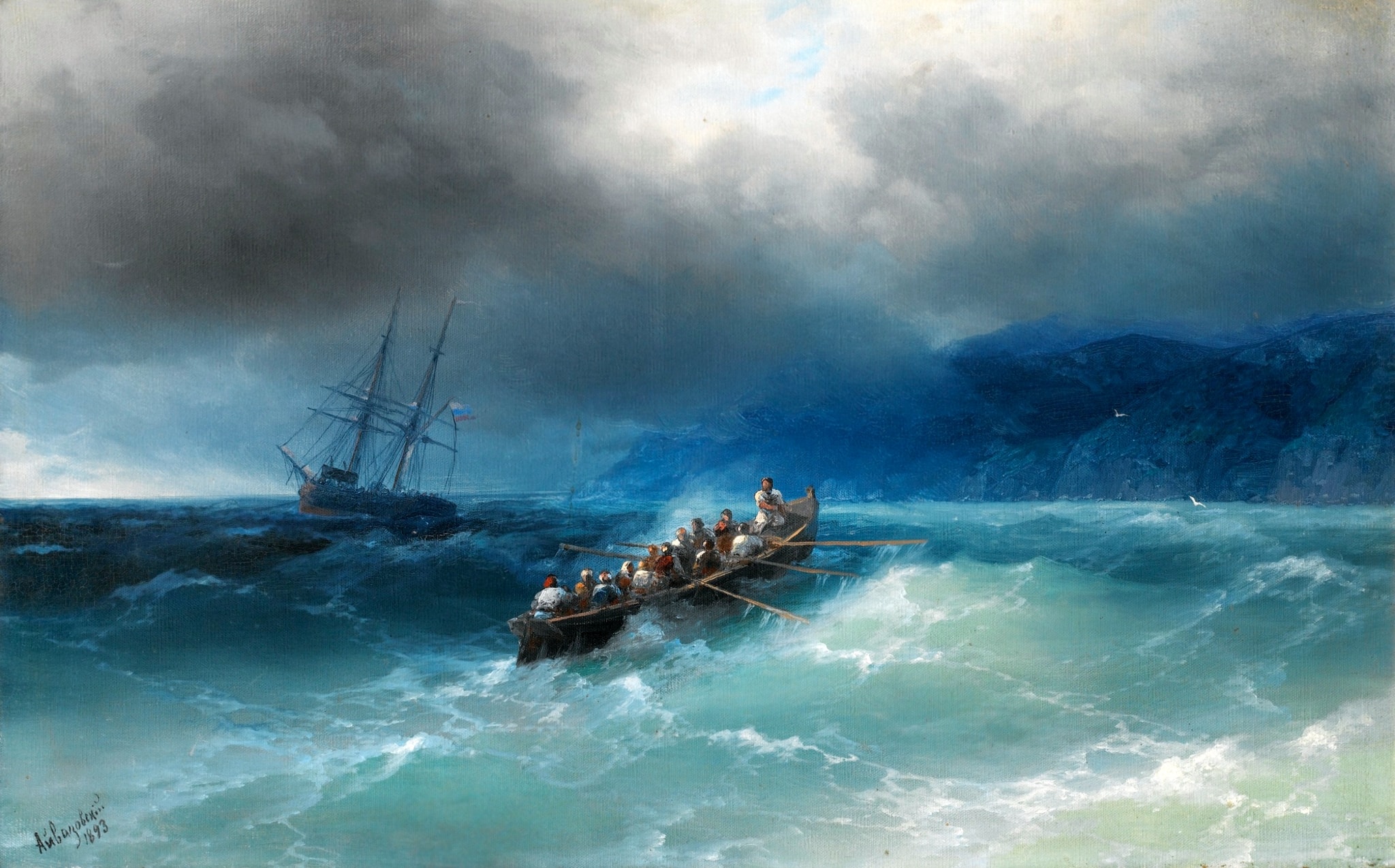
The Storm (Seascape)
In The Storm (Seascape), Ivan Aivazovsky forges a drama of human resolve against the Sublime sea. A crowded lifeboat claws up a green-blue swell toward a break of light, while a tall-masted ship lists behind and a rocky coast looms to the right. The painting crystallizes peril and hope in a single, surging moment.
Study Print Studio
Create a personal study print
Build a companion study sheet around the part of this painting that speaks to you most. Choose a detail, shape an interpretation, and walk away with something personal and display-worthy.
Fast Facts
- Year
- 1850
- Medium
- Oil on canvas
- Dimensions
- 82.5 × 117 cm
- Location
- National Gallery of Armenia, Yerevan
Click on any numbered symbol to learn more about its meaning
Meaning & Symbolism
Aivazovsky composes The Storm (Seascape) as an argument rather than a mere spectacle. He plants three actors across the breadth of the canvas—the lifeboat, the foundering ship, the shoreline—and binds them with a fourth, invisible actor: the wind that vectors cloud, spray, and flag. The boat, thrown up a steep turquoise ridge, is crammed with men who row in tense unison; their oars splay outward like a cage sprung open, a visual signal that agency is active, plural, and disciplined. The crew’s gaze concentrates toward a pale aperture in the cloud mass, a wedge of illumination that pierces the bruised sky. That light does not banish the storm; it threads through it, reading as hope hard‑won rather than granted. Behind, the tall-masted ship staggers in the troughs, its rigging finely etched but functionally overwhelmed—human engineering humbled. To the right, the coast rises as an ambivalent witness, both menace and destination. Sea birds skim low through the gale, traditional markers of landfall and a navigable course, making the picture legible as a chart of hazards and guides at once 3.
What gives this configuration its force is Aivazovsky’s control of luminosity. He electrifies the water’s surface with milk-white crests and glassy greens that transmit light from within, while the sky remains a heavy slate, cinched tight around the scene. The color logic reverses normal expectation—sea as lantern, sky as lid—so that salvation seems to well up from the very element that imperils. This inversion aligns with Romantic conceptions of the Sublime: terror edged by beauty, immensity transmuted by perception. Aivazovsky’s studio practice—working from memory and on‑site studies to synthesize convincing atmosphere—lets him choreograph these effects with theatrical clarity while preserving a “truthful vision” of motion and light 3. In the boat, a few red caps spark against the blue-grey scheme, isolating human presence without sentimentalizing it. The figures are not portraits; they are purposeful capacities—concentration, endurance, coordination—brought into alignment against chaos.
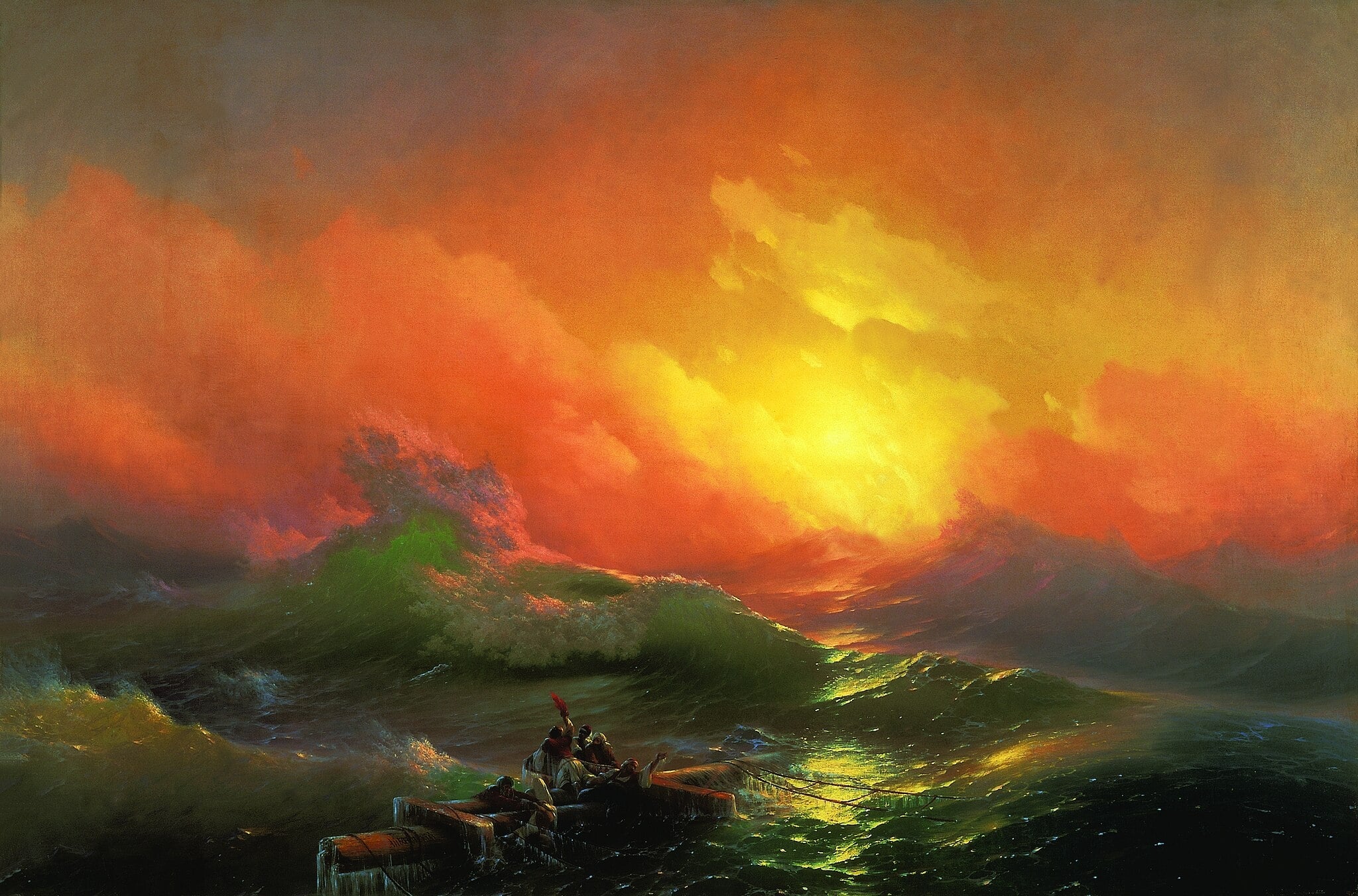
The narrative stakes sharpen when read against Aivazovsky’s career and the maritime culture of his time. By mid-century he was the Russian Navy’s chief painter, conversant with naval power even as his canvases regularly display its limits before nature 4. The listing ship operates as a vanitas of technology—magnificent, yet fragile—while the lifeboat encodes the ethical message. The painting, dated in museum records to 1850 at the National Gallery of Armenia, sits beside contemporary landmarks such as The Ninth Wave, where storm and illumination likewise stage a crisis of fate and choice 13. Here, however, the inclusion of a visible lee shore tightens the plot: safety exists, but only if the crew can read the sea and row through the breaking sets without being dashed. The birds, the angled oars, the lift of the bow all point to navigational intelligence as much as to bravery. In this way, the picture refuses fatalism. It argues that while nature dwarfs us, will plus orientation can carve a corridor through disaster.
Why The Storm (Seascape) is important, finally, is that it compresses a 19th‑century worldview—faith in providence tempered by empirical seamanship—into a single, legible image. It demonstrates how Romantic marine art could be both spectacular and instructive, translating metaphysical ideas into pictorial vectors: light breaks, bodies align, ships fail, small boats persist. In the widening swath of Aivazovsky’s oeuvre, later tempests sometimes grow darker and less consoling; this mid‑century storm still opens the sky just enough to keep effort meaningful 35. The viewer, like the crew, is asked to row toward that light—eyes fixed, stroke by stroke—through a world whose beauty is inseparable from its peril.
Explore Deeper with AI
Ask questions about The Storm (Seascape)
Popular questions:
Powered by AI • Get instant insights about this artwork
💬 Ask questions about this artwork!
Interpretations
Formal Analysis: Optical Inversion and Vector Design
Aivazovsky engineers an optical inversion—"sea as lantern, sky as lid"—that flips atmospheric expectation and reassigns narrative weight to the water’s inner light. Compositional vectors knit boat, wreck, and shore through wind-driven diagonals (flag, spray, cloud bands), while the splayed oars articulate a radiating armature that both resists and reads the swell. Coloristically, his turquoise‑to‑milk‑white surf acts like a moving reflector, casting upward illumination that refuses the sky’s closure. Such orchestration reflects his studio method—constructing motion and glare from memory and on‑site studies—yielding a staged yet persuasive meteorology that Romantic viewers prized as a “truthful vision.” The result isn’t reportage but calibrated pictorial physics: forces made legible through light gradients, edge control, and directional brushwork 34.
Source: The Art Story; The Metropolitan Museum of Art
Historical Context: Empire at Sea and Its Limits
Painted in mid‑century, when Aivazovsky served as the Russian Navy’s chief painter, the canvas speaks to imperial projection tempered by limitation. The background ship—grand but overmatched—functions as a quiet critique of maritime prowess, a reminder that strategy and metallurgy still bow to weather. Institutional accounts emphasize how his career intertwined with naval culture while resisting bombast; he repeatedly stages nature as the superior sovereign and reassigns heroism to the small, coordinated boat. Read this way, the scene aligns with a 19th‑century maritime ethos: respect the sea, distrust spectacle, valorize seamanship. The painting’s politics are maritime rather than courtly—authority migrates from the warship to the workboat, from the state to the skilled crew steering by signs 56.
Source: Tretyakov Gallery Magazine; State Russian Museum
Symbolic Reading: Providence Without Miracle
Aivazovsky’s light is not a deus ex machina; it is a thread through storm, a conditional promise rather than deliverance. Romantic discourse around the sea in his oeuvre consistently treats breaks of luminosity as signs of providence disclosed to those who can read them. Here, the pale aperture fixes the crew’s common gaze, converting illumination into an organizing ethic: steer by what glimmers, not by what blinds. This stance preserves the Sublime’s doubleness—fear and beauty coincide—while avoiding theological triumphalism. In other words, grace appears as a navigational datum, not a suspension of natural law. Such calibrated transcendence is typical of Aivazovsky’s mid‑career tempests, where hope is labor‑intensive and light functions as orientation more than rescue 3.
Source: The Art Story
Labor & Semiotics: Rowing as Knowledge‑Work
The boat’s drama is not merely muscular; it is cognitive. Seabirds skim like marginalia, annotating a safe artery through the chop; the lee shore offers topographic cues and dangers to be triangulated; the oars’ outward rake visualizes a shared algorithm for timing strokes to waves. Aivazovsky, steeped in maritime culture, renders these cues with didactic clarity, making the picture readable as a storm interface—icons (birds), thresholds (breakers), and a goal state (light) that the crew interprets in real time. The scene exemplifies 19th‑century seamanship as a form of expert labor, where survival depends on collective situational awareness more than on brute force. This merges moral and practical intelligence into one choreography of work 34.
Source: The Art Story; The Metropolitan Museum of Art
Oeuvre Trajectory: Mid‑Century Consolation vs. Late Severity
Dated 1850 in the National Gallery of Armenia’s record, this storm occupies a consolatory register within Aivazovsky’s arc: the sky opens just enough to rationalize effort. Comparative scholarship notes that some late‑century tempests mute or withdraw such apertures, darkening the moral weather. Against that later severity, this canvas preserves a Romantic compact—peril dramatized so that disciplined response can matter. It sits contemporaneously with The Ninth Wave, sharing the rhetoric of salvational light while tightening the plot via a visible lee shore. Seen across decades, the painting marks a midpoint in which the artist balances spectacle with instruction, refusing fatalism without denying risk—a stance that helped secure his wide 19th‑century reception 13.
Source: National Gallery of Armenia; The Art Story
Related Themes
About Ivan Aivazovsky
Ivan Aivazovsky (1817–1900) was a preeminent Romantic seascapist born in Feodosia, trained at the Imperial Academy in St. Petersburg, and later appointed chief painter to the Russian Navy. After formative travels in Europe and contact with Turner, he developed a studio method that fused memory, observation, and luminous atmospherics to craft grand narratives of the sea [4][3].
View all works by Ivan Aivazovsky →