The Lady of Shalott
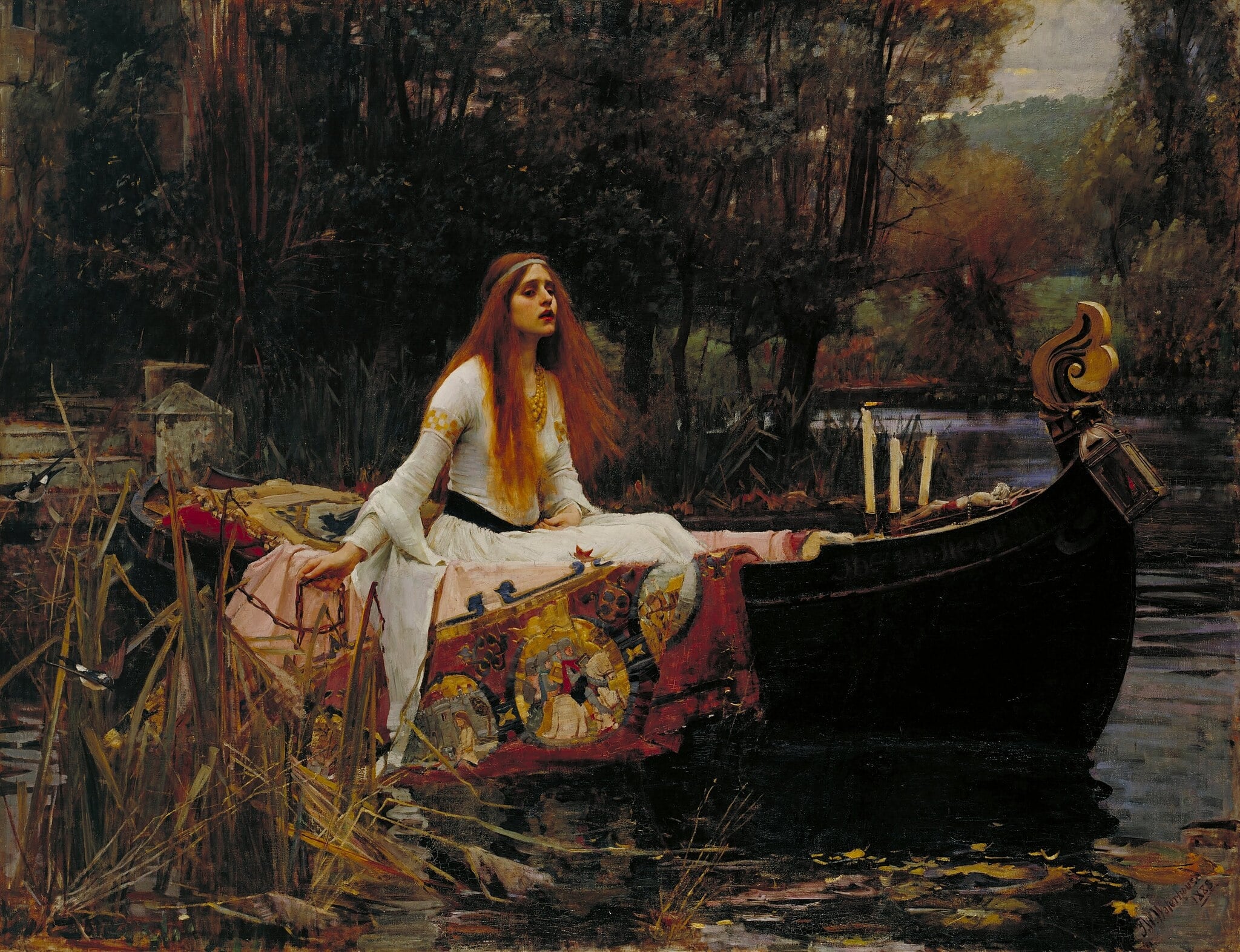
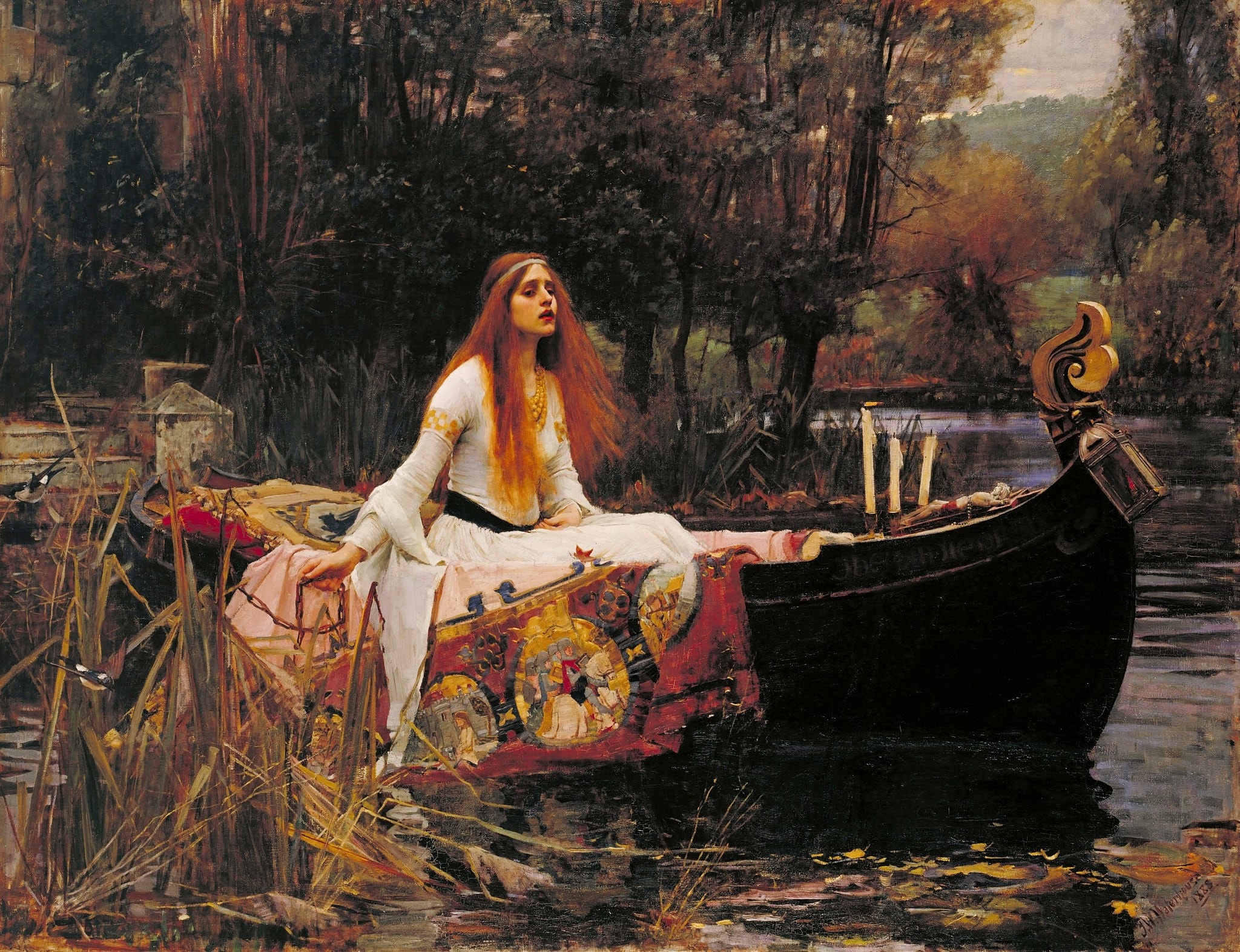
John William Waterhouse’s The Lady of Shalott fixes the tragic instant when the cursed Lady chooses to loose her mooring and drift toward Camelot. The released chain, the guttering candles, and the tapestry spilling over the boat narrate a passage from sheltered artifice to fatal reality. Waterhouse fuses late Pre-Raphaelite symbolism with elegiac atmosphere to stage beauty caught between agency and doom [1][2][3].
Study Print Studio
Create a personal study print
Build a companion study sheet around the part of this painting that speaks to you most. Choose a detail, shape an interpretation, and walk away with something personal and display-worthy.
Fast Facts
- Year
- 1888
- Medium
- Oil on canvas
- Dimensions
- 153 x 200 cm
- Location
- Tate Britain, London
Click on any numbered symbol to learn more about its meaning
Meaning & Symbolism
Waterhouse composes the scene so that fate is legible at a glance. At the boat’s prow, two candles already extinguished and a third wavering in the wind prefigure a life in its final moments, while the small crucifix beside them frames the voyage as a funereal procession rather than an escape 13. The Lady’s right hand lets slip the chain that held her—an unequivocal emblem of self-claimed action that also triggers the curse named by Tennyson. Her head tilts upward, mouth parted in a last inward hymn, not toward any rescuer but toward a destiny she acknowledges. Along the gunwale, the brilliant, story-laden tapestry she wove in isolation droops into the water: art literally crossing its boundary to touch the world, the very breach that condemns her. The black hull, carved prow, and faint inscription of her name turn the vessel into a coffin-like token of identity, a dark syllable sliding through reflective water toward Camelot. Around her, the river’s edges bristle with broken reeds and fallen leaves; a swallow skims low. These seasonal and weather signs render the banks as a memento mori corridor, and the hushed, russet trees form a dim chancel for a secular requiem 136.
Read against the poem’s logic of mirrors and shadows, every object narrates the price of direct vision. The toppled candles and the cross function as portable liturgy; the Lady undertakes her own vigil, not as penitent but as witness to desire’s consequence. The tapestry’s descent is decisive: Waterhouse makes the artwork’s radiant embroidery a counterpoint to the black boat, dramatizing the collapse of mediation—the moment when representation (her web) can no longer contain experience (the world beyond the mirror). In this light, the painting does not simply sentimentalize a victim; it stages a paradox of Victorian gendered freedom. The only available assertion of will is also a self-annulment, and yet Waterhouse’s handling dignifies that choice. He aligns her loosened hair, white dress, and forward-thrust body with a solemn autonomy rather than hysteria, sidestepping moralism to elicit compassion. Critics have read this as a late Pre-Raphaelite meditation on the “martyr-for-love,” but the image also exposes how the culture punishes female looking and movement: seeing Lancelot leads inexorably to the river, and the river to death 23.
What distinguishes Waterhouse in 1888 is the synthesis of programmatic symbolism and modern painterly atmosphere. The tactile reeds, the quivering flame, and the sheen of wet tapestry are executed with the observational relish the Pre-Raphaelites prized, yet the broader passages—the soft, merging foliage and pooled reflections—relax into mood, allowing narrative and elegy to cohabit. Exhibited at the Royal Academy and later entering the Tate as part of Sir Henry Tate’s foundational gift, the canvas secured a popular afterlife because it refines literary narrative painting into a compact moral drama: the instant when freedom, beauty, and mortality meet in a single released link of chain 125.
Explore Deeper with AI
Ask questions about The Lady of Shalott
Popular questions:
Powered by AI • Get instant insights about this artwork
💬 Ask questions about this artwork!
Interpretations
Feminist/Gaze Analysis
Waterhouse visualizes a culture that punishes female looking by staging the Lady’s agency as self-annulment. Her loosened hair and steady posture read not as hysteria but as self-possessed transgression, complicating the Victorian “fallen woman” script. The boat’s inscription of her name secures identity even as the body is imperiled, while the chain in her right hand externalizes a choice constrained by patriarchal law—the curse as a regime of the gaze. Viewers are implicated: our direct look upon her repeats the forbidden act, aestheticizing vulnerability and thereby exposing the dynamics of spectatorship itself. This ambivalence—sympathy without absolution—aligns the work with late-19th-century debates over female autonomy and the moral policing of desire 137.
Source: Victorian Web; Tate; Lucy Elliott, Process (JMU)
Medium Reflexivity (Art about Art)
The web-into-water moment is a meta-image about representation breaching life. The saturated, patterned tapestry—labor of isolation—slides over the gunwale to meet reflective currents, a literalized crossing of media (textile to landscape) that collapses the poem’s mirror economy. Waterhouse stages a dialectic: the black, coffin-like boat (fixed narrative vehicle) versus the iridescent textile (open-ended signification), with the river’s reflections serving as a third register of reproduced reality. In this triad, the painting theorizes its own medium: when images touch the world, consequences follow. This is not mere illustration but a Victorian meditation on mimesis, agency, and the ethics of seeing, sharpened by Waterhouse’s blend of meticulous detail and atmospheric fusion 135.
Source: Tate; Victorian Web; COVE (Tate metadata mirror)
Ritual and Victorian Death Culture
Two snuffed candles, one guttering, and a crucifix convert the boat into a mobile chapel—an improvised ars moriendi. Such tokens align the scene with Victorian practices of domestic vigil and memorial display, but here the subject conducts her own rite: not penance, but witness to desire’s cost. Waterhouse secularizes sacrament through landscape; broken reeds and autumnal banks become a natural liturgy, guiding the eye along a funereal procession toward Camelot. The portable rite underscores how a modern, late Pre-Raphaelite painter could merge programmatic iconography with mood: a devotional syntax set within airy atmosphere, where paint handling softens dogma into elegy 13.
Source: Tate; Victorian Web
Formal Synthesis: Late Pre-Raphaelitism Meets Academy
Textures—reeds, wet textile, flickering flame—display Pre-Raphaelite exactitude, while pooled reflections and softened foliage reveal a more academic-modern breadth. This oscillation choreographs the narrative read: hard-edged symbols at the prow (candles, cross, chain) against dissolving distance toward Camelot, translating plot into depth cues. The result is a pictorial tempo: crisp foreground signs of fate yield to elegiac atmosphere, allowing meaning to register both as iconographic code and as felt mood. Waterhouse’s hybridism—third-generation Pre-Raphaelite by subject, modern in facture—helps explain the painting’s durable appeal within the Royal Academy context and later museum display 24.
Source: Encyclopaedia Britannica; Royal Academy handbook
Serial Narrative Across Decades
This 1888 canvas inaugurates Waterhouse’s three-part engagement with Tennyson: departure (1888), forbidden look (1894), and weaving-in-isolation (1915). Read together, the trio constitutes a reverse archaeology of causation—beginning with consequence, then flashing back to transgression and origin. The 1888 work thus operates as the cycle’s moral fulcrum: a stilling of time at the threshold where choice becomes fate. Waterhouse refines Victorian narrative painting into episodic meditation, each canvas testing how composition, gesture, and object arrays produce meaning without over-reliance on literary caption. The series also charts a stylistic evolution toward greater atmospheric unity while retaining emblematic clarity 39.
Source: Victorian Web (comparative and serial studies)
Related Themes
About John William Waterhouse
John William Waterhouse (1849–1917) trained at the Royal Academy Schools and exhibited regularly at the RA. He is associated with Pre-Raphaelite subjects—poetry, myth, Arthurian legend—while blending academic composition with atmospheric, modern handling. His popularity has revived in recent decades through scholarship and major exhibitions [2].
View all works by John William Waterhouse →