The Lady of Shallot
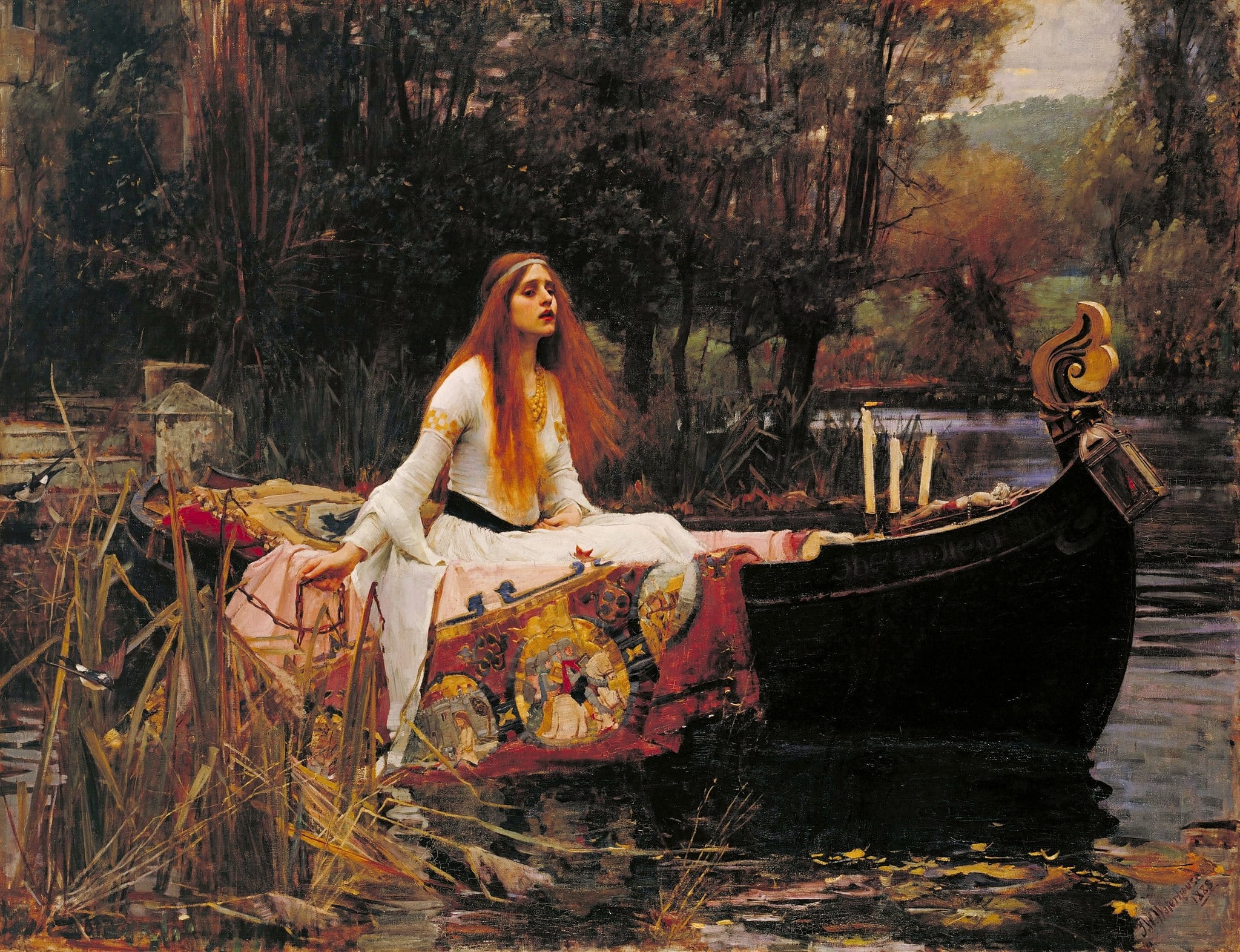
John William Waterhouse’s The Lady of Shallot (1888) fixes on the instant the cursed heroine releases her chain and sets her black, coffinlike boat adrift. The extinguished candles, the small crucifix, and the tapestry trailing into the water stage a funerary voyage toward Camelot and a choice of experience over enclosure [1][2].
Study Print Studio
Create a personal study print
Build a companion study sheet around the part of this painting that speaks to you most. Choose a detail, shape an interpretation, and walk away with something personal and display-worthy.
Fast Facts
- Year
- 1888
- Medium
- Oil on canvas
- Dimensions
- 153 x 200 cm
- Location
- Tate Britain, London
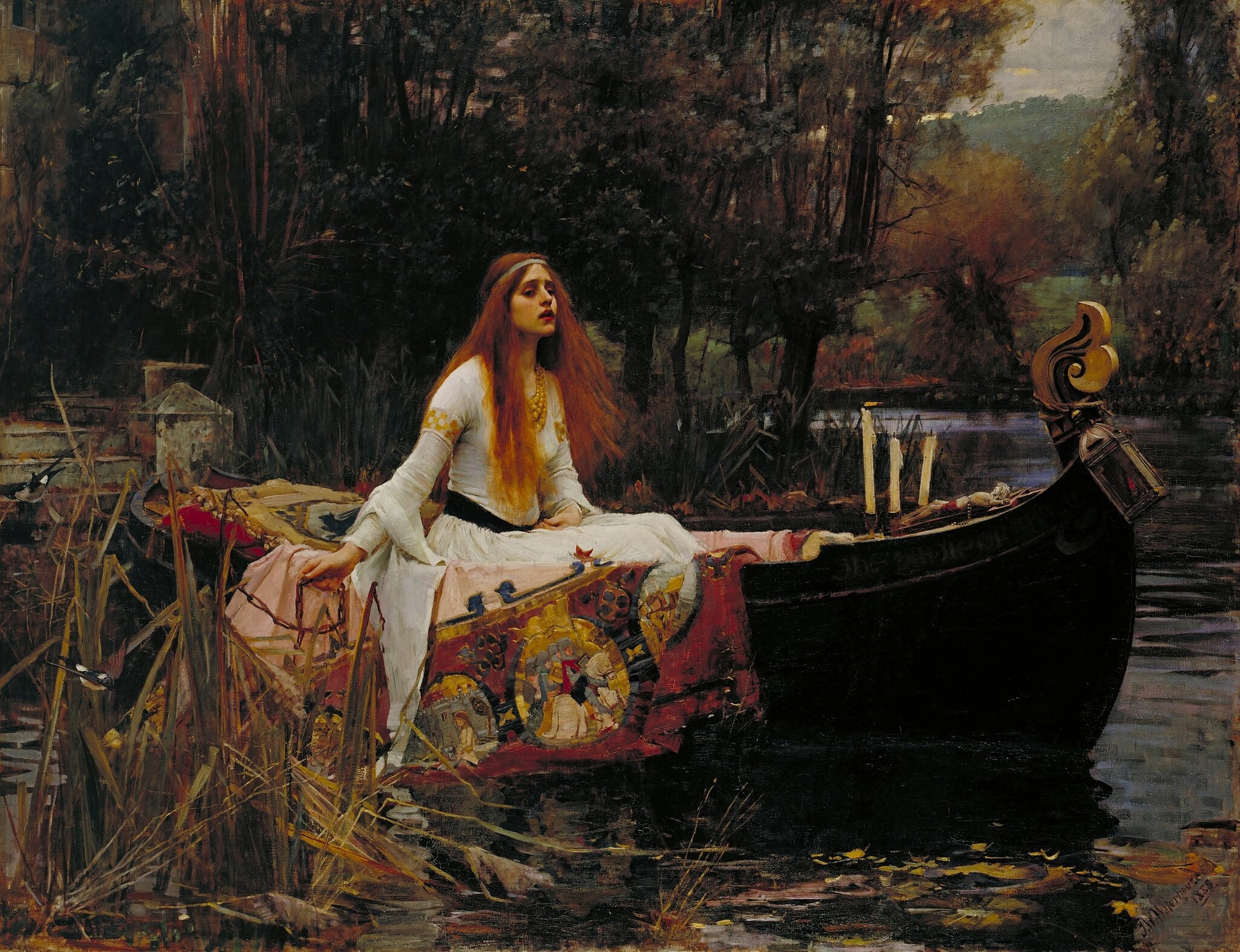
Click on any numbered symbol to learn more about its meaning
Meaning & Symbolism
Waterhouse anchors the canvas in deliberate thresholds—bank to river, enclosure to exposure, reflection to reality. The Lady sits upright yet already slackening, her loosened red hair and white gown thrown into relief against the boat’s black hull. With her left hand she steadies herself at the gunwale while her right releases the chain, a literal unbinding and a figurative refusal of confinement. The reeds immediately catch the hull, asserting how the world still clutches at her body even as she moves. At the prow, three candles stand as a life‑meter: two snuffed, the last flame weak and short, signaling that the voyage is terminal, not exploratory 2. A small crucifix near the prow and the boat’s dark, sarcophagus form convert the river into a processional aisle; the picture reads as a funeral‑pilgrimage, not a rescue attempt. Waterhouse makes the tapestry—the product of her cloistered weaving—spill heavily over the side, its embroidered legends trailing into the water as if narrative itself were drowning; the mirror‑world has unraveled into the cold medium of fact 3. Even the scratched inscription of her name on the prow fuses poem and picture, echoing Tennyson’s lines about self‑naming while compressing chronology so that identity, departure, and death are legible at once 1.
Mood, not motion, governs the scene. The autumnal canopy, dulled light, and brown water refuse any hint of springlike renewal; nature is a threshold tinted with decay. The Lady’s parted lips and upturned, unfixed gaze push beyond anecdote toward Symbolist fatalism: she is already oriented to a destiny she can no longer bargain with 4. Waterhouse’s late Pre‑Raphaelite exactitude—wet rushes, feathered magpies, stitched brocade—does not illustrate for its own sake; it consecrates the stakes of her choice by giving tactile mass to every sign. The release of the chain becomes an ethic as much as a plot point: authentic encounter is purchased at mortal cost. In Victorian terms, the painting reflects and critiques the script of the embowered woman. Agency appears—but only as a tragic permission to leave the frame of supervision, with the public river (and Camelot’s gaze waiting downstream) functioning as the price of visibility 3. That doubleness—liberation sealed as doom—explains the work’s hold on viewers and its canonical status at Tate Britain. Read alongside Tennyson, the canvas invites intermedial completion: we ‘know’ what happens next, and Waterhouse leans on that knowledge to intensify the present, turning a single, stilled instant into a complete elegy 12.
Explore Deeper with AI
Ask questions about The Lady of Shallot
Popular questions:
Powered by AI • Get instant insights about this artwork
💬 Ask questions about this artwork!
Interpretations
Formal Thresholds and Liminal Psychogeography
Compositional thresholds—bank/river, enclosure/exposure, reflection/reality—are not scenic backdrops but engines of meaning. The obstructing reeds “catch” the hull, visualizing the world’s counter‑agency; the lateral drift reads as inexorable rather than dynamic. Tonalization in browns and attenuated light refuses triumphal forward motion, turning the river into a limen where time feels suspended and choice already spent. Victorian commentators note how the scene privileges mood over moment, inviting viewers to dwell in the interval where decision has occurred but its cost has not yet fully collected 42.
Source: Victorian Web; The Guardian
Labor, Unweaving, and the Drowned Narrative
The tapestry slumped over the gunwale literalizes the unmaking of domestic labor. As the web trails into the water, narrative—once safely patterned within the loom—meets contingency and begins to “read” as sodden, illegible matter. This is medium reflexivity with stakes: the picture is about a maker abandoning mediated vision (mirror, web) for the real, and the material of art registers that break by failing. Waterhouse thus reframes Victorian feminine work: not dismissed, but allowed to dissolve so experience can commence, even as that experience is terminal 36.
Source: Victorian Web; Diggit Magazine
Studio Fiction and Constructed Nature
Contemporary reporting notes the model was posed in a small North London courtyard, not by a river. That disjunction clarifies Waterhouse’s method: the scene is an assembled fiction where studio craft simulates ritual landscape. Far from diminishing authenticity, this construction underscores intention—the “real” river is less important than the ideational one bearing sacramental signs. Late Victorian viewers habituated to Royal Academy tableaux would recognize this crafted naturalism as a moral theater, not reportage, which is why the image convinces emotionally even as it admits fabrication 91.
Source: The Guardian (2009 exhibition reporting); Britannica
Symbolist Sacrament within Pre-Raphaelite Naturalism
Waterhouse’s botanical exactitude (rushes, leaves, light on water) performs Pre‑Raphaelite truth to nature, yet the image reads as Symbolist rite. Crucifix, tripartite candles, and a bier‑like boat convert landscape into liturgy; the river becomes an aisle, the voyage a requiem. Here, facticity is a carrier for metaphysics: meticulously painted things become emblems rather than anecdotes. This marriage of scrupulous surface to inward fatalism explains the painting’s durable affect—observation transubstantiated into omen, detail into doctrine 21.
Source: The Guardian (Picture of the Day); Britannica
Intermediality and Time-Compression
Waterhouse engineers an intermedial contract with Tennyson: the scratched name on the prow, the candles, and the sarcophagus boat compress multiple stanzas into a single, legible emblem. This pictorial “synopsis” presumes the viewer’s prior reading and converts the canvas into a hinge between poem and picture—an ekphrastic echo that heightens pathos because we already know the end. The result is a deliberately anachronic image: identity inscription (naming), embarkation, and elegy co‑occupy one still moment. Such compression is typical of late Victorian narrative painting, but here it carries a Symbolist charge: mood becomes meaning, and detail acts like a glyph rather than mere illustration 36.
Source: Victorian Web; Diggit Magazine
Gendered Spectatorship and the Price of Visibility
The painting stages the Lady’s move from private embroidery to public exposure as a transaction with surveillance. Leaving the loom grants agency, but the river is also a viewing apparatus delivering her body to Camelot’s gaze. Victorian culture eroticized such women as fragile and watchable; Waterhouse participates in and critiques this by giving the heroine agency only as tragic permission. The tactile profusion—hair, silk, rushes—intensifies desirability even as the funereal staging forecloses rescue. In this reading, the composition models how femininity is produced at the seam of spectacle and harm: to be visible is to be vulnerable, and the picture coolly records that exchange 54.
Source: Process: Journal of Multidisciplinary Undergraduate Scholarship; Victorian Web
Related Themes
About John William Waterhouse
John William Waterhouse (1849–1917) trained at the Royal Academy Schools and exhibited regularly at the RA. He is associated with Pre-Raphaelite subjects—poetry, myth, Arthurian legend—while blending academic composition with atmospheric, modern handling. His popularity has revived in recent decades through scholarship and major exhibitions [2].
View all works by John William Waterhouse →