How Much Is Four Darks in Red Worth?
Last updated: May 11, 2026
Quick Facts
- Methodology
- comparable analysis
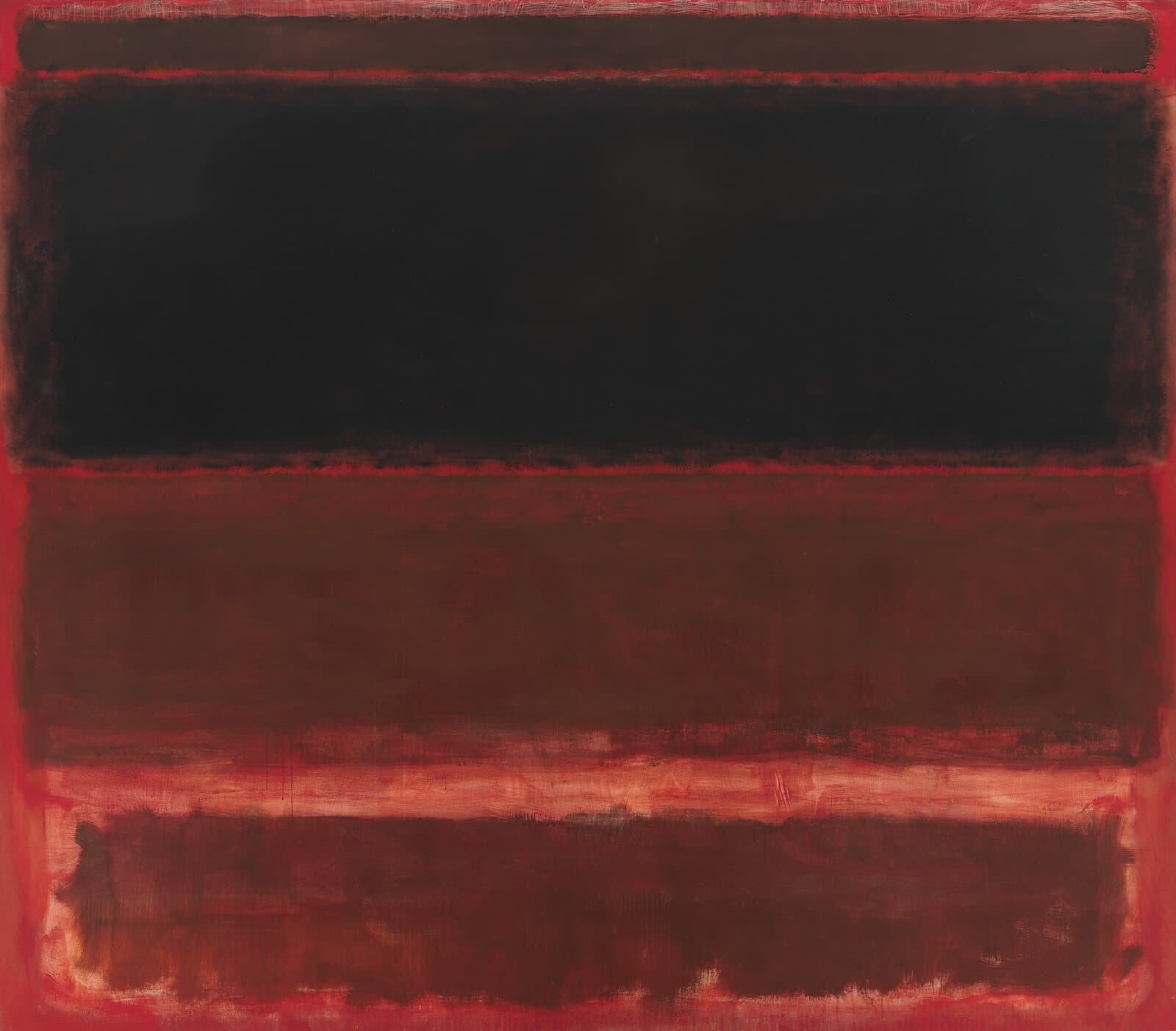
Final insured/saleable estimate for Mark Rothko’s Four Darks in Red (1958, Whitney accession 68.9) is $50–100 million. This range is derived from auction and private‑sale comparables for large, mature late‑1950s/early‑1960s Rothkos, adjusted for the painting’s museum provenance, scale and presumed marketability.
Valuation Analysis
Valuation conclusion: Based on comparable auction outcomes for large, mature Rothkos and the painting’s institutional status, I value Mark Rothko’s Four Darks in Red (1958, oil on canvas, c. 101 13/16 × 116 3/8 in / 258.6 × 295.6 cm, Whitney accession 68.9) in the band of $50–100 million for an insured/saleable example. The work is museum‑held and has not appeared on the public market since acquisition, which both strengthens its art‑historical standing and constrains immediate liquidity [1].
My band is anchored to clear public precedents: large red/maroon field Rothkos from the late 1950s–early 1960s have repeatedly realized in the high tens of millions at major evening sales. Representative public results include several lots in the $66–87M range and multiple 1958–1961 canvases that exceeded $80M in recent years; these sales provide the principal datum set for a comparable‑driven estimate [2]. Private, arranged transactions can and do trade at premia to public results, sometimes exceeding triple digits, but those are selective and not reliably generalizable.
How the band is shaped: The lower bound ($50M) reflects conceivable sellability if the work were made marketable but carried condition questions or if market appetite softened; the upper bound ($100M) reflects the premium a large, pristine, museum‑verified 1958 Rothko could command in a tightly contested private sale or a rare institutional acquisition scenario. For a live auction offering without material conservation concerns the most probable realized range for a painting of this stature would concentrate in the mid portion of the band—roughly $60–85M—based on direct comparables and recent market behavior.
Key variables that would materially refine the estimate are: an up‑to‑date condition/conservation report, complete provenance and exhibition/publication history from the Whitney, and clear evidence of any encumbrances or donor restrictions. If the Whitney maintained the work for exhibition and scholarship only (no intention to deaccession), the piece is functionally off‑market and its insurance/replacement valuation would still sit inside this band but be treated differently by institutions and insurers.
Recommended next steps: obtain the Whitney’s condition report and acquisition documentation, compile a short list of closest‑match auction comparables by year/size/palette, and commission a formal appraisal from a major auction house specialist for a fixed insured value. Those discrete inputs typically adjust a preliminary comparable‑based band by tens of millions either direction.
Key Valuation Factors
Art Historical Significance
High ImpactFour Darks in Red dates from 1958, squarely within Rothko’s mature color‑field period—arguably the most collectible phase of his career. Works from this period are central to Rothko scholarship and museum survey exhibitions and are commonly cited in monographs and catalogues raisonnés. Museum custody (Whitney accession 68.9) amplifies the work’s scholarly prominence and confirms attribution and canonical status. That art‑historical significance underpins both institutional demand and private collector interest, and it is a principal justification for the upper segment of the valuation band. In short, the painting’s place in Rothko’s mature oeuvre is a primary value driver and supports a high valuation relative to minor or early works.
Comparables & Price Evidence
High ImpactValuation relies heavily on auction and private sale comparables for large late‑1950s/early‑1960s Rothkos. Public auction lots of similar scale and palette have clustered in the high tens of millions (many in the $66–87M bracket) with a number of 1958–1961 canvases realizing above $80M. Private, off‑market transactions occasionally achieve higher levels and inform the upper bound of the band. Because Four Darks in Red has not appeared at auction since joining the Whitney, these comparables serve as the best market evidence for a hypothetical offering. The consistency of high results for mature red‑field works is the single most material quantitative input to the estimate.
Provenance & Exhibition History
High ImpactInstitutional provenance (Whitney Museum ownership, acquired 1968) significantly strengthens authenticity, scholarship and exhibition pedigree—pressing factors for major buyers and insurers. A long museum residency enhances catalogue and scholarly visibility and typically increases market desirability; however, it can also complicate saleability because deaccession from a major museum is rare and subject to policy scrutiny. A rich exhibition history and frequent citation in Rothko literature will generally push an insured/saleable valuation upward, whereas gaps in provenance or donor restrictions could reduce market demand or limit buyer types.
Condition & Conservation
Medium ImpactCondition and conservation history are decisive for Rothko values. Large canvases are sensitive to relining, surface abrasion, inpainting and discoloration; major structural intervention or visible overpainting materially lowers market and insurance valuations. Conversely, original, stable surfaces with documented conservation work and minimal intervention favor the top of the band. Because the Whitney’s internal condition report is not public here, the estimate errs on comparables and provenance; obtaining a formal conservation assessment is necessary to move from a band to a single insured value.
Liquidity & Deaccession Risk
Medium ImpactMuseum ownership reduces immediate market liquidity—most institutions do not sell masterpieces, and if they do, sales are tightly managed and often routed to other nonprofit institutions. That rarity of supply can create upward price pressure in hypothetical private negotiations, but it also means fewer direct buyers and a more constrained market when a work is offered. In a deaccession scenario, institutional buyers or major private collectors typically compete intensely, which can drive realized prices toward the high end; in an open auction context, prices depend more directly on buyer confidence and condition.
Sale History
Four Darks in Red has never been sold at public auction.
Mark Rothko's Market
Mark Rothko is a blue‑chip Modern/Abstract Expressionist master whose mature late‑1950s/early‑1960s color‑field canvases consistently command the highest prices in his market. Major evening‑sale Rothkos have repeatedly realized in the high tens of millions, with landmark auction and private sales establishing a resilient price floor for high‑quality, large works. Institutional collectors, major private buyers and endowment funds form the core demand base. While prices fluctuate with broader market cycles, Rothko’s historical significance and scarcity of top examples sustain strong long‑term value.
Comparable Sales
Orange, Red, Yellow
Mark Rothko
Large mature Rothko (1961), high-profile evening sale and a market high-water mark for Rothko's red field works; comparable scale/palette and top-end price precedent.
$86.9M
2012, Christie's New York
~$121.5M adjusted
No. 10
Mark Rothko
Same year as Four Darks in Red (1958), large mature-period Rothko sold in a major evening sale—closely comparable in date, scale and market standing.
$81.9M
2015, Christie's New York
~$111.0M adjusted
No. 7
Mark Rothko
Major post-war Rothko achieving a high result (Macklowe provenance); significant but from an earlier date (1951) and slightly different place in Rothko's development.
$82.5M
2021, Sotheby's New York (The Macklowe Collection)
~$97.8M adjusted
Untitled (Shades of Red)
Mark Rothko
Mature red-palette Rothko (1961) sold in a high-profile sale but at a lower price than peak examples—useful to show pricing dispersion within the red field group.
$66.8M
2022, Christie's New York (The Collection of Anne H. Bass)
~$73.3M adjusted
Current Market Trends
The high end of the post‑war/contemporary market remains selective but robust for canonical, museum‑quality works. Large Rothkos have shown steady strong results over the past decade; occasional private transactions above public auction levels indicate persistent deep demand among ultra‑high‑net‑worth collectors and institutions. Macro volatility and shifting cross‑market appetite (e.g., tech wealth, hedge‑fund collectors) can create short‑term variability, but Rothko’s core market signals remain positive.
Study print
Study this painting as a print
Pair the full artwork with a museum-style study sheet focused on one meaningful detail.
Sources
- Whitney Museum of American Art — Collection entry for Mark Rothko, Four Darks in Red (1958)
- Christie’s / Major auction results for large Rothko canvases (representative press releases and sale results)
- Christie’s press release — Orange, Red, Yellow (2012) high‑profile sale
- CNBC reporting on a reported private Rothko sale (indicative of private‑sale upside)