Four Darks in Red

by Mark Rothko

Four Darks in Red stages four hovering bands within a smoldering red field to generate an immersive, solemn atmosphere. Thinly layered washes and feathered edges make the dark zones throb like thresholds, suspending viewers between weight and glow [1][4]. Painted in 1958 at monumental scale, it aligns with Rothko’s late‑’50s turn to wine‑dark, enclosing spaces [1][2].
💰

Market Value

$50-100 million

How much is Four Darks in Red worth?

Study Print Studio

Create a personal study print

Build a companion study sheet around the part of this painting that speaks to you most. Choose a detail, shape an interpretation, and walk away with something personal and display-worthy.

Fast Facts

Year
1958
Medium
Oil on canvas
Dimensions
258.6 × 295.6 cm (101 13/16 × 116 3/8 in.)
Location
Whitney Museum of American Art, New York
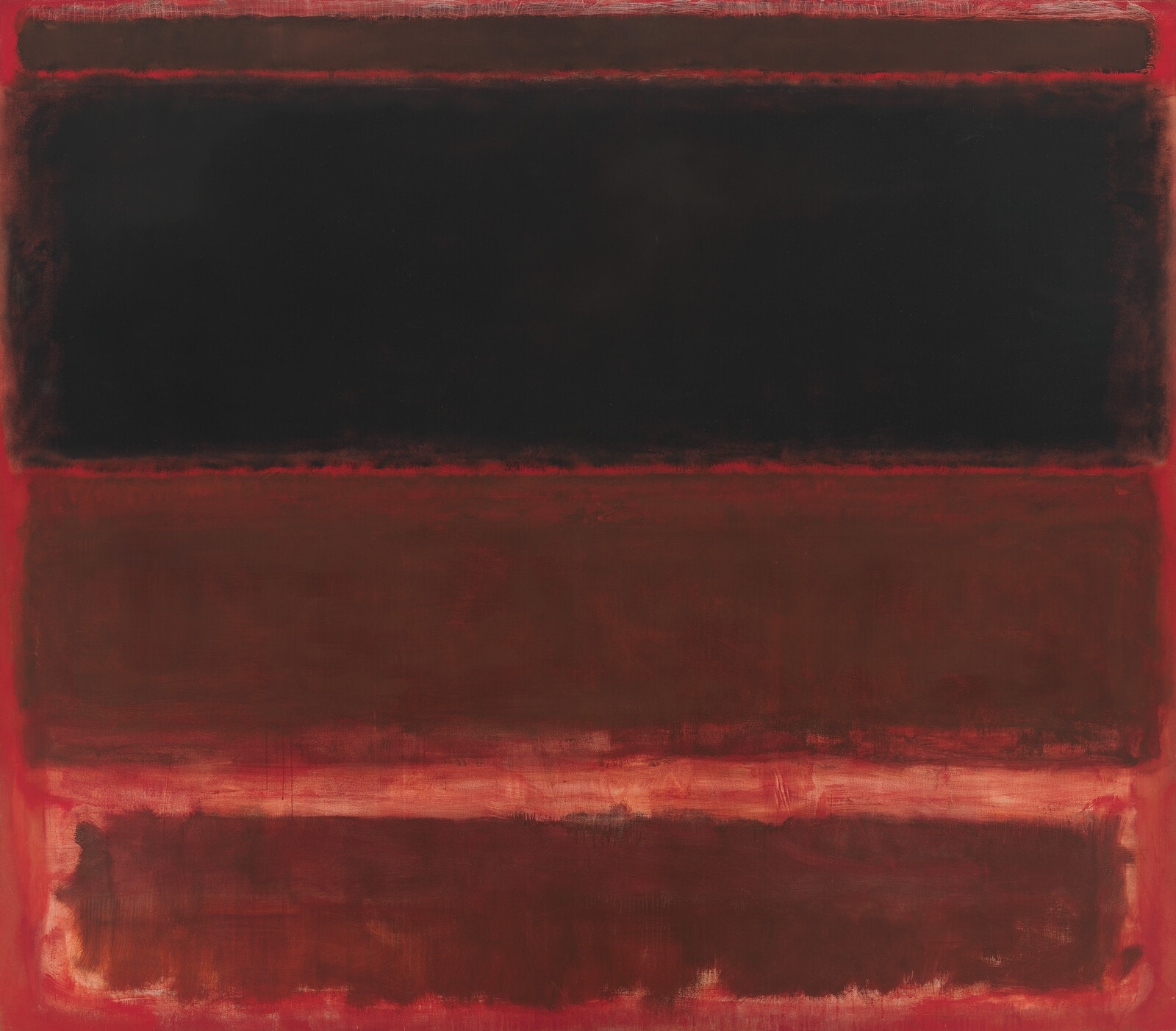
Four Darks in Red by Mark Rothko (1958) featuring Hovering dark bands (rectangles), Incandescent borders (feathered edges), Smoldering red field (enclosing ground), Pressing black mass (reversal of gravity)

Click on any numbered symbol to learn more about its meaning

Meaning & Symbolism

Rothko organizes the surface as four stacked fields—an almost black expanse on top, followed by three maroon‑to‑crimson bands—whose edges stain outward into the red ground. Up close, the seams where dark meets red ignite into incandescent borders, especially along the lower divisions, where narrow flickers of hotter red run like embers. These effects are not accidents of brushwork but the result of multiple thin washes that let light penetrate and rebound from within the paint film, creating a breathing, inward glow rather than a matte wall of pigment 14. The upper register’s mass, heaviest at the top, produces a deliberate reversal of gravity: blackness presses down while the lower reds pulse upward, trapping the viewer in a charged interval between weight and illumination. In this tension the rectangles act less as shapes than as thresholds—zones of passage that alternately receive and resist your gaze 2. This threshold logic links the canvas to Rothko’s contemporaneous pursuit of a closed space—rooms of wine‑dark portals that envelop the body at close range. By 1958 he spoke of painting environments that behave architecturally, akin to vestibules or pilasters abstracted into color; the stacked bars here read like compressed horizons or lintels that seal the field while opening it inward 23. The near‑black top panel is not opaque; its feathered perimeter wicks red into darkness, so passage feels possible yet withheld. The central maroon expanse is deeper but warmer, and its softly frayed lower edge releases strips of heated red that suggest life’s persistence under pressure—a flicker of expectancy inside solemnity. Such affective ambivalence is core to Rothko’s aim that painting operate like music—sustained chords that move feeling without narrative illustration 3. The four bands function as a low, organ‑like voicing: bass (black) anchoring, baritone (maroon) resonating, alto (crimson) glowing—an emotional architecture that you sense physically in the chest when the nearly ten‑foot‑wide canvas fills your peripheral vision 13. Within Rothko’s trajectory, Four Darks in Red marks a decisive consolidation of the late‑1950s dark palette and monumental format. The painting demonstrates how his color‑fields cease to be backgrounds for objects and become the object—an enveloping presence whose ambiguity encourages inward, even spiritual, attention. Scholarly accounts often describe this liminal pull as an invitation to inward transformation, a passage “through” the aperture of color rather than a look “at” an image 26. That interpretive center is confirmed by viewers’ and curators’ long practice of installing such works in chapel‑like settings, encouraging stillness and proximity. Crucially, none of this depends on symbolism in the illustrative sense. The meaning of Four Darks in Red is enacted, not decoded: the softly breathing borders, the drips and scumbles embedded in the lower band, the way the top black presses while the red ground refuses to extinguish, all choreograph an encounter between despair and expectancy. This is why Four Darks in Red is important within Abstract Expressionism and Color Field painting: it shows color itself carrying the burden of tragedy and hope at architectural scale, achieving the rare modern feat of making painting into a place 1257.

Explore Deeper with AI

Ask questions about Four Darks in Red

Popular questions:

Powered by AI • Get instant insights about this artwork

💬 Ask questions about this artwork!

Interpretations

Material Optics and the Engineering of Inner Light

Look past the solemn palette to the craft: multiple thin washes and feathered seams act like stacked glazes, letting light penetrate, scatter, and rebound to produce an inward incandescence rather than surface sheen. This is not expressionist accident but a controlled optical machine—capillary edges wick red into darkness so the borders flicker like embers. Conservation studies of Rothko’s late‑1950s method describe varied binders and scumbles that slow and warm reflected light, explaining the painting’s “breathing” effect at close range. In Four Darks in Red, that engineered glow complicates the funereal tonality: the near‑black is optically porous, and the reds are volumetric, not flat. The result is a paradoxical luminosity—gravity above, photospheric heat below—that sustains tension without pictorial narration 14.

Source: Whitney Museum of American Art; National Gallery of Art (Conservation)

Architectural Liminality: From Pilaster to Portal

Rothko’s 1958 turn toward a “closed space” aligns the stacked bars with architectural thinking: lintels, pilasters, and compressed vestibules abstracted into color. Curators connect this shift to the Seagram cycle’s wine‑dark portals and to Rothko’s admiration for spaces like Michelangelo’s Laurentian vestibule, which he cited for its “trapped” sensation. Four Darks in Red anticipates that enclosure by sealing the top with weight and articulating lower thresholds that open inward while denying passage. The work thus occupies a hinge between planar bands and full aperture structures, converting painting from image to envelope. Rather than depict architecture, Rothko mobilizes its affective logics—compression, overhang, axial pull—to choreograph approach, halt, and hover in front of the surface 23.

Source: National Gallery of Art (Seagram Murals); Isabelle Dervaux (NGA/PBS)

Embodied Perception: Low Frequencies for the Peripheral Body

At nearly ten feet across, the canvas recruits peripheral vision, where form and value dominate over detail. Rothko’s low‑key chord—black, maroon, crimson—functions like a sustained organ register, a somatic vibration felt in the chest more than parsed by the eye. This is why close viewing matters: the painting is calibrated for immersion, not distant appraisal. The stacked bars become perceptual thresholds that alternately absorb and release the gaze, producing micro‑temporal shifts akin to musical suspension and resolve. In this phenomenological frame, Four Darks in Red is less an object than a durational event—time thickens at the borders, and the viewer’s stance, breath, and distance co‑compose the work’s emotional key 13.

Source: Whitney Museum of American Art; Isabelle Dervaux (NGA/PBS)

Apophatic Reading: Immanent Transcendence Without Icons

Scholars of religion read Rothko’s late dark fields as apertures to an experience of the sacred that withholds imagery—an apophatic strategy where meaning arises through absence and ambiguity. Installed quietly and viewed up close, the panels form a ritual threshold: the near‑black isn’t void but a permeable dark, the maroons smoulder, and the seams glow, suggesting presence refracted rather than depicted. This aligns with Rothko’s insistence on non‑narrative, music‑like feeling and with curatorial framings of the Seagram works as a “closed space.” Four Darks in Red thus offers “immanent transcendence,” a solemn encounter grounded in material paint yet oriented to inward transformation, not doctrinal symbol 27.

Source: MDPI Religions (on Rothko’s liminality); National Gallery of Art

Reception and Display: The Chapel Effect in Secular Museums

Critical reception often notes the chapel‑like atmosphere around Rothko rooms: low light, bench seating, close hangs that invite hush. Writing on the Tate murals and related installations, critics describe portal forms that focus attention and induce a mood of solemn concentration, while commentators in medical humanities invoke a cathedral-like therapeutic quiet. Four Darks in Red, though not site‑specific, has been contextualized within this display tradition, which amplifies its contemplative pull and frames viewers’ responses as durational and reflective. Such curatorial staging is not neutral: it steers the painting’s meanings toward consolation, grief work, and awe—even as the work’s abstraction resists any single narrative or doctrine 68.

Source: The Guardian (critical reception of Rothko rooms); British Journal of Psychiatry

Related Themes

About Mark Rothko

Mark Rothko (1903–1970), a leading figure of Abstract Expressionism, developed his signature format of stacked, soft-edged rectangles by 1949. Rejecting literal symbolism, he sought to convey fundamental emotions through color, scale, and immersive viewing conditions [2][3][9].
View all works by Mark Rothko

More by Mark Rothko