Untitled (Black on Grey)

by Mark Rothko

Mark Rothko’s Untitled (Black on Grey) compresses feeling into two stacked fields: a vast, softly modulated black pressing down upon a lower band of chalky grey, both ringed by a narrow white border. The blurred seam between them holds a charged threshold where descent and persistence meet [1][3][4].
💰

Market Value

$20-60 million

How much is Untitled (Black on Grey) worth?

Study Print Studio

Create a personal study print

Build a companion study sheet around the part of this painting that speaks to you most. Choose a detail, shape an interpretation, and walk away with something personal and display-worthy.

Fast Facts

Year
1969–1970
Medium
Acrylic on canvas
Dimensions
203.3 × 175.5 cm (80.0 × 69.1 in)
Location
Solomon R. Guggenheim Museum, New York
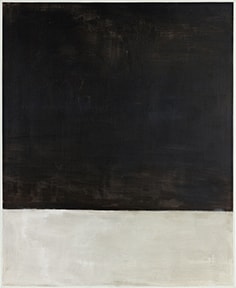
Untitled (Black on Grey) by Mark Rothko (1969–1970) featuring Upper black field, Lower grey band, Feathered seam (threshold), Narrow white border

Click on any numbered symbol to learn more about its meaning

Meaning & Symbolism

Untitled (Black on Grey) organizes perception around a single, unyielding relation: an upper field of dense black hovers over a paler strip of grey, their junction feathered into a soft, irregular seam. The black is not a sealed void; it is built from thin, transparent veils that let warmth and coolness breathe through the surface, so that darkness appears alive rather than opaque. The grey below reads as ash or fog, a register of diminished light. A narrow white border—created when Rothko taped his canvas edges, a habit stemming from his late work on paper—holds the image inside a bright perimeter, heightening the sensation that we are looking into a chambered interior rather than at a flat panel 38. Together these devices enact a drama without figures: weight versus lift, absorption versus emission, enclosure versus exposure. The upper black exerts gravity, pulling the eye downward; the lower grey resists, a tenuous ground that is not quite surrendered. The seam where they touch functions as a threshold, a locus where opposing forces temporarily balance before tipping again 14. This distilled structure belongs to Rothko’s late series of 1969–70, when he pursued increasingly austere formats—often two zones divided by a continuous, horizon-like edge—while maintaining his lifelong ambitions for silence, tragedy, and direct emotional address 129. Rather than signaling emptiness, the reduction intensifies the work’s ethical and existential charge. Within the tradition critics call the abstract sublime, Rothko relocates the experience of vastness and limit from landscape and myth to the sensory facts of color, scale, and edge; the painting becomes an environment for the viewer’s duration and inwardness, not a picture of something else 5. Up close, the brush-lapped blacks reveal subtle temperature shifts and scumbled transitions; the grey band shows uneven, chalky passages where the weave of the canvas and the drag of the brush catch the light. These material breaths keep the image open, refusing both decorative polish and nihilistic flatness. The white perimeter—explicitly articulating the painting’s boundary—frames the inner field like a tomb edge, window casing, or medical margin, sharpening our awareness that meaning happens at the line between what is held and what is lost 38. Read this way, Untitled (Black on Grey) is not a private lament but a public instrument for endurance. Its scale invites the viewer’s body into a quiet confrontation, the way a chapel or a horizon does: time slows, attention steadies, and feeling accrues rather than announces itself. The painting sustains contradictory impulses—it darkens and clarifies, presses down and holds fast—so that the viewer recognizes mortality without conceding to despair. In 1969–70, when Rothko returned to large canvases after illness, he did not abandon his aims; he concentrated them. The two fields, the taped white edge, and the breathing black achieve an economy in which form and ethics coincide: to look is to stand at a limit, and to keep looking is to endure it 1245.

Explore Deeper with AI

Ask questions about Untitled (Black on Grey)

Popular questions:

Powered by AI • Get instant insights about this artwork

💬 Ask questions about this artwork!

Interpretations

Formal Analysis: Edge, Perimeter, and the Mechanics of Gravity

Rothko’s late two‑field format leverages a continuous, feathered seam to act as a load‑bearing edge—a horizon that governs optical gravity and lift. The upper black is not a monolith but a stack of thin, translucent veils, producing a breathing darkness that alternately absorbs and releases light; the grey registers as diminished illumination rather than mere pigment. Crucially, the taped white border—a practice carried over from his post‑1968 work on paper—operates like a clinical margin or window casing, intensifying the sensation of an inner chamber and making boundary itself a subject. Conservation studies confirm the layered handling and scumbled transitions that complicate any reading of the black as flat. The picture’s authority thus lies in edge conditions: horizon, margin, and the charged seam where contrary vectors meet and hover 236.

Source: National Gallery of Art (conservation/tech); Anderson Collection (formal description)

Historical Context: Austerity After Aneurysm

Following an aortic aneurysm in 1968, Rothko shifted heavily to paper, often masking edges with tape—habits that migrated back to canvas when he resumed large formats in 1969. The Black on Grey series emerges from this recuperative phase, coupling newfound material economies (acrylic, reduced underlayers, taped margins) with his longstanding aims of silence and tragic gravity. Institutional records anchor the series to 1969–70, with major canvases in the Guggenheim and other museums. Far from a capitulation to darkness, the late austerity refines the immersive goals tested in earlier mural cycles, channeling them into a stripped, portable architecture of contemplation. The result is a language of economized means that keeps faith with earlier ambitions while acknowledging changed physical circumstances and studio routines 134.

Source: Guggenheim Museum (object record); National Gallery of Art (paper practice); Tate (late-series context)

Symbolic Reading: The Abstract Sublime as Threshold

Within the lineage of the abstract sublime, Rothko relocates vastness and limit from mythic scenery to the sensorium of color, scale, and edge. The painting is not a depiction but a threshold apparatus: a zone where absorption (black) and emission (grey) negotiate a precarious balance. This substitution—cosmos for canvas—answers a modern need for transcendence without representation, placing the viewer inside an ethical test of attention and duration. Scholarly accounts of the sublime in modernism clarify how Rothko’s pared structure can still deliver awe: the field becomes a measured infinity, its horizon a limit that both halts and invites passage. Seen this way, the work is less a lament than a rite of calibration between measure and immeasurable feeling 56.

Source: Cambridge University Press (Rosenblum’s abstract sublime); Anderson Collection (experiential framing)

Reception & Caution: Beyond Moonscapes and Biography

Contemporaries sometimes nicknamed the 1969–70 works “moonscapes,” and later viewers folded them into a biographical narrative of decline. David Anfam, Rothko’s catalogue raisonné author, cautions that such readings are naïve reductions: the late blacks and greys extend a persistent inquiry into scale, silence, and the tragic, rather than merely illustrating mood or fate. Authoritative biographies similarly stress continuity—serial thinking, immersive address, and ethical ambition—over anecdote. Responsible interpretation thus brackets sensationalism to track how technical means (veiled darks, taped borders) sustain long‑held aims. The painting’s gravity is earned formally, not borrowed from external events; its darkness works as a philosophical medium, not a diagnostic sign 78.

Source: David Anfam (via Christie’s catalog essay); Encyclopaedia Britannica (career continuity)

Material Specificity: Acrylic Darkness and Optical Breath

The Guggenheim’s Untitled (Black on Grey) is acrylic on canvas, a choice that facilitated thin, permeable films and rapid adjustments in the late studio. Technical observation shows how temperature shifts inside black—warm and cool veils—create a low, pulsing luminosity rather than a dead matte. The grey’s chalky passages catch on the weave, modulating reflectance and preventing nihilistic flatness. These micro‑events of light turn the surface into a slow instrument, rewarding proximity and duration: the longer one looks, the more air seems to circulate through the dark. In this sense, material fact and metaphysical claim coincide; what feels like metaphysics is built from binders, fillers, drag, and edge control managed with extraordinary restraint 12.

Source: Guggenheim Museum (object medium); National Gallery of Art (technical analysis of Rothko’s surfaces)

Related Themes

About Mark Rothko

Mark Rothko (1903–1970), a leading figure of Abstract Expressionism, developed his signature format of stacked, soft-edged rectangles by 1949. Rejecting literal symbolism, he sought to convey fundamental emotions through color, scale, and immersive viewing conditions [2][3][9].
View all works by Mark Rothko

More by Mark Rothko