How Much Is No. 1 (Royal Red and Blue) Worth?
Last updated: May 11, 2026
Quick Facts
- Last Sale
- $75.1M (2012, Sotheby's New York)
- Methodology
- comparable analysis
Anchored to the painting’s Sotheby’s sale on 2012-11-13 (price realized USD 75,122,500) and evaluated against subsequent high‑end Rothko comparables, I estimate a current auction-value range of approximately USD 60,000,000–100,000,000. Final realization will be driven by condition, confirmed provenance/catalogue status, and whether the sale is public or private (private placements can command meaningful premiums).
Valuation Analysis
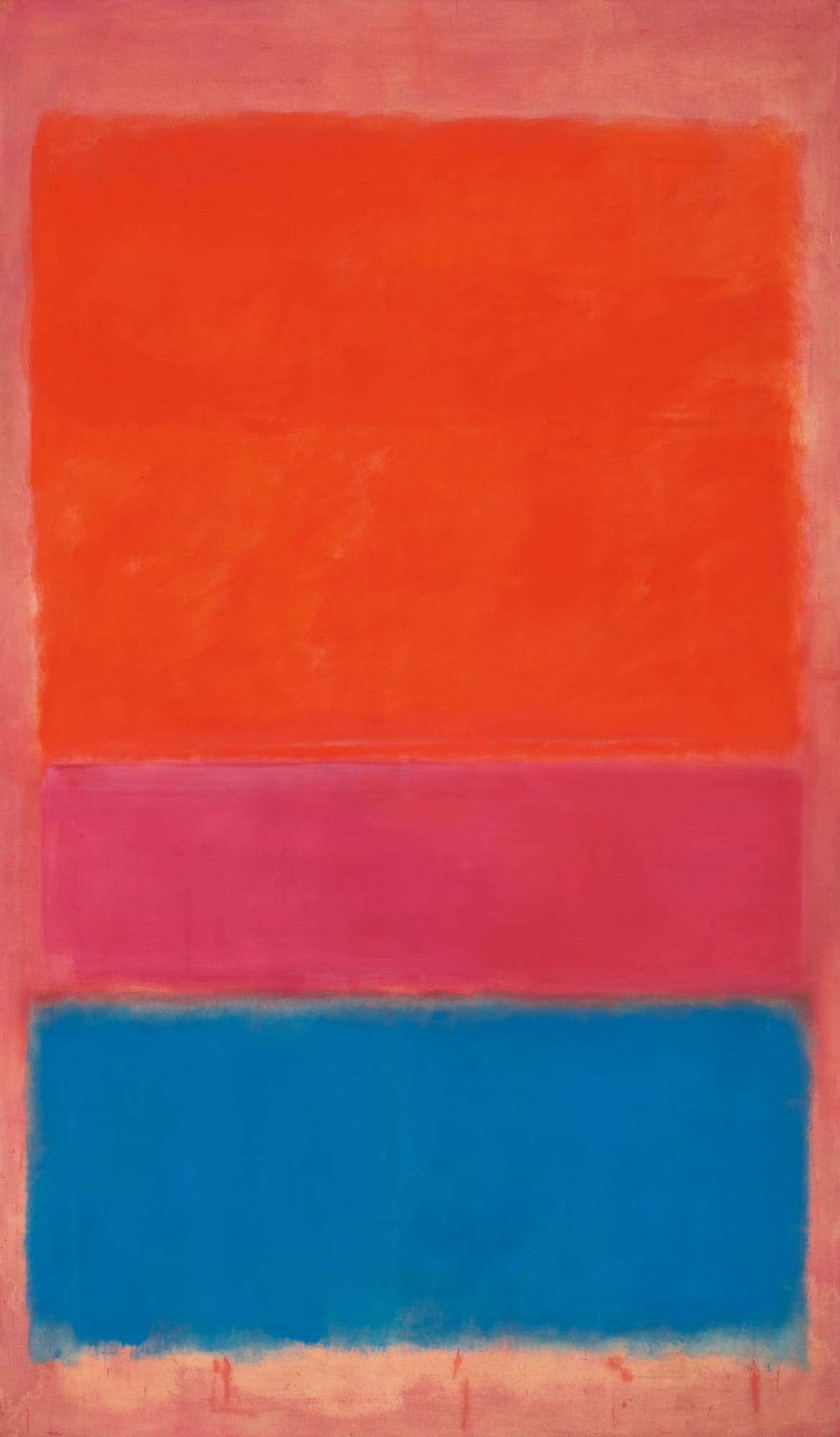
Valuation conclusion: The principal hard anchor for No. 1 (Royal Red and Blue) is its Sotheby’s price realized on 13 November 2012: USD 75,122,500, which I use alongside later high‑end Rothko comparables to derive a present auction range of USD 60M–100M [1]. Adjusting the 2012 result for decades of market movement and cross‑checking against marquee Rothko sales supports a midpoint toward the upper part of this band, but not reliably above it in a public auction absent exceptional competitive pressure.
Why this range: The 2012 Sotheby’s sale is direct evidence of this exact canvas’ market value and is therefore the most important datapoint; that sale occurred when demand for large Rothko color‑field paintings was robust and remains the primary anchor for the work’s market worth [1]. Comparable evening‑sale results for large 1950s–early 1960s Rothkos (for example, high public results such as the top‑of‑market 2012 Christie’s Orange, Red, Yellow) demonstrate a public auction ceiling in the high tens of millions to sub‑hundred‑million range for canvases of exceptional provenance and scale [2]. More recent high‑quality mid‑century Rothko lots (2021–2023) traded in the $45M–$82M band at public auction, underscoring a spread depending on provenance, size and sale conditions.
Key contingencies: The realized outcome is highly sensitive to (a) condition and any conservation history; (b) confirmed, unencumbered title and catalogue‑raisonné/exhibition documentation; and (c) sales route and marketing. If the painting is presented with a museum‑grade condition report, clean title, and marketing that draws global institutional and private bidders, it should perform toward the top of the stated band. If defects, provenance gaps, or legal/title encumbrances exist, the work could fall well below the low end. Conversely, a negotiated private placement to a single buyer (or a nine‑figure private sale with guarantee) can exceed the public‑auction band but is not predictable without a committed buyer pool.
Practical next steps: to refine and finalize a sale estimate suitable for insurance or sale planning, secure the full Sotheby’s 2012 lot catalogue entry and condition report, confirm catalogue‑raisonné status and exhibition citations, and obtain up‑to‑date condition/conservation documentation. With those materials, an auction house specialist or independent appraiser can give a transaction‑ready reserve/estimate or negotiate a private‑sale strategy.
Sources and anchors used in this valuation: Sotheby’s 2012 lot entry for No. 1 (Royal Red and Blue) and leading Christie’s and Sotheby’s Rothko evening‑sale results that set high‑end market context [1][2].
Key Valuation Factors
Art Historical Significance
High ImpactNo. 1 (Royal Red and Blue) dates from Rothko’s mature color‑field period (1954), the era that defines his market and museum importance. Paintings from this period are central to Rothko scholarship and to museum installations of Rothko rooms; works chosen by the artist for major 1954 exhibitions (e.g., the Art Institute of Chicago selection) carry additional scholarly weight. This intrinsic art‑historical standing makes the painting highly desirable to institutional and private collectors seeking canonical examples of mid‑century American abstraction, and it underpins the painting’s ability to command top‑tier prices when other commercial conditions are aligned.
Provenance & Exhibition History
High ImpactProvenance reported at the 2012 sale indicates long‑term ownership within a private collection and inclusion among works Rothko selected for a 1954 museum show — both strong provenance markers. Well‑documented exhibition history and inclusion in catalogue‑raisonné citations materially enhance buyer confidence and price realization. Conversely, gaps in provenance, disputed title or absence from major catalogues or literature would depress value. The painting’s established sale at Sotheby’s in 2012 as a marquee lot already signifies strong provenance, but any new documentation or museum loans would further support the upper half of the valuation band.
Condition & Conservation
High ImpactCondition can be decisive for a Rothko: paint‑layer stability, surface varnish, lining/restoration history, and integrity of the ground and stretcher all influence prices. A clean conservation record and a recent professional condition report will sustain value at auction and encourage institutional interest; evidence of heavy restoration, inpainting, or structural compromise can reduce marketability and pricing by tens of percent. Before listing, obtain an independent conservation assessment and, if needed, conservative conservation treatment to preserve value and buyer confidence.
Size & Visual Impact
High ImpactAt 288.9 × 171.5 cm (≈113¾ × 67½ in), the canvas is a large, room‑filling work — the scale collectors and museums prize for canonical Rothkos. Larger canvases have greater institutional appeal and generally achieve higher prices relative to small formats or works on paper. The painting’s scale, coupled with strong color and composition characteristic of Rothko’s mature period, increases its chances of drawing competitive bidding at evening auctions and of achieving placement in museum collections or major private galleries.
Market Liquidity & Sale Venue
Medium ImpactTop Rothko canvases trade in both public auction and private sale channels. Public auctions offer price discovery and the potential for competitive bidding; private placements can achieve premiums, especially when a guaranteed sale or preferred buyer is available. Recent market behavior shows selective liquidity: a handful of marquee Rothkos transact at very high private prices while many public auction results cluster in the mid‑to‑high tens of millions. Choice of house, sale timing, and marketing to institutional and global private buyers will therefore materially affect the final outcome.
Sale History
Sotheby's New York, Contemporary Art Evening Sale
Sotheby's New York (Macklowe collection sale)
Christie's New York
Christie's New York
Christie's New York
Mark Rothko's Market
Mark Rothko is a blue‑chip postwar master whose large 1950s–early 1960s color‑field canvases form the core of his market strength. Major museum and private‑collection demand for canonical works remains robust; marquee Rothkos have achieved results in the tens of millions to near‑hundred‑million range at auction or in private placements. The market is selective: while the very top examples can transact privately at nine figures, many high‑quality Rothkos continue to sell publicly in the $40M–$90M band depending on size, provenance and sale conditions. Rothko retains institutional cachet and cross‑market appeal.
Comparable Sales
No. 1 (Royal Red and Blue)
Mark Rothko
Exact painting — primary anchor for valuation (large scale, strong provenance; sold as a leading lot in 2012).
$75.1M
2012, Sotheby's New York
~$96.2M adjusted
No. 7
Mark Rothko
Early‑1950s Rothko, large‑scale and high‑profile (Macklowe collection sale) — shows robust demand for important early‑50s canvases.
$82.5M
2021, Sotheby's New York
~$92.4M adjusted
Orange, Red, Yellow
Mark Rothko
Large 1961 canvas that set the public‑auction ceiling for Rothko — useful as a top‑end market benchmark.
$86.9M
2012, Christie's New York
~$111.2M adjusted
No. 1
Mark Rothko
Same title but later date (1962) — demonstrates how date/series/size/provenance can produce materially lower results for comparable-named works.
$49.6M
2022, Christie's New York
~$54.1M adjusted
Untitled (Yellow, Orange, Yellow, Light Orange)
Mark Rothko
Mid‑1950s Rothko sold in a recent evening sale — a good indicator of mid‑market pricing for important but not top‑provenance works from the period.
$46.4M
2023, Christie's New York
~$48.7M adjusted
Untitled
Mark Rothko
1960s untitled Rothko — another recent high‑quality sale from the 1960–62 period, useful for assessing how later‑date works trade vs. early‑1950s canvases.
$48.0M
2022, Sotheby's New York
~$52.3M adjusted
Current Market Trends
The Post‑War/Color‑Field market has been selective since 2024, showing a contraction followed by uneven recovery; high‑end works increasingly move privately, reducing public comparables. Geographic diversification (more offerings in Asia) and dealer/private placements have introduced price dispersion. Blue‑chip Rothkos remain desirable and recover faster than the broader market when demand returns, but auction outcomes depend heavily on marketing, sale venue and the presence of competing buyers.