How Much Is White Center (Yellow, Pink and Lavender on Rose) Worth?
Last updated: May 11, 2026
Quick Facts
- Last Sale
- $72.8M (2007, Sotheby's, New York (Contemporary Art Evening Sale, Lot 31))
- Methodology
- comparable analysis
Anchored by the painting’s documented Sotheby’s sale (price realized $72,840,000 on 15 May 2007) and subsequent high‑end Rothko comparables, I estimate a market range of $60–120 million for White Center (Yellow, Pink and Lavender on Rose). Under typical evening‑sale conditions this work would most likely realize in the $75–90M band; pristine condition, museum‑level provenance and heated international bidding could drive the price toward the top of the range.
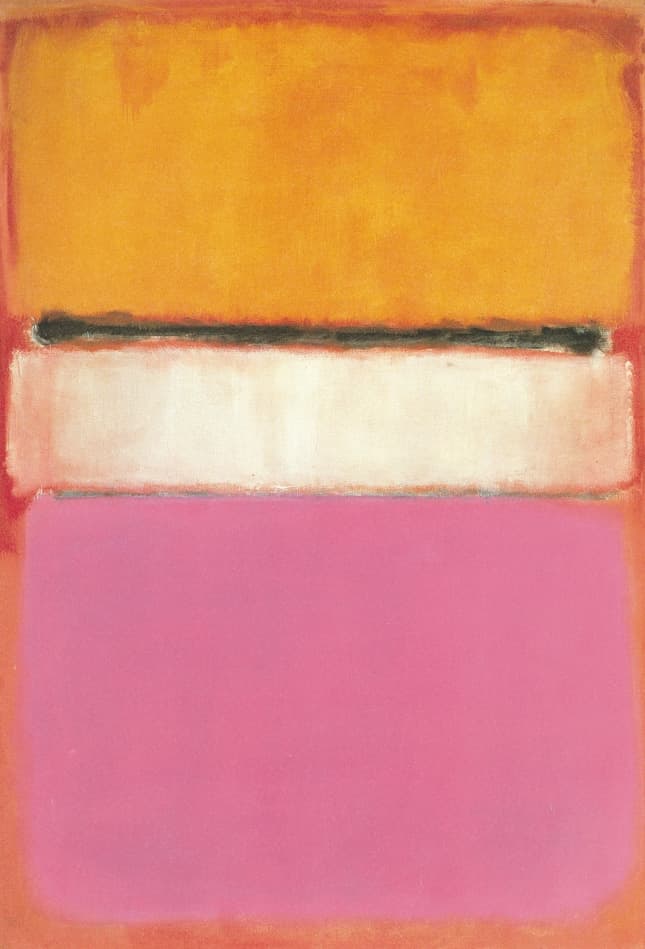
White Center (Yellow, Pink and Lavender on Rose)
Mark Rothko, 1950 • Oil on canvas
View more by Mark Rothko →Valuation Analysis
Valuation conclusion: Anchored to the painting’s public‑sale result at Sotheby’s (15 May 2007; price realized $72,840,000) [1] and calibrated against later marquee Rothko sales (notably Christie's 2012 Orange, Red, Yellow) [2], this valuation places White Center (1950) in a market range of $60,000,000–$120,000,000 (USD). The lower bound recognizes scenarios with condition questions, limited recent exhibition exposure or subdued buyer appetite; the high end assumes museum‑grade provenance, excellent condition and active competitive bidding.
The 2007 Sotheby’s result provides a direct and high‑quality anchor because it is the same physical work and it carried top provenance (David Rockefeller) and a strong catalogue note; that realized price ($72.84M nominal) is an unequivocal datapoint for buyer willingness at scale and, when considered alongside later Rothko evening‑sale highs, supports the stated range [1][2]. Comparable Rothkos of similar scale and visual potency have realized between roughly $66M and $87M at public auction in the 2012–2022 window, and CPI‑style adjustments would place the 2007 nominal result substantially higher in today’s dollars—hence the upward flexibility of the top end.
Why this painting merits this level: White Center (1950) is a well‑recognized transitional/multiform work of major scholarly interest. It appears in the principal Rothko catalogue‑raisonné and has a documented exhibition/provenance history that elevates institutional confidence. Works with that combination of catalogue inclusion and high‑profile provenance typically attract museum and deep‑pocket private interest, which supports values at the top of the postwar market tier.
Key contingencies: The single largest immediate drivers of realized price will be (1) the physical condition and conservation history (lining, retouching, flaking or inpainting materially affect buyer confidence), (2) the completeness and clarity of title/provenance documentation, and (3) market mechanics at time of sale (auction guarantees, single‑owner sales, private treaty interest from sovereign or institutional buyers). A clean condition report plus demonstrable major‑museum exhibition loans can add material premium; conversely any major restoration or ambiguity in title will pull bids toward the low end.
Practical recommendation: Before marketing, obtain a modern written condition report and compile full provenance/exhibition documentation (catalogue‑raisonné citation, museum loans). If the goal is maximum price discovery, offer in a premier contemporary/postwar evening sale with institutional outreach; if the priority is confidentiality or strategic placement, a calibrated private treaty with auction‑house guarantees may secure a floor near the mid‑range.
Final note: this estimate is a market (fair value) range based on public auction anchors and recent comparable sales; it is not a formal insured appraisal, which would require in‑hand inspection and review of conservation records and original documentation.
Key Valuation Factors
Art Historical Significance
High ImpactWhite Center (1950) occupies an important position in Rothko’s transition to the mature multiform/color‑field idiom. It is not merely a study but a fully realized canvas from a decisive year; the work is reproduced in scholarship and appears in the principal catalogue‑raisonné, which increases both academic and market recognition. Collectors and institutions prize works that illustrate pivotal evolutionary stages in an artist’s practice; this painting’s demonstrable role in Rothko’s development elevates its desirability relative to lesser studies or fragmentary works. That status supports participation by major museums and blue‑chip private buyers, underpinning the upper tier of the valuation range.
Provenance & Exhibition History
High ImpactProvenance is a decisive value driver. White Center’s descent through reputable commercial galleries and its long‑term ownership by David Rockefeller (consigned to Sotheby’s 2007) provides a transparent ownership chain that reduces buyer risk and increases institutional interest. Public exhibitions and catalogue citations further lift market value by confirming authenticity and historical importance; the documented exhibition/history noted in the Sotheby’s lot record materially strengthens buyer confidence. Conversely, any gaps in provenance, contested title or absence of catalogue‑raisonné inclusion would reduce competitive bidding and press the price toward the lower bound.
Condition & Conservation History
High ImpactRothko’s technique and surface handling can be fragile; conservation interventions (lining, relining, inpainting, consolidation) have a large and measurable effect on market value. A pristine, original or minimally intervened surface that reads well at exhibition scale preserves market confidence and supports top‑end pricing. Significant restoration, unstable paint layers, or extensive retouching will depress bids because buyers and institutions factor in future conservation costs and display risk. For this work a current, detailed condition report is essential; the valuation above assumes no major, value‑reducing restorations unless otherwise disclosed.
Market Liquidity & Buyer Demand
High ImpactThe pool of active buyers capable of transacting above $50M is limited—major institutions, sovereign/royal collections and a small number of ultra‑high‑net‑worth private collectors. That concentration means results can swing significantly with one or two motivated bidders; ownership by a high‑profile seller, guarantees or private interest can therefore push a result above the nominal midpoint. Market cycles and macroeconomic conditions (liquidity, credit, currency moves) moderate this dynamic, but Rothko remains a marquee name whose best works prompt competitive international bidding when offered in premier venues.
Sale History
Sotheby's New York — Contemporary Art Evening Sale
Christie's New York — Evening Sale
Sotheby's New York — Evening Sale
Christie's New York — Anne H. Bass Sale
Mark Rothko's Market
Mark Rothko is a top‑tier blue‑chip artist within the postwar American canon. His auction record and repeated high‑eight‑figure realizations for large, canonical multiforms demonstrate deep institutional and private demand. Scarcity at the very top—many seminal Rothkos are held in museums or major collections—supports persistent price strength for fresh‑to‑market, well‑provenanced works. While mid‑level Rothkos trade in the multi‑millions, museum‑quality canvases regularly populate the $50–90M band and can exceed that range under exceptional circumstances.
Comparable Sales
White Center (Yellow, Pink and Lavender on Rose)
Mark Rothko
Exact work — direct public‑sale anchor with strong provenance (David Rockefeller) and catalogue‑raisonné/exhibition history.
$72.8M
2007, Sotheby's New York (Contemporary Art Evening Sale)
~$114.1M adjusted
Orange, Red, Yellow (1961)
Mark Rothko
Record-setting Rothko multiform from a similar scale/period; demonstrates top‑end auction demand for canonical Rothkos.
$86.9M
2012, Christie's New York (Evening Sale)
~$123.1M adjusted
No. 1 (Royal Red and Blue)
Mark Rothko
Large-scale Rothko multiform sold in the same strong 2012 market — useful high‑end benchmark close to White Center's realized level.
$75.1M
2012, Sotheby's New York (Evening Sale)
~$106.5M adjusted
Untitled (Shades of Red)
Mark Rothko
Recent high‑profile Rothko auction (2022) — a useful mid‑to‑upper‑range contemporary-cycle comparable for buyer appetite post‑2010s.
$66.8M
2022, Christie's New York (Anne H. Bass sale)
~$74.2M adjusted
Current Market Trends
As of mid‑2026 the blue‑chip postwar and contemporary market remains selective but resilient: marquee works by established masters still command competitive bidding, though macroeconomic headwinds and capital allocation priorities have introduced caution at the very highest levels. Private‑sale guarantees and strategic placements continue to shape outcomes, but public evening sales remain the primary mechanism for price discovery for ultra‑high‑value works.
Sources
- Sotheby's — Lot 31, Contemporary Art Evening Sale, 15 May 2007 (White Center)
- Christie's — Post‑Sale Release: Orange, Red, Yellow (1961), 8 May 2012
- Christie's — Anne H. Bass Sale: Post‑Sale Release (Mark Rothko, Untitled (Shades of Red)), 12 May 2022
- ArtsJournal / CultureGrrl — Coverage of Sotheby's 2007 Contemporary Sale