How Much Is A Woman and a Girl Driving Worth?
Last updated: February 22, 2026
Quick Facts
- Methodology
- comparable analysis
Hypothetical fair-market value for Mary Cassatt’s A Woman and a Girl Driving (1881) is estimated at $10–18 million. This canonical, large-scale, peak-period Impressionist oil with an iconic modern-life subject would likely set a new auction record for the artist if brought to market. The work is in the Philadelphia Museum of Art; valuation is necessarily hypothetical.
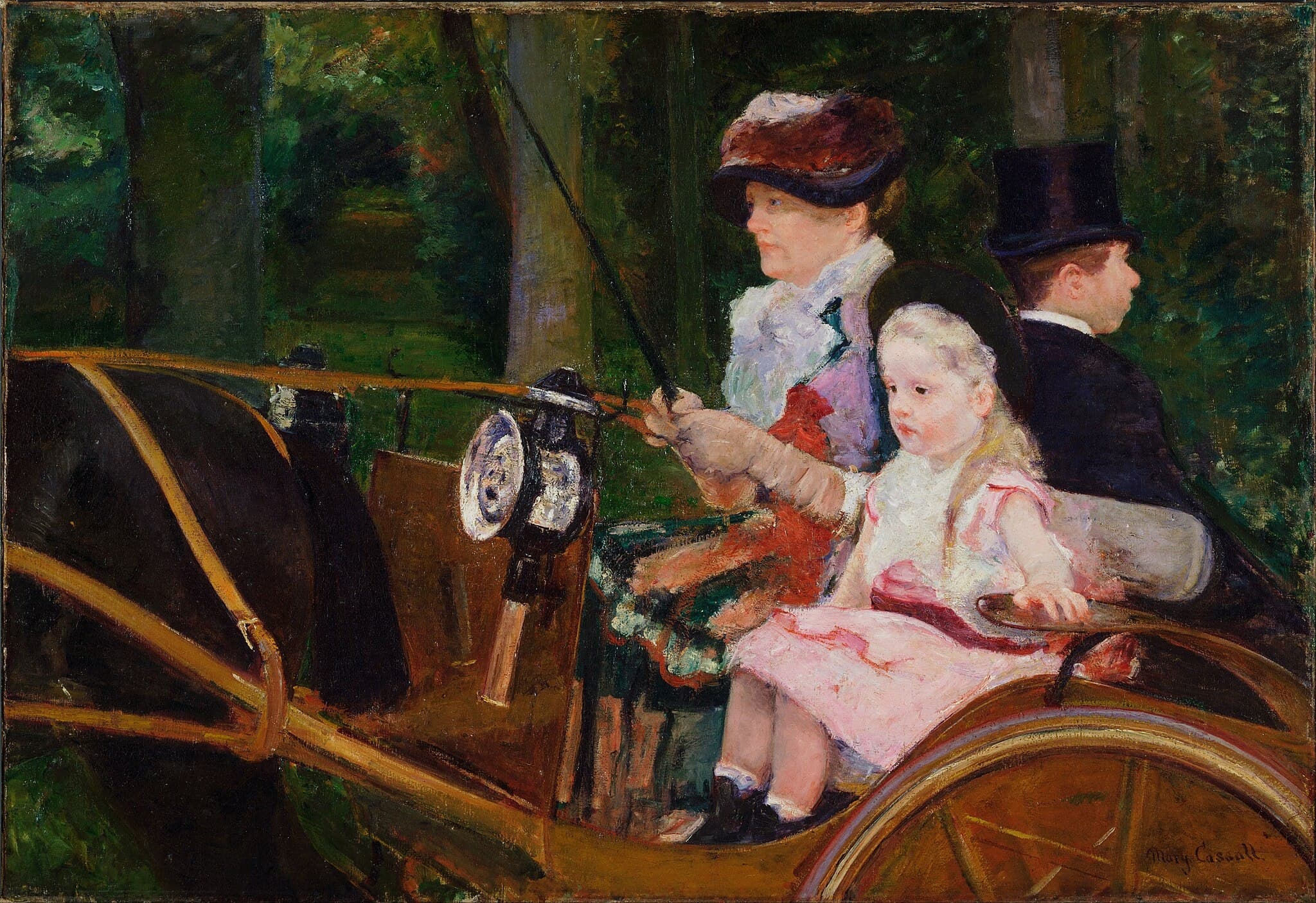
A Woman and a Girl Driving
Mary Cassatt, 1881 • Oil on canvas
Read full analysis of A Woman and a Girl Driving →Valuation Analysis
Summary valuation: Based on artist benchmarks, category headroom, and the painting’s canonical status, a prudent hypothetical auction range for Mary Cassatt’s A Woman and a Girl Driving (1881; oil on canvas, approx. 89.7 × 130.5 cm) is $10–18 million. The painting is held by the Philadelphia Museum of Art and featured prominently in its 2024 exhibition Mary Cassatt at Work, underscoring its status as a touchstone of the artist’s early mature period [2].
Record headroom and direct comparables: Cassatt’s standing auction record is $7.489 million for a late‑1870s work on paper (Young Lady in a Loge, Gazing to Right; Christie’s, 2022), purchased by the Pola Museum of Art [1]. Strong oils have reached the mid‑single digits, most notably Children Playing with a Dog at $6.2 million (2007) and $4.8 million (2018), establishing the historical ceiling for the medium [3]. At the category level, Berthe Morisot’s Après le déjeuner (1881) achieved $10.9 million in 2013, illustrating low‑ to mid‑eight‑figure potential for masterpiece‑level Impressionist works by women artists [4]. Given its prime 1881 date, ambitious scale, and celebrated modern‑life subject (women in public space), A Woman and a Girl Driving would reasonably be expected to surpass Cassatt’s current record and compete in the low eight figures.
Museum-caliber scarcity and demand tailwinds: The painting’s frequent reproduction, exhibition prominence, and art‑historical importance position it among the best‑known Cassatt oils in a U.S. collection [2]. Supply of museum‑grade Cassatt oils is exceptionally thin; when works of this period and quality appear, they attract deep institutional and private demand. Broader market research indicates the Impressionist segment remains a relatively stable “safe harbor,” with top results concentrated in best‑in‑class, guaranteed consignments—and a renewed appetite for historically important women artists, which has supported stronger estimates and bidding for canonical material [5].
Assumptions and sensitivities: This range presumes sound condition, no material structural issues, and retention of current scale and surface integrity. A current technical/condition report could shift the estimate. The upper end would be further supported by comprehensive early dealer provenance (e.g., Durand‑Ruel), deep exhibition history, and competitive third‑party interest. Replacement/insurance values in a museum context would likely sit above fair‑market, reflecting scarcity and record‑setting potential.
Conclusion: On a marquee evening platform with appropriate global marketing and a back‑stop guarantee, A Woman and a Girl Driving would be a headline lot with a credible path to $10–18 million, resetting Cassatt’s auction record and aligning with peer benchmarks for canonical 1881 Impressionism [1][2][4][5].
Key Valuation Factors
Art Historical Significance
High ImpactPainted in 1881, A Woman and a Girl Driving sits squarely in Cassatt’s peak Paris years and encapsulates her modern-life focus on women in public space. The picture’s visibility in scholarship and exhibitions and its resonance within feminist art-historical narratives elevate it beyond a typical genre scene. It is one of the artist’s most cited and reproduced oils in a U.S. museum, strengthening its cultural capital and market cachet. Works that define an artist’s contribution to Impressionism—and that are widely recognized by curators and the public—command premium pricing because they anchor both private and institutional collections.
Prime Period, Subject, and Scale
High ImpactCollectors pay a premium for Cassatt’s late‑1870s to mid‑1880s oils, especially when the subject embodies her modern sensibility. This composition—women driving in the Bois de Boulogne—offers unusual dynamism and social nuance, distinct from (yet complementary to) her iconic mother‑and‑child interiors. The canvas is notably large for Cassatt (approx. 89.7 × 130.5 cm), amplifying wall power and rarity. The combination of prime date, ambitious format, and highly commercial subject matter justifies a valuation step‑up over mid‑tier oils and supports low‑eight‑figure potential if offered in a marquee sale.
Provenance and Institutional Validation
High ImpactLong‑term placement in the Philadelphia Museum of Art and its feature in the museum’s 2024 exhibition Mary Cassatt at Work confer exceptional prestige. Institutional validation signals quality, condition oversight, and scholarly relevance, all of which materially de‑risk a potential acquisition. While museum ownership means the work is not on the market, it simultaneously heightens scarcity; if hypothetically deaccessioned or otherwise made available, the painting would enter a context of pent‑up demand, strong curatorial interest, and potential institutional competition, supporting the upper half of the valuation range.
Market Liquidity and Category Headroom
High ImpactCassatt’s current auction record is $7.489 million for a late‑1870s work on paper, with strong oils historically at $4.8–6.2 million. Peer category evidence—such as Berthe Morisot’s 1881 masterpiece at $10.9 million—demonstrates headroom for canonical works by women Impressionists. Broader Impressionist market studies show steady sell‑through and low volatility, with top prices clustered in museum‑grade material. Against this backdrop, a celebrated, large‑scale 1881 Cassatt oil can credibly clear prior artist records and transact in the low eight figures, assuming competitive staging and appropriate financial backstops.
Sale History
A Woman and a Girl Driving has never been sold at public auction.
Mary Cassatt's Market
Mary Cassatt is a blue‑chip American Impressionist with broad international demand. Her auction record stands at $7.489 million for a late‑1870s pastel/gouache (Christie’s, 2022), underscoring the power of A+ subjects even on paper. Oils have historically realized in the mid‑ to high‑single‑digit millions, with top examples clustered in the late 1870s–mid‑1880s and in highly commercial themes (mother and child or modern women in public). Supply of museum‑caliber paintings is thin, which both limits headline totals and creates pent‑up demand when canonical works surface. In recent years, prints and pastels have shown steady liquidity in the five‑ to six‑figure range, while fresh, high‑quality oils remain the key drivers of new record potential.
Comparable Sales
Young Lady in a Loge, Gazing to Right
Mary Cassatt
Artist record; prime late‑1870s Paris subject of a modern woman in public, closely aligned thematically to 1881 ‘Driving’; signals top-end Cassatt demand, albeit on paper rather than oil.
$7.5M
2022, Christie's New York (The Ann & Gordon Getty Collection: Volume 1)
~$8.2M adjusted
Children Playing with a Dog
Mary Cassatt
Major Cassatt oil; strong subject (children), museum‑grade quality; among the artist’s highest oil results in recent decades and a key benchmark for oil pricing.
$4.8M
2018, Christie's New York
~$6.1M adjusted
Baby Charles Looking Over His Mother’s Shoulder (No. 3)
Mary Cassatt
Cassatt oil on canvas with hallmark mother‑and‑child theme; recent New York auction comp establishing current appetite for good but non‑trophy oils.
$1.6M
2021, Sotheby's New York (American Art)
~$1.9M adjusted
Portrait de jeune femme au chapeau blanc
Mary Cassatt
Cassatt oil dated 1879—very close to 1881 ‘Driving’; strong period portrait result in Europe, indicating demand for late‑1870s/early‑1880s oils.
$1.3M
2023, Ader (Hôtel Drouot, Paris)
~$1.4M adjusted
Après le déjeuner
Berthe Morisot
Category headroom: canonical 1881 Impressionist painting by a peer woman Impressionist; demonstrates the market’s capacity to value masterpiece‑level works around low‑ to mid‑eight figures.
$10.9M
2013, Christie's London
~$15.0M adjusted
Mother Resting Her Cheek on Her Daughter’s Blond Head
Mary Cassatt
Recent Cassatt oil result at a regional house; useful for gauging floor pricing for smaller, intimate oils versus marquee, museum‑level subjects.
$480K
2023, Guyette & Deeter (Portsmouth, NH)
~$505K adjusted
Current Market Trends
Impressionism remains a comparatively stable, low‑volatility category, with top results concentrated in rare, best‑in‑class works. Since 2024, houses have emphasized de‑risked consignments and third‑party guarantees; buyers are prioritizing quality, provenance, and curatorial significance over momentum. A sustained recalibration toward connoisseurship has benefited historic women artists, with multiple category records and renewed museum interest. Within this context, canonical Cassatt works—especially peak‑period oils with modern‑life subjects—are well positioned to outperform prior artist benchmarks, provided they are presented in marquee evening contexts with global marketing and competitive financial terms.
Study print
Study this painting as a print
Pair the full artwork with a museum-style study sheet focused on one meaningful detail.
Sources
- Christie’s — Ann & Gordon Getty Collection sale results (includes Cassatt record)
- Philadelphia Museum of Art — Mary Cassatt at Work (exhibition; includes A Woman and a Girl Driving)
- Christie’s — Mary Cassatt artist page (auction history and highlights)
- ArtFixDaily — Morisot’s Après le déjeuner sells for $10.9m (2013)
- Artnet News — Impressionism at 150: market overview and sell-through data (2024)