How Much Is Young Mother Sewing Worth?
Last updated: February 22, 2026
Quick Facts
- Methodology
- comparable analysis
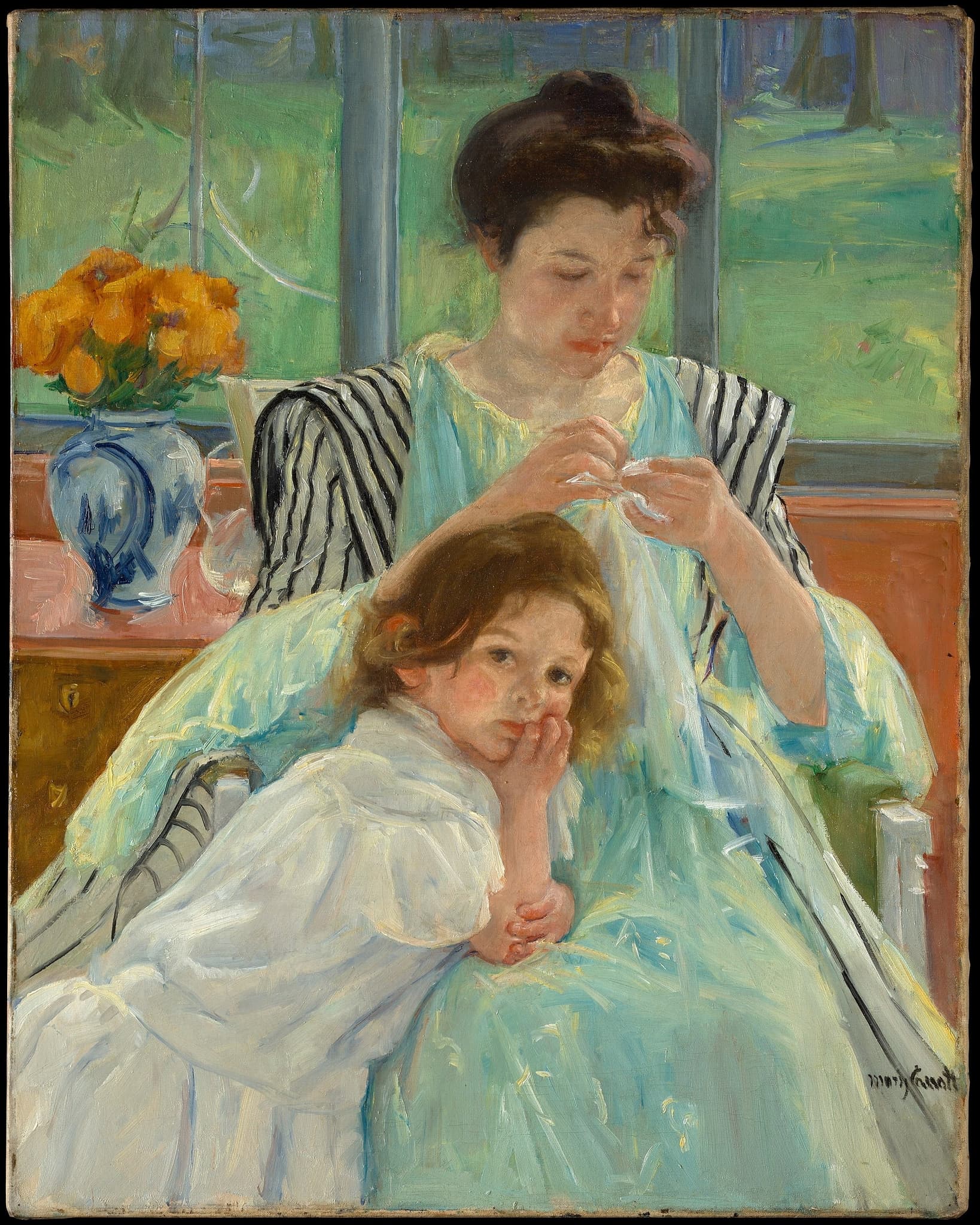
Young Mother Sewing (1900) is a canonical, museum-held mother-and-child oil by Mary Cassatt from The Met’s Havemeyer bequest. Based on closely matched comparables and the work’s iconic status and pedigree, we estimate a hypothetical fair market value of $12–20 million. This exceeds typical Cassatt oil results due to extreme rarity of A-level oils and a likely trophy premium.
Valuation Analysis
Work and context. Mary Cassatt’s Young Mother Sewing (1900) is a peak-period, fully finished oil on canvas that epitomizes her most sought-after subject—the intimate mother-and-child—at sizeable scale. The painting entered The Metropolitan Museum of Art via the H.O. Havemeyer bequest and is among Cassatt’s most widely reproduced images, reinforcing its status as a textbook work in her oeuvre [1]. Its mature date, compositional clarity, and museum pedigree make it an outlier in quality and visibility compared with the majority of Cassatt material that reaches the market.
Market standing and key benchmarks. Cassatt’s market is blue-chip but thin for great oils; works on paper are more common and liquid. Her current auction record—$7.489 million—was set in 2022 by Young Lady in a Loge, Gazing to Right, a mixed-media work on paper with exceptional subject and provenance, demonstrating that A+ Cassatt images can command prices beyond the typical oil curve when quality and story align [2]. For oils close to Young Mother Sewing in date/ambition, strong public benchmarks cluster around the mid–seven figures: The Sun Bath, With Three Figures achieved $4.4 million in 2020 [3], and Children Playing with a Dog brought $4.8 million in 2018 [4]. More modest mother-and-child oils, such as Baby Charles Looking Over His Mother’s Shoulder (No. 3), realized $1.593 million in 2021, underscoring the spread between good and great examples [5].
Deriving the estimate. Because Young Mother Sewing is a canonical, museum-caliber mother-and-child oil with Havemeyer/Met pedigree and broad scholarly recognition, it materially outranks observed auction comparables in quality, fame, and cachet. Scarcity of top-tier Cassatt oils on the open market, combined with the “flight to quality” dynamic evident in recent Impressionist/Modern seasons, supports a substantial premium over the $1.6–4.8 million range established by strong but non-iconic oils. Factoring these premiums, a hypothetical fair market value of $12–20 million is justified. The upper bound reflects potential private-sale or single-owner competition for a true trophy that could reset public expectations, while staying disciplined relative to the artist’s publicly observed price architecture.
Caveats and insurance context. The work is held by The Met and is not marketable under ordinary circumstances; this valuation is hypothetical and contingent on condition, which would need confirmation via technical examination. Museums typically schedule insurance above FMV to reflect replacement difficulty; for a painting of this stature, a 20–40% uplift over FMV is customary in practice. Taken together, the evidence of Cassatt’s peak market, the specific strength of mature mother-and-child oils, and the painting’s unparalleled provenance underpin the proposed $12–20 million range [1][2][3][4][5].
Key Valuation Factors
Art Historical Significance
High ImpactYoung Mother Sewing is one of Cassatt’s most reproduced and cited paintings, encapsulating her mature Impressionist language and her definitive theme of maternal intimacy. Painted in 1900, it sits squarely within the period in which Cassatt’s technique and compositional confidence were fully realized. The work’s frequent appearance in museum surveys and scholarship elevates it beyond a strong example to an emblematic image in the artist’s canon. That status drives demand among top collectors and institutions because it represents not just Cassatt’s favored subject but also a crystallization of her contribution to modern painting—female-centered, domestic, and psychologically nuanced imagery executed at a high level. Such canonical positioning merits a material premium over otherwise comparable oils.
Provenance and Institutional Pedigree
High ImpactThe painting’s passage through the storied Havemeyer collection and its long-standing placement in The Metropolitan Museum of Art create an exceptional provenance chain. Havemeyer ownership signals early, discerning patronage among America’s most important collectors of Impressionism, while The Met’s custody confers global visibility and scholarly validation. Works with this caliber of pedigree are comparatively irreplaceable, and even hypothetical market offerings would attract competition from buyers who prioritize institutional-grade material. The museum association also implies careful conservation and documentation. Together, these attributes confer a ‘trophy’ premium—buyers pay up not only for the object’s intrinsic quality but for its association with a blue-chip collecting lineage and the branding halo of a top museum.
Market Scarcity and Demand
High ImpactFirst-rate Cassatt oils—especially iconic mother-and-child compositions at substantial scale—are exceptionally scarce on the market. Most transacted Cassatts are works on paper, which remain liquid but cap out well below the potential of the very best oils. When top oils do appear, competition is intense and results can leapfrog prior benchmarks. The scarcity effect is amplified by sustained institutional interest in women Impressionists and by collector focus on prime-period, signature-subject works. In such conditions, price discovery can reset quickly once a trophy-quality example is in play. Young Mother Sewing’s combination of subject, date, execution, and fame positions it among the small subset of Cassatt oils that can command an order-of-magnitude premium over good but non-iconic paintings.
Comparable Sales and Price Anchors
High ImpactRecent public anchors include Cassatt’s record on paper—Young Lady in a Loge, Gazing to Right at $7.489m—which proves market headroom for A+ imagery, and strong mature oils such as The Sun Bath ($4.4m) and Children Playing with a Dog ($4.8m). More modest mother-and-child oils have realized ~$1.6m. Young Mother Sewing clearly surpasses these comparables in renown, subject centrality, and pedigree; therefore a rational valuation requires a step-change above the mid–seven-figure cluster. The $12–20m bracket captures a realistic ‘trophy premium’ over high-quality, non-iconic oils while acknowledging the artist’s historically observed auction ceilings. It is also consistent with private-sale dynamics in which best-in-class pieces trade at meaningful premia to public records.
Sale History
Young Mother Sewing has never been sold at public auction.
Mary Cassatt's Market
Mary Cassatt’s market is blue-chip, with deep institutional and private demand, especially in the United States. Supply defines outcomes: works on paper and prints are frequent and liquid at mid–six figures, while the very best oils are rare and can command substantial premiums. Public oil benchmarks in recent cycles have clustered around $1.6–4.8 million, but Cassatt’s current auction record ($7.489 million) was set by an iconic work on paper in 2022, underscoring that subject, image recognition, and provenance can outrank medium in driving prices. When A-level oils or early exhibition-related pastels surface fresh to market, competition is robust; otherwise, buyer selectivity is evident. Private sales for top-quality, signature-subject oils can exceed public results due to scarcity and controlled placement.
Comparable Sales
The Sun Bath, With Three Figures
Mary Cassatt
Same artist; late 1890s/1900s mother-and-child oil from Cassatt’s mature period, closely aligned in date, subject, and ambition to Young Mother Sewing. Sold 2020-10-28 for $4.4m; ≈$5.28m in 2025 dollars. Strong benchmark for top-tier Cassatt oils centered on maternal intimacy.
$4.4M
2020, Sotheby's New York
~$5.3M adjusted
Children Playing with a Dog
Mary Cassatt
Same artist; 1907 oil on canvas of children (closely related subject family, comparable ambition/scale). Sold 2018-11-11 for $4.8m; ≈$6.05m in 2025 dollars. A leading oil benchmark for Cassatt’s early 20th-century child-themed paintings, though without the mother figure.
$4.8M
2018, Christie's New York
~$6.0M adjusted
Baby Charles Looking Over His Mother’s Shoulder (No. 3)
Mary Cassatt
Same artist; 1900 oil on canvas and direct mother-and-child subject, extremely close in date and theme to Young Mother Sewing. Sold 2021-05-19 for $1,593,000; ≈$1.82m in 2025 dollars. Useful like-for-like subject comp at a lower quality/scale tier.
$1.6M
2021, Sotheby's New York
~$1.8M adjusted
Young Lady in a Loge, Gazing to Right
Mary Cassatt
Same artist; 1878–79 mixed media work on paper setting the current Cassatt auction record. Not an oil and different subject, but demonstrates market headroom for A+ iconic images with top provenance. Sold 2022-10-20 for $7,489,000; ≈$8.24m in 2025 dollars.
$7.5M
2022, Christie's New York
~$8.2M adjusted
A Kiss for Baby Ann (No. 3)
Mary Cassatt
Same artist; 1897 pastel, premier mother-and-child subject (top-tier works on paper). Sold 2022-10-21 for $1,108,800; ≈$1.22m in 2025 dollars. While not an oil, it helps calibrate demand for Cassatt’s best maternal imagery.
$1.1M
2022, Christie's New York
~$1.2M adjusted
Femme portant un bonnet noir et vert, cousant
Mary Cassatt
Same artist; c. 1889–90 oil depicting a woman sewing—closest thematic link to Young Mother Sewing albeit without the child. Hammer recorded at $650,000 (premium would be higher). As a same-theme oil of lesser ambition, it shows the base market for sewing imagery absent the iconic mother-and-child composition.
$650K
2025, Christie's New York
Current Market Trends
Impressionist and early Modern segments softened in 2024 but rebounded in late 2025, with a marked ‘flight to quality’ and strong results for trophy works from blue-chip names. Within this context, best-of-type pictures—prime period, iconic subject, and impeccable provenance—have outperformed category averages, while secondary examples face selective bidding. Women Impressionists, including Cassatt, continue to gain institutional focus and collector attention, supporting demand for high-quality maternal and domestic imagery. Day-sale absorption for good works on paper remains healthy, but masterpiece oils are scarce and command disproportionate premiums when available. Overall, conditions favor canonical, museum-grade material such as Young Mother Sewing, which aligns with the market’s quality-first bias.
Study print
Study this painting as a print
Pair the full artwork with a museum-style study sheet focused on one meaningful detail.
Sources
- The Metropolitan Museum of Art – Young Mother Sewing (Object page)
- Christie’s – Ann & Gordon Getty Collection results (Cassatt record noted)
- Sotheby’s – Live-streamed Contemporary and Impressionist & Modern sales recap (includes Cassatt’s The Sun Bath result)
- Christie’s – Mary Cassatt artist page (includes Children Playing with a Dog result)
- Artdaily – Report on Sotheby’s American Art (includes Baby Charles result)