How Much Is Femme au chapeau blanc Worth?
Last updated: June 28, 2026
Quick Facts
- Methodology
- comparable analysis
Indicative fair-market/insurance valuation: $40-65 million for Pablo Picasso’s Femme au chapeau blanc (1921), a large, museum-quality neoclassical portrait. The estimate is derived from closely matched early‑1920s oil comparables and recent blue‑chip Picasso benchmarks. The work is in a French national museum and inalienable; this figure is a notional indemnity-style valuation.
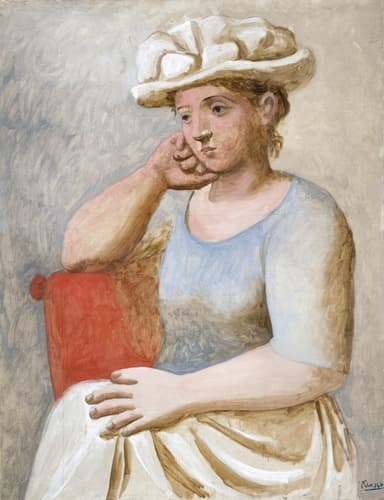
Femme au chapeau blanc
Pablo Picasso, 1921 • Oil on canvas
Read full analysis of Femme au chapeau blanc →Valuation Analysis
Conclusion: Femme au chapeau blanc (1921) by Pablo Picasso supports a notional fair‑market/insurance valuation of $40–65 million. The work is a large (118 × 91 cm), fully realized neoclassical portrait from Picasso’s critical post‑WWI “return‑to‑order” phase and resides in the Musée de l’Orangerie via the Walter–Guillaume bequest, making it inalienable under French law; accordingly, this is an indemnity‑style indication rather than a sale prediction [1][2].
Method and anchors: The range is built from tightly aligned early‑1920s oil comparables and calibrated against broader Picasso benchmarks. A near‑period anchor is Guitare sur une table (1919), ex‑MoMA, which realized $37.1m at Sotheby’s in 2022—about $40m in 2025 dollars—confirming high‑eight‑figure demand for best‑in‑class neoclassical works [3]. Femme au chapeau blanc is a major portrait and materially larger, warranting an upward adjustment from that baseline.
Direct period comps: In the same stylistic window, La Lettre (La Réponse) (1923, Olga) made $25.2m in 2019 (≈$31.8m in 2025 dollars) [4], while Deux femmes et enfant (1922) brought $13.0m in 2014 (≈$17.6m in 2025 dollars) [5]. These results establish the mid‑to‑low anchor for early‑1920s oils. At the upper context, a 1932 Marie‑Thérèse portrait such as Le Repos fetched $36.9m in 2018 (≈$47.2m in 2025 dollars), and the period’s trophy peak, Femme à la montre (1932), achieved $139.4m in 2023, underscoring how prime‑year icons sit on a different pricing plane [6]. A wartime Dora Maar portrait reached ~$37m in Paris in 2025, signaling broad portrait depth even outside New York [7].
Positioning this work: The Orangerie picture’s scale, finish, and deep exhibition/literature profile (Zervos; notable provenance from Paul Guillaume to the Walter–Guillaume collection) argue for the upper tier of early‑1920s portrait pricing [1]. While the 1921 classical style trades below the artist’s most commercially fevered peaks (1932, major Cubist icons), museum‑grade portraits of this size and quality can command robust competition. The $40–65m bracket captures (i) the $40m near‑period still‑life anchor, (ii) uplift for larger, highly finished portraiture, and (iii) allowance for image‑specific upside in a strong New York marquee setting, where top Modern consignments saw renewed depth in spring 2026 [3][8].
Key sensitivities: Condition (lining, retouching, paint stability) could shift the indication materially; pristine surface and strong color saturation would bias the result to the top half. Image recognizability and publication density also drive demand. Conversely, market timing and macro risk can trim aggressive bidding. Given the work’s legal inalienability, this figure functions as an insurance/indemnity proxy grounded in observable market data rather than a prediction of a sale event [1][2].
Key Valuation Factors
Art Historical Significance
High ImpactPainted in 1921, the work is a textbook example of Picasso’s rappel à l’ordre—the post‑WWI return to classical monumentality that rebalanced form after a decade of Cubist innovation. This neoclassical phase is a central chapter in Picasso’s arc and is richly represented in museum collections and scholarship. As a large, authoritative portrait, Femme au chapeau blanc embodies the period’s sculptural modeling, serene poise, and Mediterranean classicism that have long attracted curators and collectors. While market premiums concentrate around 1932 and core Cubism, the 1919–23 “classical” corpus remains academically prized and increasingly recognized for its role in shaping interwar modernism, supporting strong, durable demand among connoisseur buyers.
Period and Subject Appeal
Medium ImpactEarly‑1920s female portraits—often linked to Olga Khokhlova—carry broad appeal for their calm, idealized presence and refined draftsmanship. Commercially, this tranche typically prices below Picasso’s most coveted cycles (notably 1932 Marie‑Thérèse icons) but ahead of many later works, reflecting a blend of historical importance and decorative accessibility. The restful imagery and classical gravitas can bridge private and institutional tastes, widening the buyer pool at the high eight figures. That said, the market has shown consistent hierarchy: exceptional 1932 or Cubist masterpieces command nine figures, while neoclassical portraits of similar scale and quality generally cluster in the mid‑to‑upper eight figures, with image‑specific outliers defining the ceiling.
Scale, Image Quality, and Condition
High ImpactAt 118 × 91 cm, the painting has commanding, museum‑wall presence—an important value driver at the top end. The composition’s finish, clarity of contour, and volumetric modeling exemplify the period’s strengths, increasing its suitability for marquee evening contexts. Condition is the key swing factor: original surface, minimal retouching, and coherent varnish will support the upper half of the range; structural issues (lining, instability, discoloration) would compress pricing. As a work preserved in a national museum, stewardship and documentation are typically strong, which can bolster confidence for insurance determination even absent a full public condition report.
Provenance, Publication, and Legal Status
High ImpactProvenance through the influential dealer‑collector Paul Guillaume and inclusion in the Walter–Guillaume bequest to the French state confer exemplary pedigree, reinforced by extensive exhibition and literature history (including Zervos). Such visibility and scholarly anchoring reduce attribution or authenticity risk and enhance value resilience. The work’s status in a French national museum makes it legally inalienable, meaning the valuation is not a sale forecast but an indemnity‑style benchmark; paradoxically, this public‑collection status also tends to elevate perceived cultural importance, supporting a premium within insurance frameworks, even as it removes near‑term marketability.
Sale History
Femme au chapeau blanc has never been sold at public auction.
Pablo Picasso's Market
Pablo Picasso remains the market’s most liquid and globally recognized Modern artist, consistently leading sales by both volume and value. His auction record is $179.4m for Les Femmes d’Alger (Version O, 1955), while 1932 Marie‑Thérèse portraits have reached the nine‑figure tier, led recently by Femme à la montre at $139.4m (2023). Core‑period Cubist canvases continue to command fierce competition, with strong seven‑ to eight‑figure results for prime works. Beyond these peaks, Picasso’s late Musketeers, major drawings, and early‑1920s neoclassical oils trade actively at disciplined levels. Supply of top examples is the key constraint. In this context, well‑published, museum‑quality works with scale and presence tend to outperform period averages and draw deep, international bidder pools.
Comparable Sales
La Lettre (La Réponse)
Pablo Picasso
Same artist; early‑1920s neoclassical portrait of Olga in a near‑identical format/scale to Femme au chapeau blanc; directly comparable in period, subject, and finish.
$25.2M
2019, Christie's New York
~$31.8M adjusted
Deux femmes et enfant
Pablo Picasso
Same artist; 1922 neoclassical composition from the same phase (rappel à l’ordre). Subject differs (mother‑and‑child group rather than single portrait) but strong period proxy.
$13.0M
2014, Christie's New York
~$17.6M adjusted
Guitare sur une table
Pablo Picasso
Same artist; near‑period 1919 oil from the neoclassical turn; museum‑grade (ex‑MoMA) with exceptional finish. Not a portrait, but an excellent market anchor for early‑1920s oils.
$37.1M
2022, Sotheby's New York
~$40.8M adjusted
Le Repos
Pablo Picasso
Same artist; 1932 Marie‑Thérèse portrait from Picasso’s most commercially coveted year. Used as an upper‑bound reference for top‑tier Picasso portrait pricing (different period/subject).
$36.9M
2018, Sotheby's New York
~$47.2M adjusted
Bust of a Woman with a Flowered Hat (Dora Maar)
Pablo Picasso
Same artist; wartime portrait (1943) demonstrating robust demand for strong Picasso portraits at mid‑to‑high eight figures, even outside New York; helpful portrait benchmark though later period.
$37.0M
2025, Hotel Drouot, Paris
Current Market Trends
Modern art rebounded after a softer 2023–2024, with 2025–2026 marquee auctions signaling renewed depth for blue‑chip material and stronger sell‑throughs. The market remains bifurcated: masterpiece‑level works attract aggressive bidding, while lesser examples face estimate discipline. Picasso sits at the center of this dynamic—prime 1932 and core Cubist works lead the charge, but best‑in‑class neoclassical oils from 1919–23 also perform firmly in the mid‑to‑upper eight figures. Activity continues to concentrate in New York for $10m+ lots, though significant results have emerged in Paris. Against this backdrop, a large, museum‑grade 1921 neoclassical portrait appropriately calibrates at $40–65m on an insurance‑style basis.
Study print
Study this painting as a print
Pair the full artwork with a museum-style study sheet focused on one meaningful detail.
Sources
- Musée de l’Orangerie collection entry: Picasso, Femme au chapeau blanc (1921)
- Code du patrimoine (France), Art. L451-5: Inalienability of national collections
- Sotheby’s result: Picasso, Guitare sur une table (1919), sold $37.1m (Nov 14, 2022)
- Christie’s/Press: Picasso, La Lettre (La Réponse) (1923) sold $25.2m (May 13, 2019)
- Christie’s Post‑sale results (May 6, 2014): Picasso, Deux femmes et enfant (1922) $13.045m
- Sotheby’s: Picasso, Femme à la montre (1932) sold $139.4m (Nov 8, 2023)
- AP News: Picasso Dora Maar portrait fetches €32m (~$37m) in Paris (Oct 24, 2025)
- The Art Newspaper: Strong Modern evening sale signals stabilization (May 20, 2026)