How Much Is Grande baigneuse Worth?
Last updated: June 28, 2026
Quick Facts
- Methodology
- comparable analysis
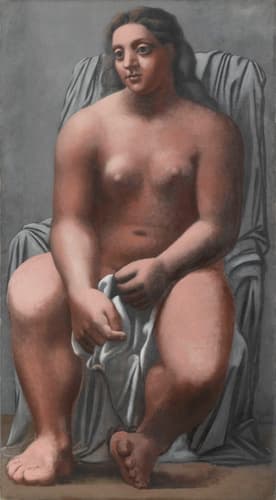
Hypothetical open‑market value for Picasso’s Grande baigneuse (1921) is $60–120 million as of mid‑2026. The estimate reflects the painting’s museum‑grade scale and importance within Picasso’s neoclassical period, set against current price leadership for 1932 works and seminal Cubism. The work is in the French national collection at the Musée de l’Orangerie and is not legally for sale.
Valuation Analysis
Conclusion: If legally deaccessioned and exportable, Pablo Picasso’s Grande baigneuse (1921) would be expected to achieve $60–120 million in today’s market. The work is a monumental, canonical example of Picasso’s neoclassical “return to order,” held by the Musée de l’Orangerie (Walter–Guillaume collection) and therefore inalienable under French law, making this a strictly hypothetical valuation [1][2].
Method: We applied a comparable-analysis framework anchored to recent, top-tier Picasso results and the limited set of directly relevant neoclassical comparables. On the market’s ceiling side, Picasso continues to command repeated nine‑figure prices for iconic periods and subjects—Sotheby’s sold Femme à la montre (1932) for $139.36 million in November 2023, while the artist’s auction record remains $179.37 million for Les Femmes d’Alger (Version “O”) in 2015 [3][4]. These outcomes set the upper reference points for blue‑chip Picasso figuration.
Period positioning: Grande baigneuse belongs to the crucial 1918–24 neoclassical phase. While art‑historically pivotal, this period typically prices below the most commercially coveted categories (notably 1932 Marie‑Thérèse portraits and core Cubism). Direct subject‑year comps are scarce at scale; an instructive data point is the pocket‑size Quatre baigneuses (1921) at $3.4 million from the Paul G. Allen Collection—its very small format underscores how size and finish transform value within this subject [5]. By contrast, the Orangerie canvas is a fully realized, 182‑cm, museum‑grade statement picture, a caliber of object that is seldom available.
Market temperature: After a selective 2024–25, spring 2026 marquee sales indicate renewed depth for blue‑chip Modern masters: Sotheby’s May 2026 Modern Evening achieved roughly $303 million with competitive bidding, including $42.6 million for a 1909 Cubist Picasso—evidence of sustained demand at the top of this artist’s market [6]. That momentum supports a robust lower bound for a major, early‑20s Picasso, even with a period discount relative to 1932.
Range rationale: The $60 million floor reflects (i) Picasso’s unmatched market depth, (ii) the painting’s imposing scale and subject, and (iii) museum‑caliber provenance and literature/exhibition history, all in a context of healthy Modern demand. The $120 million ceiling captures trophy‑chasing potential if presented fresh in a premier New York evening sale with strong third‑party support and multiple committed bidders, recognizing that neoclassical works trade below 1932 and seminal Cubism but can stretch into low nine figures when rarity, scale, condition, and visibility align [3][4][6].
Key sensitivities: A current, clean condition report could tighten the range; significant structural issues would compress the estimate. Any constraints on export or title would reduce buyer participation and pricing. Absent those, Grande baigneuse’s scarcity and stature justify its positioning well above small neoclassical examples and comfortably below 1932 icons—hence the $60–120 million range.
Key Valuation Factors
Art Historical Significance
High ImpactPainted in 1921, Grande baigneuse is an emblematic statement of Picasso’s neoclassical ‘return to order,’ a key bridge between the rigors of Cubism and the monumental figuration that shaped interwar Modernism. Within Picasso’s oeuvre, the neoclassical bathers are central to scholarship and institutional programming, and the Orangerie canvas stands out for its commanding scale and resolved composition. While Blue/Rose, seminal Cubism, and 1932 Marie‑Thérèse works headline price charts, the neoclassical period carries major art-historical weight. This context elevates the painting well above routine early-1920s works and underpins sustained institutional and collector demand for best-in-class examples. Its status as a widely exhibited, literature-cited, museum-grade picture amplifies significance and value potential.
Period and Subject Appeal
Medium ImpactMarket preference within Picasso is sharply tiered by period and subject. The most intense bidding concentrates on 1932 Marie‑Thérèse portraits/nudes and on core Cubism; the neoclassical phase, though admired, typically prices below those peaks. That said, the bather motif has broad, cross-cultural appeal and is a recognized signature of Picasso’s early‑1920s idiom. Large, fully realized neoclassical oils very rarely surface, and when they do, scale, color, and sculptural modeling can attract top-tier collectors seeking canonical but less frequently traded Picasso. Thus, while a ‘period discount’ applies against 1932 icons, subject strength and rarity lift Grande baigneuse materially above smaller oils, studies, and works on paper from the same years.
Scale, Execution, and Condition
High ImpactAt roughly 182 × 101.5 cm, the painting’s monumental format is a decisive value driver. Large, fully finished museum pictures by Picasso are exceptionally scarce in private hands and command significant premiums over sketches, small panels, or works on paper. The composition’s clarity and sculptural presence exemplify the neoclassical mode’s gravitas. As this work resides in a state museum, a recent condition report is not public; in a hypothetical sale, confirmation of stable structure, minimal overpaint, and high surface integrity would sustain the estimate. Conversely, material condition compromises (e.g., extensive relining issues or significant retouch) would lower expectations. In the absence of red flags, scale and execution warrant top-tier pricing within the period.
Provenance and Museum Status
High ImpactProvenance through Paul Guillaume/Jean Walter culminating in the Musée de l’Orangerie confers exceptional pedigree, exhibition visibility, and cataloging depth—attributes that reduce transaction risk and attract trophy‑level buyers. While French national‑collection works are legally inalienable, this provenance would be a powerful positive if a comparable work of this caliber and subject emerged from private hands. Museum‑level documentation and sustained public exposure reinforce scholarly consensus and cultural recognition, elements that consistently correlate with stronger bidding at marquee sales. The only caveat is that public‑collection status precludes a real transaction here; our valuation assumes a hypothetical scenario with clear title, exportability, and market-standard warranties, in which such provenance would enhance demand and pricing.
Sale History
Grande baigneuse has never been sold at public auction.
Pablo Picasso's Market
Pablo Picasso remains the archetypal blue‑chip Modern master, routinely leading global auction turnover and drawing deep international demand. The artist’s auction record stands at $179.37 million (Christie’s, 2015), and as recently as November 2023 a prime 1932 portrait achieved $139.36 million at Sotheby’s, affirming sustained nine‑figure appetite. Pricing is stratified by period: 1932 Marie‑Thérèse portraits/nudes and core Cubist works anchor the top tier, while wartime portraits and late ‘Musketeers’ form strong but lower bands. Liquidity for quality is exceptional, with multiple active bidders for top lots and frequent third‑party guarantees. In short, Picasso’s market remains one of the most resilient and internationally diversified, offering a reliable benchmark for Modern art valuations.
Comparable Sales
Quatre baigneuses
Pablo Picasso
Same artist, same year (1921), same neoclassical bather subject; direct period/subject comp though on a very small panel.
$3.4M
2022, Christie's New York (Paul G. Allen Collection, Part I)
~$3.7M adjusted
Femme assise près d’une fenêtre (Marie-Thérèse)
Pablo Picasso
Same artist; large, iconic female figure from Picasso’s most coveted 1932 year—establishes a realistic nine‑figure ceiling for prime Picasso figuration.
$103.4M
2021, Christie's New York
~$123.1M adjusted
Femme nue couchée
Pablo Picasso
Same artist; museum‑grade 1932 nude that benchmarks demand for Picasso’s most valuable figural nudes, used to bracket the upper range versus the 1921 neoclassical mode.
$67.5M
2022, Sotheby's New York
~$74.3M adjusted
Femme à la montre
Pablo Picasso
Same artist; top‑tier 1932 Marie‑Thérèse portrait providing the current Picasso price ceiling and market context for nine‑figure demand in iconic figuration.
$139.4M
2023, Sotheby's New York (Emily Fisher Landau Collection)
~$147.7M adjusted
Bust of a Woman with a Flowered Hat (Dora Maar)
Pablo Picasso
Same artist; strong wartime portrait with fresh‑to‑market appeal—illustrates robust mid‑high tier Picasso pricing outside the 1932 peak; useful as a mid‑range anchor.
$37.0M
2025, Drouot, Paris
Homme à la pipe
Pablo Picasso
Same artist; late musketeer‑period portrait offering a lower‑tier benchmark for general Picasso demand and liquidity versus earlier neoclassical masterpieces.
$17.4M
2024, Sotheby's London
~$17.9M adjusted
Current Market Trends
Modern art has seen a ‘flight to quality’ since 2024, with trophy‑caliber works outperforming a more selective middle market. By spring 2026, marquee New York sales signaled renewed depth for blue‑chip material, aided by disciplined estimates and robust third‑party support. Within Picasso, collectors are highly period‑sensitive—1932 and core Cubism command the fiercest competition—yet scarcity can elevate best‑in‑class neoclassical works. Currency dynamics and macro sentiment remain relevant, but institutional visibility from the 2023 anniversary program and ongoing museum displays have kept Picasso top‑of‑mind. In this environment, a rare, large neoclassical bather would likely attract global bidding and price well into the high eight to low nine figures.
Study print
Study this painting as a print
Pair the full artwork with a museum-style study sheet focused on one meaningful detail.
Sources
- Musée de l’Orangerie — Grande baigneuse (1921)
- Code du patrimoine (France), Art. L451-5 — Inalienability of public collections
- Sotheby’s — New York Sales Nov 2023 results (Femme à la montre $139.36m)
- Christie’s — Press release: Les Femmes d’Alger (Version "O") sells for $179,365,000 (2015)
- The Art Newspaper — Paul G. Allen sale; includes Picasso’s Quatre baigneuses (1921) at $3.4m
- The Art Newspaper — Sotheby’s Modern Evening Sale (May 19, 2026) totals ~$303m; 1909 Picasso at $42.6m