How Much Is Femme au tambourin Worth?
Last updated: June 27, 2026
Quick Facts
- Methodology
- comparable analysis
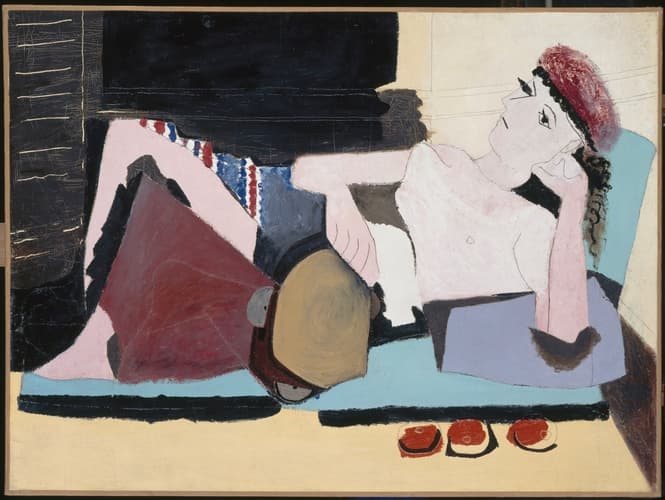
Hypothetical fair-market value for Picasso’s Femme au tambourin (1925, oil on canvas, 97 × 130 cm; Musée de l’Orangerie) is $25–45 million. The estimate is anchored to recent, closely related Picasso results and positions the work below 1932 icons but above lower-intensity late works.
Valuation Analysis
Work identification and status. Picasso’s Femme au tambourin (1925) is a large oil on canvas (97 × 130 cm) in the French national collections at the Musée de l’Orangerie (RF 1963-73), with early provenance to dealer Paul Guillaume and subsequent inclusion in the Walter–Guillaume holdings. There is no record of a public auction sale; the work entered the French State collection in 1963 and, as part of a national museum collection, is effectively inalienable. This valuation therefore models a hypothetical, unconstrained sale in a major venue (New York/London) and assumes clean title and sound condition [1][2][7].
Method and comparables. We benchmark against Picasso oils from the adjacent mid-to-late 1920s and strong female-figure portraits outside the 1932 apex. A key period-proximate anchor is La fenêtre ouverte (1929), a Surrealist-leaning studio picture that realized £16.32m (≈$21.7m) at Christie’s London in March 2022 [4]. At the higher end of non‑1932 comparables, a vivid wartime Dora Maar portrait sold in Paris for €32m (≈$37m) in October 2025 [5]. For ceiling context, 1932 Marie‑Thérèse masterworks such as Femme à la montre achieved $139.4m in November 2023, a category structurally above this 1925 canvas [3]. May 2026 marquee auctions further underscored depth for blue‑chip Moderns, with Picasso evening-sale results clustering in the $40m–$50m band for non‑1932 trophies [6].
Estimate derivation. Created at the pivotal 1925 juncture—between the early‑1920s neoclassical language and the intensifying Surrealist idiom—Femme au tambourin is a significant, museum‑provenanced female‑figure composition with substantial wall power. On a period/quality basis, it should command a premium to the $20m–$25m results for solid but less imposing late‑1920s canvases, while calibrating below the $70m–$140m zone reserved for 1932 icons. Accordingly, we synthesize a $25–45 million range (with buyer’s premium), with the mid‑$30m area a reasonable central tendency, contingent on condition and image impact [1][3][4][5][6].
Sensitivity factors. Upside drivers include exceptional condition (original support, minimal retouch), strong coloristic punch and figure presence, deep publication/exhibition history (e.g., inclusion in major retrospectives), and top‑tier sale choreography with global outreach. Downside risks include structural condition issues (lining, cupping, overpaint), a more restrained or decorative reading versus Picasso’s most aggressive 1925 imagery, or softer macro liquidity at season time. While the work’s current museum status implies inalienability under French law, this affects real‑world marketability rather than notional fair‑market value in a hypothetical international sale [6][7].
Conclusion. Placed within Picasso’s market today, Femme au tambourin merits a confident $25–45 million estimate: materially above late‑period portraits and in line with strong, non‑iconic Picassos, yet prudently below the 1932 Marie‑Thérèse apex. The work’s date, large scale, subject category, and Walter–Guillaume pedigree collectively support this band [1][3][4][5][6].
Key Valuation Factors
Art Historical Significance
High ImpactDated 1925, the work sits at a pivotal juncture in Picasso’s trajectory, as he intensifies a Surrealist-inflected language after his early‑1920s neoclassical phase. This is the moment of The Three Dancers and a broader formal expansion that redefined his treatment of the figure. A large, resolved female‑figure composition from this date carries clear art-historical weight, especially within the Walter–Guillaume context. While not as canonically central as the 1932 Marie‑Thérèse cycle or the Cubist breakthroughs, it remains a significant period statement. In valuation terms, this confers a premium relative to late works and secondary neoclassical subjects, and positions the canvas among the stronger mid‑1920s Picassos.
Period/Subject Appeal
High ImpactPicasso’s female‑figure oils are the backbone of his market, with 1932 Marie‑Thérèse images constituting the apex. A 1925 odalisque/dancer with tambourine leverages enduring collector appetite for sensual, stylized portrayals while offering the edge and experimentation associated with his Surrealist turn. Recent auctions confirm sustained demand for striking female portraits outside 1932 (e.g., Dora Maar works in the mid‑ to high‑seven figures). This subject profile typically outperforms still lifes or minor genre scenes of the same era. The period/subject mix therefore supports a valuation materially above late “Musketeer” portraits and within the band occupied by strong, non‑iconic Modern-period Picassos.
Scale and Image Power
Medium ImpactAt 97 × 130 cm, the painting has genuine wall power, a key commercial driver for top-tier collectors seeking statement pieces for prime spaces. Scale alone is not determinative, but when combined with a legible, high-contrast figure and a confident compositional architecture, it meaningfully lifts competitive bidding. If the palette is lively and the figure emphatically articulated, the work could track to the upper half of the range; conversely, if the composition reads more decorative or restrained versus Picasso’s bolder 1925 canvases, it would likely anchor nearer the middle. Overall, the scale is a net positive for valuation.
Provenance and Exhibition History
Medium ImpactEarly acquisition by Paul Guillaume (1927) and subsequent inclusion in the Walter–Guillaume collection convey blue‑chip, historically resonant provenance. The painting’s long residence in a French national museum adds authority and likely correlates with strong exhibition and literature coverage. While public‑collection status limits literal marketability, it enhances perceived quality and scholarly anchoring, both of which matter in pricing. In a hypothetical sale scenario, this pedigree would reassure bidders about authenticity, importance, and condition stewardship over time, supporting confidence at the estimate band. The museum seal thus operates as a reputational premium, even as a practical sale would require exceptional steps.
Condition and Marketability
Medium ImpactNo current public condition report is available. The estimate assumes a structurally sound canvas with stability consistent with museum care. Condition can swing outcomes materially: evidence of heavy lining, widespread overpaint, or active craquelure could compress demand toward the lower band; conversely, a clean surface with minimal retouch supports upper-band competition. Marketability is otherwise high for a 1925 Picassian female figure; sale orchestration (New York or London evening sale, third‑party guarantee, and robust global outreach) would further mediate demand. Legal inalienability affects actual deaccessioning but not the notional fair‑market value used here for insurance or hypothetical‑sale purposes.
Sale History
Femme au tambourin has never been sold at public auction.
Pablo Picasso's Market
Pablo Picasso remains a foundational blue‑chip artist with exceptionally deep global demand and liquidity across price tiers. At the top, the market is defined by landmark results such as Les Femmes d’Alger (Version “O”) at $179.4m (2015) and Femme à la montre at $139.4m (2023), with the 1932 Marie‑Thérèse cycle setting the contemporary ceiling. Strong, non‑1932 Modern-period portraits and salient Cubist or pre‑war works comfortably occupy the $30m–$60m band in robust seasons, while late-period “Musketeer” canvases generally realize lower teens to high‑teens. Beyond paintings, Picasso’s drawings, prints, and ceramics ensure broad-based participation and consistent sell‑through. Supply of A+ paintings—rather than demand—is typically the gating factor for headline prices.
Comparable Sales
La fenêtre ouverte
Pablo Picasso
Same artist; late-1920s Surrealist-leaning oil on canvas, close in period and experimentation to the 1925 transitional moment; strong studio/interior composition provides a period-proximate market anchor.
$21.7M
2022, Christie's London
~$24.0M adjusted
Buste de femme accoudée, gris et blanc
Pablo Picasso
Same artist; female portrait (Dora Maar period), oil on canvas; later date but comparable subject-type and market tier for non-iconic Picassos; helpful lower-bound benchmark.
$16.0M
2022, Sotheby's London
~$17.7M adjusted
Bust of a Woman with a Flowered Hat (Dora Maar)
Pablo Picasso
Same artist; vivid wartime Dora Maar portrait in oil; a recent, well-publicized sale that reflects demand for strong Picasso female-figure canvases outside the 1932 peak years.
$37.0M
2025, Drouot Paris
Femme nue couchée
Pablo Picasso
Same artist; iconic 1932 Marie-Thérèse reclining nude, oil on canvas; very close in subject-type (reclining female), serving as an upper benchmark for the category.
$67.5M
2022, Sotheby's New York
~$74.7M adjusted
Femme à la montre
Pablo Picasso
Same artist; 1932 Marie-Thérèse masterwork in oil; not a period match but the definitive ceiling for prime Picasso female portraits in today's market.
$139.4M
2023, Sotheby's New York
~$148.3M adjusted
Current Market Trends
The Modern segment has shown renewed strength after a slower 2024, with 2025 regaining momentum and May 2026 marquee auctions reporting high sell‑throughs and competitive bidding at the top end. UBS/Art Basel’s latest reporting describes a cautious but real recovery, with notable resilience above $10m and a continued flight to quality. Within this context, blue‑chip Modern masters like Picasso benefit from capital seeking stability and art-historical consensus. Pricing remains sensitive to image strength, scale, and sale choreography; iconic subjects command aggressive premiums, while non‑iconic but strong works cluster in the mid‑eight figures. Net: conditions favor well‑curated offerings with clear period significance and strong provenance.
Study print
Study this painting as a print
Pair the full artwork with a museum-style study sheet focused on one meaningful detail.
Sources
- Musée de l’Orangerie—Femme au tambourin (work entry)
- On‑line Picasso Project—Catalogue of 1925 (Zervos V, no. 415)
- Sotheby’s—Femme à la montre (2023) sale recap
- Artnet News—Top Lots, March 2022 (includes Picasso, La fenêtre ouverte, 1929)
- Associated Press—Picasso Dora Maar portrait sold in Paris for €32m (2025)
- The Art Newspaper—Sotheby’s Modern Evening Sale, New York (May 2026)
- Legifrance—Code du patrimoine, art. L451-5 (inalienability of public collections)
- UBS/Art Basel—The Art Market Report 2026
- Christie’s—Post‑sale release: Les Femmes d’Alger (Version "O") record (2015)