How Much Is Nu sur fond rouge Worth?
Last updated: June 28, 2026
Quick Facts
- Methodology
- comparable analysis
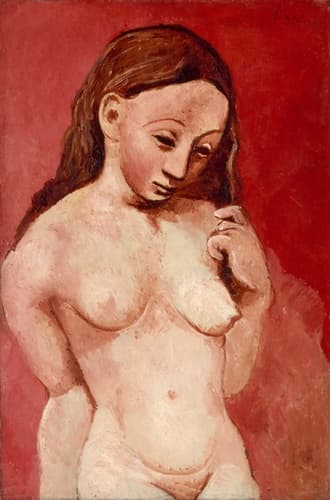
Hypothetical fair market value for Picasso’s Nu sur fond rouge (1906) is $85–115 million. The estimate is anchored by early-period Picasso benchmarks (Blue/Rose nudes and Rose-period icons) and calibrated for the work’s pivotal 1906 date, strong museum pedigree, and moderate scale (81 × 54 cm).
Valuation Analysis
Conclusion and scope. We estimate a hypothetical fair market value of $85–115 million for Pablo Picasso’s Nu sur fond rouge (1906; oil on canvas, 81 × 54 cm). The work is held by the Musée de l’Orangerie as part of France’s national collections and is inalienable; this valuation is therefore a market-based benchmark useful for insurance and comparative analysis rather than an indication of sale intent [1][2].
Why this range. The painting sits at a pivotal 1906 Rose/Gósol moment, immediately prefiguring the formal breakthroughs of 1907. Within Picasso’s oeuvre, well-resolved 1906 oil nudes are scarce and carry outsized art-historical weight. Price discovery must be inferred from adjacent benchmarks: Rose-period icons such as Fillette à la corbeille fleurie (1905) at $115m (2018) and Garçon à la pipe (1905) at $104.2m (2004) establish the upper boundary for early Picasso trophies with strong pop-cultural recognition [4][5]. On the other side, major Picasso nudes with broader collecting bases—e.g., 1932 Marie‑Thérèse works—have achieved $106.5m (2010) and $67.5m (2022), while the Blue-Period nude La Gommeuse (1901) made $67.45m (2015) [3][6][7].
Positioning Nu sur fond rouge among the comps. Nu sur fond rouge’s 1906 date, subject (standing nude), and canonical publication/exhibition history place it above the Blue‑Period La Gommeuse benchmark and within striking distance of the 1905 Rose icons on an art-historical basis. Two features temper ceiling potential: the moderate scale (81 × 54 cm) versus the larger 1905 record-holders, and comparatively lower popular branding. Balancing these pushes (period scarcity, museum-grade status) and pulls (scale, fame delta), a concentrated range in the high eight to low nine figures is warranted, with upside toward the top of the band if condition is excellent and the work were hypothetically positioned in a New York evening sale [1][4][5][6].
Market climate and liquidity. Recent seasons confirm deep liquidity for blue-chip Picasso across best periods, with the second-highest Picasso auction price of $139.4m achieved as recently as 2023 for a 1932 portrait, underscoring current trophy appetite. While 2024–2025 saw selectivity and recalibration, marquee Modern sales in 2026 demonstrate renewed depth at the top end, particularly for historically central material—precisely where a 1906 nude resides [3].
Key sensitivities. The upper half of the range assumes clean structural condition, attractive surface preservation, and the already-strong literature/exhibition record. Any material conservation concerns would place the work toward the lower band. Its French public-collection status does not reduce intrinsic value but limits real-world price discovery; valuation here synthesizes available comparables, period premiums, and current market momentum [1][2].
Key Valuation Factors
Art Historical Significance
High ImpactNu sur fond rouge dates to 1906, the critical Rose/Gósol year that directly anticipates the seismic innovations of 1907. Within Picasso’s arc, resolved nudes from this moment are scarce and central to scholarship on his transition from Rose naturalism to the proto-Cubist language that culminated in Les Demoiselles d’Avignon. The work’s placement in a major national museum, and its sustained publication and exhibition history, reinforce its canonical standing. That art-historical centrality commands a significant premium over earlier Blue-Period works of comparable scale and over later, less pivotal years. In valuation terms, this factor is a primary driver lifting the work well into the high eight to low nine figures.
Period and Subject Rarity
High ImpactEarly Picasso nudes that are both fully resolved and situated in the narrow 1905–1906 corridor are meaningfully rarer on the market than 1930s portraits and late-period canvases. Nu sur fond rouge’s subject (standing nude) and date align it with the collecting vanguard for early Picasso, where demand is deepest but supply is largely locked in institutions. This imbalance supports strong pricing when private examples emerge and informs hypothetical valuation for museum-held works. Compared with Blue-Period nudes (e.g., La Gommeuse), the 1906 date carries additional scholarly cachet tied to the artist’s formal evolution—warranting a premium over the mid‑eight‑figure benchmarks from prior sales.
Provenance and Institutional Status
High ImpactThe work’s chain from Ambroise Vollard to Paul Guillaume to the Jean Walter–Paul Guillaume collection, and its 1963 acquisition by the French state, give it impeccable provenance. Extensive museum exhibition and bibliography further de-risk authenticity and importance. While the inalienability of French national collections precludes actual sale, this status generally enhances perceived quality and would bolster confidence in any hypothetical underwriting for insurance or fair‑market scenarios. The same pedigree signals to top-tier buyers (in a hypothetical context) that the painting is a ‘museum picture,’ a designation that supports pricing at or near the upper end of comparable ranges for early Picasso.
Scale, Condition, and Aesthetic Resolution
Medium ImpactAt 81 × 54 cm, the painting is a refined, classical easel format—attractive for collections but smaller than the grand-scale Rose icons that set the very highest early-Picasso prices. Scale typically correlates with ceiling values at auction. The upper end of our range assumes excellent structural and surface condition (minimal lining-related compromise, stable ground and paint layers, and judicious past cleaning). A fully ‘resolved’ image—clear contours, balanced modeling, and a saturated red ground—positions the work above studies but below the most theatrical 1905 icons, guiding placement within the proposed band. Any material conservation or surface issues would bias the estimate to the lower end.
Sale History
Nu sur fond rouge has never been sold at public auction.
Pablo Picasso's Market
Pablo Picasso remains among the most liquid and globally coveted artists. His auction record stands at $179.4 million for Les Femmes d’Alger (Version O) in 2015, and his second-highest price, $139.4 million for Femme à la montre (1932), was achieved in 2023—evidence of sustained trophy-level demand. Collectors consistently prioritize Blue and Rose periods, major Cubist works, and the celebrated 1932 Marie‑Thérèse series. While results in 2024–2025 were selective, the upper market continues to support eight‑ and nine‑figure outcomes for best‑in‑class material. Early masterpieces and canonical subjects command significant premiums and attract broad international bidding, with New York evening sales remaining the most reliable venue for peak pricing.
Comparable Sales
Fillette à la corbeille fleurie (Young Girl with a Flower Basket)
Pablo Picasso
Same artist and very close Rose-period (1905) timing; museum-grade icon that sets an upper bound for early-period Picasso pricing.
$115.0M
2018, Christie's New York
~$147.9M adjusted
Garçon à la pipe (Boy with a Pipe)
Pablo Picasso
Another Rose-period (1905) benchmark; large, iconic work that has long defined the ceiling for early Picasso.
$104.2M
2004, Sotheby's New York
~$178.1M adjusted
La Gommeuse
Pablo Picasso
Blue Period (1901) nude—direct subject affinity and early-period importance; scale broadly comparable to Nu sur fond rouge and a strong market datapoint for early Picasso nudes.
$67.5M
2015, Sotheby's New York
~$91.9M adjusted
Nude, Green Leaves and Bust
Pablo Picasso
Prime 1932 Marie-Thérèse nude; calibrates the premium the market pays for celebrated Picasso nudes across periods.
$106.5M
2010, Christie's New York
~$157.7M adjusted
Femme nue couchée
Pablo Picasso
Major 1932 reclining nude; strong recent benchmark showing what a top-tier but non-record Picasso nude brings in today’s market.
$67.5M
2022, Sotheby's New York
~$74.5M adjusted
Femme à la montre
Pablo Picasso
1932 Marie-Thérèse portrait (not a nude) but the second-highest Picasso auction price; useful as an upper-end ceiling for current Picasso demand.
$139.4M
2023, Sotheby's New York
~$147.6M adjusted
Current Market Trends
Modern/Impressionist rebounded into 2025–2026 as collectors rotated toward established, blue-chip names. Within Picasso’s market, depth remains strongest for historically pivotal periods and iconic subjects; more routine late works are price-sensitive. High-profile sales in 2023–2026 confirmed that capital is available for top-tier works, though the market remains discerning. Against that backdrop, early-period Picassos with museum-grade provenance and scholarship continue to outperform, supported by institutional programming and sustained collector focus on canonical 20th‑century masters. Selectivity and condition scrutiny persist, but bidding is competitive when quality, period, and narrative align—factors that underpin the present $85–115 million valuation range.
Study print
Study this painting as a print
Pair the full artwork with a museum-style study sheet focused on one meaningful detail.
Sources
- Musée de l’Orangerie – Nu sur fond rouge (object record)
- French Heritage Code (Musées de France) – Inalienability (Art. L451-5)
- Sotheby’s – Emily Fisher Landau Collection highlights (Femme à la montre $139.4m)
- Christie’s Press – Fillette à la corbeille fleurie sold for $115m (2018)
- Washington Post – Garçon à la pipe sells for $104.2m (2004)
- Wikipedia – La Gommeuse (sale $67.45m, 2015)
- The Value – Sotheby’s Modern Evening Sale (Femme nue couchée $67.5m, 2022)