How Much Is Still Life with Chair Caning Worth?
Last updated: May 6, 2026
Quick Facts
- Methodology
- extrapolation
Hypothetical open‑market valuation for Picasso’s Still Life with Chair Caning (1912) is $200–400 million. As a foundational Cubist collage in a French national collection, it would likely set a new Picasso record if ever sold, though an actual sale is effectively precluded by patrimony law.
Valuation Analysis
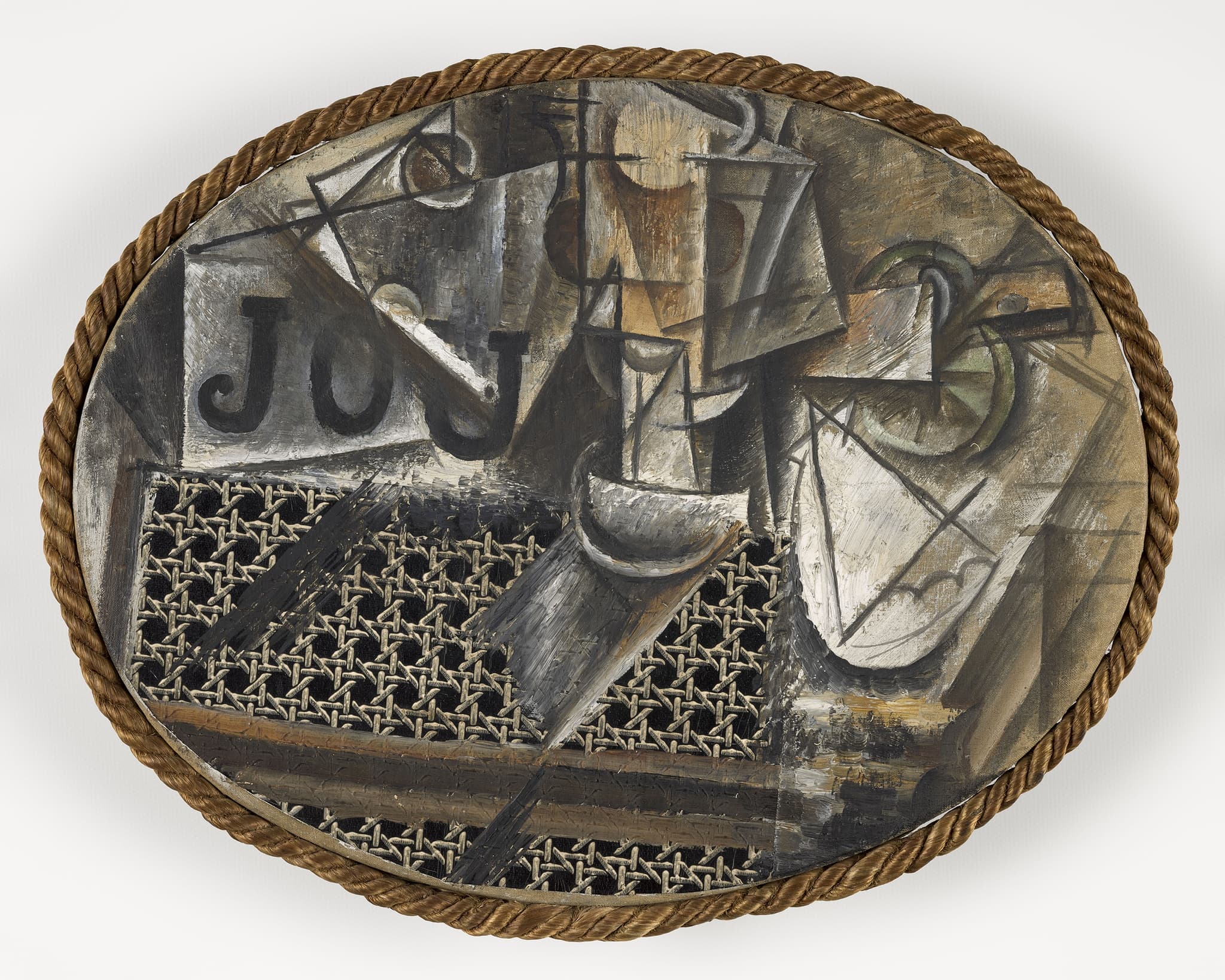
Conclusion: In an unconstrained, global marquee sale, Pablo Picasso’s Still Life with Chair Caning (1912) would command approximately $200–400 million. This estimate extrapolates above Picasso’s public auction benchmarks to reflect the work’s singular art‑historical status as an inaugural Cubist collage—oil, printed oilcloth, and rope on an oval support, c. 29 × 37 cm—long recognized as a turning point toward Synthetic Cubism and a cornerstone of 20th‑century art [1].
Price anchors and market depth: Picasso’s auction ceiling stands at $179.4 million for Les Femmes d’Alger (Version “O”) (2015) [2], with his second‑highest recent result at $139.4 million for Femme à la montre (2023) [3]. These nine‑figure sales demonstrate deep, repeatable trophy demand for the artist. Unlike those later, large‑format paintings, Still Life with Chair Caning represents a step‑change in the language of modern art—introducing mass‑produced material into high art and collapsing picture and object. That qualitative difference justifies an upward extrapolation beyond the standing Picasso record in a competitive, guarantee‑backed sale.
Scarcity and trophy competition: Works of comparable early‑Cubist significance are overwhelmingly in museum collections, leaving virtually no peer objects available to private buyers. The combination of primacy, uniqueness of materials and format, and its canonical status within Picasso’s oeuvre positions this piece at the apex of cross‑category collecting, where non‑price‑sensitive buyers pursue “once‑in‑a‑generation” opportunities. That dynamic underwrites the high end of the $200–400 million range.
Collection status and legal context: The work resides in the Musée national Picasso–Paris (MP36) and forms part of the French national patrimony. Under the Code du patrimoine, museum collections in France are inalienable; practical deaccession or export is extraordinarily unlikely [4]. This valuation therefore models an idealized open‑market scenario (declassification, export permission, global marketing). A constrained, domestic‑only transaction would be expected to clear below this band due to reduced bidder access.
Market conditions: After a broad high‑end slowdown in 2024, blue‑chip Modern segments re‑asserted pricing power as supply improved, with dealers and auction houses emphasizing fresh, best‑of‑category works. Picasso remains a bellwether; recent analysis attributes fluctuations primarily to supply rather than demand, with leading dealers expecting strength to persist at the top end [5]. Against that backdrop, a museum‑grade, field‑defining Picasso from 1912 would attract global competition and plausibly set a new artist record.
Estimate rationale: The $200–400 million range triangulates (i) Picasso’s established nine‑figure liquidity [2][3], (ii) the work’s unmatched art‑historical primacy and extreme scarcity [1], and (iii) current appetite for canonical Modern trophies despite cyclical variability [5]. While its small scale and mixed materials are atypical for record‑level lots, the conceptual significance and status of Still Life with Chair Caning decisively outweigh format considerations.
Key Valuation Factors
Art Historical Significance
High ImpactCreated in spring 1912, Still Life with Chair Caning is widely cited as a foundational modern collage, introducing printed oilcloth and rope into the painted field. This move catalyzed Synthetic Cubism, collapsing boundaries between art and mass culture and redefining how images function as objects. The work’s primacy within both Picasso’s practice and 20th‑century art history confers an outsized premium independent of size or medium. Its frequent reproduction in scholarship and teaching cements iconic status, elevating it above period peers. For collectors, this is not merely an exemplary Cubist work; it is a category‑defining innovation with cross‑disciplinary significance.
Rarity and Market Scarcity
High ImpactSeminal early‑Cubist works with first‑order historical importance are almost entirely held by museums; direct market comparables for this object do not exist. That scarcity funnels global trophy demand toward any single, transferable example. The work’s unique combination of printed oilcloth, rope frame, and oval format further differentiates it from studio variants and later Cubist still lifes. In today’s top tier, bidders compete as much for narrative and primacy as for aesthetics. This painting offers both in singular measure, enabling aggressive bidding that can exceed prior artist records when the opportunity is unrepeatable.
Artist Market and Benchmark Pricing
High ImpactPicasso’s market is among the deepest and most international, with durable liquidity at nine figures. The $179.4 million record for Les Femmes d’Alger (2015) and the $139.4 million sale of Femme à la montre (2023) demonstrate capacity for sustained, premium pricing when top‑quality works appear. Relative to those trophies, Still Life with Chair Caning carries greater art‑historical weight, justifying an extrapolation above the current record. Collector preference often peaks for Blue/Rose period and 1932 portraits, but cross‑category trophy seekers will rank a watershed 1912 collage as the rarer, more consequential prize, supporting a $200–400 million band.
Condition, Materials, and Scale
Medium ImpactThe work’s modest dimensions (~29 × 37 cm) and hybrid construction (oil, printed oilcloth, rope) can be perceived as atypical for “record” paintings. Material stability of early collages can require careful conservation protocols, and some bidders may discount for perceived fragility. Against that, the piece has been extensively exhibited and published by a leading institution, signaling institutional confidence in its condition and care. In the current market, conceptual primacy and canonical status generally outweigh scale; collectors have repeatedly paid premiums for historically pivotal works regardless of size, particularly when provenance and scholarship are impeccable.
Legal/Export Status and Market Access
Medium ImpactAs part of the Musée national Picasso–Paris, the work is in the French national patrimony and legally inalienable under the Code du patrimoine. Practically, that makes an actual sale or export extraordinarily unlikely. Our valuation assumes a hypothetical, fully transferable, internationally marketed sale; in reality, any constrained or domestic scenario would reduce bidder participation and likely clear below the estimate. This factor does not diminish the artwork’s intrinsic fair‑market potential; it contextualizes execution risk. If declassification and export were granted, pent‑up global demand would likely produce an aggressive, record‑challenging result.
Sale History
Still Life with Chair Caning has never been sold at public auction.
Pablo Picasso's Market
Pablo Picasso remains one of the most liquid and globally collected artists, anchoring Modern art’s top tier. His auction record stands at $179.4 million (Les Femmes d’Alger, 2015), and his second‑highest auction result, $139.4 million (Femme à la montre, 2023), was the most expensive work sold at auction in 2023. Demand is robust across periods, with peaks for Blue/Rose works, 1932 Marie‑Thérèse portraits, and key Dora Maar subjects. Market depth is reinforced by strong institutional visibility, frequent major exhibitions, and cross‑category collecting. Price variation across seasons reflects supply—when genuine A+ Picassos surface, nine‑figure bidding routinely follows.
Current Market Trends
After a high‑end slowdown in 2024, top‑tier Modern art stabilized and began to rebound as supply improved and private sales remained active. Analysts attribute Picasso’s 2024 auction dip largely to a dearth of great consignments rather than waning demand. By late 2025–early 2026, fresh‑to‑market quality works were again drawing competitive bidding across regions. For an unparalleled, museum‑grade Picasso—especially one foundational to Cubism—current conditions suggest strong trophy appetite and the potential to surpass existing artist records, provided the sale is fully international, guarantee‑backed, and staged in a premier evening auction context.
Sources
- Musée national Picasso–Paris: Still Life with Chair Caning (1912) object entry
- Christie’s Press Release (May 11, 2015): Les Femmes d’Alger (Version 'O') sells for $179,365,000
- Sotheby’s: New York Sales November 2023 Results (Femme à la montre, $139,363,500)
- Legifrance: Code du patrimoine — inalienability of French museum collections
- Artnet News (Jan 10, 2025): 2024 Artist Auction Rankings and supply dynamics