How Much Is Motherhood (La Maternité) Worth?
Last updated: July 8, 2026
Quick Facts
- Insurance Value
- $18.0M (Assistant estimate (comparable analysis))
- Methodology
- comparable analysis
Motherhood (La Maternité), 1903, a finished pastel and charcoal on paper from Picasso’s Blue Period, is a rare, iconographically prime work on paper. Based on period/subject premiums and recent pricing for Picassos across media, a prudent hypothetical market/insurance valuation is $10–18 million. The range reflects strong demand for Blue Period mother-and-child imagery, tempered by the fragility of pastel and noted conservation sensitivities.
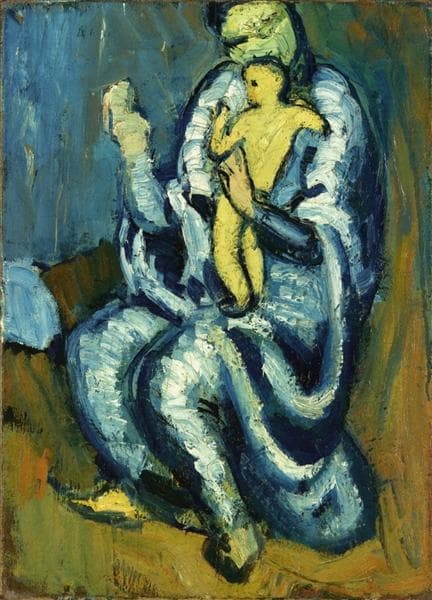
Motherhood (La Maternité)
Pablo Picasso, 1903 • Pastel and charcoal on paper
Read full analysis of Motherhood (La Maternité) →Valuation Analysis
Work identified: Picasso’s Motherhood (La Maternité)—catalogued by the Museu Picasso, Barcelona, as Desamparados (The Disinherited Ones), 1903—is a pastel and charcoal on paper measuring 47 × 40 cm (MPB 4.269). Created at the heart of the Blue Period, it depicts the emblematic mother-and-child theme and entered the museum in 1932 via the City of Barcelona’s purchase from the Plandiura collection [1]. The museum’s conservation team notes the work has been displayed on an inclined plane since 2003 to mitigate pastel loss, underscoring the fragility typical of this medium [2].
Method and anchors: There is no modern-era public sale record for this specific sheet, so valuation relies on comparable analysis across three axes: (i) Blue Period premium and subject desirability; (ii) medium hierarchy (finished pastel on paper versus oils); and (iii) the current depth of Picasso’s market. At the top end, the artist’s market remains exceptionally strong, with the 1932 masterpiece Femme à la montre realizing $139.4 million in 2023—an important ceiling and demand signal for best-in-class Picassos [4]. At the works-on-paper level, strong drawings by Picasso continue to transact publicly in the seven figures; for example, a 1938 Dora Maar drawing achieved about $1.5 million with fees in May 2024, confirming robust liquidity even outside apex periods [3].
Positioning this work: Blue Period material (1901–1904) commands a pronounced premium, and the mother-and-child iconography is central to the period’s pathos and art historical importance. While oils from this moment are the most coveted and can achieve eight- and nine-figure prices, finished and visually rich pastels from 1903 occupy a second but still elite tier. The present sheet’s scale (47 × 40 cm), finish, and museum-level profile support placement in the low-to-mid eight figures for a hypothetical sale or replacement scenario. Offsetting this, the intrinsic fragility of pastel—evidenced by the museum’s adapted display to control pigment loss—counsels conservatism within that band without a current condition report [2].
Conclusion and range: We estimate a fair hypothetical market/insurance value of $10–18 million. The low end reflects prudent adjustment for medium sensitivity and the absence of direct, recent public comparables for 1903 Blue Period pastels of this subject and finish; the high end captures the intense demand for Blue Period mother-and-child works, scarcity of comparable quality on paper, and Picasso’s unrivaled market depth [1][3][4]. This range aligns with observed differentials between Blue Period oils and prime-period works on paper, and it is appropriate for institutional insurance or private-market planning pending a full, up-to-date condition and literature review.
Key Valuation Factors
Art Historical Significance
High ImpactDated 1903, this work sits at the core of Picasso’s Blue Period, when themes of poverty, motherhood, and human vulnerability crystallized in his early language. The mother-and-child motif is among the most resonant and frequently cited subjects from this phase, closely related to the emotional tenor of canonical oils like La Vie. As a finished, colored sheet in pastel and charcoal, it is not a cursory sketch but a realized composition that encapsulates the period’s pathos. Such alignment of date, theme, and execution materially elevates importance and desirability, positioning the work at the top tier for Picasso works on paper of the era.
Period and Subject Demand
High ImpactBlue Period material is exceptionally scarce and remains one of the most heavily competed segments of Picasso’s market. Within that, mother-and-child compositions carry an additional premium due to their iconic status and cross-collector appeal. Historical auction dynamics show collectors pay materially more for prime subjects from celebrated periods. Even as top prices are set by oils, the demand curve for well-finished works on paper from 1901–1904 remains steep, creating a wide but strong valuation band that supports low-to-mid eight-figure indications for outstanding examples.
Medium and Condition
Medium ImpactPastel offers extraordinary chromatic and atmospheric effects but is mechanically fragile. The Museu Picasso’s decision to display this sheet on an inclined plane since 2003 to reduce pigment loss is a prudent, well-documented conservation measure that also signals sensitivity typical of this medium. In valuation, pastel’s vulnerability introduces greater dispersion: pristine surface preservation pushes value upward; evidence of flaking, abrasion, or media loss can compress it. Without a current condition report, the estimate brackets this uncertainty, keeping the low end conservative and the high end reflective of Blue Period demand.
Provenance and Institutional Profile
Medium ImpactThe work’s early and impeccable provenance—acquired by the City of Barcelona from the Plandiura collection in 1932 and housed at the Museu Picasso—confers institutional-grade credibility and eliminates market concerns common to early 20th‑century works. While museum ownership means it is not commercially available, such pedigree enhances any hypothetical replacement or insurance value by underscoring authenticity, significance, and historical visibility. Its repeated museum presentation and discussion further anchor its scholarly profile, supporting confident placement within the upper tier for Picasso works on paper of this date.
Sale History
Motherhood (La Maternité) has never been sold at public auction.
Pablo Picasso's Market
Pablo Picasso commands one of the deepest and most international buyer pools in the global art market. His auction record remains $179.4 million (Les Femmes d’Alger, Version “O,” 2015), and demand for apex moments—particularly 1932 Marie‑Thérèse portraits and key Cubist subjects—continues to deliver eight- and nine-figure results. In November 2023, Woman with a Watch (1932) sold for $139.4 million, reaffirming the market’s willingness to pay for top-tier Picassos. Works on paper are more accessible but still highly liquid, with strong, well-finished sheets regularly achieving seven figures. Blue Period examples are notably scarce and command significant premiums relative to later drawings, reflecting the period’s centrality to Picasso’s early development and enduring collector interest.
Comparable Sales
Femme assise (Dora Maar)
Pablo Picasso
Same artist; high‑quality work on paper; recent public benchmark for Picasso drawings. Later period and different subject/technique, so used as a lower‑anchor for on‑paper liquidity rather than a period/subject match.
$1.5M
2024, Christie's New York
~$1.5M adjusted
Femme à la montre (Woman with a Watch)
Pablo Picasso
Same artist; marquee 1932 oil establishing the upper bound for Picasso pricing and reaffirming depth of demand for top‑tier works. Not medium- or subject‑comparable; used as a market ceiling/context anchor.
$139.4M
2023, Sotheby's New York
~$150.0M adjusted
Bust of a Woman with a Flowery Hat (Dora Maar)
Pablo Picasso
Same artist; major wartime oil sold in Paris, indicating mid‑eight‑figure appetite beyond NY/London. Not medium- or period‑comparable; used to contextualize the gap between oils and works on paper.
$37.0M
2025, Hôtel Drouot, Paris
Arlequín (Busto)
Pablo Picasso
Same artist; early-period (1909) canonical Cubist oil showing strong demand for important pre‑WWI subjects. Not a work on paper; used as an early‑period market anchor above Blue‑Period works on paper.
$42.6M
2026, Sotheby's New York
~$41.8M adjusted
Femme nue couchée
Pablo Picasso
Same artist; prime 1932 oil confirming the wide pricing gulf between masterpiece oils and works on paper. Not medium- or subject‑comparable; used as a high‑end benchmark for Picasso demand.
$67.5M
2022, Sotheby's New York
~$75.0M adjusted
Current Market Trends
The Modern segment has remained resilient at the top end, with trophy-level Picassos continuing to attract aggressive bidding in marquee New York sales. While price dispersion increased across sub-categories in recent years, the combination of artist stature, scarce supply in coveted periods, and deep global demand supports firm pricing for best-in-class works. Within works on paper, buyers remain selective on period, subject, finish, and condition; Blue Period subjects stand out as a clear focus of competition. Against this backdrop, a finished 1903 mother-and-child pastel is well positioned in the low-to-mid eight figures for hypothetical market or insurance purposes, provided condition is stable and documentation is robust.
Study print
Study this painting as a print
Pair the full artwork with a museum-style study sheet focused on one meaningful detail.
Sources
- Museu Picasso Barcelona – The Disinherited Ones (Desamparados), 1903
- Museu Picasso Barcelona – The Mystery of the Tilted Picture (conservation of the 1903 pastel)
- The Art Newspaper – Christie's Modern Evening Sale (May 2024) results overview
- Sotheby’s – Emily Fisher Landau Collection: Woman with a Watch achieves $139.4m (Nov 2023)